
12 Stunning Half Moon Entryway Tables to Elevate Your Small Foyer
Transform your cramped entryway with our expert curation of demilune tables. Discover spatial design secrets, styling tips, and the perfect piece for your home.
Apr 9, 2026 - Written by: Linda Wise

I’ve walked into hundreds of homes where the entryway feels like an architectural afterthought. You open the front door, and immediately, you’re forced into an awkward shuffle to avoid a massive, blocky console table that dominates the narrow corridor. It’s a frustrating introduction to a living space.
But here’s the real kicker: you don’t have to sacrifice style just because your foyer lacks square footage.
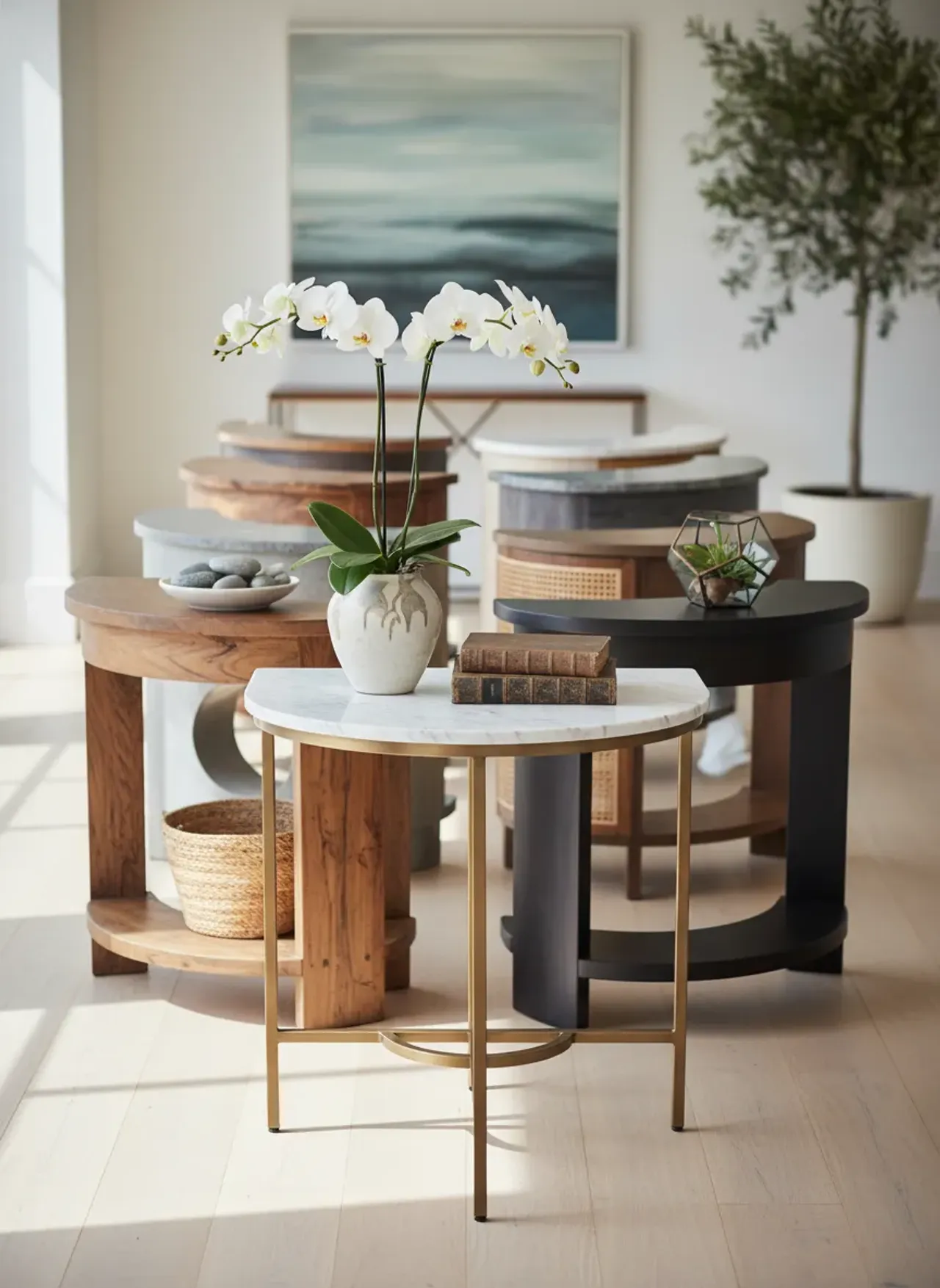
The secret weapon of interior designers dealing with tight thresholds is the demilune—the half-moon table. By stripping away the harsh, aggressive 90-degree corners of traditional consoles, a half-moon silhouette naturally guides foot traffic while providing that essential “drop zone” for your keys, mail, and morning coffee.
I’ve personally found that choosing the right semi-circular piece entirely rewrites the spatial dynamics of a small foyer. You get the functional surface area you desperately need without the bruised hips. Below, I’ve curated a masterclass in entryway design, highlighting the exact pieces that blend high aesthetic value with spatial efficiency.
Quick Comparison: Top Picks
The Spatial Psychology of the Demilune
Before we dissect the specific tables, we need to talk about why the half-moon shape works so brilliantly in confined environments.
When you place a rectangular table in a narrow hallway, you create what architects call “spatial friction.” The sharp corners jut into the walking path, subconsciously forcing the brain to register them as obstacles. Your guests naturally tense up, pulling their shoulders inward to pass by. It creates an underlying sense of anxiety the moment they step through your door.
A semi-circle eliminates that friction. The sweeping, continuous curve mimics natural human movement. It allows the eye—and the body—to glide past effortlessly. Furthermore, because the deepest part of the table sits dead-center and tapers off at the ends, you maximize your functional surface area right where you stand to drop your keys, while preserving the critical inches of clearance needed for a door swing.
Pro Tip: When measuring your foyer for a half-moon table, always factor in your front door’s “swing arc.” Ensure the deepest part of your demilune sits entirely outside this invisible boundary to prevent catastrophic handle-to-furniture collisions.
12 Stunning Half Moon Entryway Tables to Elevate Your Small Foyer
1. The Transitional Classic: Safavieh French Country
If you’re wrestling with a foyer that demands elegance but refuses to offer the square footage for it, the Safavieh American Home French Country Demilune is a lifesaver. This piece strikes a masterful balance between rustic charm and refined silhouetting. I often recommend this specific table because of its cleverly integrated single drawer. That tiny bit of closed storage is a game-changer for hiding the visual clutter of stray mail and dog leashes. The slightly distressed finish pairs exceptionally well with a neutral, linen-textured wallpaper.
2. The Industrial Edge: Convenience Concepts Oxford
Sometimes, a space needs grounding. The Convenience Concepts Oxford Half Moon Console brings a slightly more structural, geometric vibe to the curved table category. Its standout feature is the lower open shelf, which visually anchors the piece to the floor. I love placing a pair of woven rattan baskets on that bottom tier to hold winter scarves or slippers. It creates a weighted, intentional look that prevents the table from feeling like it’s “floating” aimlessly in your hallway.
3. The Heritage Warmth: Decor Therapy Vintage Cherry
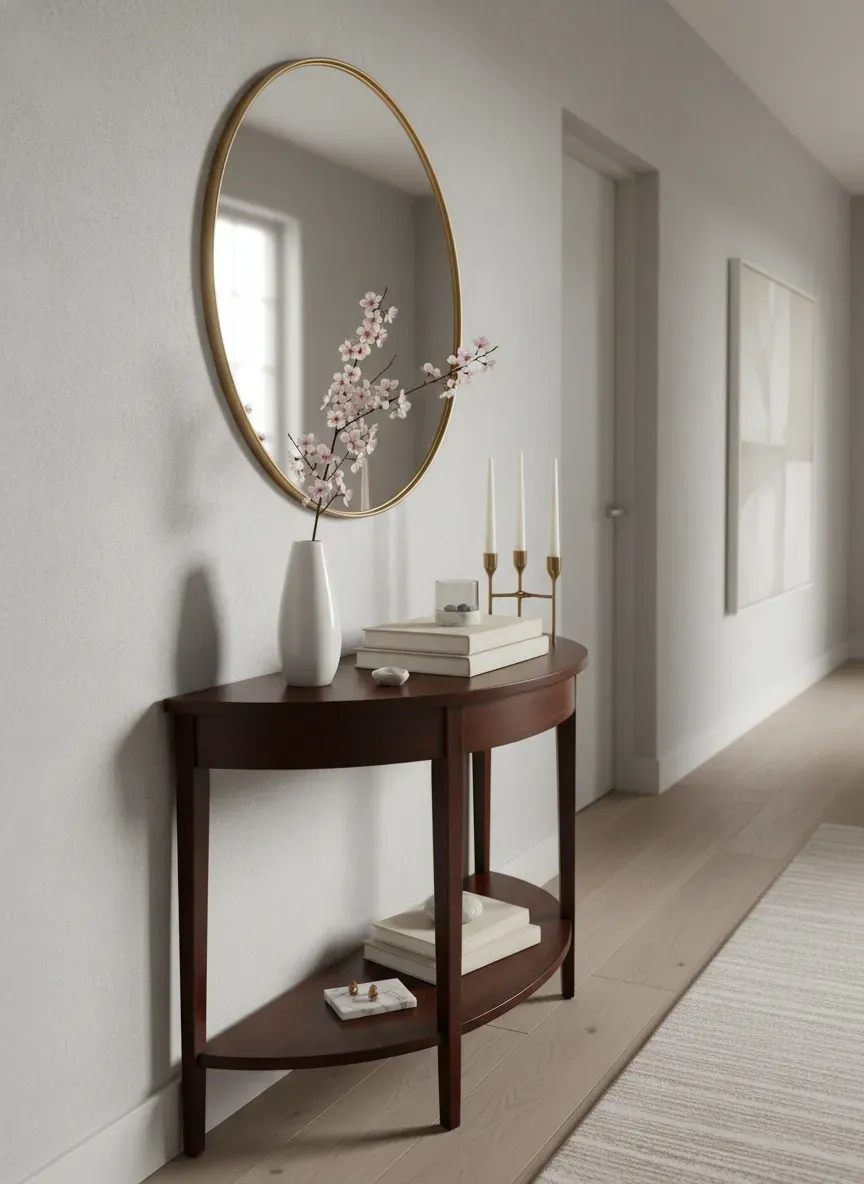
There’s an undeniable gravitas to rich wood tones. The Decor Therapy Vintage Cherry Demilune feels like an antique you inherited from a well-traveled relative. The turned legs provide a traditional architectural element that sings in historic homes or spaces with heavy, classic crown molding. Because cherry wood has such an aggressive visual weight, I suggest contrasting this table above with a highly reflective, frameless arched mirror to bounce light around the cramped threshold.
4. The Fluted Plaster Marvel
We are witnessing a massive resurgence in fluted textures, and for good reason. A half-moon table carved from pale, chalky plaster with deep vertical fluting creates spectacular shadow play depending on the time of day. This style is an absolute showstopper in minimalist or Mediterranean-inspired homes. The ribbed texture draws the eye vertically, making low ceilings feel just a bit higher. Keep the styling on top strictly minimal—a single, sprawling branch in a wabi-sabi ceramic vase is all you need.
5. The Burl Wood Showstopper
Burl wood is the chaotic, beautifully imperfect cousin of traditional timber. A demilune table crafted from olive burl veneer introduces organic, swirling patterns that act as functional art. Because the wood grain itself is so busy and captivating, the half-moon shape is necessary to keep the piece from overwhelming a tight space. I’ve used burl wood consoles in stark, ultra-modern foyers to inject immediate warmth and tactile juxtaposition against polished concrete floors.
6. The Floating Acrylic Illusion
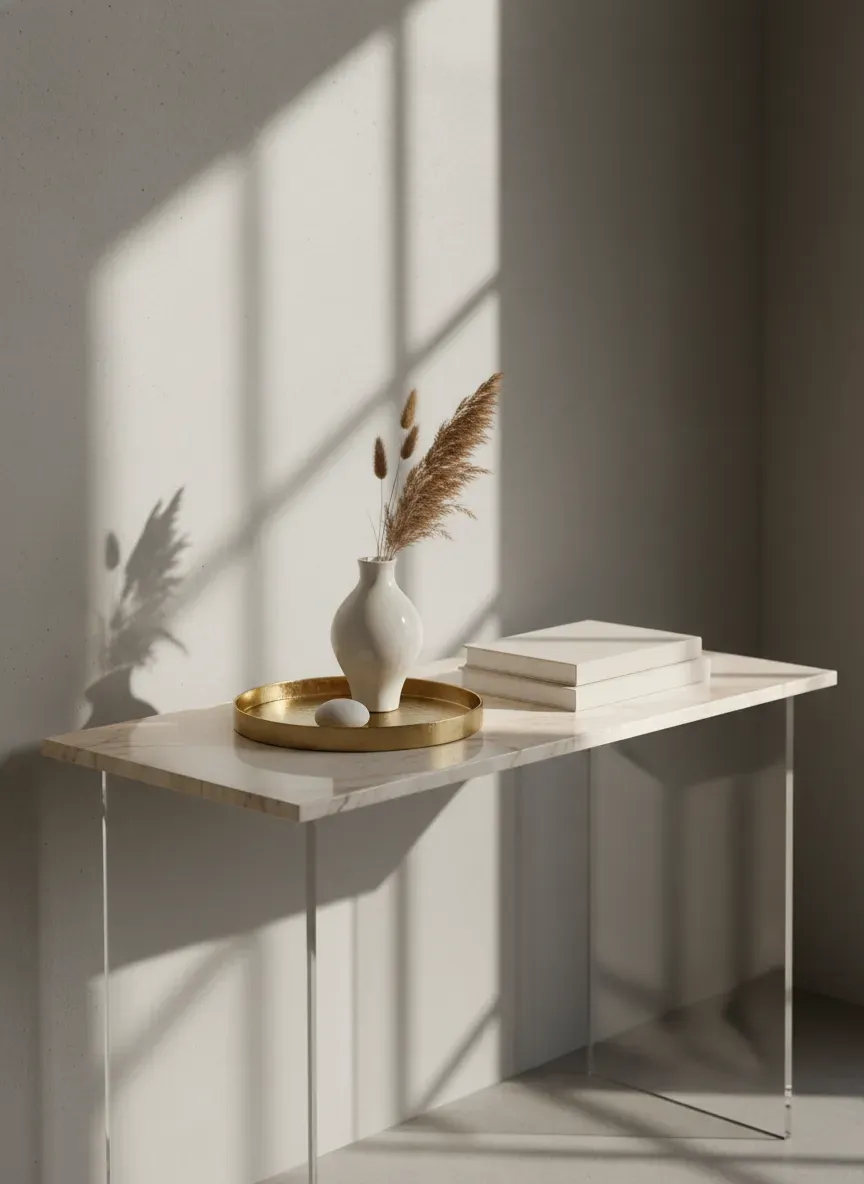
When dealing with an outrageously narrow corridor—think urban apartment or historic townhouse—you might need your furniture to practically disappear. A thick, molded lucite or acrylic half-moon table offers zero visual obstruction. Light passes straight through it, maintaining the illusion of a completely open hallway while still providing a flat surface for a catch-all tray. Pair this with a bold, colorful runner rug that will be entirely visible through the table’s transparent legs.
7. The Wrought Iron Provencal
Wrought iron isn’t just for patio furniture. A slender demilune with a forged iron base and an antiqued mirror top brings a touch of Parisian balcony charm directly into your entryway. The beauty of an iron base lies in its visual permeability; the spindly, twisting metalwork doesn’t block the eye. This is the perfect table if you have intricate floor tiles (like a classic black-and-white checkerboard or a Moroccan encaustic pattern) that you don’t want to hide behind solid wood furniture legs.
8. The Mid-Century Walnut Wedge
Mid-century modern design relies heavily on tapered lines and warm walnut tones. A half-moon table executing this style usually features aggressive, outward-angled peg legs and a sleek, unadorned tabletop edge. It brings a retro, Mad Men-esque sophistication to the foyer. To nail this look, source a vintage brass valet tray and a mid-century mushroom lamp. The curved back of the table pushes flush against the wall, perfectly maximizing the limited footprint.
9. The Marble and Brass Anchor
For sheer, unadulterated luxury in a bite-sized package, nothing beats a genuine Carrera marble slab resting on a brushed brass framework. The cold, heavy stone provides an incredible tactile experience the moment you drop your keys. Because marble is porous and prone to scratching, I highly recommend sourcing a leather mat to act as your daily drop-zone. This table style demands dramatic lighting—think a pair of alabaster sconces flanking the table to highlight the brass detailing.
10. The Rattan Coastal Semicircle
If your home leans toward breezy, coastal, or bohemian aesthetics, a heavy wood console will look entirely out of place. Enter the woven rattan demilune. Light, airy, and textured, these tables often feature wrapped joints and cane webbing. They are incredibly lightweight, making them easy to maneuver if you need to access a hidden wall outlet or baseboard heater behind them. Top it with a piece of bleached driftwood or a cluster of sea glass vases to complete the narrative.
11. The Matte Black Monolith
For the moody, contemporary home, a matte black, monolithic half-moon table makes a severe and gorgeous statement. Imagine a piece carved from ebonized oak or poured concrete dyed pitch black. It operates almost like a shadow in your entryway. To keep it from feeling like a black hole, you absolutely must style it with high-contrast elements. A gleaming brass bowl or a stack of bright, oversized art books will pop magnificently against the dark void.
12. The Mirrored Art Deco Revival
Taking cues from the roaring twenties, a demilune enveloped in beveled antique mirror panels is pure glamour. While it requires a bit more maintenance (keep the glass cleaner handy for fingerprints), a mirrored table works miracles in dark, windowless foyers. It catches ambient light from adjoining rooms and reflects it back, effectively doubling the perceived brightness of your entryway. It’s bold, unapologetic, and perfect for the homeowner who wants their foyer to feel like a high-end boutique hotel lobby.
Practical Applications & Styling Masterclass
You can buy the most beautiful table in the world, but if you abandon it in your hallway without proper styling, it will look like an orphaned piece of furniture waiting for moving day.
The curved edge of a demilune requires a specific styling approach. You cannot treat it like a long, rectangular console.
The Visual Triangle Because the table peaks in the center, your styling should follow a triangular hierarchy. Anchor the dead center of the wall directly above the table with a substantial vertical element—a tall mirror or a commanding piece of vertical art. This creates your apex.
Flank the sides with varying heights. On the left, introduce a tall, slender lamp. On the right, keep it low and dense with a stack of architectural books topped by a brass bowl. This asymmetry creates dynamic tension, keeping the eye engaged without feeling cluttered.
Pro Tip: The “drop zone” is sacred. Never let your decorative items consume the deepest, most functional part of the table. Reserve a dedicated, stylish valet tray (leather, brass, or carved wood) explicitly for your daily pocket-dump.
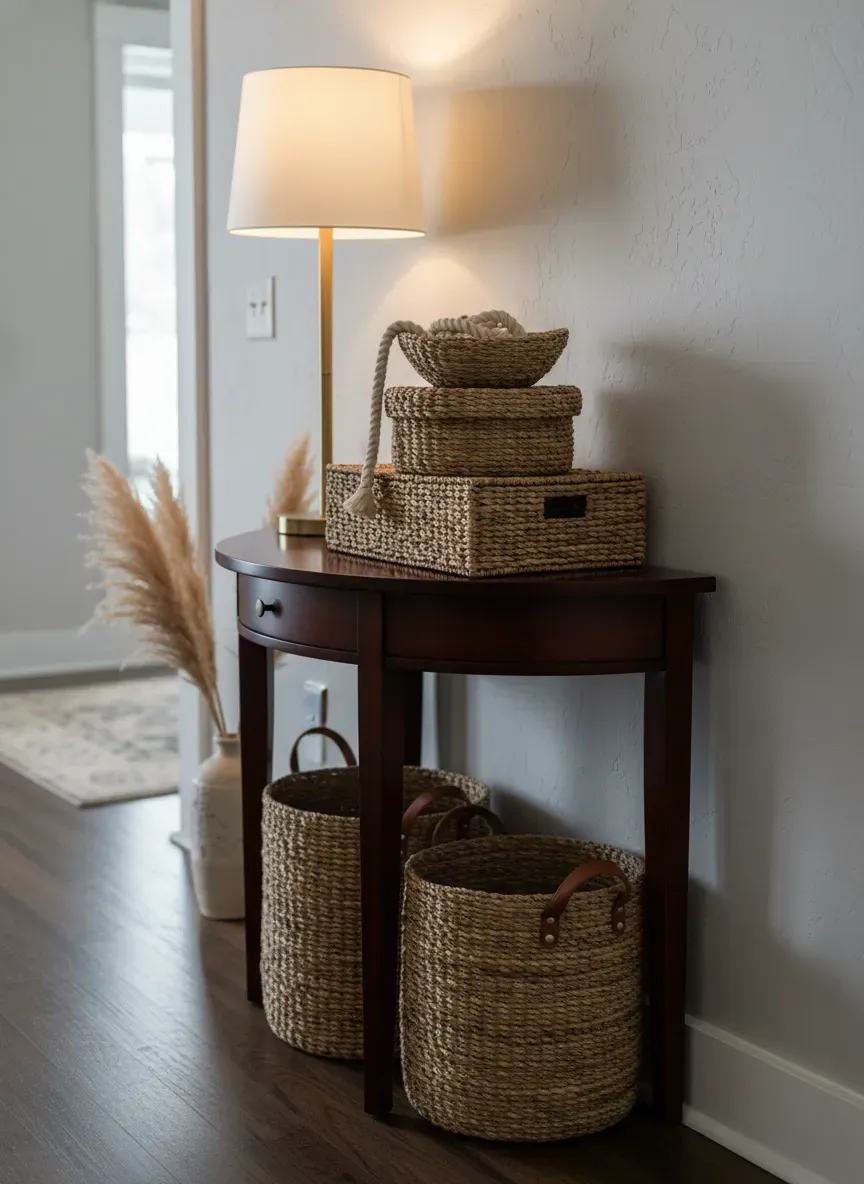
Lighting the Threshold A dark foyer is an unwelcoming foyer. If you don’t have the luxury of hardwiring sconces above your new half-moon table, a slender buffet lamp is non-negotiable. Look for lamps with a narrow base footprint. Alternatively, I’ve seen incredible results using cordless, rechargeable LED table lamps. They eliminate the ugly necessity of draping a black power cord down the wall to a distant baseboard outlet.
Key Takeaways for Small Foyer Design
- Measure the Depth First: The width matters, but the depth is what ruins a small foyer. Keep demilune depths between 12 and 16 inches for tight corridors.
- Match the Baseboard: If your table lacks adjustable feet, ensure its height and leg structure clear your home’s baseboard molding, allowing the flat back to sit perfectly flush against the drywall.
- Anchor the Base: If you choose an open-leg table, utilize the floor space underneath. A textured umbrella stand, a woven basket, or a structured leather tote grounds the piece visually.
Common Pitfalls in Foyer Design
I see the same mistakes repeated endlessly in entryway design. The most egregious offense is the “floating island” syndrome. This happens when a homeowner buys a diminutive half-moon table and places it perfectly centered on a massive, blank wall. The scale is completely disjointed. The tiny table looks swallowed by the negative space around it.
If you have a long wall but a narrow walking path, don’t just buy a wider table. Instead, extend the visual footprint of the demilune by placing a tall indoor plant (like a Ficus Audrey or a Snake Plant) on one side, and a stylish umbrella stand or floor mirror on the other. You are building a comprehensive entryway vignette, not just dropping a piece of wood against some drywall.
Another trap is the “clutter creep.” Because half-moon tables have less surface area than rectangular ones, they cannot support your hoarding habits. The moment you let three days of junk mail, two empty Amazon boxes, and a dog leash pile up, the elegance of the curved silhouette is completely obliterated. Be ruthless about your entryway inventory.
The Bottom Line: A half-moon table is a tool of spatial manipulation. It softens hard architectural lines, opens up walking paths, and provides a highly localized zone for your daily transition from the outside world to your private sanctuary. Treat the purchase not as an afterthought, but as the critical opening statement of your home’s design narrative.
Can’t Find the Perfect Fit? Build It Yourself.
Sometimes, despite scouring every catalog, you just can’t find a demilune table that perfectly hugs the bizarre, specific dimensions of your home’s architecture. Maybe you need a specific 11.5-inch depth to clear an awkward closet door, or you want to match the exact grain of your antique hardwood floors.
Here’s the real kicker: custom furniture costs a fortune, but building it yourself is surprisingly attainable.
I’ve personally found that the fastest way to get exactly what you want is to bypass the retail markup entirely. If you want to craft a bespoke entryway table that fits your space like a glove, I highly recommend checking out Ted’s Woodworking. You get instant access to over 16,000 step-by-step woodworking plans, completely eliminating the guesswork of cutting perfect curves and stable joints. Right now, they are offering an incredible 75% discount, making it the perfect time to grab the blueprints and build a stunning, heirloom-quality piece that will define your foyer for decades to come.