
The 5-Minute Tidy: Entryway Storage Habits for Maintaining Organization and Flow
Master the art of the 5-minute tidy to transform your entryway into a serene, organized space. Discover storage habits that maintain flow and eliminate clutter.
Feb 2, 2026 - Written by: linda wise

The entryway is more than just a threshold; it is the transitional membrane between the chaotic outside world and the sanctuary of your home. It sets the psychological tone for the rest of your living space. When you walk through the door, the immediate visual feedback you receive—whether it is a serene, curated vignette or a chaotic pile of shoes and mail—signals your brain to either relax or tense up.
Despite its importance, the entryway often becomes the household’s primary dumping ground. It is the path of least resistance for shedding the day’s burdens: heavy coats, muddy boots, keys, and an endless stream of parcels. Without a robust system in place, this clutter accumulates rapidly, disrupting the energetic flow of the home and creating a bottleneck of stress.
The solution does not necessarily require a complete architectural renovation or an expansive mudroom. Instead, it relies on the implementation of intelligent infrastructure combined with a behavioral shift we call the “5-Minute Tidy.” By marrying strategic storage solutions with consistent daily habits, you can maintain an entryway that functions seamlessly and welcomes you home with dignity.
The Psychology of Arrival and Transitional Spaces
To understand why entryway organization is vital, one must first appreciate the concept of cognitive load. Clutter is not merely an aesthetic nuisance; it is visual noise that competes for your attention. When the first thing you see upon entering your home is disarray, your cortisol levels spike, and the mental transition from “work mode” to “rest mode” is inhibited.
An organized entryway acts as a decompression chamber. It facilitates a smooth transition, allowing you to physically and mentally unburden yourself. This concept of “flow” is physical, referring to the ease of movement through the space, but it is also psychological. A clear path promotes a clear mind.
However, maintaining this flow requires acknowledging that entropy is natural. Items will always enter the home. The goal is not to stop the influx of life’s accessories but to create a system that processes them efficiently. This is where the intersection of home organization and habit formation becomes critical.
Establishing the Infrastructure: A Place for Everything
Before a 5-minute tidying routine can be effective, the physical environment must be conducive to order. You cannot tidy clutter if that clutter does not have a designated home. The “infrastructure” of your entryway consists of the furniture and storage vessels that govern the space.
Verticality and Floor Space
In many homes, entryways are narrow corridors or small landings. Therefore, the cardinal rule of entryway storage is to utilize vertical space. Floor space is premium real estate that should be reserved for movement.
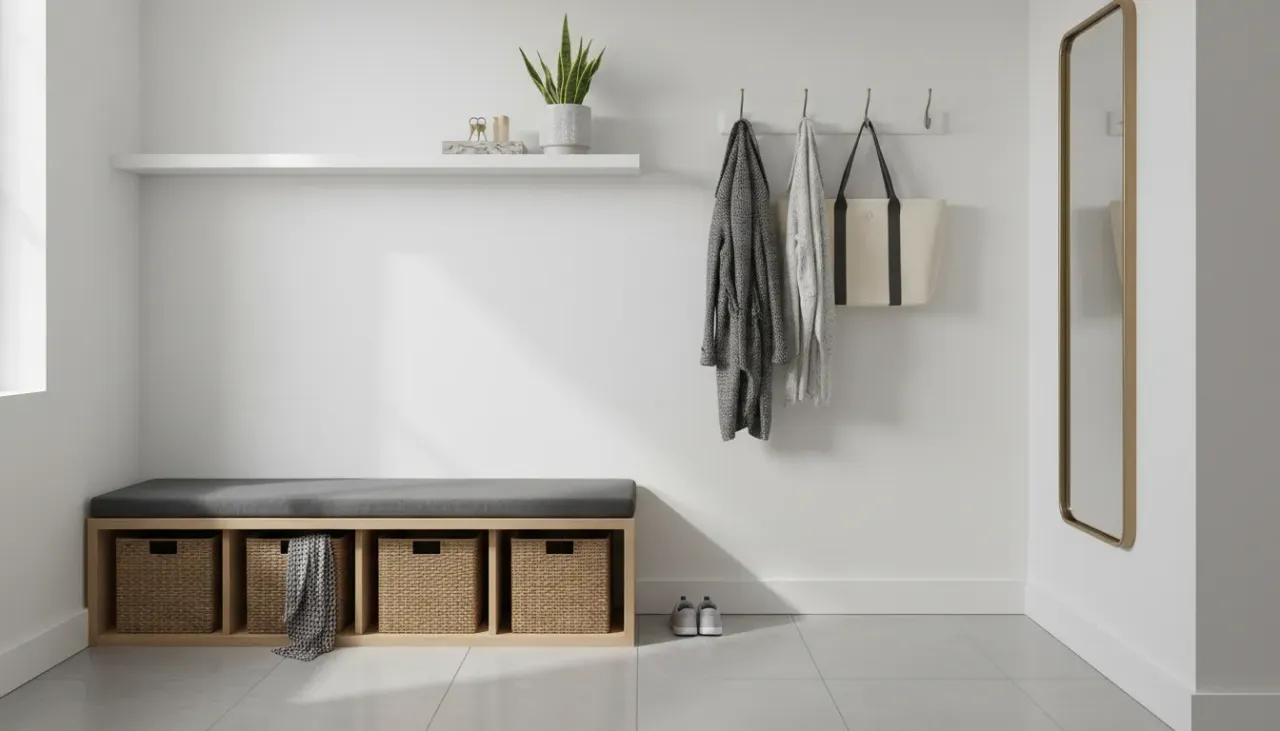
Coat racks, wall-mounted hooks, and floating shelves are essential. They lift items off the ground, instantly expanding the visual footprint of the room. For footwear, which is the primary culprit of floor clutter, a dedicated storage unit is non-negotiable. It serves as a boundary; shoes are either on feet or in the unit, never floating in the walkway.
If you are currently struggling with a pile of shoes that trips you up daily, consider investing in a streamlined piece of furniture that doubles as seating. A bench with integrated storage allows you to sit while removing shoes and immediately stow them away, closing the loop on the action.
Find the perfect modern entryway shoe storage bench here
The “Landing Strip” Concept
Apart from clothing, the entryway collects “pocket debris”—keys, wallets, sunglasses, and receipts. Without a specific receptacle, these items end up scattered across dining tables or kitchen counters.
Designate a surface—a console table or a shelf—as your “landing strip.” This area needs specific containment vessels. A tray for keys and a bowl for loose change create micro-zones that prevent items from migrating. When every object has a defined coordinate, the act of tidying becomes a simple matching game rather than a complex decision-making process.

The 5-Minute Tidy Protocol
Once your infrastructure is in place—hooks for bags, racks for shoes, and trays for small items—you can implement the 5-Minute Tidy. This is not a deep cleaning session; it is a rapid reset routine designed to return the entryway to neutral.
This routine is best performed at a specific transition point in your day, such as right after dinner or immediately before bed. The objective is to ensure that the entryway is clear for the following morning, setting yourself up for a calm departure.
Minute 1: The Shoe Sweep
Begin with the floor. Stray shoes are the biggest impediment to flow.
- Scan the floor for any footwear not currently in use.
- Place everyday shoes into their designated rack or cubby.
- Identify any out-of-season or specialty footwear (like hiking boots used once a month) and relocate them to a secondary storage location, such as a bedroom closet or garage.
Minute 2: Coat and Bag Triage
Next, address the vertical clutter.
- Hang up coats that have been draped over bannisters or chairs.
- Check the pockets of coats for trash or forgotten items.
- Assess the bags. Is your work bag packed for tomorrow? Are gym bags emptied? If a bag is not needed for the next 24 hours, it should be moved to a deep storage area, or at least hung neatly on a designated hook.
Minute 3: The Landing Strip Reset
Focus on the console table or shelf.
- Return keys to their bowl.
- Put sunglasses in their case.
- Sort the mail (more on this in the next section).
- Remove any items that do not belong in the entryway. This includes coffee cups, toys, or tools that have migrated near the door. Place them in a “transit basket” to be carried to their rightful rooms.
Minute 4: The Floor Polish
This step is brief but impactful.
- Shake out the doormat.
- Quickly sweep or vacuum any visible grit or dried mud. This prevents debris from being tracked further into the house, protecting your flooring and reducing overall cleaning time later.
Minute 5: Aesthetic Adjustment
The final minute is for visual harmony.
- Straighten the rug.
- Center the decorative bowl.
- Fluff a pillow if you have a bench.
- Ensure that the visual lines are clean. This moment of curation transforms the space from merely “clean” to “styled.”
Mastering the Mail: The Paper Flow System
Paper clutter is insidious. It enters the home daily and, unlike shoes or coats, it requires cognitive processing to remove. It cannot simply be hung up; it must be read, paid, filed, or recycled.
To maintain organization, you must treat the entryway as a triage center for mail. Do not let mail travel past the entryway until it has been sorted.
Install a recycling bin discreetly near the door or inside a cabinet. As soon as mail arrives, stand over the bin. Junk mail and flyers go immediately into recycling. Only genuine correspondence and bills enter the home.
For the items that must be kept, utilize a wall-mounted organizer. This keeps paper off flat surfaces. A system with specific slots for “outgoing,” “bills,” and “file” is ideal. This vertical approach prevents the dreaded “doom pile” of paper from forming on your console table.
Browse efficient wall mounted mail organizers with hooks
Zoning for Flow and Function
Effective entryway decor is not just about aesthetics; it is about defining zones of activity. Even in a small hallway, distinct zones help distinct family members understand where their items belong.
The “In” vs. “Out” Zones
Ideally, your entryway should facilitate two distinct flows: arrival and departure.
- The Arrival Zone: This is where you shed layers. It requires a heavy-duty mat, shoe storage, and coat hooks.
- The Departure Zone: This is where you grab essentials. It requires a mirror for a final check, a key tray, and perhaps a small shelf for outgoing items (library books to return, dry cleaning).
By separating these mental zones, you prevent the bottleneck where one person is trying to find keys while another is trying to take off boots.
For more insights on managing space efficiently, you might consider reading our guide on optimizing small closet spaces.
Seasonal Rotation: The Secret to Minimalism
A common failure point in entryway organization is the attempt to store everything simultaneously. Your entryway is a high-traffic transit hub, not a long-term storage facility.
The 5-Minute Tidy is significantly easier when there is less inventory to manage. Implement a strict seasonal rotation policy.
- Spring/Summer: Heavy wool coats, scarves, and winter boots must be evacuated to deep storage. The entryway should only hold light jackets, rain gear, and sandals.
- Autumn/Winter: Flip-flops and sun hats are removed. Winter gear takes their place.
This rotation ensures that the closet or hooks are never at 100% capacity. When storage is at 80% capacity, it is easy to hang something up. When it is at 101% capacity, items end up on the floor.
Troubleshooting Common Drop Zone Disasters
Even with the best intentions, certain items defy standard storage solutions. Here is how to handle the outliers.
The “Oversized” Problem
Sports equipment, musical instruments, and large parcels can quickly overwhelm an entryway. If you have children involved in sports, the entryway can smell like a locker room and look like an obstacle course.
The solution is large, open-top storage. Heavy-duty wicker baskets or canvas bins are excellent for containing odd-shaped items like balls, helmets, or shin guards. They hide the visual clutter while making it easy for children to toss items in. If the item is too large (like a hockey stick or guitar), it must have a rule: it does not live in the entryway. It flows through the entryway to a garage or bedroom immediately.
The Pet Factor
Leashes, waste bags, and muddy paws add another layer of complexity. Dedicate a specific hook solely for leashes. Keep a container of wipes or a designated “paw towel” in a basket near the door. This prevents the chaos of searching for a leash while a dog is barking, and keeps mud contained at the threshold.
Integrating Aesthetics with Utility
Storage solutions should not look industrial unless that is your specific design preference. The most sustainable organization habits are those that bring joy. If you love the way your entryway looks, you will be more motivated to keep it tidy.
Invest in high-quality materials. A cheap plastic shoe rack suggests that the items on it are of low value, encouraging careless tossing. A solid wood console or a beautiful metal rack commands respect.
Use decor to dictate behavior. A beautiful runner rug creates a runway that subconsciously tells people, “Do not leave bags here; keep walking.” A large mirror not only checks your appearance but reflects light, making a cramped entryway feel expansive and airy.
A console table is the anchor of the entryway. Choose one with drawers to hide the unglamorous necessities like batteries, tape, or flashlights. Style the surface with a lamp and a plant to signal that this is a display surface, not a dumping ground.
Shop for stylish decorative entryway console tables
Habit Stacking: Making the Tidy Automatic
The 5-Minute Tidy should not feel like a chore; it should be a reflex. The concept of “habit stacking,” popularized by behavioral psychologists, suggests attaching a new habit to an existing one.
- Trigger: You lock the front door for the night.
- Action: You spend 5 minutes resetting the entryway.
- Reward: You wake up to a clean home.
Alternatively:
- Trigger: You are waiting for your coffee to brew in the morning.
- Action: You quickly straighten the shoes and hang up yesterday’s coat.
By anchoring the tidying process to these daily moments, the decision fatigue is removed. You stop asking, “Should I clean?” and simply execute the flow.
Conclusion: The Ripple Effect of a Tidy Entryway
The state of your entryway is a microcosm of your home’s ecosystem. When the entry is cluttered, that chaotic energy tends to spill over into the living room and kitchen. Conversely, when the entry is organized, it acts as a firewall, keeping the stress of the outside world at bay.
The 5-Minute Tidy is a small investment with a compounding return. It preserves your flooring, protects your belongings, saves you time searching for lost keys, and most importantly, protects your peace of mind.
By combining smart storage solutions, defined zones, and a simple daily ritual, you transform your entryway from a hurdle into a welcome embrace. Organization is not a destination; it is a practice. And it starts the moment you walk through the door.
Key Takeaways for Maintaining Entryway Flow
- Establish Zones: Distinctly separate shoe storage, coat hanging, and mail sorting areas.
- Go Vertical: Maximize wall space with hooks and shelves to keep the floor clear.
- The Landing Strip: Use trays and bowls to contain small pocket items.
- Seasonal Rotation: Store off-season gear elsewhere to prevent overcrowding.
- The Daily Reset: Commit to a 5-minute routine to reset the space every 24 hours.
For further reading on maintaining a serene home environment, explore our guide on decluttering your living space.