
The Best Wall-Mounted Key Organizer Racks: Magnetic, Traditional, and Smart Options
Stop losing your keys. We break down the best magnetic, traditional, and smart wall-mounted organizers to streamline your entryway and sanity.
Feb 10, 2026 - Written by: Linda Wise

There is a specific, adrenaline-fueled panic that sets in at exactly 8:43 AM. You have coffee in one hand, your bag on your shoulder, and a meeting in twenty minutes. The only thing standing between you and a punctual arrival? A missing set of keys.
We’ve all been there. It’s not a failure of character; it’s a failure of systems.
The entryway is the most volatile square footage in your home. It’s a transition zone where the outside world meets your private sanctuary, and without a dedicated “landing strip” for your essentials, chaos is inevitable. I’ve spent years analyzing interior organization, and I can tell you that tossing your keys into a decorative bowl is a recipe for frustration. You need a dedicated, wall-mounted solution.
But here is where it gets tricky. The market is flooded with cheap plastic hooks and flimsy adhesives that fall off the wall the moment you hang a heavy janitor-style keychain on them. You need hardware that marries utility with aesthetic endurance.
We are going to dissect the three dominant archetypes of key organization: the invisible magic of Magnetic systems, the reliability of Traditional racks, and the emerging utility of Smart modular options.
The Psychology of the “Drop Zone”
Before we start drilling holes in your drywall, understand why this matters. Cognitive load is real. Every time you have to scan a room to locate an object, you are burning micro-doses of mental energy. A permanent, fixed location for your keys creates a “habit loop.” Eventually, your hand will reach for the rack automatically, bypassing conscious thought entirely.
Pro Tip: “The most effective organizer is the one located on the path of least resistance. If you have to walk behind a door or open a cabinet to hang your keys, you won’t do it. Mount your rack at eye level, immediately adjacent to the door frame.”
1. Magnetic Key Organizers: The Minimalist’s Dream
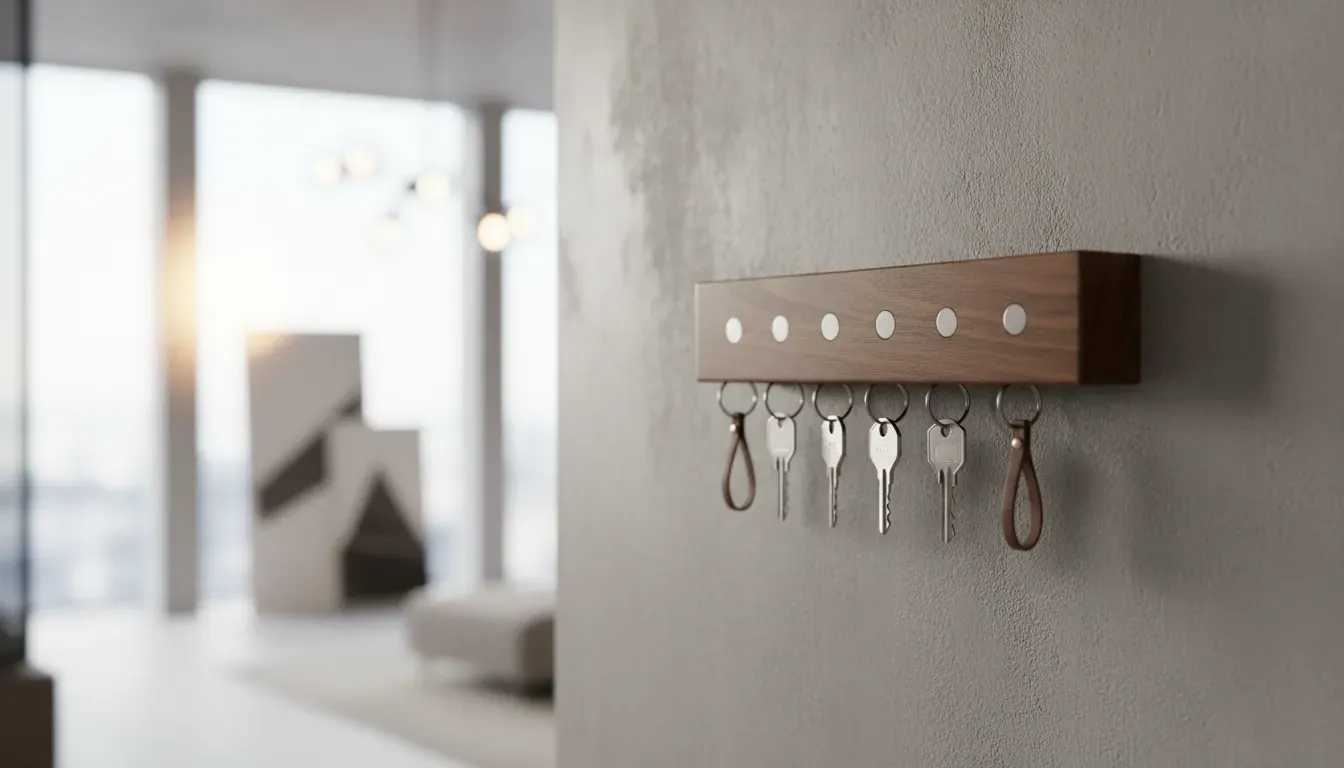
If you hate visual clutter, magnetic racks are your best friend. These usually take the form of a simple block of wood or slate with high-powered neodymium magnets embedded inside. The result? Your keys appear to float against the wall.
The Engineering Behind the Magic
Not all magnets are created equal. I’ve tested “magnetic” holders that couldn’t support a single car fob, let alone a full set of house keys. You need to look for racks utilizing N52 grade neodymium magnets. These rare-earth magnets pack a tremendous amount of pull force relative to their size.
The beauty of this system is the “grab-and-go” friction. There are no hooks to thread. You simply slap the keys against the wood, and they stick. It’s oddly satisfying, providing a tactile “click” that confirms your keys are safe.
The Aesthetic Advantage
Magnetic bars are chameleons. In a mid-century modern home, a walnut magnetic strip looks like intentional decor. In an industrial loft, a slate or concrete bar blends seamlessly. Because there are no protruding hooks, you avoid the risk of snagging your sweater as you rush out the door—a minor but genuine annoyance with traditional racks.
However, there is a caveat. If you carry a massive keychain loaded with non-ferrous metals (like aluminum bottle openers or plastic fobs) or just sheer bulk, a magnetic strip might struggle. Gravity is a harsh mistress.
If you want the absolute best experience in this category, looking for strong rare-earth integration is key. I highly recommend checking out the Modern Innovations 16 Inch Stainless Steel Magnetic Key Holder. It balances pull-strength with a sleek profile that doesn’t scream “utility closet.”
Common Pitfalls with Magnets
- Scratching: Ensure the magnet is covered by wood, leather, or silicone. Raw metal-on-metal contact will eventually scratch your expensive car fob.
- Demagnetization Myths: People worry about magnets wiping their credit cards or key fobs. Unless you are using an industrial electromagnet, the static field from a key rack is generally too weak to damage the RFID chip in a modern car key. However, maybe don’t store your backup credit card directly on the magnet for weeks at a time.
2. Traditional Racks: The Heavy Lifters
Sometimes, you just need a hook. Traditional racks are the workhorses of the entryway. They don’t rely on physics tricks; they rely on the structural integrity of a curved piece of metal.
The Shelf-and-Hook Combo
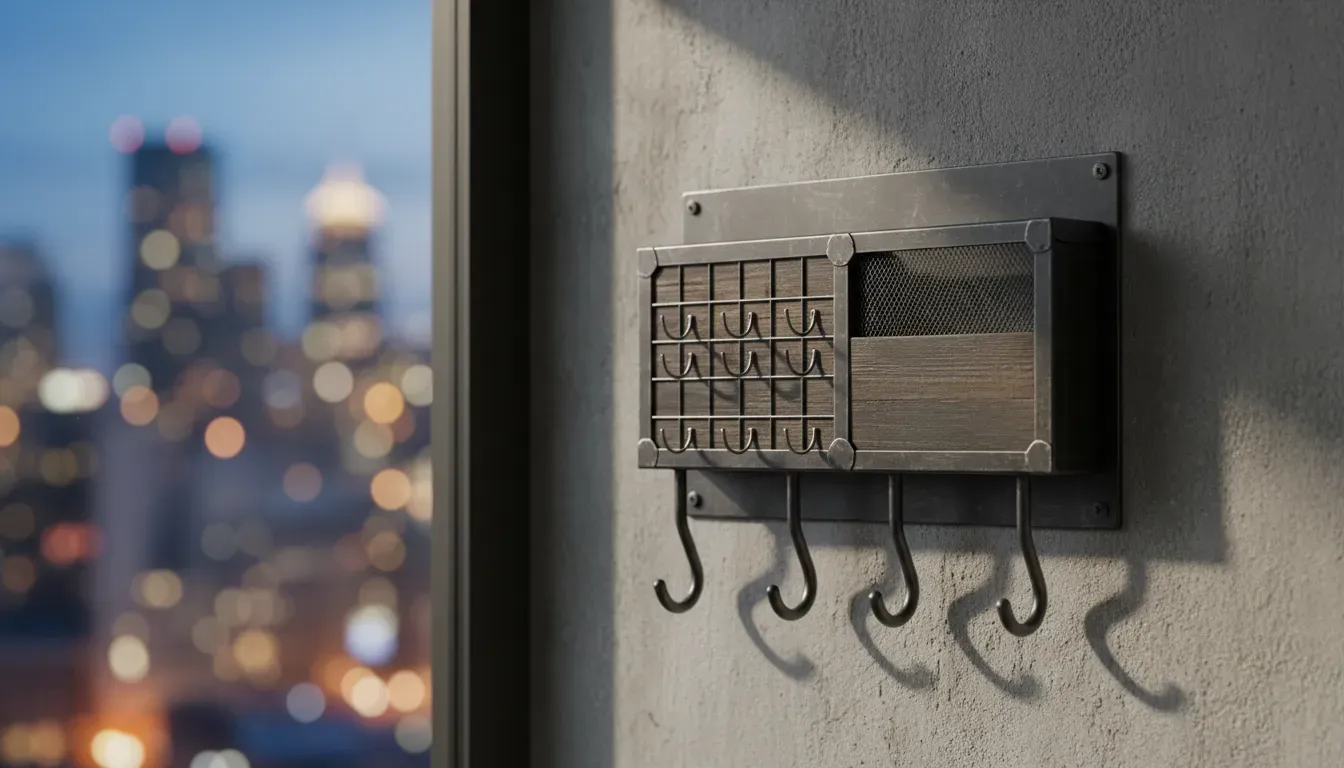
The superior version of the traditional rack isn’t just a row of hooks; it’s the “entryway command center.” This usually includes a small shelf or basket above the hooks. Why is this superior? Because keys rarely travel alone. They travel with sunglasses, wallets, and outgoing mail.
Having a shelf immediately above your keys solves the “wallet problem.” If you hang your keys but throw your wallet on the kitchen table, you’ve only solved 50% of your morning scramble.
Material Durability
When selecting a traditional rack, pay attention to the hook curvature. Shallow L-hooks are notorious for letting keys slide off if you brush past them. You want a deep J-hook or a U-hook.
Furthermore, look at the spacing. Cheap racks crowd the hooks together. If you have bulky car keys, you need at least 2.5 inches of clearance between hooks, or else you’ll be knocking down your partner’s keys every time you grab yours.
For a robust, no-nonsense solution that handles mail and heavy coats alongside your keys, the Lwenki Wall Mounted Key Holder with Shelf is a standout. It merges the rustic farmhouse aesthetic with genuine utility, providing enough shelf depth for actual use, not just decoration.
3. Smart and Modular Systems: The Future of Entryways
We are moving into an era where furniture is no longer static. Modular rail systems and “smart” organizers are gaining traction for people who love tech and adaptability.
The Modular Rail Concept
Borrowing from kitchen organization and workshop pegboards, modular entryway rails allow you to swap out components. Maybe today you need three hooks and a phone tray. Next year, you might need a mail sorter and a planter.
These systems use a base rail mounted to the wall, onto which various accessories clip or slide. It allows for a customized “ecosystem” that evolves with your lifestyle. If you get a dog, you snap on a leash holder. If you start biking, you add a helmet hook.
Tech Integration
Some modern racks now come with integrated wireless charging pads on the shelf. You drop your keys on the hook and your phone on the shelf, and by morning, everything is charged. It reduces the cable spaghetti that plagues most hallway console tables.
While less common, there are high-end options integrating tile-tracking concepts, where the rack itself can “ping” if a specific set of keys hasn’t been returned by a certain hour—though that might be overkill for anyone not running a fleet of vehicles.
For those who want a system that feels engineered rather than just “built,” the Orbitkey Nest and Accessories offers a level of modularity and polish that is hard to beat. While often used as a desk organizer, their wall-mounted ecosystem principles apply heavily to the modern tech-focused home.
The Installation Deep Dive: Do Not Use the Included Anchors
I cannot stress this enough: manufacturers save money on the hardware packet. The little plastic drywall anchors that come with your $50 key rack are usually garbage. They are brittle, they have no bite, and they will spin in the wall the moment you apply torque.
Key Takeaways: Installation Rules
- Find the Stud: If your rack is wide enough (16 inches or more), try to hit at least one stud. A screw in wood beats an anchor in drywall every time.
- Upgrade Your Anchors: If you must use drywall, go buy a pack of self-drilling toggle anchors or threaded drywall anchors (like E-Z Ancor). They hold 50lbs+ and won’t rip out when you yank your keys in a hurry.
- Use a Level: A crooked key rack will annoy you every single day for the rest of your life. Use a spirit level, or at the very least, the measure app on your phone.
Material Science: Wood vs. Metal vs. Plastic
The tactile experience of your entryway sets the tone for your home.
Wood (Walnut, Oak, Bamboo)
Wood brings warmth. It softens the acoustics of an entryway, which is often an echoey space with tile or hardwood floors. However, verify the finish. Unfinished wood will absorb oils from your hands and eventually look grimy. You want a sealed, satin finish.
Metal (Steel, Aluminum, Brass)
Metal is sterile, clean, and incredibly durable. Powder-coated steel is the gold standard here—it resists chipping and rust. If you live in a humid environment or near the coast, avoid cheap chrome plating, which will pit and rust over time.
Plastic (Acrylic, 3D Printed)
Generally, I advise avoiding plastic unless it is high-grade acrylic or a deliberate design choice (like Pop Art decor). Plastic hooks become brittle with age and UV exposure. There is nothing sadder than a snapped key hook.
The “Feng Shui” of Keys
You don’t have to believe in Chi to understand that clutter creates stress. In Feng Shui, the entryway (the “Mouth of Chi”) dictates the energy entering your home. A chaotic pile of keys and mail stops energy from flowing smoothly.
By lifting your keys off a surface and onto the wall, you are literally and metaphorically elevating your organization. It clears horizontal surfaces (tables, counters), which makes the room feel larger and cleaner.
The Bottom Line: Your key rack should not be an afterthought. It is the first thing you interact with when you get home and the last thing you touch before you leave.
Maintaining the System
Buying the rack is the easy part. Building the discipline to use it is the challenge.
Here is the real kicker about human behavior: we are lazy. If your key rack is mounted behind a coat rack, or too high, or too low, you will stop using it within a week.
Ergonomic Placement: Mount the rack at approximately shoulder height. This allows for a natural arm extension. If you have kids, consider a dual-height system or a lower rail specifically for their school IDs and house keys.
The Weekly Purge: Traditional racks with shelves often become graveyards for old receipts, broken sunglasses, and mysterious screws you found on the floor three months ago. Treat your key rack shelf as a “transit zone,” not a storage unit. Clear it every Sunday.
Final Thoughts on Selection
When you are ready to buy, look at your keychain first.
- Do you have a massive “janitor” ring? Go Traditional/Hooks.
- Do you have a sleek, minimal setup? Go Magnetic.
- Do you love gadgets and modularity? Go Smart/Rail.
The investment is small—usually under $50—but the return on investment regarding your peace of mind is astronomical. Stop searching the couch cushions. Stop blaming your spouse for moving your keys. Mount a rack, build the habit, and reclaim your morning routine.