
Corner Entryway Storage Solutions: Utilizing Awkward Angles in Small Apartments
Discover expert strategies for transforming awkward corners into functional entryway storage. Maximize space in small apartments with these clever solutions.
Feb 2, 2026 - Written by: linda wise

In the architecture of urban living, the entryway often suffers the most neglect. It is simultaneously the most high-traffic area of the home and, frequently, the smallest. When dealing with compact apartments, the challenge is compounded by structural quirks: awkward angles, narrow hallways, and dead space that seems impossible to utilize. However, the corner of your entryway—often dismissed as a void where dust bunnies gather—holds immense potential.
Transforming a tight corner into a functional drop zone requires a shift in perspective. It is not merely about finding smaller furniture; it is about leveraging geometry and verticality to create a storage system that is both efficient and aesthetically pleasing. A well-designed corner solution can act as the anchor for your entire home organization strategy, preventing the migration of clutter into the living room and kitchen.
This comprehensive guide explores the strategic utilization of awkward angles. We will delve into structural assessments, vertical storage theories, and specific furniture recommendations designed to maximize every square inch of your foyer. By reimagining the corner, you can reclaim valuable footage and establish a tone of organized sophistication the moment you walk through the door.
The Anatomy of the Awkward Corner
Before purchasing shelving units or drilling holes, one must understand the specific constraints of the space. In small apartments, corners near the door are rarely perfect ninety-degree angles unobstructed by other elements. They are often compromised by baseboards, light switches, intercom systems, or the swing radius of the front door itself.
Assessing the Footprint
Begin by mapping the exact dimensions of the floor space available. In a corner configuration, this usually involves measuring the distance from the vertex (the point where the walls meet) outward along both walls until you hit an obstruction, such as a door frame or a walkway. This triangular footprint defines your maximum capacity for floor-standing units.
Crucially, consider the vertical clearance. Are there bulkheads, fuse boxes, or beams overhead? High ceilings offer a distinct advantage in small footprints, allowing you to build upward rather than outward. Taking precise measurements ensures that any solution you implement will look bespoke rather than forced.
The Swing Radius Factor
The most common error in entryway design is ignoring the door swing. If your front door opens inward toward the corner in question, your storage depth is severely limited. In such scenarios, the solution must be flush against the wall or mounted high enough to clear the door’s movement. Conversely, if the door opens away from the corner, you have deeper storage options, but you must ensure that bulky items do not impede the visual flow into the rest of the apartment.
Verticality: The Architecture of Storage
When floor space is at a premium, the only way is up. Vertical storage is the cornerstone of small apartment organization, utilizing the often-wasted space between eye level and the ceiling. In a corner, this principle is even more vital, as the converging walls provide structural support for tiered solutions.
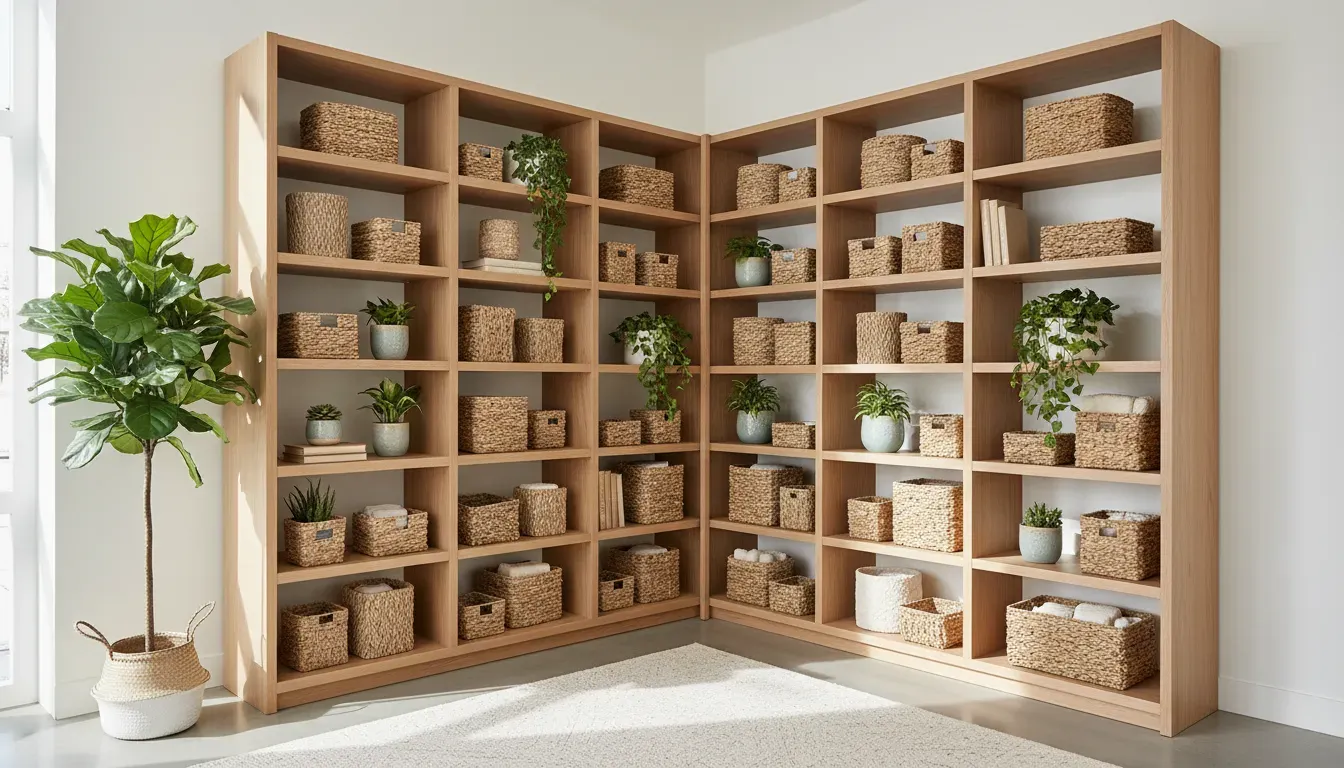
Floor-to-Ceiling Shelving Units
A tall, narrow corner unit draws the eye upward, creating an illusion of height while providing significant storage volume. These units are ideal for housing items that are not needed daily, such as seasonal accessories or decorative objects, on the upper tiers, while keeping keys, wallets, and bags at waist height.
When selecting a unit, opt for open shelving rather than solid cabinetry. Solid doors in a tight corner can feel imposing and block light, making the entryway feel smaller. Open shelves maintain an airy atmosphere. If visual clutter is a concern, utilize uniform baskets or bins on the shelves to hide loose items.
Floating Corner Shelves
For spaces where the floor footprint is obstructed by radiators or baseboard heaters, floating shelves are indispensable. By mounting shelves directly into the corner studs, you eliminate the need for legs, keeping the floor visible. This visibility is a key psychological trick in interior design; the more floor you can see, the larger the room feels.
Floating shelves can be cut to custom triangular shapes to fit odd angles that standard rectangular shelves cannot accommodate. Staggering these shelves at different heights creates a dynamic visual interest and allows for the storage of items of varying heights, from tall boots at the bottom to small catch-all trays at the top.
Specialized Furniture for Angular Spaces
Standard rectangular console tables often protrude too far into a narrow hallway, creating a hip-bumping hazard. Fortunately, furniture designers have recognized the plight of the small apartment dweller, creating pieces specifically engineered for 90-degree nooks.
The Corner Hall Tree
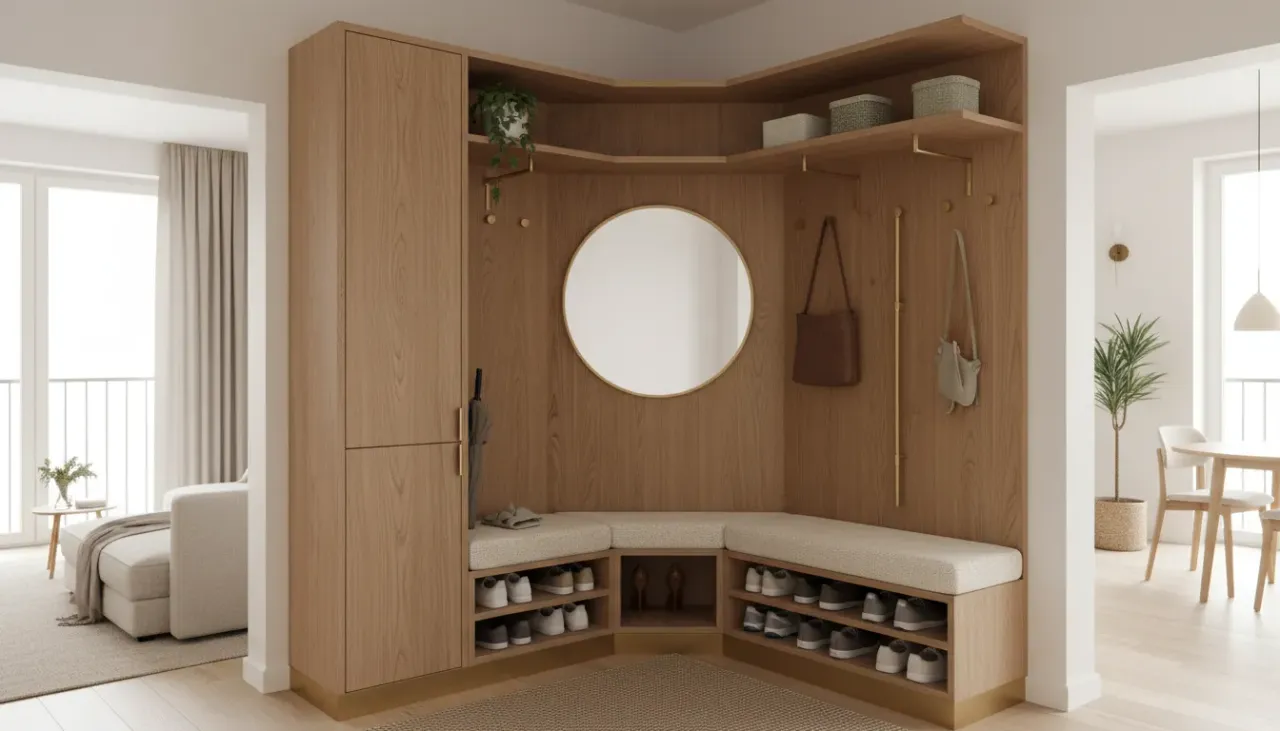
A hall tree is an all-in-one solution typically featuring hooks for coats, a bench for putting on shoes, and shelving for storage. While traditional hall trees are wide and flat, a corner hall tree is shaped like a wedge. It fits snugly into the vertex, maximizing depth without encroaching on the walkway.
These units are particularly effective because they centralize the “leaving the house” workflow. You can sit to tie your shoes, grab your coat, and check your appearance in a mirror—all within a two-foot radius.
For those seeking a ready-made solution that balances durability with industrial-chic aesthetics, consider exploring robust metal and wood options.
Search for Corner Hall Trees on Amazon
Triangular Console Tables
If your goal is to have a surface for mail and keys rather than heavy coat storage, a triangular console table is an elegant choice. These tables slice across the corner, softening the harsh angle of the room. Because they taper toward the back, they take up minimal visual weight.
Beneath a corner console, you can place a large hamper or a decorative umbrella stand. This utilizes the “dead” space underneath the table surface, which is often overlooked. It is an excellent spot for hiding unsightly items like reusable grocery bags or pet leashes.
Wall-Mounted Systems: Hooks, Rails, and Grids
Sometimes, the corner is too tight even for the slimmest furniture. In extremely narrow entryways, wall-mounted systems are the only viable option. By treating the two converging walls as a single continuous canvas, you can create a high-density storage zone that protrudes mere inches from the wall.
The Wrap-Around Technique
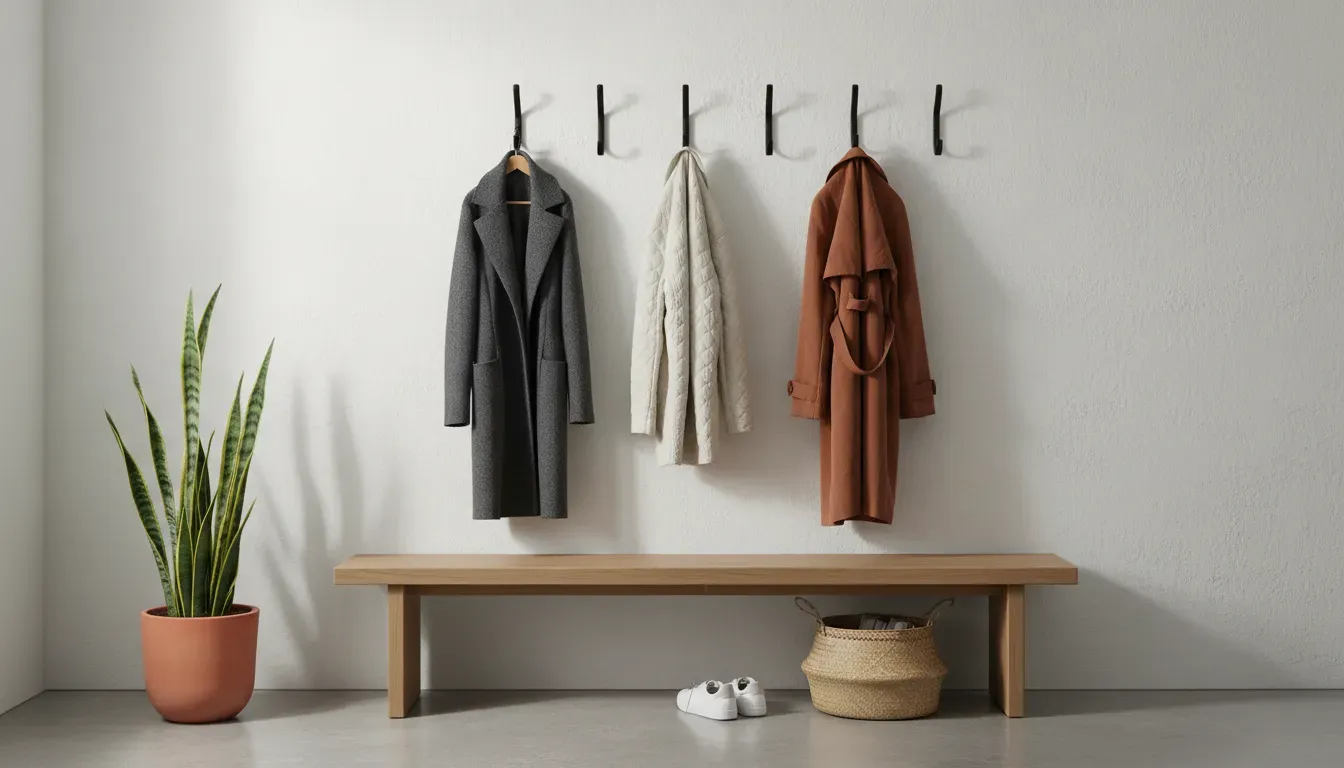
Install hooks or peg rails that continue from one wall to the adjacent one, wrapping around the interior corner. This continuous line draws the eye through the space and maximizes hanging capacity. To prevent the corner from looking like a chaotic closet, stagger the hooks. Place hooks on the left wall slightly higher or lower than those on the right wall to ensure that hanging coats do not overlap excessively at the vertex.
Pegboards and Grid Walls
For a more modular approach, install pegboard panels or wire grids on both sides of the corner. These systems allow for infinite reconfiguration. You can attach small baskets for mail, hooks for keys, and shelves for sunglasses. The beauty of a grid system is its transparency; it does not block the wall color, helping it blend into the decor rather than dominating it.
For readers interested in optimizing other tight areas of the home, you might find our guide on Small Foyer Organization particularly useful for identifying complementary strategies.
The Shoe Storage Conundrum
Shoes are the primary source of entryway clutter. In a corner entryway, traditional shoe racks are often too wide. The solution lies in rotation and vertical stacking.
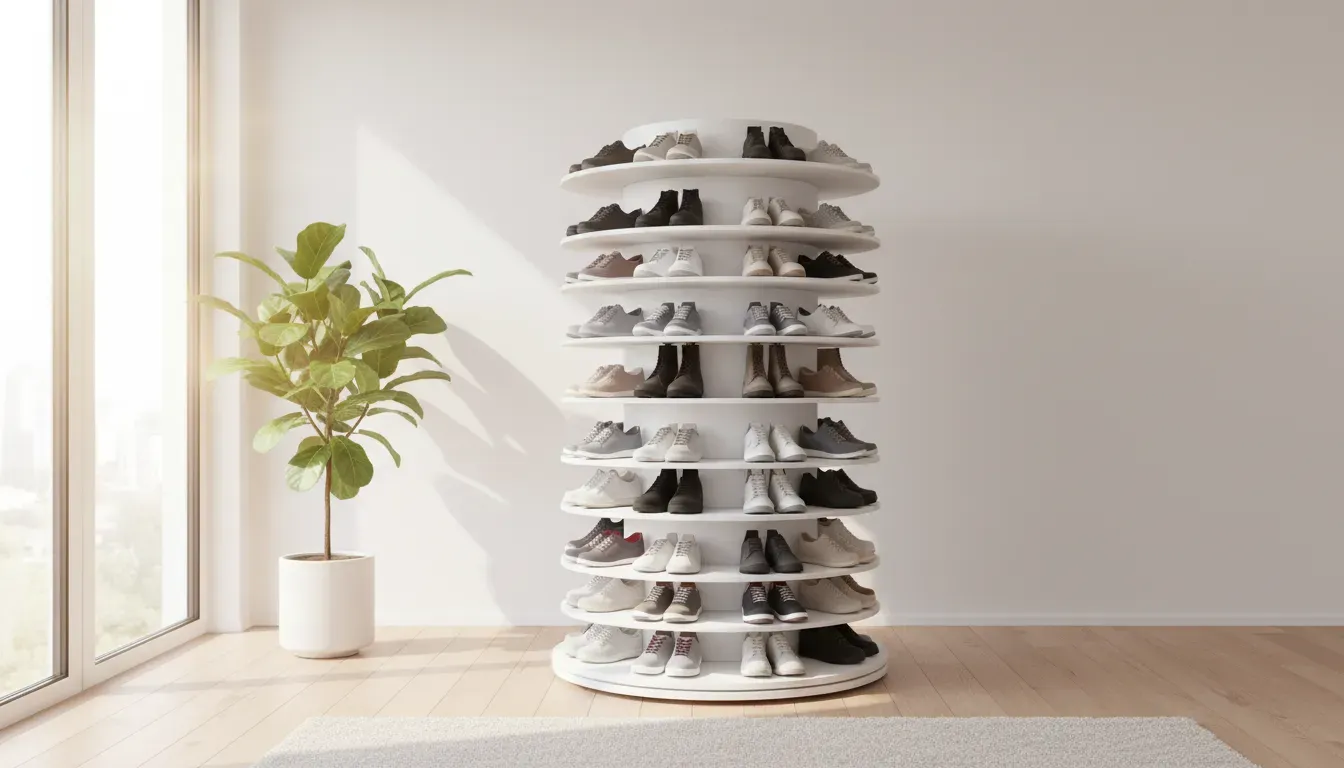
Rotating Shoe Racks
Often referred to as a “Lazy Susan” for footwear, vertical rotating shoe racks are a game-changer for corners. These cylindrical towers spin 360 degrees, allowing you to access shoes on all sides while occupying a compact square footprint. They utilize the depth of the corner effectively, as the rotation mechanism requires some clearance from the wall, which the corner naturally provides.
Wall-Mounted Shoe Cabinets
Ultra-slim tipping shoe cabinets are designed to be shallow, often less than 10 inches deep. While typically rectangular, two narrow units can be placed on adjacent walls meeting at the corner, or a single unit can be placed on the longer wall while hooks occupy the shorter wall. These cabinets hide shoes completely, presenting a clean facade that reduces visual noise—a critical factor in maintaining a serene small apartment.
Search for Slim Shoe Storage Cabinets on Amazon
Lighting and Mirrors: expanding the Visual Space
Dark corners act as black holes in an apartment, absorbing light and making the space feel cramped. Proper illumination is not just about visibility; it is about expanding the perceived volume of the entryway.
Strategic Mirror Placement
Placing a mirror in a corner requires careful consideration of angles. A tall, thin mirror on one wall of the corner can reflect the open hallway, effectively doubling the visual length of the entry. Alternatively, using two mirrors meeting at the corner can create an interesting architectural effect, though one must be wary of the “funhouse” infinite reflection if they are perfectly perpendicular.
Mirrors also serve the functional purpose of a final outfit check. If you lack wall space for a large mirror, consider utilizing mirrored cabinet doors on your storage units.
Lighting the Nook
Overhead lighting often fails to reach into tight corners, casting shadows that make the storage area look dingy. Install a wall sconce or a small pendant light directly above the corner storage. If hardwiring is not an option, rechargeable motion-sensor LED strips placed under floating shelves or inside cabinets can provide functional task lighting that elevates the sophistication of the display.
Integrating Decor: Function Meets Form
A storage corner should not look like a utility closet. It is the first thing guests see, so it must reflect your personal style. The key is to blend decorative elements with functional ones.
The Power of Textiles
Soft textures counteract the rigidity of corners and shelving units. If your solution includes a bench, add a high-quality cushion or a throw pillow. A small, round rug placed at the base of the corner can soften the angularity of the walls and define the entryway zone distinct from the rest of the apartment.
Greenery and Life
Plants are excellent for filling awkward gaps. A hanging planter suspended from the ceiling into the corner adds life and vibrancy without taking up shelf space. Snake plants or ZZ plants are ideal for entryways as they tolerate low light and have a vertical growth habit that complements the architecture of the corner.
Hidden Storage: The Secret to Minimalism
For those who prefer a minimalist aesthetic, visible coats and shoes are the enemy. “Hidden” storage solutions utilize containers to mask the chaos of daily life.
Uniform Bins and Baskets
The most effective way to tidy a corner shelf is to use identical bins. Whether you choose woven seagrass, felt, or wire baskets, uniformity creates a sense of calm. Assign a specific category to each bin—winter gear, dog walking supplies, electronics—and label them discreetly.
Finding baskets that fit triangular or odd-shaped shelves can be difficult. In these cases, flexible woven baskets are superior to rigid boxes, as they can squish slightly to fit the space.
Search for Woven Storage Baskets on Amazon
DIY Solutions for Custom Angles
Sometimes, commercial products simply do not fit the unique geometry of a historic apartment or a loft conversion. In these instances, DIY solutions offer the best return on investment.
Custom Cut Plywood Shelves
With basic woodworking skills, you can cut plywood triangles that fit your corner perfectly. By painting them the same color as the wall, you create a built-in look that feels expensive and intentional. This technique is particularly useful for obtuse or acute angles that are not standard 90-degrees.
Repurposed Ladders
A vintage wooden ladder leaning into a corner can serve as a rustic towel or scarf rack. By securing the ladder to the wall for safety, you gain multiple rungs of vertical storage with a minimal footprint. This is an excellent solution for renters who want to minimize drilling.
Navigating the “Drop Zone” Psychology
The success of your corner entryway storage depends not just on the furniture, but on habit formation. The “drop zone” is a behavioral concept. If the system is too complex—for example, if you have to open a drawer and unclip a box to put away your keys—you will likely revert to dumping them on the nearest surface.
The One-Motion Rule
Design your corner storage so that the most frequently used items require only one motion to store. Hooks are better than hangers for coats. Open bowls are better than lidded boxes for keys. Reserve the more complex storage (high shelves, lidded bins) for items used less frequently.
Managing Overflow
A small corner cannot hold everything. It is vital to implement a seasonal rotation system. In summer, heavy coats and boots should be moved to a bedroom closet or under-bed storage, freeing up the entryway corner for light jackets and sandals. This discipline prevents the corner from becoming overwhelmed and ensures the entryway remains passable.
Troubleshooting Common Layouts
Every small apartment layout presents a unique variation of the corner problem. Here are strategies for specific scenarios.
The “Door-Adjacent” Corner
If the corner is immediately next to the door hinge, depth is your enemy. Use flat wall organizers, magnetic boards, or ultra-shallow picture ledges. Do not place anything on the floor that could stop the door from opening fully.
The “Hallway” Corner
In a long, narrow hallway that turns a corner, the outer corner is a high-traffic collision zone. Focus storage on the inner corner. Rounded furniture edges are crucial here to prevent bruises as you navigate the turn. Curved floating shelves are an excellent way to soften the turn while adding utility.
The “Open Plan” Corner
In studio apartments where the entry opens directly into the living space, the corner storage must act as a room divider. A tall, open bookshelf placed perpendicular to the wall can define the “entryway” while serving the living room on the other side. This dual-purpose approach is the hallmark of efficient studio design.
For more inspiration on defining spaces within open layouts, refer to our article on Creative Entryway Decor Ideas.
Conclusion
Utilizing awkward angles in small apartments is less about finding the perfect product and more about adopting a strategic mindset. It requires viewing the corner not as a limitation, but as an opportunity for architectural creativity. By embracing verticality, investing in specialized angular furniture, and adhering to the principles of visual flow, you can transform a neglected nook into the most hardworking area of your home.
Whether you opt for a sleek corner hall tree, a custom floating shelf system, or a rotating shoe tower, the result should be a space that welcomes you home with order and style. Remember that in small spaces, every inch counts. The corner is no longer a dead zone; it is your new frontier for organized living.