
Designing a Kid-Friendly Entryway: Low-Access Hooks and Organizers for Young Children
Transform your entryway into an organized, independent space for children. Discover the best low-access hooks, shoe storage, and design strategies.
Feb 5, 2026 - Written by: linda wise

The entryway is the transitional hub of the home. It is the boundary between the sanctuary of the indoors and the demands of the outside world. For families with young children, this transition is often fraught with friction. The morning rush can quickly devolve into a chaotic search for missing shoes, tangled backpacks, and misplaced mittens. However, the root cause of this disorganization is rarely the child’s lack of discipline; rather, it is usually a failure of design.
Standard entryway furniture is designed for adult ergonomics. Coat racks stand six feet tall, shelves are positioned at eye level for a grown man, and drawers are often heavy or difficult to open. Expecting a three-year-old to independently manage their belongings in an environment built for giants is a setup for failure. To cultivate independence and maintain a tidy home, one must approach the entryway from the perspective of a child.
By implementing low-access hooks, accessible organizers, and intuitive systems, parents can transform the “drop zone” from a point of stress into an engine of autonomy. This guide explores the architectural and psychological principles of designing a kid-friendly entryway that merges functional storage with sophisticated interior design.
The Philosophy of the Child-Centric Entryway
Before selecting hardware or rearranging furniture, it is essential to understand the pedagogical value of an accessible environment. Borrowing from the Montessori method, the goal of a child-friendly space is to foster independence. When a child can reach their coat, put on their own shoes, and stow their backpack without assistance, they develop a sense of agency and competence.
A well-designed entryway reduces the cognitive load on parents. Instead of acting as a concierge for every departure and arrival, the parent becomes a guide. The environment itself instructs the child on what to do. If the hook is at their eye level, the affordance is clear: the coat goes here. If the shoe basket is open and low, the action of putting shoes away requires minimal effort.
This design philosophy also addresses the visual noise of a home. Clutter is often the result of items not having a designated, accessible place. By lowering the infrastructure of the entryway, we effectively expand the storage capacity of the room, utilizing vertical space from the floor up, rather than just the top half of the wall.
Assessing Your Space and Ergonomics
The first step in redesigning the entryway is a physical assessment of the available space and the physical capabilities of the children involved. A toddler of two years has vastly different motor skills and reach than a seven-year-old.
Determining the “Zone of Independence”
The “Zone of Independence” refers to the vertical space a child can comfortably access without stretching, jumping, or climbing. For the average toddler to preschooler, this zone is typically between 25 inches and 35 inches off the floor.
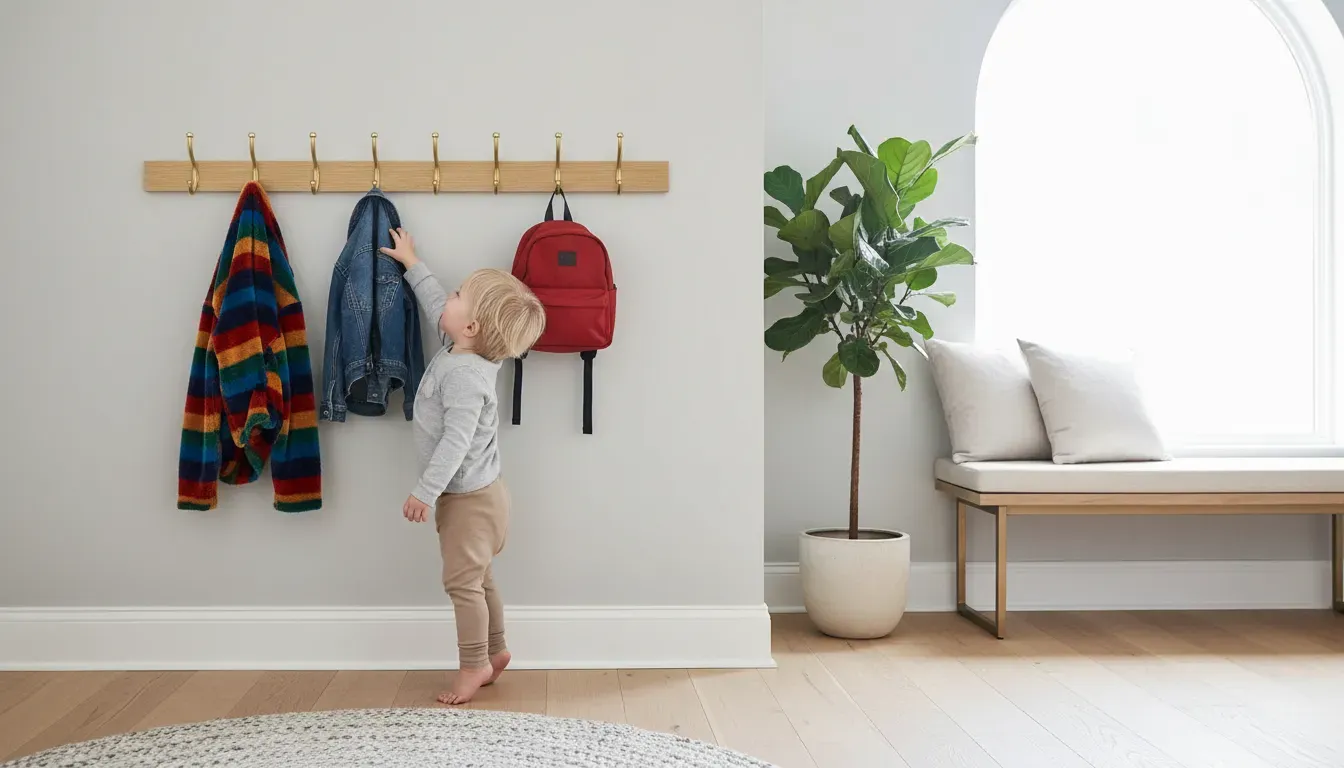
Measure your child’s height and their vertical reach. Ideally, hooks should be placed at shoulder height or slightly below to allow for the upward motion of lifting a coat loop over a peg. Cubbies and bins should be placed at floor level or on low shelves no higher than chest level to ensure they can see the contents inside.
Traffic Flow Considerations
Entryways are high-traffic areas. When lowering storage elements, one must ensure they do not become tripping hazards. Hooks placed at hip-height for an adult can easily snag a purse or grocery bag if placed in a narrow corridor.
If your entryway is a narrow hallway, consider recessed hooks or flat-profile organizers. For larger mudrooms, a dedicated low bench creates a natural barrier that protects the wall-mounted storage from passing foot traffic. For more on maximizing tight areas, you might review our guide on small space entry strategies.
The Foundation: Low-Access Hooks
The cornerstone of a kid-friendly entryway is the humble coat hook. While it seems like a simple piece of hardware, the choice of hook and its installation are critical for long-term success.
Choosing the Right Hardware
Children are not gentle with home fixtures. They tug, they pull, and they hang heavy backpacks on hooks meant for light jackets. Therefore, durability is non-negotiable. Avoid plastic adhesive hooks, which will inevitably peel paint or snap under pressure. Opt for metal or solid wood hardware anchored into studs or using high-quality drywall anchors.
The shape of the hook matters as well. Sharp, narrow hooks can poke holes in delicate fabrics or, worse, injure a child if they stumble against the wall. Look for hooks with:
- Blunt, rounded tips: These prevent injury and fabric damage.
- Deep curves: A shallow hook will let coats slide off easily, leading to frustration and piles on the floor. A deep “J” or “U” shape secures the item.
- Double prongs: These maximize vertical space, allowing a backpack and a jacket to occupy the same hardware footprint.
For a robust, classic option that fits both modern and farmhouse aesthetics, consider heavy-duty dual hooks.
Amazon Product Recommendation: Heavy Duty Wall Mounted Dual Coat Hooks
Installation Strategies
When installing hooks for children, consider a “rail” system rather than individual hooks scattered on the wall. A wooden rail mounted to the wall allows you to space hooks evenly and provides a unified visual element.
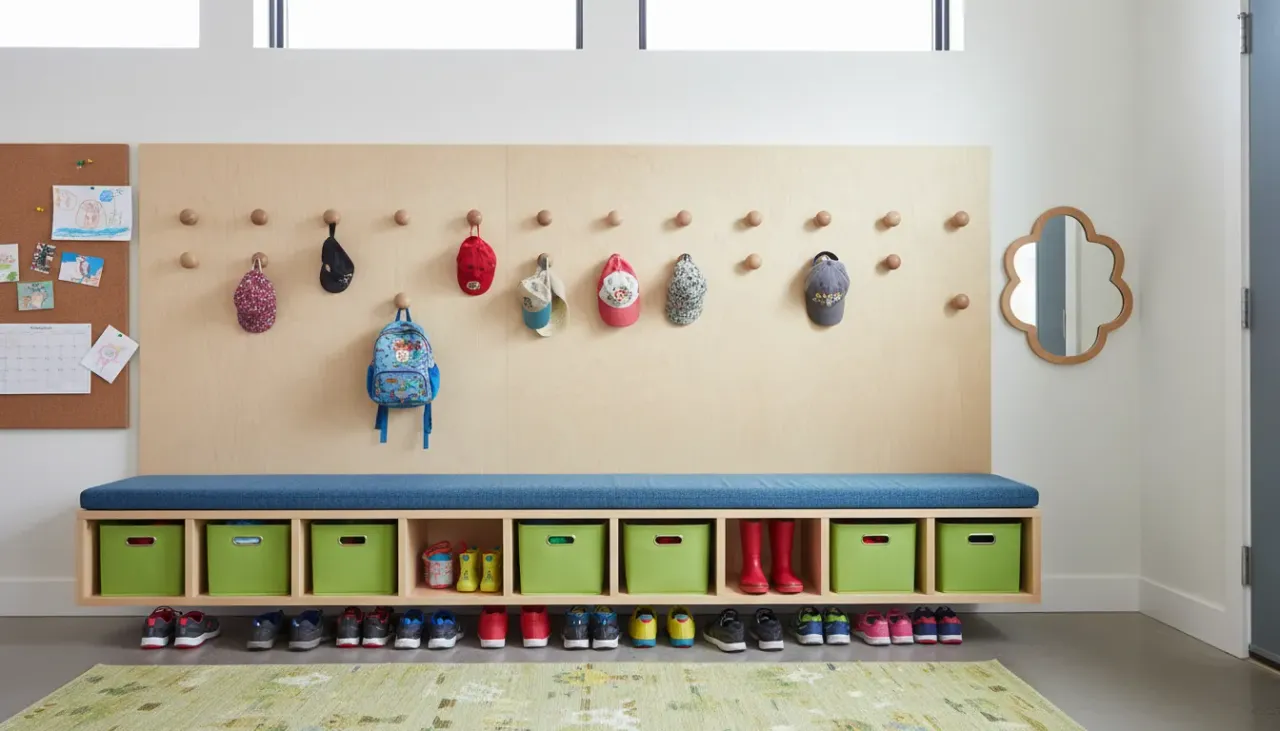
The Growth Strategy: Instead of drilling new holes every year as your child grows, consider installing a vertical slat wall or a pegboard system. This allows you to move hooks up in one-inch increments without damaging the drywall. Alternatively, install two rows of hooks initially—one at 30 inches for current use, and one at 45 inches for future use (or for longer items like snow pants).
Shoe Storage Solutions for Little Feet
Shoes are the primary source of entryway clutter. Unlike adults, who might line shoes up neatly, children are more likely to kick them off wherever they stand. The storage solution must be easier to use than leaving the shoes on the floor.
The Power of Open Storage
Closed cabinets and shoe drawers are often barriers to entry for young children. Opening a door, placing shoes inside, and closing the door is a three-step process. A tired child will skip it. Open shelving or designated baskets remove the friction.
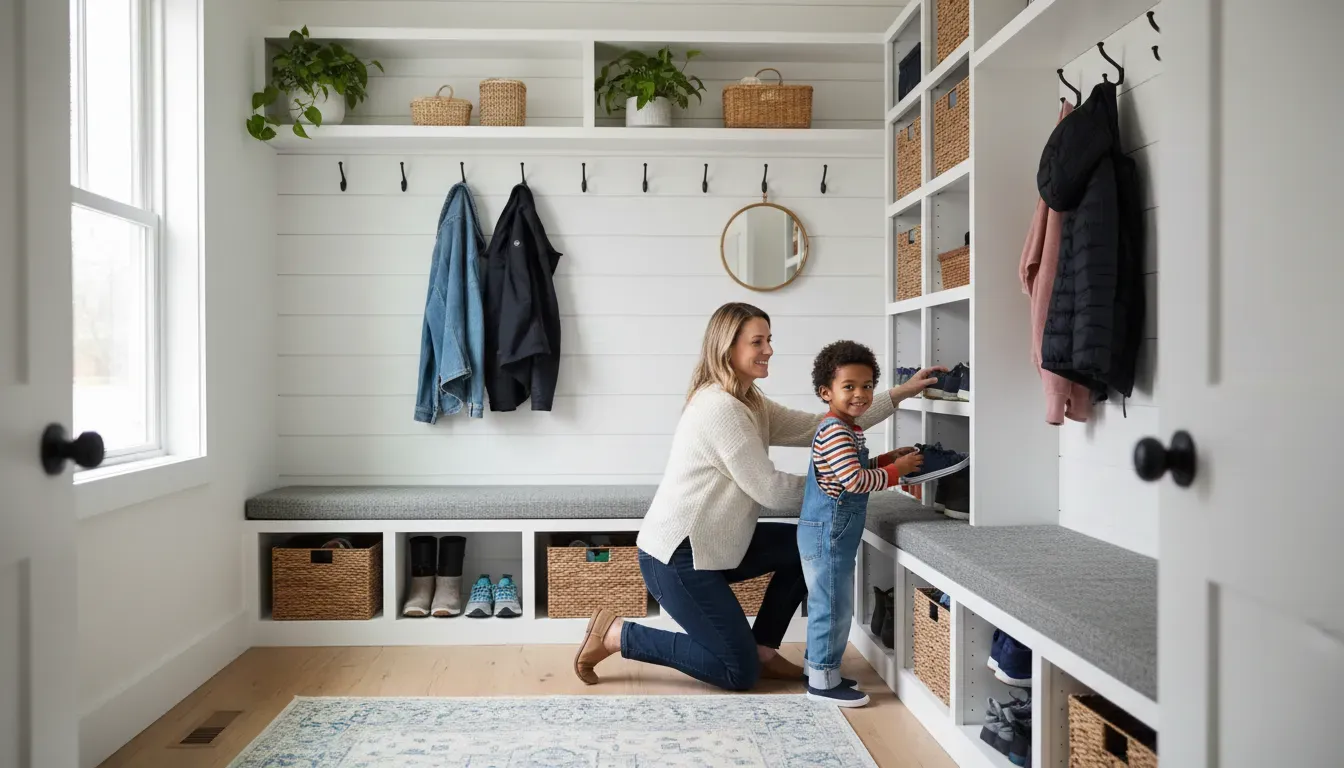
Cubby systems are particularly effective. Assigning a specific cubby to each child gives them territorial ownership over their space. If a cubby bench is used, ensure it is low enough for the child to sit on while putting on their shoes. This creates a functional station: sit, remove shoes, place in cubby.
Baskets and Trays
For younger toddlers, even lining shoes up on a shelf can be a fine-motor challenge. In this instance, a “dump basket” is a perfectly acceptable solution. A large, low-profile woven basket or a sturdy canvas bin allows the child to simply drop their shoes in. While less organized than a rack, it keeps the floor clear, which is the ultimate goal.
To manage wet or muddy footwear, use a rubber boot tray with a raised lip. Place this tray explicitly in the child’s zone. Using a visual marker, such as a tray in a fun color, helps delineate where the muddy items belong.
For a solution that combines seating with accessible storage, a low-profile storage bench is ideal.
Amazon Product Recommendation: Kids Storage Bench with Cubbies
Organizing Accessories and Seasonal Gear
Jackets and shoes are the large items, but entryways are often overrun by the small debris of childhood: mittens, hats, sunglasses, sunscreen, and permission slips. These items require containment to prevent them from vanishing.
The “One-In, One-Out” Rule
Before organizing, it is vital to limit the quantity of items in the entryway. A child does not need access to five hats and three pairs of sunglasses simultaneously. Keep off-season or backup gear in a closet or secondary storage area. The entryway should only house what is currently in rotation.
Wall-Mounted Pockets and Organizers
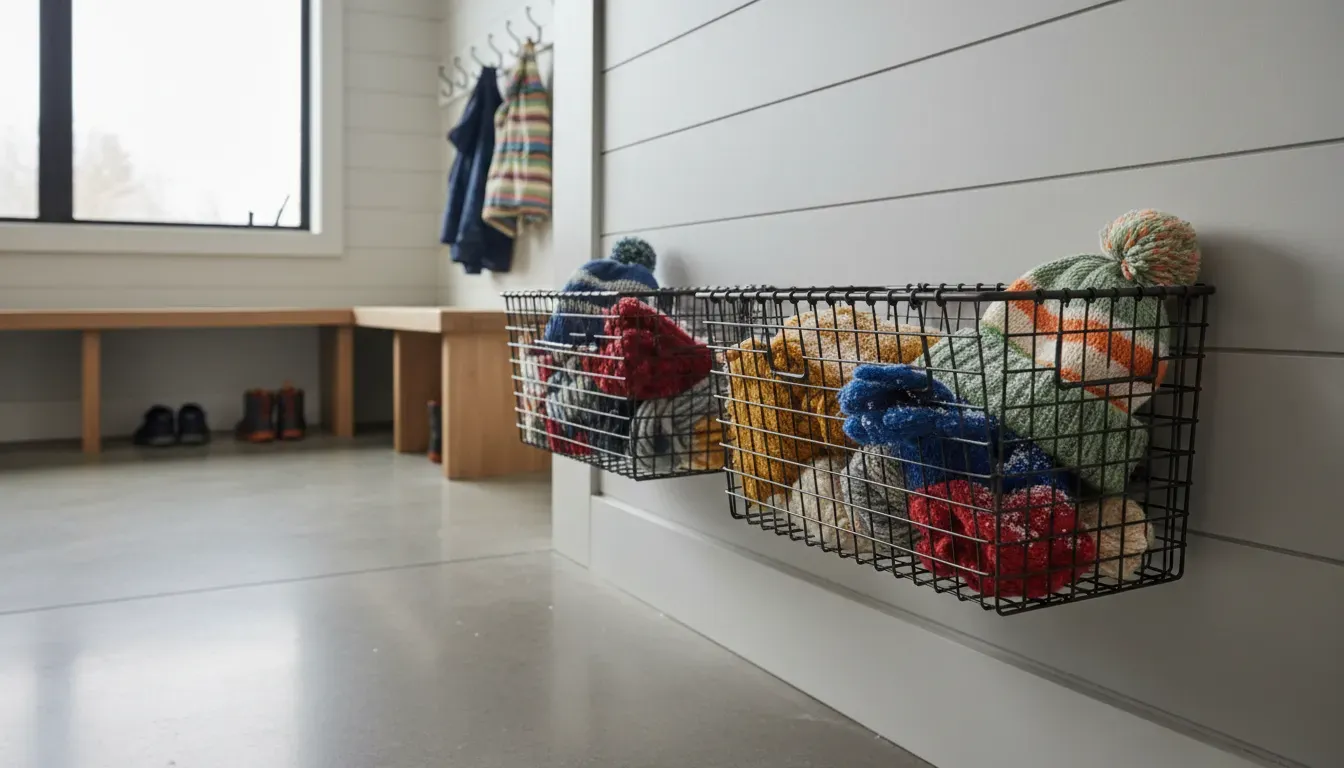
Hooks are poor storage for small loose items. Instead, utilize wall-mounted wire baskets or fabric wall pockets hung at the child’s height. These are perfect for dropping in gloves or winter hats.
Transparent or wire mesh baskets are superior to opaque bins because they allow the child (and the parent) to see exactly what is inside, reducing the frantic search for a matching mitten.
Backpack Management
School bags are heavy and bulky. While they can be hung on heavy-duty hooks, they often protrude into the room. A designated floor spot or a sturdy, wide shelf is often better. If you prefer hanging, ensure the hook is substantial.
Design Aesthetics: Merging Function with Style
Creating a kid-friendly space does not require sacrificing the aesthetic integrity of your home. You do not need to use primary-colored plastic bins or cartoon-themed furniture. In fact, integrating the child’s storage into the home’s overall design creates a more cohesive look and teaches the child to respect the shared environment.
Material Consistency
If your home features mid-century modern walnut tones, choose low hooks and benches in matching wood finishes. If your style is coastal, opt for whitewashed oak and seagrass baskets. Using “adult” materials for children’s furniture elevates the space.
Visual Coding
Children who cannot read yet rely on visual cues. Instead of text labels, use icons or photos. You can attach small wooden tags to baskets with simple icons of a shoe, a hat, or a coat.
Color coding is another subtle way to organize without clutter. If you have multiple children, assign a specific color hook or basket liner to each. This reduces arguments over whose space is whose and makes it immediately obvious who left their items on the floor.
For a streamlined look that handles mail for parents and accessories for kids, consider a multi-functional wall organizer.
Amazon Product Recommendation: Wall Mounted Entryway Organizer with Basket
Safety Considerations
Low-access storage introduces specific safety dynamics that must be addressed.
- Anchoring: Any piece of furniture, including benches, cubbies, or freestanding coat racks, must be anchored to the wall. Children will inevitably climb on storage units to reach items or simply for play.
- Protrusion Hazards: Ensure that hooks and handles do not protrude sharply at the eye level of a running child. Swivel hooks that fold flat against the wall when not in use are an excellent safety feature for narrow spaces.
- Heavy Lids: If utilizing a toy-box style bench for storage, ensure it is equipped with safety hinges that prevent the lid from slamming down on small fingers.
- Slip Prevention: Entryways are often tiled. Ensure that any rugs or mats used for shoe storage have non-slip backings to prevent falls when children rush in with wet feet.
Building the Routine
Design is only half the equation; behavior is the other. The most beautifully designed low-access mudroom will fail if the habits aren’t established.
Habit Stacking
Link the action of using the entryway storage to the transition itself. The rule should be: “We do not enter the living room until shoes are in the basket.” By “stacking” the organization habit onto the arrival habit, it becomes automatic.
Modeling Behavior
Children mimic what they see. If parents kick their shoes off in the middle of the hallway and drape coats over the bannister, children will do the same. Parents must utilize their own designated storage zones to model the expected behavior.
The “Reset”
Despite best efforts, the entryway will get messy. Implement a weekly “reset” time, perhaps on Sunday evenings, where pockets are emptied of trash, stray items are returned to rooms, and the space is returned to baseline.
Adapting the Space as They Grow
A child-friendly entryway is not a static installation. As your children grow, their reach expands, their shoes get larger, and their gear becomes heavier.
When designing the initial layout, avoid gluing fixtures permanently if possible. Use screw-in hardware that can be patched and painted later. Modular shelving systems are excellent investments because shelves can be spaced further apart as boots get taller.
Eventually, the low hooks used for a toddler’s jacket can be repurposed for holding school bags or gym kits, while new hooks are installed at adult height for coats. This vertical evolution maximizes the wall space over time.
Conclusion
Designing a kid-friendly entryway is an investment in family harmony. By bringing the infrastructure of the home down to the child’s level, you empower them to take responsibility for their belongings. Low-access hooks, intuitive shoe storage, and safety-conscious design turn the morning rush into a manageable routine.
This approach acknowledges that children are not just visitors in the home, but active residents who deserve spaces that accommodate their physical reality. With the right tools and a thoughtful layout, the entryway becomes a welcoming threshold for every member of the family, regardless of their size.