
Fast & Easy: DIY Bench Projects You Can Finish in a Single Weekend
Transform your space with these high-impact weekend DIY bench projects. Learn expert woodworking techniques, material selection, and rapid joinery tricks.
Mar 21, 2026 - Written by: Linda Wise
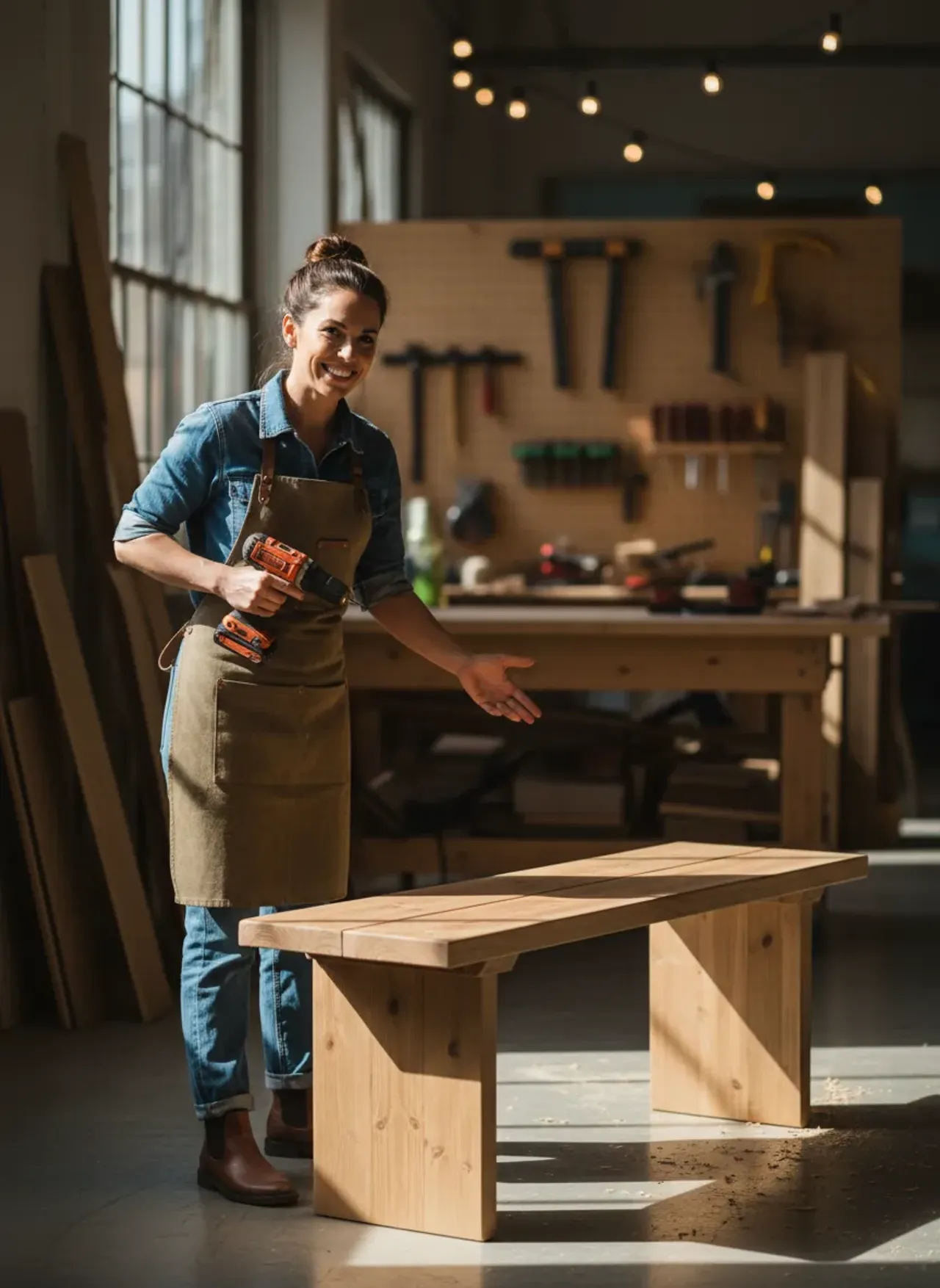
There is a distinct, visceral satisfaction that comes from transforming a stack of raw dimensional lumber into a functional piece of furniture. You measure, you cut, sawdust fills the air, and suddenly, you have created something out of nothing. I’ve personally found that the humble bench is the ultimate gateway drug into the world of woodworking. It requires precision, but forgives minor sins. It demands structural integrity, yet allows for immense creative freedom.
If you are staring down a Saturday morning with an empty garage and a desire to build, you are in the right place. We are completely bypassing the convoluted, month-long heirloom builds that require specialized humidity-controlled shops and thousands of dollars in exotic hardwoods. Instead, we are focusing on high-impact, structurally sound DIY bench projects engineered for rapid deployment. These are builds you can cut, assemble, and finish before Sunday dinner.
Here’s the real kicker: building fast does not mean building cheap. By leveraging intelligent joinery, modern adhesives, and strategic design, you can craft a piece that looks like it came from a boutique furniture showroom.
Before we dive into the specific cut lists and joinery tactics, let’s establish your rapid-build tool arsenal.
Quick Comparison: Top Picks
| Product | Rating | Check Price |
|---|---|---|
| DeWalt 20V MAX Cordless Drill Combo | ⭐⭐⭐⭐⭐ | View on Amazon |
| Kreg Pocket-Hole Jig 320 | ⭐⭐⭐⭐½ | View on Amazon |
| Makita 5-Inch Random Orbit Sander | ⭐⭐⭐⭐⭐ | View on Amazon |

The Anatomy of a Weekend Build
Why do some woodworking projects drag on for weeks while others are completed in a furious 48-hour sprint? The secret lies in material selection and joinery philosophy.
When you constrain your timeline to a single weekend, you must ruthlessly eliminate bottlenecks. Mortise and tenon joints are beautiful, but chopping them out by hand is a chronological black hole. Wood glue is incredibly strong, but standard PVA (polyvinyl acetate) requires 24 hours to fully cure before you can safely apply heavy stress to the joint.
Mastering Material Selection
To execute a fast build, you need materials that are ready to work immediately. Buying construction-grade pine from a big-box home center is tempting due to the price tag, but it comes with a massive caveat: moisture content.
Construction lumber is often kiln-dried to around 19% moisture. As it acclimates to the drier environment of your home, it will aggressively shrink, cup, bow, and twist. If you build a bench with wet 2x4s on Saturday, you will have a wobbling, warped disaster by next Thursday.
Instead, seek out “select pine” or kiln-dried hardwoods like poplar, oak, or ash. If you must use construction lumber, you need to buy it weeks in advance and let it dry in your shop, or meticulously dig through the lumber hack to find boards that feel significantly lighter (indicating lower water weight) and have the tightest, straightest end-grain rings possible.
Pro Tip: When selecting boards, look down the edge of the wood like you are aiming a rifle. This immediately highlights any crowning or bowing. Always check the end grain—boards with the pith (the exact center of the tree) included are practically guaranteed to split as they dry.
Ergonomic Geometry: The Rules of Seating
You can build the most aesthetically pleasing bench on earth, but if the geometry is wrong, no one will sit on it. Standard bench ergonomics are non-negotiable.
- Height: The ideal seat height is between 17 and 19 inches from the floor. This accommodates the average human leg perfectly.
- Depth: Aim for 14 to 16 inches of depth. Anything shallower feels like a tightrope; anything deeper cuts into the back of the knees.
- Overhang: If your bench has a top seat resting on legs or an apron, leave a 1 to 1.5-inch overhang. It provides a visual shadow line that gives the piece professional depth.
Project 1: The Minimalist Mudroom Bench
The mudroom bench is the absolute workhorse of the modern home. It handles wet boots, heavy groceries, and the chaotic morning scramble. Because of its functional nature, a minimalist design is incredibly effective. This build relies on clean lines, a thick top, and robust geometric legs.
If you’re outfitting a front hall, a custom seating area pairs perfectly with these professional entryway storage solutions to immediately elevate your home’s organizational capacity.
The Cut List and Logic
For this build, we are utilizing a “waterfall” aesthetic, where the grain of the seat appears to fold seamlessly down the sides to become the legs. To pull this off in a weekend, we bypass complicated miters and use heavy-duty dowel joinery or strategically hidden pocket holes.
You will need:
- One solid slab of wood (or edge-glued panels) measuring 1.5 inches thick, 14 inches wide, and roughly 6 feet long.
- A sturdy cross-stretcher to prevent racking (the lateral side-to-side wobble).
Rapid Assembly Protocol
- The Chops: Cut your top to 48 inches. The remaining wood will be cut into two 16.5-inch sections for the legs.
- The Joinery: To join the legs to the top at a 90-degree angle, utilize a Kreg Pocket-Hole Jig 320. Drill your pocket holes on the inside faces of the legs, pointing upward into the underside of the seat.
- The Stretcher: A bench without a stretcher will eventually collapse under sheer lateral force. Cut a 2x4 or a piece of matching stock to fit perfectly between the two legs, about 4 inches off the floor. Secure this with pocket screws and wood glue.
You’ll notice that driving screws into end-grain is notoriously weak. The pocket hole system bypasses this by driving the steel screw at a sharp angle across the grain fibers, creating a mechanical lock that, when paired with a high-tack wood glue, is practically indestructible.

Project 2: The Rustic Farmhouse Dining Bench
Farmhouse tables require seating that matches their visual weight. A delicate, spindle-legged bench will look entirely out of place next to a chunky dining table. We need heft. We need visual gravity. We are going to build a trestle-style bench.
Engineering the Trestle Base
The magic of the trestle base is that it centralizes the leg structure, meaning people sliding onto the bench won’t continuously bang their knees on the outside corners.
Key Takeaways for Trestle Builds:
- Base Plate: Use a 4x4 or laminated 2x4s for the horizontal foot resting on the floor.
- Upright: A single thick vertical post (or an X-brace) rises from the center of the base plate.
- Top Cleat: A horizontal support attached to the top of the upright, which the seat rests upon.
- Through-Stretcher: The critical beam that connects the left and right trestle assemblies.
Executing the Build
To finish this in two days, we are going to use half-lap joints for any X-bracing. A half-lap is created by removing exactly half the thickness of two intersecting pieces of wood. When glued and clamped, they form a flush, incredibly strong intersection.
If you are intimidated by cutting half-laps with a router, you can execute them rapidly using a circular saw or a table saw. Simply set your blade depth to exactly half the thickness of your wood, make a series of parallel cuts (kerfs) across the joint area, and knock out the remaining wafers of wood with a sharp chisel.
For assembling the heavy base components, rely on your DeWalt 20V MAX Cordless Drill Combo to drive 3-inch structural screws. Always countersink your screws and hide the heads with wooden plugs. A rustic bench should look like it was assembled by a 19th-century blacksmith, not fastened together with shiny, modern Phillips-head hardware.
Project 3: The Modern Slatted Outdoor Bench
Outdoor furniture plays by an entirely different set of rules. Inside your home, wood lives in a climate-controlled utopia. Outside, it is subjected to UV radiation, torrential rain, fungal attacks, and wild temperature swings.
Defeating the Elements
Building an outdoor bench requires specific biological and chemical considerations. You cannot use untreated pine unless you want it to rot into compost by next spring.
Your best choices for a weekend outdoor build are:
- Western Red Cedar: Naturally rich in tannins and oils that repel insects and resist rot. It is lightweight, dimensionally stable, and easy to cut.
- White Oak: Incredibly dense with closed cellular structures (tyloses) that make it practically waterproof. (Note: Red oak acts like a straw and will rot quickly; ensure it is white oak).
The Slatted Design Philosophy
The enemy of outdoor furniture is standing water. If your bench seat is a solid slab, water will pool, eventually breaking down the finish and infiltrating the wood fibers.
The slatted bench solves this purely through design. By leaving a 1/4-inch to 3/8-inch gap between a series of narrow boards, water instantly sheds through the seat.
- The Frame: Build a simple rectangular box frame out of 2x4 cedar.
- The Legs: Attach 4x4 cedar posts directly into the inner corners of the box frame using heavy carriage bolts.
- The Slats: Cut 1x3 cedar boards to lay across the top.
Here is where attention to detail separates the amateur from the expert. Do not eyeball the gaps between your slats. Use a physical spacer—a spare piece of 1/4-inch plywood or a carpenter’s pencil—to ensure the distance between every single slat is mathematically identical.
Furthermore, you must use the correct fasteners. Standard steel screws will react with the tannic acid in cedar and oak, creating ugly black streaks down your beautiful wood. You must use stainless steel or polymer-coated exterior screws.

Finishing in a Hurry: The Weekend Constraint
You have cut, assembled, and sanded your bench. It is Sunday at 2:00 PM. You are exhausted, but the wood is still raw. This is where many DIYers ruin their weekend projects by applying the wrong finish.
If you apply a traditional oil-based polyurethane right now, it will take 12 to 24 hours to dry. It will attract every speck of dust in your garage, and it will require three coats, with sanding in between. You do not have time for that.
The Hard Wax Oil Revolution
To finish a bench on a Sunday afternoon, you need to abandon traditional polyurethanes and embrace hard wax oils (like Rubio Monocoat or Osmo Polyx). These finishes were originally designed for commercial hardwood floors. They are a mixture of natural oils (linseed) and waxes (carnauba).
Why they are perfect for weekend builds:
- Single Coat Application: You wipe it on, let it bond with the wood fibers for 15 minutes, and aggressively buff off all the excess. That’s it. You are done.
- Zero Dust Nibs: Because you wipe off the excess, there is no wet film sitting on the surface waiting to trap airborne dust.
- Matte Elegance: It leaves the wood feeling like actual wood, not like it has been entombed in cheap plastic.
Surface Preparation is Everything
Before applying any finish, you must sand. Skipping grits will leave deep, visible scratches that the finish will aggressively highlight.
Start with 80-grit sandpaper to remove tool marks and level joints. Move to 120-grit to remove the 80-grit scratches. Finish with 220-grit to leave the surface feeling like glass.
Using a high-quality Makita 5-Inch Random Orbit Sander is essential here. Cheap sanders spin in predictable patterns, leaving tiny spiral scratches (pigtails) all over your wood. A true random orbit sander oscillates unpredictably, ensuring a flawlessly smooth surface ready to absorb your hard wax oil.
The Bottom Line: A flawless finish cannot hide terrible sanding. Dedicate at least 20% of your weekend build time entirely to surface preparation.
Elevating Your Craftsmanship
Building a bench in a weekend proves that you don’t need endless free time to create something beautiful and enduring. The satisfaction of sitting on a piece of furniture you engineered yourself is unmatched. You’ve navigated wood movement, conquered joinery, and mastered rapid finishing techniques.
You’ve got the momentum now. The garage is set up, the tools are dialed in, and you’ve proven to yourself that you can execute a build from raw lumber to final product.
If you are ready to stop endlessly searching the internet for reliable cut lists and want to immediately elevate your woodworking game, you need a centralized source of truth. I highly recommend checking out Ted’s Woodworking. It is an absolute goldmine containing over 16,000 meticulously detailed woodworking plans, ranging from simple weekend patio furniture to complex, master-level cabinetry. The schematics take the guesswork completely out of the equation. Plus, if you grab it through that link right now, you can lock in a massive 75% discount. Stop guessing on your dimensions and start building with absolute confidence.