
Floating Shelves vs. Wall Hooks: Choosing the Best Entryway Storage for Narrow Spaces
Discover the optimal entryway storage solution for narrow halls. We compare floating shelves and wall hooks to maximize space, style, and functionality.
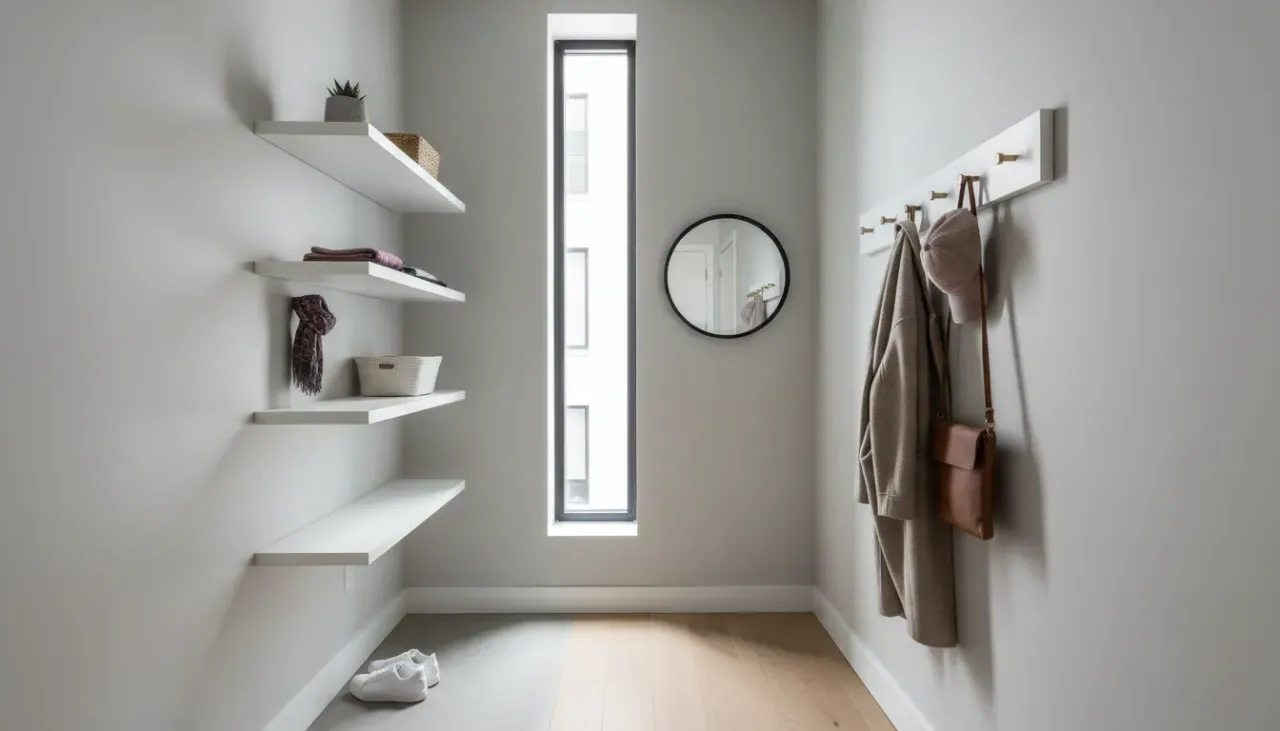
Feb 2, 2026 - Written by: linda wise

The entryway is the handshake of the home. It is the first space that greets you upon arrival and the last space you interact with before departure. However, for many homeowners and apartment dwellers, this vital transition zone is often compromised by a lack of square footage. Narrow hallways and tight foyers present a unique architectural challenge: how do you cultivate a functional “drop zone” without encroaching on the physical flow of traffic?
When floor space is at a premium, verticality becomes your greatest asset. The debate for the most effective wall-mounted solution typically centers on two primary contenders: the floating shelf and the wall hook. Both offer distinct advantages regarding aesthetics, utility, and spatial economy. Yet, selecting the wrong option can lead to a cluttered corridor or a dysfunctional storage system that fails to meet your daily needs.
This comprehensive guide dissects the “Floating Shelves vs. Wall Hooks” debate, analyzing spatial dynamics, visual ergonomics, and organizational capacity to help you curate the perfect narrow entryway.
The Anatomy of a Narrow Entryway
Before evaluating the hardware, it is essential to understand the constraints of the space. A narrow entryway is generally defined as a corridor or foyer with a width of less than 42 inches. In such confined environments, every inch of protrusion from the wall matters.
Standard furniture, such as console tables or hall trees, typically requires a depth of 12 to 18 inches. In a narrow hall, this can restrict the walking path to an uncomfortable claustrophobic width, making it difficult to carry groceries, maneuver strollers, or simply walk past another person.
Therefore, the ideal storage solution for these spaces must adhere to the “shallow profile” rule. It must provide utility without projecting more than a few inches into the room. This is where the battle between shelves and hooks begins.
Contender 1: Floating Shelves
Floating shelves are celebrated for their clean lines and architectural simplicity. By eliminating visible brackets, they create an illusion of lightness that is particularly beneficial in small spaces.
The Case for Floating Shelves
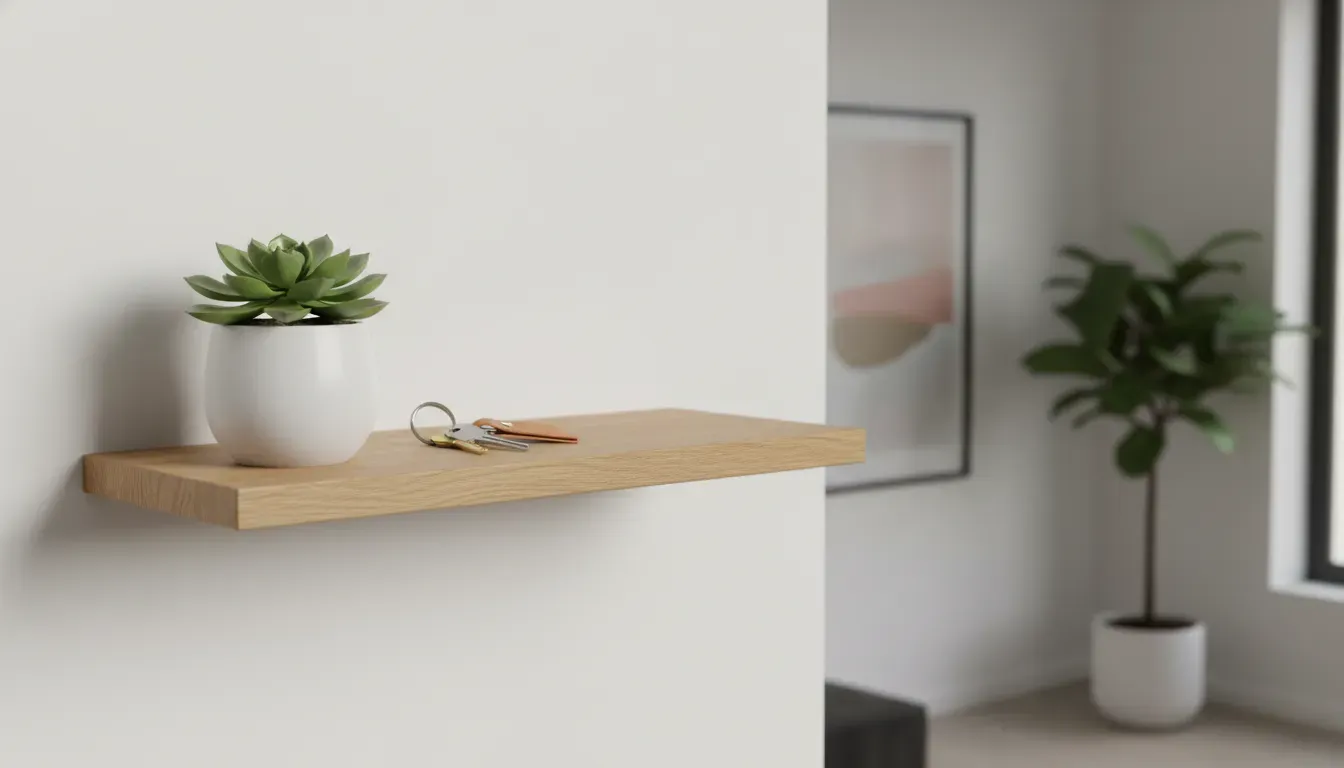
1. The Horizontal Landing Pad The primary advantage of a floating shelf is the provision of a horizontal surface. This is critical for the “unburdening” ritual of entering a home. Humans have a natural inclination to place items down on flat surfaces. A shelf provides a dedicated spot for mail, sunglasses, wallets, and the ever-elusive car keys. Without a flat surface, these small items often end up lost in coat pockets or scattered on kitchen counters further inside the home.
2. Decorative Potential From a design perspective, floating shelves offer superior styling opportunities. They serve as a gallery for entryway decor, allowing you to display artwork, a mirror, or a small plant. This elevates the entryway from a purely utilitarian pass-through to a designed space that reflects your personality.
3. Visual Structure Shelves introduce strong horizontal lines that can visually widen a narrow hallway. When placed correctly, they draw the eye along the length of the wall, creating a sense of depth and perspective.
The Limitations in Narrow Spaces
1. The Depth Hazard The greatest drawback of floating shelves in a narrow corridor is the protrusion factor. A standard shelf depth is often 8 to 10 inches. In a tight hallway, this poses a bumping hazard for shoulders and heads, especially if installed at a standard eye level. For narrow entries, you must seek out “picture ledge” styles or custom shallow shelves that are no deeper than 4 to 6 inches.
2. Weight Capacity While aesthetics are a plus, floating shelves—especially shallow ones—often have lower weight capacities compared to bracketed shelves or heavy-duty hooks. They are excellent for keys and mail but cannot support heavy backpacks or winter coats.
3. The Clutter Magnet A flat surface invites accumulation. Without discipline, a floating shelf can quickly become a dumping ground for junk mail, receipts, and loose change, creating visual chaos at the front door.
If you decide that a surface area is non-negotiable for your routine, consider looking for ultra-slim designs specifically engineered for tight corridors.
Recommended Product for Narrow Profiles
For those leaning towards the sleek aesthetic of a shelf, we recommend searching for high-quality, shallow-depth floating shelves that prioritize timber quality and hidden mounting hardware.
Check out this option on Amazon
Contender 2: Wall Hooks
Wall hooks represent the utilitarian approach to entryway storage. Whether installed as individual units or as a rail system, hooks prioritize the management of soft goods and hangable items.
The Case for Wall Hooks
1. Zero-Footprint Storage When not in use, a wall hook occupies almost zero cubic space. Even when loaded, the protrusion is dictated by the item hanging on it, not the hardware itself. This makes hooks the undisputed champion of spatial efficiency. In an ultra-narrow hallway, hooks allow for a dynamic usage of space—the wall is flat when empty and functional when full.
2. High-Volume Capacity Hooks address the bulk of entryway items: coats, scarves, handbags, dog leashes, and umbrellas. While a shelf handles the small “pocket” items, hooks manage the outerwear that physically takes up the most room. A sturdy hook anchored into a stud can hold significantly more weight than a floating shelf, accommodating heavy winter gear or loaded tote bags.
3. Ease of Use (The “Toss” Factor) Organization requires effortless habits. It is much easier to hang a coat on a hook than it is to open a closet door and find a hanger. For families with children, hooks mounted at varying heights provide an accessible solution that encourages kids to clean up after themselves.
The Limitations in Narrow Spaces
1. The “Bulging Wall” Effect While the hooks themselves are small, the items they hold are not. A row of puffy winter coats hanging on a wall in a narrow hallway can reduce the walkway width significantly. This creates a “soft wall” that you have to brush past, which can feel cluttered and claustrophobic.
2. Visual Noise Unlike the curated look of a styled shelf, a hook rack is often a riot of colors and textures. Coats, bags, and scarves hanging visibly can create a sense of disorder, which disrupts the calm atmosphere desired in a home entrance.
3. No Platform for Small Items Hooks cannot hold sunglasses, letters, or a cup of coffee. If you choose hooks exclusively, you forfeit the “landing pad” function, meaning you will still need to carry small items further into the home to find a resting place.
Recommended Product for Heavy Duty Storage
For those who need robust hanging capabilities without sacrificing style, look for modern hook rails that feature retractable hooks. These allow the unit to sit completely flush against the wall when not in use.
Check out this option on Amazon
Head-to-Head Comparison: Efficiency and Ergonomics
To assist in your decision-making process, let us compare these two solutions across four critical categories relevant to narrow spaces.
1. Spatial Economy
- Winner: Wall Hooks. Hooks encroach on the walkway significantly less than shelves. Even shallow shelves have a fixed depth that permanently narrows the corridor. Hooks offer a flexible depth that changes based on usage.
2. Functional Versatility
- Winner: Tie. It depends entirely on what you are carrying. For keys and mail, the shelf wins. For coats and bags, the hook wins. Neither solution solves the problem of the other completely.
3. Installation and Maintenance
- Winner: Wall Hooks. Installing hooks or a hook rail is generally more forgiving than floating shelves. Floating shelves require precise leveling and often complex bracket installation to ensure they do not sag. Hooks, even if slightly off-level, function perfectly. Furthermore, dusting a shelf is a weekly chore; hooks require virtually no maintenance.
4. Aesthetic Impact
- Winner: Floating Shelves. Shelves offer a sophisticated architectural element that adds value to the interior design. They provide a stage for personality. Hooks are functional hardware; while they can be beautiful, they are rarely the focal point of a room’s design.
The Hybrid Approach: The Ultimate Solution?
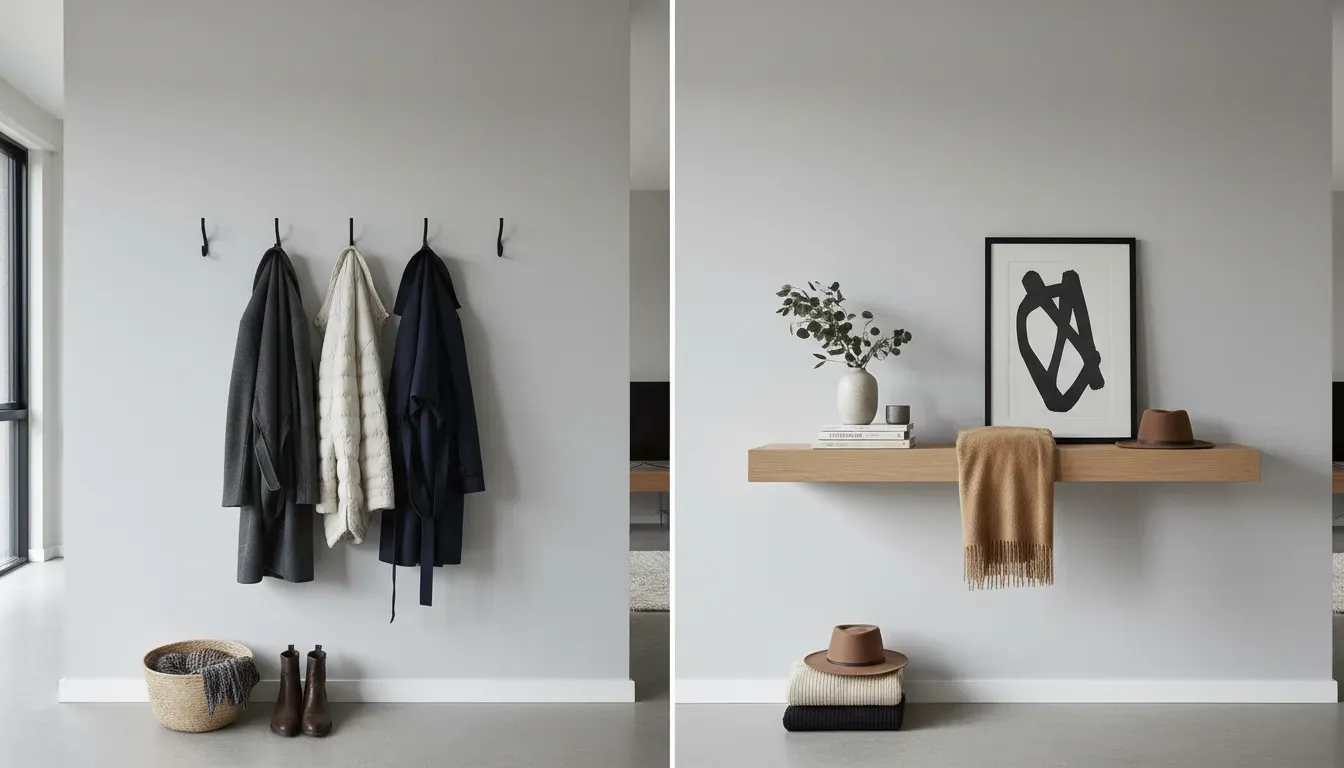
Why choose one when you can employ both? In many narrow entryways, the most effective strategy is a vertical layering of both systems. This approach maximizes the utility of the vertical plane without expanding the footprint.
The “Shelf-Over-Hook” Configuration
This is the gold standard for narrow entryways. By installing a shallow floating shelf (or picture ledge) at approximately 60 to 65 inches high, and a row of hooks underneath at 45 to 50 inches high, you separate the functions.
- Top Tier (Shelf): Holds decorative items, mail, and keys. It keeps visual clutter high and out of the direct line of sight.
- Bottom Tier (Hooks): Holds bags and coats. Because the shelf above protrudes slightly, it creates a visual “cap” for the coats below, making the arrangement look intentional and organized rather than messy.
This configuration effectively turns a flat wall into a two-dimensional mudroom. The key is to ensure the shelf is shallow enough that it does not cast a shadow or obstruct access to the hooks below.
For an even more integrated solution, many manufacturers offer “entryway organizers” that combine a shelf and hooks into a single unit. This simplifies installation as it requires mounting only one piece of furniture.
Recommended Product for Hybrid Storage
For the best of both worlds, consider a wall-mounted entry organizer that combines a mail sorting shelf with sturdy hooks.
Check out this option on Amazon
Design Strategies for Narrow Hallways
Regardless of which hardware you choose, specific design principles will help integrate storage into a tight space without overwhelming it.
1. The Monochromatic Technique
To minimize visual clutter, paint your shelves or hook rails the same color as the wall. This “camouflaging” technique helps the hardware disappear, leaving only the functionality visible. A white shelf on a white wall feels significantly less intrusive than a dark wood shelf on a white wall.
2. Vertical Staggering
If you are using individual hooks, avoid placing them in a straight horizontal line. Staggering them at different heights allows you to fit more storage in a narrow horizontal span. For example, place one hook high for a tall person’s coat, and the next hook lower for a bag or a child’s jacket. This prevents the items from bulking up on top of each other, reducing the outward protrusion.
3. The Mirror Trick
Place a mirror above your floating shelf or amidst your hooks. Mirrors are the oldest trick in the interior design book for a reason—they bounce light and trick the eye into perceiving more space. A mirror above a shelf also creates a designated “grooming station” for a final check before leaving the house.
4. Material Matters
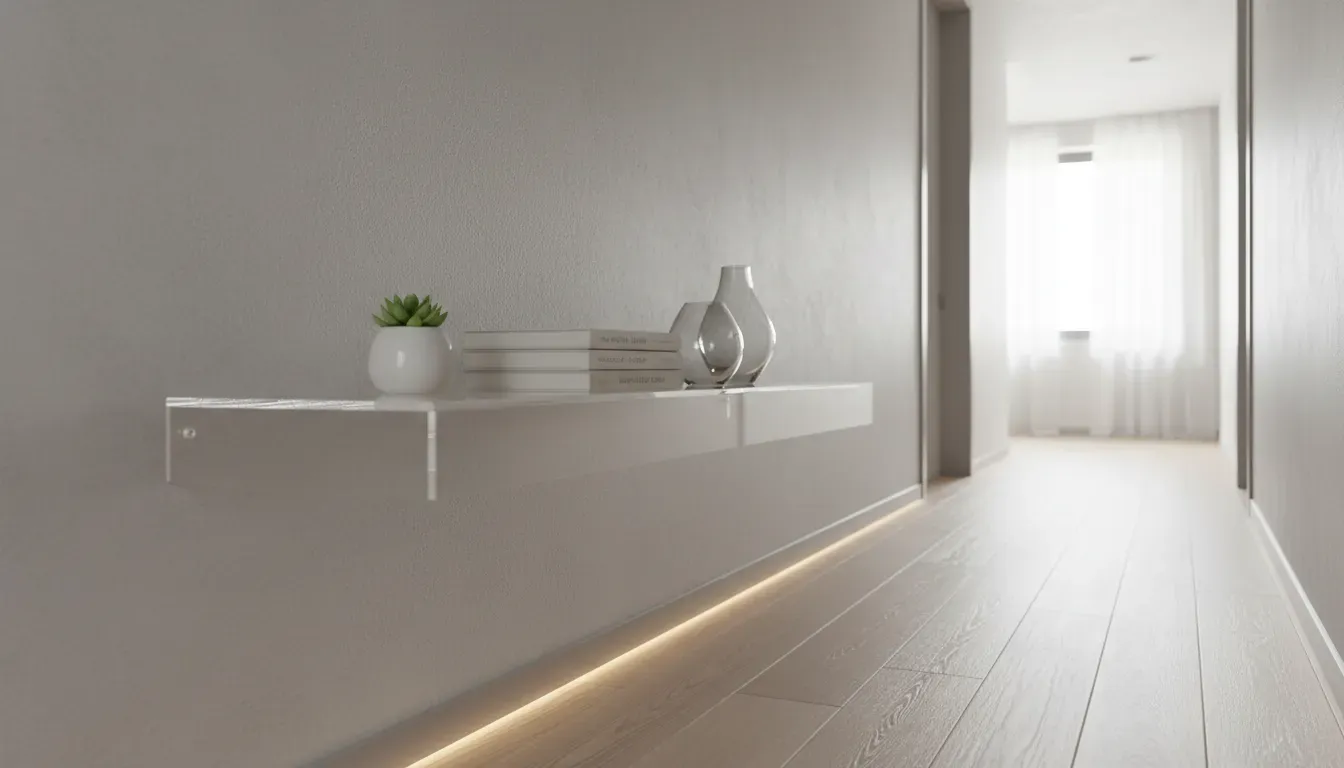
In narrow spaces, transparency is a virtue. Consider acrylic floating shelves. Because they are clear, they possess very little “visual weight.” They provide the functionality of a surface without visually cutting the room in half. Conversely, for hooks, heavy cast iron can feel too aggressive in a tight hall; consider brushed brass or matte black for a modern, sleek profile.
Installation Guide: Safety and Placement
In a narrow thoroughfare, secure installation is paramount. Because people will be brushing past these fixtures, and heavy coats will be taken on and off, the hardware must be anchored securely.
Finding the Studs
Never rely solely on drywall anchors for entryway storage, especially for hooks that will hold heavy bags. Use a magnetic or electronic stud finder to locate the wooden framing behind the drywall. Anchoring into a stud provides typically 50+ lbs of holding strength, whereas drywall anchors can fail over time due to the dynamic movement of grabbing coats.
Height Considerations
Placement height is critical in a narrow hall to avoid injury.
- Hooks: Should be placed high enough that long coats do not drag on the floor, but low enough to be accessible. 60 inches is a standard height, but 48-50 inches is better for bags and kids’ items.
- Shelves: Should be placed above the shoulder line to prevent accidental bumping. A height of 60 to 66 inches usually clears the shoulder zone of most adults while keeping items within eye level.
Clearance Check
Before drilling, tape the outline of your shelf or hook rail on the wall with painter’s tape. Walk past it several times carrying a grocery bag or wearing a bulky coat. If you find yourself instinctively leaning away from the wall, the placement is likely too intrusive, and you should consider a shallower option.
Organizational Psychology: Habits vs. Hardware
Ultimately, the best storage solution is the one that aligns with your behavior. No amount of beautiful hardware will solve a behavioral clutter problem.
The piler vs. the hanger:
- If you are a “piler”—someone who walks in and immediately drops everything in a heap—a shelf (or a basket under a shelf) is your friend. It provides a designated “heap” zone.
- If you are a “hanger”—someone who prefers to see items separated and suspended—hooks are the logical choice.
The “One In, One Out” Rule: In narrow spaces, you cannot store your entire winter wardrobe. The entryway storage should be for items currently in rotation. Off-season coats and rarely used bags should be moved to a bedroom closet. Both shelves and hooks in a narrow hall function best when they are not utilized to 100% capacity. Aim for 70% capacity to maintain a sense of openness.
Conclusion
Choosing between floating shelves and wall hooks for a narrow entryway is not truly a binary choice between form and function; it is a negotiation of space.
If your priority is the organization of small daily carry items (keys, wallet, mail) and adding a decorative touch to a bland corridor, floating shelves are the superior choice—provided you select a shallow depth profile.
If your priority is managing high-volume items like coats, backpacks, and dog leashes to keep them off the floor, wall hooks are the undisputed winner for their spatial efficiency and load-bearing capacity.
However, for the majority of households, the hybrid solution—combining a slender upper shelf with lower hooks—offers the most comprehensive utility. By respecting the constraints of your narrow space and selecting hardware that minimizes protrusion, you can transform even the tightest hallway into an organized, welcoming entry that sets the tone for the rest of your home.
Remember, the goal is not just storage; it is flow. Select the system that clears your path and simplifies your departure, ensuring your entryway helps you start and end your day with ease.