
foyer shoe cabinet
Discover expert strategies for selecting, styling, and organizing a foyer shoe cabinet that eliminates entryway chaos and elevates your home's first impression.
Apr 19, 2026 - Written by: Linda Wise

Walk through your front door. What is the very first thing your eyes gravitate toward? For a vast majority of households, the answer is a sprawling, chaotic landscape of discarded footwear. Sneakers piled haphazardly over dress shoes. Muddy boots asserting dominance over delicate flats. It is an immediate visual assault, a subconscious stress trigger that entirely dictates the mood as you transition from the chaotic outside world into your private sanctuary.
I’ve spent years dissecting interior spatial dynamics, and I can tell you unequivocally that the entryway sets the psychological baseline for your entire home. You cannot achieve domestic tranquility if you are literally tripping over a pair of running shoes the second you turn your key in the lock.
The antidote to this ubiquitous architectural failure is a properly engineered foyer shoe cabinet. We aren’t talking about a flimsy wire rack tucked behind a door. We are discussing a dedicated, purpose-built piece of furniture that marries aggressive storage capacity with undeniable aesthetic appeal. Mastering this space requires an understanding of spatial geometry, ventilation physics, and human behavioral patterns.
Before we tear down the mechanics of entryway storage, let’s establish a baseline of what actually works in the real world.
Quick Comparison: Top Picks
The Psychology of the Threshold
The foyer acts as an airlock between the public sphere and your private life. Architects refer to this as a transitional zone. When this zone is cluttered, it signals to your brain that the chaos of the street has breached your home’s perimeter.
Shoes are particularly problematic intruders. They carry physical dirt—micro-plastics, soil, moisture, and road salt. But they also carry visual weight. A size 12 leather work boot demands attention. Multiplying that visual noise by four family members creates a focal point of pure disorganization.
A dedicated cabinet masks this visual noise entirely. It enforces a strict boundary: the dirt stops here. Furthermore, an enclosed storage system forces a behavioral shift. When there is a designated, easily accessible slot for a pair of loafers, inhabitants are far more likely to put them away rather than kicking them into a corner. It establishes a micro-habit of cleanliness right at the threshold.
Anatomy of a High-Functioning Foyer Shoe Cabinet
Selecting the right unit isn’t merely about matching wood stains to your flooring. It requires rigorous attention to dimensional constraints and material science. If you miscalculate these variables, you will end up with an expensive box that your family absolutely refuses to use.
Dimensional Constraints and Clearances
Here is a reality check that furniture catalogs conveniently ignore: shoes are large, and hallways are narrow. A standard men’s US size 11 shoe is roughly 11.5 inches long. Once you account for the back panel of a cabinet and the thickness of the doors, a traditional shelving unit needs a minimum exterior depth of 14 inches just to allow the doors to close without crushing the toe boxes.
If your foyer is a grand, sweeping space, a 14-inch depth is trivial. If you live in a standardized suburban build or an urban apartment, a 14-inch obstruction in your entryway will severely disrupt kinetic flow. The minimum comfortable clearance for a hallway is 36 inches. If your cabinet pinches that walkway down to 28 inches, you will be constantly slamming your hip into the corners when carrying groceries.
Pro Tip: Use painter’s tape to outline the exact footprint of your proposed cabinet on the foyer floor. Leave it there for 48 hours. If you step on the tape while navigating your daily routine, the cabinet is too deep.
The Physics of Ventilation
Enclosing footwear inside a sealed wooden box is a recipe for an olfactory nightmare. Shoes absorb foot sweat; they absorb rainwater; they drag in snow. If you throw damp leather into an unventilated MDF box, you are effectively creating a humidor for bacteria.
This is where the engineering of the cabinet becomes critical. You need passive airflow. Louvered doors are the historical gold standard for a reason. The angled slats obscure the visual mess inside while allowing continuous air exchange. If you detest the traditional look of louvers, look for cabinets that employ rattan webbing or decorative perforated metal screens.
At the bare minimum, the rear panel of the cabinet must be vented. Some high-end units feature discrete cutouts at the base and the top of the back panel to encourage a natural chimney effect, pulling cool air from the floor and expelling warmer, stale air out the top.
Material Selection: The Humidity Factor
Particleboard is the enemy of the wet season. I have seen countless cheap shoe cabinets completely disintegrate at the base because a family placed snow-covered boots on the bottom shelf. The compressed wood fibers act like a sponge, swelling, warping, and eventually snapping the cam-lock fasteners holding the frame together.
If you live in a climate with actual weather, you must prioritize materials built for moisture resistance.
- Solid Wood: Teak, cedar, and white oak are naturally resistant to rot and moisture. They require occasional oiling but will outlast the mortgage.
- Powder-Coated Steel: Industrial, indestructible, and entirely immune to water damage. The tradeoff is a colder aesthetic that may clash with traditional decor.
- High-Grade Plywood with Edge Banding: A fantastic middle ground. It resists warping far better than MDF and accepts a wide variety of veneers.
If you absolutely must purchase an MDF or particleboard unit due to budget constraints, I strongly advise coating the interior shelves with a clear, matte polyurethane prior to assembly. It adds an invisible layer of waterproofing that will double the lifespan of the piece.
Styles and Configurations: Finding Your Architectural Match
The modern furniture market has evolved rapidly beyond the basic bookshelf model. Manufacturers have recognized the unique spatial challenges of the entryway and developed highly specialized form factors. Let’s break down the three dominant configurations.
The Tilt-Out (Drop-Front) Mechanism
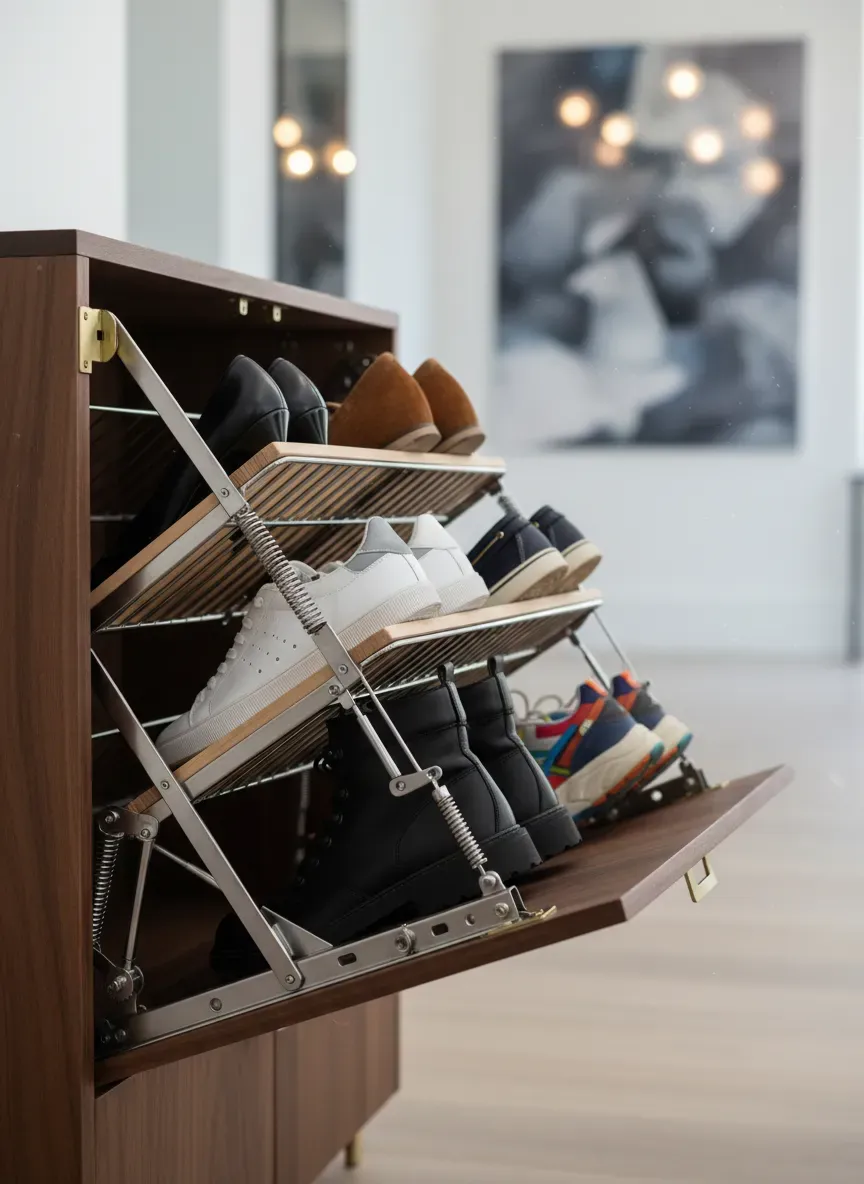
This is the undisputed champion of spatial economy. Instead of horizontal shelves, the tilt-out cabinet utilizes pivoting drawers that store shoes diagonally.
The geometric advantage here is staggering. By tilting the shoe at a 45-degree angle, you reduce the required depth of the cabinet from 14 inches down to a mere 7 to 9 inches. These ultra-slim profiles can be mounted flush against the wall directly behind a swinging front door, utilizing dead space that would otherwise remain entirely wasted.
There are, however, limitations. Tilt-out mechanisms thrive on low-profile footwear. Sneakers, oxfords, flats, and loafers slot in perfectly. High-top basketball shoes, combat boots, and anything with a stiff ankle shaft will jam the pivot mechanism. If your wardrobe leans heavily toward boots, a purely tilt-out system will frustrate you endlessly.
The Bench Hybrid
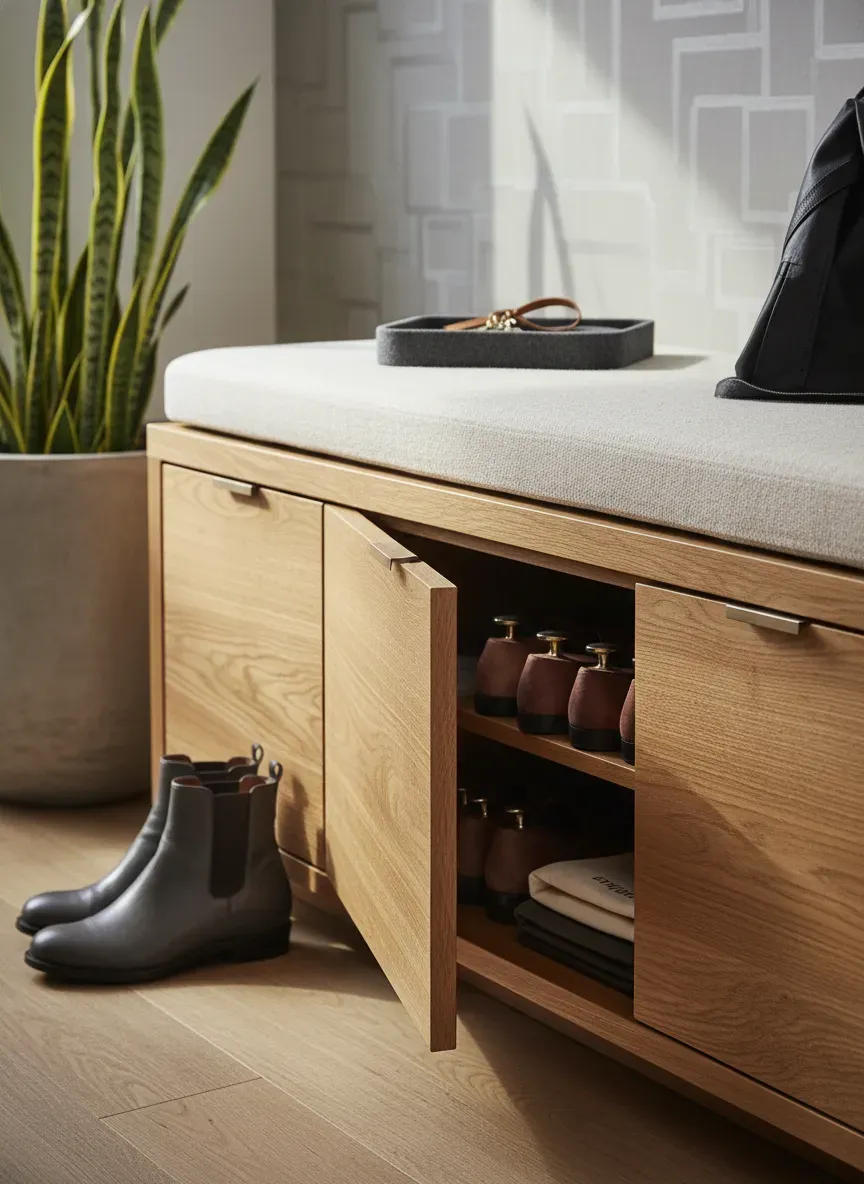
Functionality layered upon functionality. The bench hybrid combines a seating surface for tying laces with storage compartments underneath.
These units are highly advantageous for households with young children or elderly individuals who require a stable surface while wrestling with winter gear. The psychological cue of the bench is strong: “Sit here, remove your shoes.”
The tradeoff is vertical capacity. Because a comfortable seating height maxes out around 18 to 20 inches, you are severely limited in how many tiers of shoes you can stack. A typical bench hybrid will hold roughly 6 to 8 pairs. For a family of four, this barely covers the daily drivers. If you opt for a bench, you will almost certainly require secondary, deeper storage elsewhere in the home for out-of-season footwear.
The Monolithic Armoire
When square footage is tight but vertical space is abundant, the armoire is the heavy artillery of shoe storage. Stretching from the floor almost to the ceiling, these units treat footwear like an extensive library.
A well-designed tall cabinet can house upwards of 40 pairs of shoes. They often feature adjustable shelving, allowing you to configure the bottom section for knee-high boots while compressing the upper shelves tightly together for summer sandals.
The primary danger of the monolithic approach is visual dominance. A massive, dark-wood armoire placed in a narrow, poorly lit hallway will absorb all the ambient light and make the space feel like a subterranean tunnel. If you must go vertical, opt for a unit painted to match your wall color, or one featuring mirrored doors to bounce light around the room.
Product Deep Dive: Analyzing the Heavyweights
To give you a concrete sense of what separates a mediocre cabinet from a spectacular one, let’s dissect the three pieces I highlighted earlier. These aren’t just random selections; they represent best-in-class examples for specific architectural constraints.
The Spatial Savior: Slimline Rattan Tilt-Out
If your foyer is essentially just a hallway, the Slimline Rattan Tilt-Out Shoe Cabinet is your most viable option.
What I appreciate about this specific design is the integration of natural materials into a modern mechanical frame. The rattan webbing on the drop-front drawers isn’t just a nod to coastal or bohemian aesthetics; it is a highly functional ventilation system. It allows continuous airflow while completely obscuring the contents.
The pivot hardware on this unit is unexpectedly robust. Cheaper tilt-outs use plastic dowels that snap under the weight of heavy dress shoes. This unit employs a metal-on-metal track that glides smoothly even when fully loaded.
The Caveat: It tops out at around men’s size 11. If you have someone in the house wearing a size 13, their shoes will have to be wedged in sideways, defeating the efficiency of the design.
The Pragmatic Workhorse: Industrial Entryway Bench
The Industrial Entryway Bench with Hidden Storage embraces brutalist utility.
Featuring a heavy-gauge steel frame and a distressed solid wood top, this piece is designed to take a beating. It doesn’t flinch at muddy cleats or dripping rain boots. The mesh shelving underneath provides maximum, unobstructed airflow, guaranteeing that wet shoes dry rapidly.
I specifically recommend this unit for active households. It doesn’t attempt to hide the shoes behind a solid door, which means it requires less effort from children to use. The barrier to entry is zero. You sit down, you slide your shoes underneath.
The Caveat: Because the storage is open-air, visual clutter is only organized, not eliminated. You still see the shoes. You must enforce a strict “two pairs per person” rule on this bench, or it will quickly look like a retail display during a clearance sale.
The High-Capacity Vault: Prepac Wood Floor-to-Ceiling Armoire
When you simply have too many shoes and refuse to pare down your collection, the Prepac Wood Floor-to-Ceiling Shoe Armoire is the tactical solution.
This unit offers customizable grid shelving. I’ve personally found that the ability to adjust shelf height down to the millimeter is the difference between storing 20 pairs and storing 36 pairs. By eliminating the dead air space above low-profile shoes like Converse or ballet flats, you exponentially increase capacity.
The Prepac utilizes a minimalist, handle-free door design that helps it blend into the background, preventing it from overwhelming the foyer.
The Caveat: It is heavy, and it acts as a lever against your wall. You must anchor this unit directly into wall studs. Using drywall anchors for a unit of this height and weight is an unacceptable safety risk.
Installation Architecture: Navigating Baseboards and Vents
A beautiful cabinet instantly looks like a cheap afterthought if it isn’t installed with architectural sympathy. Homeowners routinely drag a cabinet into their foyer, push it against the wall, and ignore the massive two-inch gap created by their baseboard trim.
This gap is a magnet for dust, dropped keys, and dog hair. It ruins the illusion of a built-in, cohesive space.
You have three professional avenues to address this:
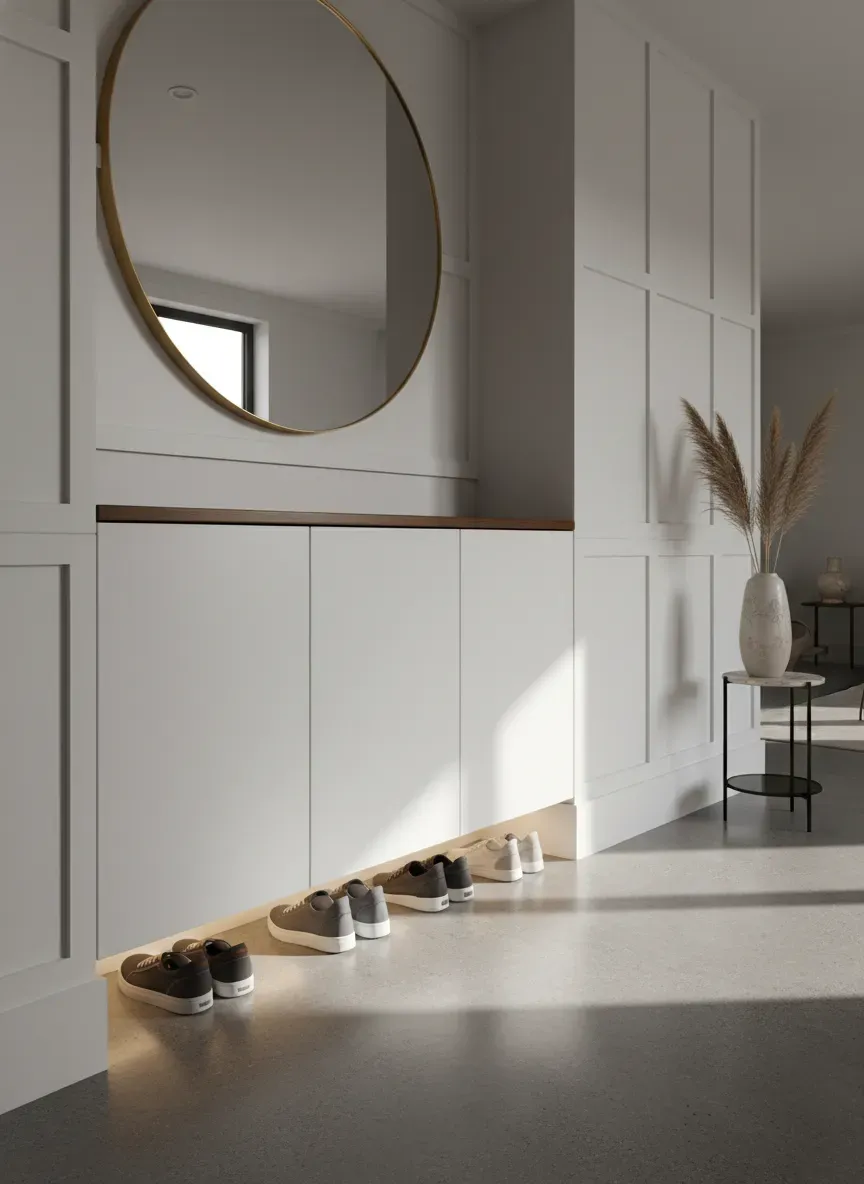
- The Floating Installation: Purchase a cabinet designed to be wall-mounted. By floating the unit six inches off the floor, you bypass the baseboard entirely. This has the added benefit of making the foyer feel larger, as the unbroken sightline of the floor extends underneath the furniture.
- The Baseboard Notch: If you are comfortable with a jigsaw, you can carefully trace the profile of your baseboard onto the side panels of the cabinet and cut away the material. This allows the unit to sit perfectly flush against the drywall.
- Adjustable Rear Legs: Some advanced units feature rear legs that are inset several inches from the back edge, allowing the cabinet body to clear the baseboard while the legs rest firmly on the floor.
Equally critical is HVAC awareness. Never place a solid-bottom shoe cabinet directly over a floor vent. You will choke the airflow to the room and subject the bottom of your cabinet to intense, direct heat, which will rapidly dry out and crack leather shoes stored inside.
Odor Management and Longevity Protocols
Buying the cabinet is only the first phase. Maintaining an enclosed environment full of worn footwear requires a deliberate chemical and environmental strategy. If you neglect this, your foyer will smell like a locker room within three months.
- Key Takeaway: Activated Charcoal is Non-Negotiable. Baking soda is an amateur solution; it absorbs moisture but does little for complex organic odors. Purchase linen bags filled with activated bamboo charcoal and drop two into the back corners of your cabinet. They passively trap odor molecules and regulate humidity. Once a month, place the bags in direct sunlight for three hours to recharge the charcoal.
- Key Takeaway: The Quarantine Zone. Never, under any circumstances, place a soaking wet shoe directly into a closed wooden cabinet. Establish a small, rubber boot tray outside the cabinet (or in the garage) as a quarantine zone. Shoes must dry for 12 hours before being granted entry into the main cabinet.
- Key Takeaway: Cedar Integration. For high-end leather dress shoes, utilize untreated cedar shoe trees. Not only do they maintain the structure of the leather and prevent vamp creasing, but the natural aromatic oils in the cedar actively neutralize the bacteria responsible for foot odor.
Seasonal Rotation: The Strategy of Archiving
A common pitfall I see is homeowners attempting to force their entire yearly footwear collection into the foyer at the same time. A foyer cabinet should operate on a strict active-duty roster.
If it is July, your insulated Sorel snow boots have no business taking up premium real estate by the front door. They are dead weight.
Implement a biannual rotation schedule. In the spring, all heavy boots and winter gear should be thoroughly cleaned, conditioned, stuffed with acid-free tissue paper to hold their shape, and migrated to secondary storage—under the bed, in the attic, or in the back of a master closet.
This frees up massive amounts of volumetric space in your foyer cabinet, allowing your daily drivers (sneakers, sandals, work shoes) to sit comfortably without being crushed against one another. It reduces friction in your morning routine and preserves the structural integrity of your footwear.
The Bottom Line on Entryway Mastery
A high-functioning foyer shoe cabinet is not a luxury; it is a structural necessity for a calm, ordered household. It represents a hard boundary against the physical and visual debris of the outside world.
Whether you opt for the aggressive spatial efficiency of a slimline tilt-out, the rugged utility of an industrial bench, or the massive capacity of an armoire, the goal remains identical: frictionless ingress and egress.
You must measure your space ruthlessly. You must prioritize ventilation. You must respect the moisture limitations of your chosen materials. If you execute on these principles, you will entirely eliminate the low-level anxiety that accompanies a cluttered threshold. You will reclaim your entryway.
Building Your Own: The Ultimate Custom Solution
Let’s face a difficult truth. Sometimes, the commercial market simply fails to accommodate the unique architectural quirks of your home. Maybe your foyer has a bizarre alcove that measures exactly 31.5 inches wide, and every cabinet you find is either 28 inches (wasting space) or 32 inches (impossible to fit). Maybe you want a specific tilt-out mechanism but refuse to settle for cheap particleboard.
When off-the-shelf solutions force you into unacceptable compromises, the only remaining path is custom fabrication. Building your own foyer shoe cabinet allows you to dictate every single millimeter of the dimensions, ensuring a flawless, built-in aesthetic. You control the wood species, the hinge quality, and the ventilation design.
Listen, I’ve personally found that the barrier to entry for custom woodworking is far lower than most people assume, provided you aren’t flying blind. You don’t need to be a master carpenter to build a beautiful, structurally sound shoe cabinet—you just need the right blueprints.
Here’s the real kicker: instead of wasting hours trying to draft your own cut lists and inevitably making expensive mistakes, you can leverage a massive archive of pre-calculated, professional designs. I strongly recommend checking out Ted’s Woodworking. It gives you immediate access to over 16,000 detailed woodworking plans, including brilliant, highly specific entryway storage solutions that you can scale to your exact hallway dimensions. Right now, they are offering a massive 75% discount on the entire database. It’s the smartest investment you can make if you want a foyer cabinet that is built to last generations, perfectly tailored to your space.