
Mastering the 2x4: How to Build High-Quality Furniture on a Budget
Discover the expert secrets to transforming cheap structural 2x4s into stunning, heirloom-quality furniture. Ditch the DIY look forever.

Mar 19, 2026 - Written by: Linda Wise
Walk down the dimensional lumber aisle of any big-box hardware store, and you’re surrounded by mountains of raw potential. Most people look at a stack of 2x4s and see the skeletal framing of a basement wall or a utilitarian garden shed. But if you know how to manipulate it, that cheap, sappy pine can become the foundation of breathtaking, heirloom-quality furniture.
I’ve spent years fighting the stigma that construction-grade lumber is exclusively for rough carpentry. The reality? The wood isn’t the problem. The methodology is. When your latest coffee table screams “cheap DIY,” it’s rarely because you used a $4 piece of framing lumber. It happens because you treated that lumber like framing material instead of treating it like fine hardwood.
Transforming a construction-grade spruce-pine-fir (SPF) board into a sleek, sophisticated piece requires a specific sequence of selection, milling, joinery, and finishing. We are going to strip away the factory-rounded edges, tame the wild moisture content, and apply finishing techniques that force the grain to behave.
Before we dive into the deep mechanics of softwood manipulation, here is a quick look at the specific gear I rely on to turn rough stock into refined furniture.
Quick Comparison: Top Picks
| Product | Rating | Check Price |
|---|---|---|
| Kreg Pocket-Hole Jig 720PRO | ⭐⭐⭐⭐⭐ | View on Amazon |
| DEWALT 20V MAX Random Orbit Sander | ⭐⭐⭐⭐½ | View on Amazon |
| Minwax Pre-Stain Wood Conditioner | ⭐⭐⭐⭐⭐ | View on Amazon |
The Anatomy of a Dimension Lumber Masterpiece
Not all 2x4s are created equal. If you grab the first ten boards off the top of the pile, your project is doomed before you even plug in your saw.
Selecting the Right Stock
The lumberyard is a battleground, and your chief adversary is water. Construction lumber is rushed from the forest to the sawmill to the retail shelf at breakneck speed. While it is technically “kiln-dried” (KD), the standard for structural lumber allows for a moisture content of up to 19%. For fine furniture, that is an ocean of water.
You need to hunt for the driest, straightest boards in the bunk. I’ve personally found that the boards resting entirely inside the stack—protected from the ambient warehouse humidity—tend to be more stable.
Look closely at the end grain. You want to avoid the “pith,” which is the dark, tiny circle indicating the dead center of the tree. Boards containing the pith are almost guaranteed to warp, twist, or cup as they dry. Instead, search for boards with tightly packed, parallel grain lines. These are effectively quarter-sawn or rift-sawn cuts hiding in plain sight. They offer incredible dimensional stability and will yield a beautiful, straight grain pattern once milled.
The Kiln-Dried Deception
Let’s talk about the physical weight of the wood. Pick up two 2x4s of the exact same length. You’ll notice that one often feels significantly heavier than the other. That extra weight isn’t denser wood fiber; it’s trapped moisture. Always select the lighter board.
When you bring this lumber home, do not immediately start cutting. This is the single biggest mistake novice builders make. The wood must acclimate to your specific shop environment. Stack the boards on a flat surface, placing small wooden spacer strips (stickers) between them to allow air circulation. Let them sit for a minimum of two weeks—ideally a month. As the moisture evaporates, the wood will move. Some boards will bow, others will twist. This is a good thing. You want the wood to throw its tantrum before you lock it into a furniture joint.
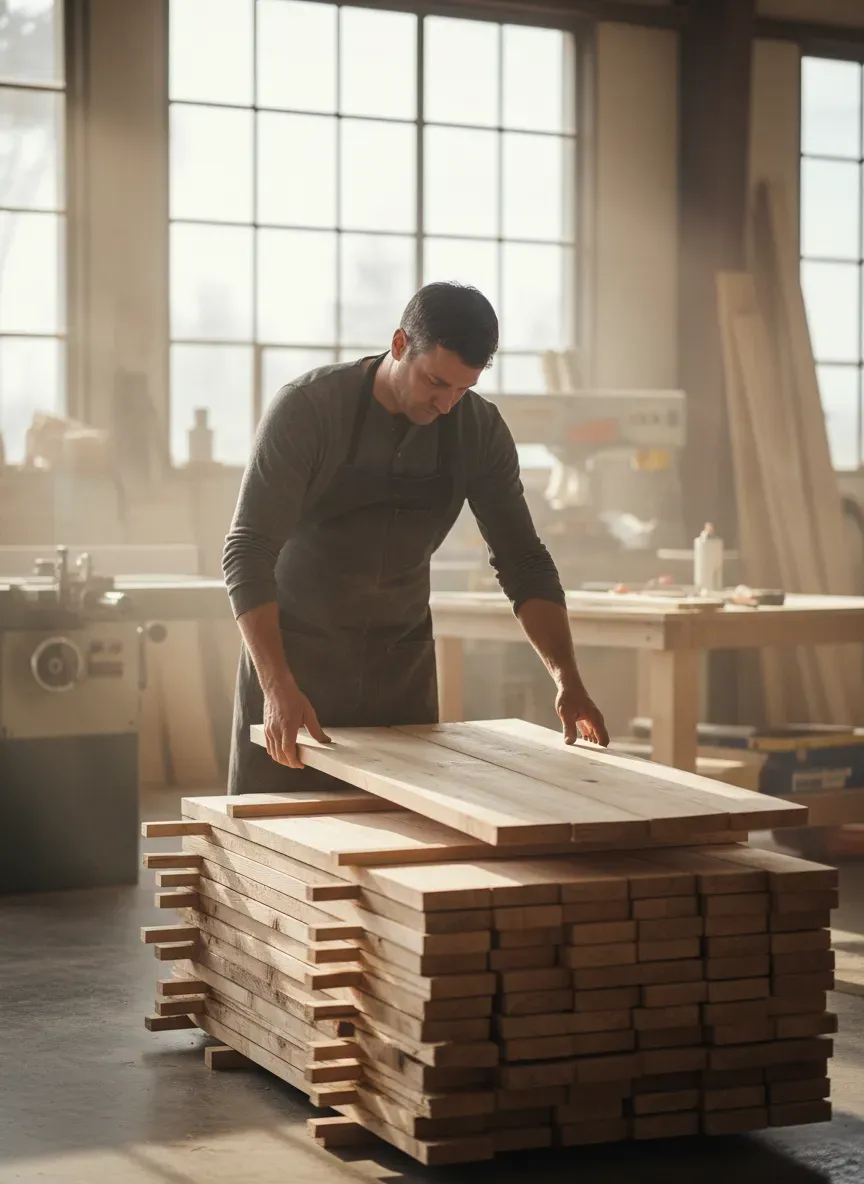
Prep Work: Transforming Framing Timber into Furniture Stock
The dead giveaway of amateur 2x4 furniture is the factory-rounded edge. Structural lumber is milled with a 1/4-inch radius on the corners to prevent splintering during rough handling. When you butt two of these rounded edges together, you create a deep, ugly V-groove that traps dust and screams “I built this in my garage in an afternoon.”
Jointing and Planing Without Heavy Machinery
To elevate your material, you must create crisp, 90-degree corners. This process, known as jointing and planing, usually requires thousands of dollars in heavy machinery. But you can achieve spectacular results with just a table saw.
Set your table saw fence to shave off precisely 1/8th of an inch from one edge of the 2x4. Run the board through, flip it, adjust the fence to 3 inches, and rip the opposite side. You now have a board that is perfectly square, measuring 1.5 inches by 3 inches. This simple step alters the entire aesthetic of the wood. The crisp lines mimic premium surfaced-four-sides (S4S) hardwood.
Pro Tip: When ripping 2x4s, the internal tension released by the cut can cause the wood to pinch the saw blade. Always use a riving knife and keep a heavy-duty push stick within arm’s reach to prevent dangerous kickback.
Dimensioning for Scale
Once your edges are squared, you need to consider the visual weight of your components. A solid 1.5” x 3” piece of pine can look incredibly chunky. For table legs, this is fantastic. For a delicate tabletop or a cabinet door frame, it’s overpowering.
Don’t be afraid to resaw your stock. By running the board through the table saw on its edge, you can slice a 2x4 into two thin panels. This allows you to create elegant, slender profiles from heavy framing lumber. When I tackled my first serious foyer build, I relied on these professional entryway storage concepts to dictate the scale of my 2x4 bench. I realized that a massive, blocky seat would overwhelm a narrow hallway, so I ripped my 2x4s down to 3/4-inch thicknesses to achieve a refined, minimalist profile.
Structural Integrity and Joinery
Softwoods like pine and fir are notoriously spongy. Their cellular structure is heavily porous, meaning they don’t hold mechanical fasteners as securely as dense woods like oak or maple. To build furniture that lasts generations, your joinery must compensate for the material’s inherent softness.
Pocket Holes vs. Traditional Joinery
For speed and efficiency, pocket hole joinery is unparalleled. Using a specialized jig—like the highly recommended Kreg Pocket-Hole Jig 720PRO—allows you to drive screws at a steep angle, pulling two boards tightly together.
However, relying solely on pocket screws in softwood can be risky for high-stress joints (like a chair leg or a bed frame). Because pine fibers compress easily, aggressive lateral force can actually cause the screw head to pull straight through the wood over time.
To prevent this, always pair your mechanical fasteners with high-quality wood glue. The glue, once cured, forms a bond that is technically stronger than the surrounding wood fibers. The pocket screws simply act as internal clamps holding the joint tight while the adhesive dries.
The Hidden Dowel Technique
If you want absolute structural dominance without the visible hardware, dowel joinery is your best friend. By drilling precise, matching holes in two adjacent boards and inserting fluted hardwood dowels coated in glue, you create an incredibly resilient joint.
The beauty of dowels in 2x4 construction is the combination of materials. The hardwood dowel acts as a rigid spine, reinforcing the softer pine. This is particularly effective when edge-gluing multiple boards together to form a wide tabletop. The dowels ensure the faces remain perfectly flush during the glue-up, drastically reducing the amount of sanding required later.

Finishing Techniques That Hide the “Pine” Look
Here is the real kicker: you can execute flawless joinery and mill your boards to perfection, but if you botch the finish, your piece will still look like cheap pine. Softwoods are wildly unpredictable when introduced to liquid stains. Because the density of the grain varies drastically between the earlywood (the light, soft part) and the latewood (the dark, hard part), liquid stain absorbs unevenly.
The result is a chaotic, blotchy, zebra-striped nightmare.
Sanding Protocols
Before a drop of finish touches the wood, your surface preparation must be clinical. I see countless DIYers grab an orbital sander, slap on an 80-grit pad, and tear into the wood, leaving behind deep, circular pigtail scratches.
You must respect the grit progression. Start with 120-grit to remove milling marks and level out any glue joints. A premium tool like the DEWALT 20V MAX Random Orbit Sander provides consistent, variable speed control, which prevents you from accidentally gouging the soft pine.
Once the surface is flat, step up to 180-grit, and finally 220-grit. Do not skip grits. The goal is to systematically replace the deep scratches of the previous sandpaper with progressively shallower ones until the surface is uniformly smooth.
Taming the Blotch: Pre-Stain Conditioners
To conquer the blotchiness of pine, you have to level the playing field. This requires chemically sealing the porous areas of the wood before applying color. A dedicated treatment, such as the Minwax Pre-Stain Wood Conditioner, acts as a barrier. It soaks into the spongy earlywood and partially blocks the pores.
When you subsequently apply your wood stain, the pigment is forced to sit evenly across the entire surface rather than plunging deep into the soft spots.
Pro Tip: For the most luxurious finish on dimensional lumber, abandon liquid penetrating stains entirely. Switch to a gel stain. Gel stains are thick, urethane-based pigments that sit on top of the wood rather than soaking in. They act almost like a translucent paint, providing rich, even color regardless of the wood’s density.
Sealing the Deal
Softwood dents easily. A dropped set of keys or a heavy coffee mug can leave a permanent impression. To protect your investment, seal your furniture with a minimum of three coats of wipe-on polyurethane.
Wipe-on poly is simply standard polyurethane thinned out with mineral spirits. It dries incredibly fast, allowing you to apply multiple thin coats in a single day. Between each coat, lightly buff the surface with #0000 steel wool or a 400-grit sanding sponge. This knocks down any microscopic dust nibs and ensures the final coat feels like glass.
Designing for the Material
You cannot force 2x4s to be something they aren’t. If you try to build a delicate, Queen Anne-style side table with cabriole legs out of construction lumber, you are going to fight the material every step of the way, and the result will look absurd.
Success requires designing furniture that naturally aligns with the physical properties of the wood.
Embracing Chunky Aesthetics
Modern farmhouse, industrial chic, and brutalist design languages are practically begging for dimensional lumber. These styles celebrate thick lines, substantial visual weight, and raw textures.
A dining table with massive 3-inch square legs (achieved by laminating two milled 2x4s together) exudes strength and permanence. Open shelving units built from thick, squared-off pine boards command attention in a room. By leaning into the inherent bulk of the material, you elevate the design from “budget hack” to intentional architecture.
Mixing Materials for High-End Appeal
One of my favorite methods for disguising the humble origins of 2x4 furniture is material contrast. Wood, by itself, is organic and warm. When you introduce cold, manufactured elements, the visual tension immediately upgrades the perceived value of the piece.
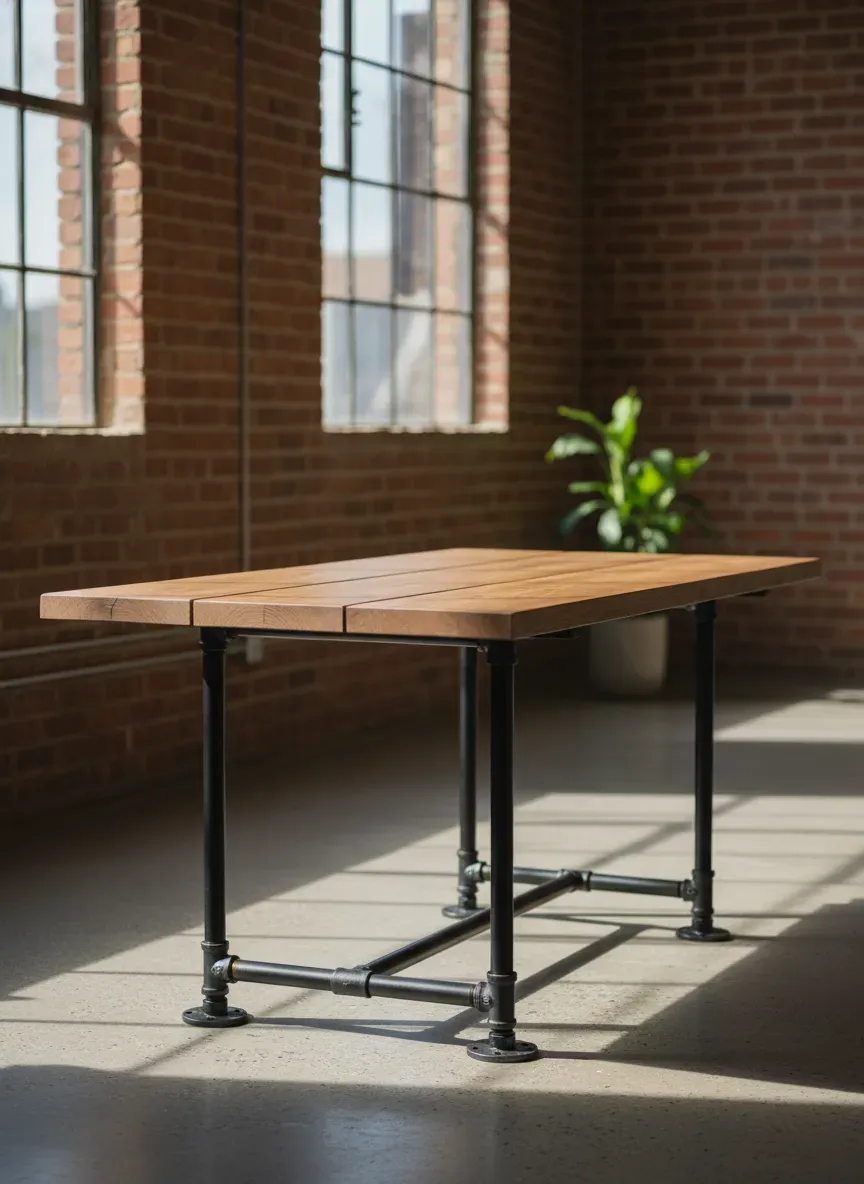
Consider building a thick, edge-glued 2x4 tabletop, staining it a rich, dark walnut color, and mounting it on heavy, black powder-coated steel hairpin legs. Or, build a solid pine credenza but outfit it with brushed brass cabinet pulls and sleek, hidden Euro-style hinges.
The human eye is drawn to these contrasts. The premium hardware tricks the brain into assuming the underlying wood is equally expensive.
Common Pitfalls and How to Dodge Them
Even with perfect milling and exquisite finishing, building with dimensional lumber presents a few unique hazards. Here are the traps that consistently ruin projects, and how to navigate around them.
The Nightmare of Movement
Wood is a hygroscopic material. It acts like a sponge, constantly absorbing and releasing moisture to reach an equilibrium with the surrounding air. Because pine is less dense than hardwood, it reacts to seasonal humidity changes rapidly.
If you tightly screw a wide, solid 2x4 tabletop directly to a rigid wooden base, you are creating a ticking time bomb. In the humid summer months, that tabletop will attempt to expand across its width. Because the screws lock it in place, the expanding wood has nowhere to go. It will eventually buckle, cup, or literally tear itself apart, splitting violently down the middle.
Always attach wide solid wood panels using figure-eight fasteners or slotted Z-clips. These ingenious little pieces of hardware secure the top to the base while allowing the wood to slide a fraction of an inch back and forth as it breathes throughout the year.
Over-Fastening
There is a psychological temptation to over-engineer softwood. Because it feels light and easily damaged, builders often compensate by driving a dozen massive lag screws into a single joint.
This actually weakens the structure. Every screw you drive severs wood fibers. If you cluster too many fasteners in a small area, you turn the wood into Swiss cheese, destroying its structural integrity. Rely on the geometry of your joinery and the chemical bond of your wood glue. A well-cut half-lap joint secured with premium wood glue and clamped tightly overnight is exponentially stronger than a butt joint held together by six heavy-duty deck screws.
Ignoring Grain Direction
When you edge-glue multiple 2x4s to create a wider panel, pay strict attention to the end grain. You will notice the growth rings curve in a specific direction. If you glue all the boards with the growth rings facing the same way, the entire panel will likely warp into a giant U-shape over time.
Alternate the direction of the growth rings (one facing up, the next facing down) across the panel. If the wood attempts to warp, the opposing forces will cancel each other out, keeping the tabletop dead flat.
The Bottom Line: Construction lumber is a blank canvas. It is unforgiving to the impatient, but infinitely rewarding to the meticulous. By properly acclimating your stock, squaring your edges, utilizing hybrid joinery, and applying finishes that respect the cellular structure of softwood, you completely rewrite the narrative of the 2x4. You stop being a DIY hobbyist nailing boards together, and you become a craftsman manipulating material.
Key Takeaways
- Never build with wet wood. Acclimate your 2x4s in your shop for at least two weeks before making the first cut.
- Shave off the factory rounded edges on a table saw to achieve the crisp, clean lines of expensive hardwood.
- Pre-stain wood conditioner is absolutely mandatory to prevent blotchy, uneven coloring when staining pine.
- Always account for seasonal wood movement by using specialized hardware rather than rigidly screwing down wide panels.
- Mix your 2x4 builds with premium elements like steel legs or brass hardware to instantly elevate the aesthetic.
If you are ready to take these techniques and apply them to real, step-by-step projects, you need a massive library of blueprints to spark your creativity. I highly recommend checking out Ted’s Woodworking. I’ve personally dug through this collection, and having access to over 16,000 meticulously detailed woodworking plans completely eliminates the guesswork of dimensioning and joinery. Whether you are building a simple entryway bench or complex shop cabinetry, these plans map out exactly what you need. Right now, you can grab the entire collection at a massive 75% discount, which is an absolute steal for the sheer volume of blueprints you receive. Grab your plans, pick up a stack of 2x4s, and start building something incredible today.