
Maximizing Entryway Storage Under the Stairs in Apartment Duplexes and Lofts
Unlock the hidden potential of your under-stair space. Expert strategies for organizing entryways in duplexes and lofts through custom shelving and smart design.
Feb 2, 2026 - Written by: linda wise

In the architectural landscape of urban living, the duplex apartment and the industrial loft stand out as coveted spaces. They offer verticality and a separation of living zones that single-floor flats cannot match. However, this vertical advantage comes with a specific challenge: the staircase. Often centrally located or immediately adjacent to the front door, the staircase consumes significant square footage. In many homes, the triangular void beneath these stairs remains an awkward, dust-gathering “dead zone.”
For the discerning homeowner or tenant, this neglected alcove represents a prime opportunity. When the staircase is positioned near the entryway, maximizing the space beneath it is not merely a storage hack; it is a design imperative. Transforming this area into a functional entryway command center can dramatically alter the flow, organization, and aesthetic appeal of your home.
This comprehensive guide explores sophisticated strategies for reclaiming the under-stair environment, tailored specifically for the unique constraints and opportunities presented by apartment duplexes and lofts.
The Architectural Assessment: Understanding Your Canvas
Before purchasing lumber or browsing for bins, one must conduct a thorough architectural assessment. The structural reality of your staircase dictates the viable storage solutions.
The Closed Stringer Staircase
Common in traditional duplexes, these staircases are boxed in with risers and plaster or drywall underneath. They create a solid, enclosed volume. The challenge here is accessibility. Without intervention, the space is a tomb. The solution usually involves structural modification—cutting into the drywall to install doors, drawers, or open shelving.
The Open Riser and Floating Staircase
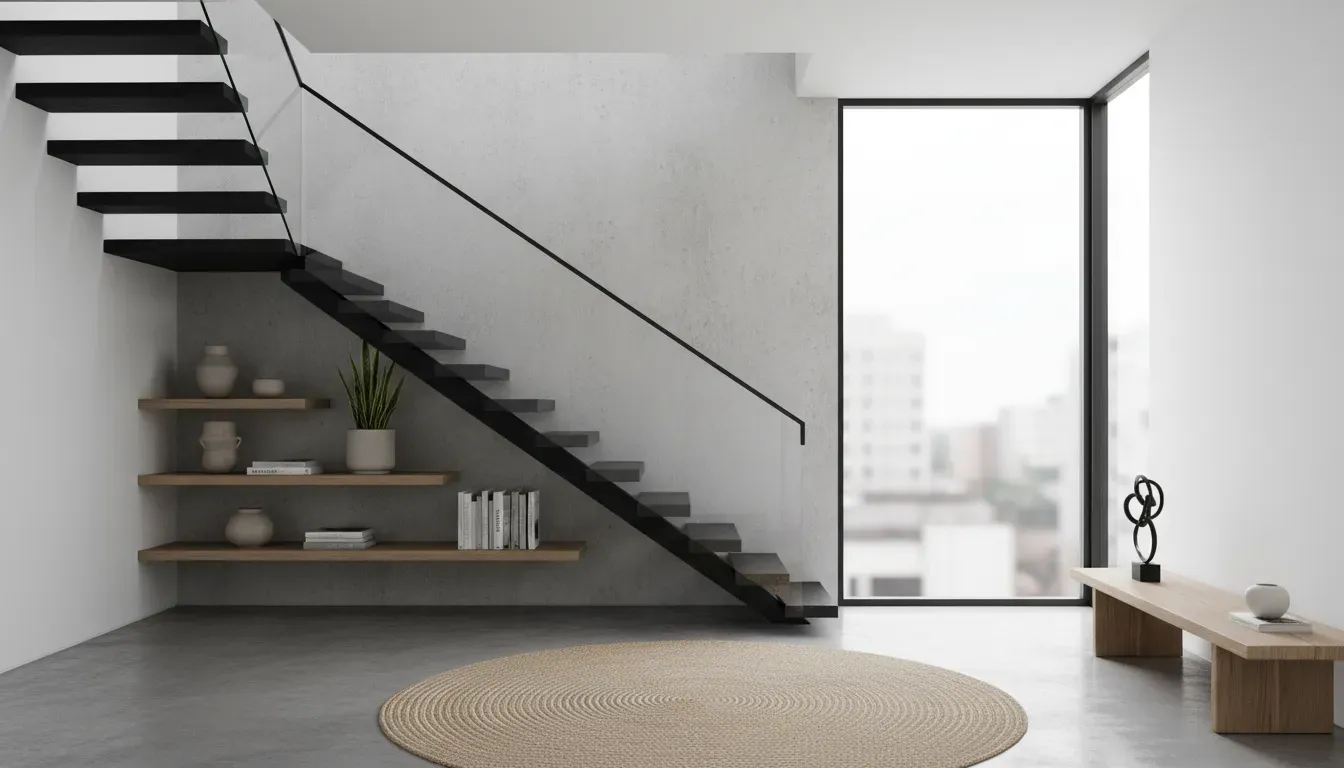
Frequently found in modern lofts, these staircases feature gaps between the steps (risers) and often lack a supporting wall underneath, relying instead on a central steel spine or side stringers. This creates a sense of visual lightness. Placing heavy, bulky storage units beneath them can ruin this aesthetic. The goal here is to integrate storage that complements the open airiness rather than blocking it.
The Spiral Staircase
Perhaps the most difficult to work with, spiral staircases are common in compact lofts. The footprint is circular, and the space beneath is limited. Here, storage solutions must be curved or extremely compact, often requiring bespoke joinery or modular units that can adapt to an irregular perimeter.
Creating the Ultimate Drop Zone
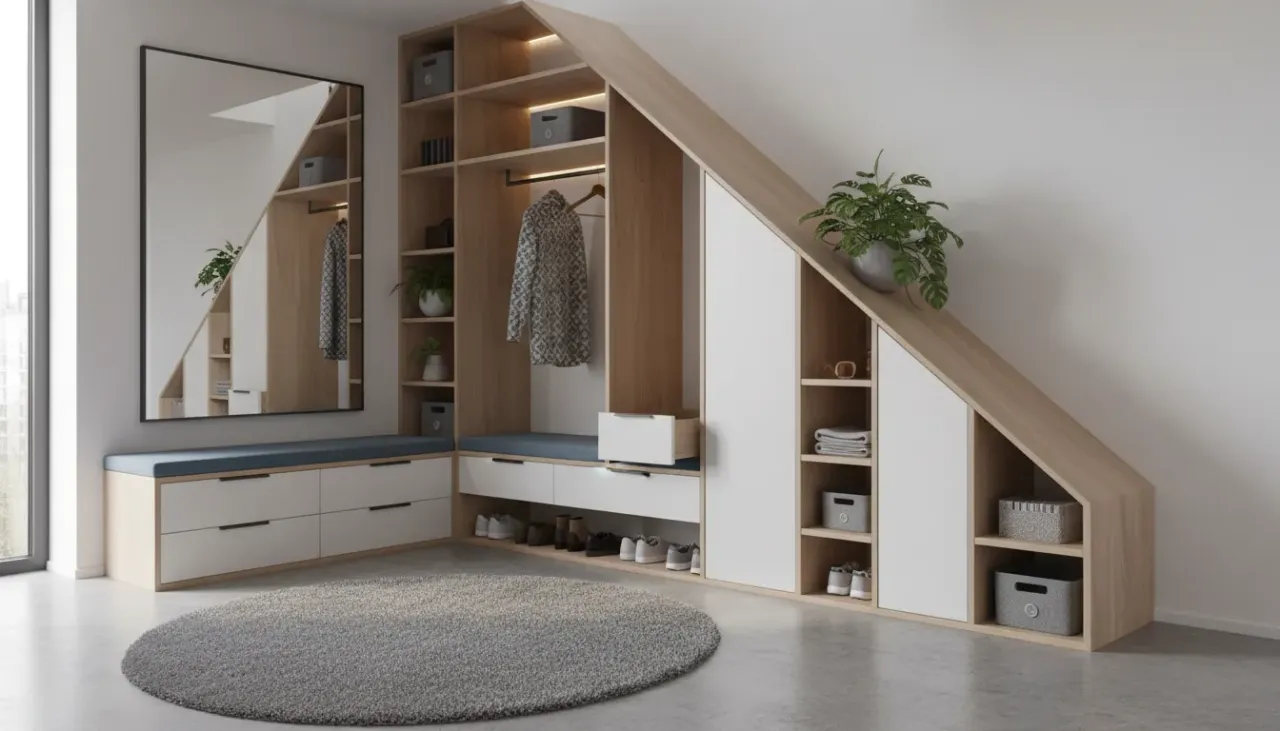
For most duplexes, the area under the stairs serves as the primary entryway. Therefore, its primary function should be that of a “mudroom,” albeit a compact one. The objective is to create a seamless transition from the chaotic outside world to the sanctuary of the home.
To achieve this, functionality must be prioritized. A drop zone requires three essential components: a place to sit, a place to hang, and a place to hide.
The Bench Integration
If the height under the stairs allows, integrating a bench is a masterstroke of utility. It provides a spot to put on shoes and creates a visual anchor. For lower sections of the slope, a built-in bench with a hinged lid offers deep storage for seasonal items like winter blankets or sports gear.
Vertical Storage: Hooks and Rails
In the taller section of the under-stair triangle, install heavy-duty hooks or a sleek rail system. This utilizes the vertical height for coats, scarves, and bags. In a loft setting with industrial aesthetics, copper piping or matte black iron rails can serve as functional art.
For those renting in a duplex where drilling into the stringer is prohibited, a freestanding hall tree that mimics the slope of the stairs can be an excellent alternative. These units often combine hooks, a bench, and shoe storage in one piece.
Recommended Product: To instantly create a drop zone without construction, consider a high-quality hall tree that fits standard ceiling heights found near stair landings. Check Price on Amazon
Custom Carpentry: The Pull-Out Solution
The most sophisticated way to handle deep under-stair space, particularly in closed staircases, is the installation of pull-out vertical drawers. Traditional cupboards with standard doors are inefficient because items get lost in the dark, tapered recesses of the back.
The Vertical Drawer System
Imagine tall, narrow units mounted on heavy-duty drawer slides that pull out perpendicular to the wall. This design brings the storage to you.
- Shoe Storage: One vertical pull-out can be dedicated entirely to shoes, with angled shelves allowing for dozens of pairs to be stored in a space just 12 inches wide.
- Coat Rack: Another unit can house a wardrobe rail. When closed, the coats are invisible, maintaining a minimalist look. When opened, the entire wardrobe slides out.
- Utility Closet: The deepest part of the triangle is ideal for storing tall items that are notoriously difficult to house in apartments, such as vacuum cleaners, ironing boards, or folding strollers.
This approach requires custom carpentry, but the return on investment is significant. It maximizes every cubic inch of the volume and adds a “wow” factor that increases property value.
Modular Solutions for Lofts
In lofts where construction might be restricted or where the aesthetic leans towards the flexible and eclectic, modular systems are superior.
Cube Organizers and Stepped Shelving
Stepped shelving units are designed to mimic the pitch of a staircase. By placing a stepped unit against the wall under the stairs, you create an “echo” of the architecture. This is particularly effective under open-riser stairs. The cubes can be left open for displaying books and art objects, or filled with uniform baskets to conceal clutter.
When selecting baskets or bins for an open entryway, material consistency is key. Whether you choose wire, felt, or wicker, ensure they are identical. This repetition calms the eye and prevents the area from looking chaotic.
Recommended Product: Uniform storage is essential for maintaining visual order in open shelving systems. Check Price on Amazon
Lighting: The Forgotten Element
The space under the stairs is inherently shadowed. Without proper illumination, even the most organized storage system becomes a black hole. Lighting serves two purposes: functional visibility and atmospheric enhancement.
Functional Illumination
If you have installed deep cupboards or a closet rod, battery-operated motion-sensor lights are indispensable. They require no hardwiring—a boon for renters—and ensure you can distinguish a navy blazer from a black one.
Atmospheric Lighting
For open shelving or glass-fronted cabinets, LED strip lighting installed along the underside of the shelves adds depth and drama. In a loft, backlighting the stairs themselves can turn the storage area into a focal point rather than a utility corner.
Recommended Product: Ensure you can see your belongings with discreet, easy-to-install lighting solutions. Check Price on Amazon
The “Hidden Office” Nook
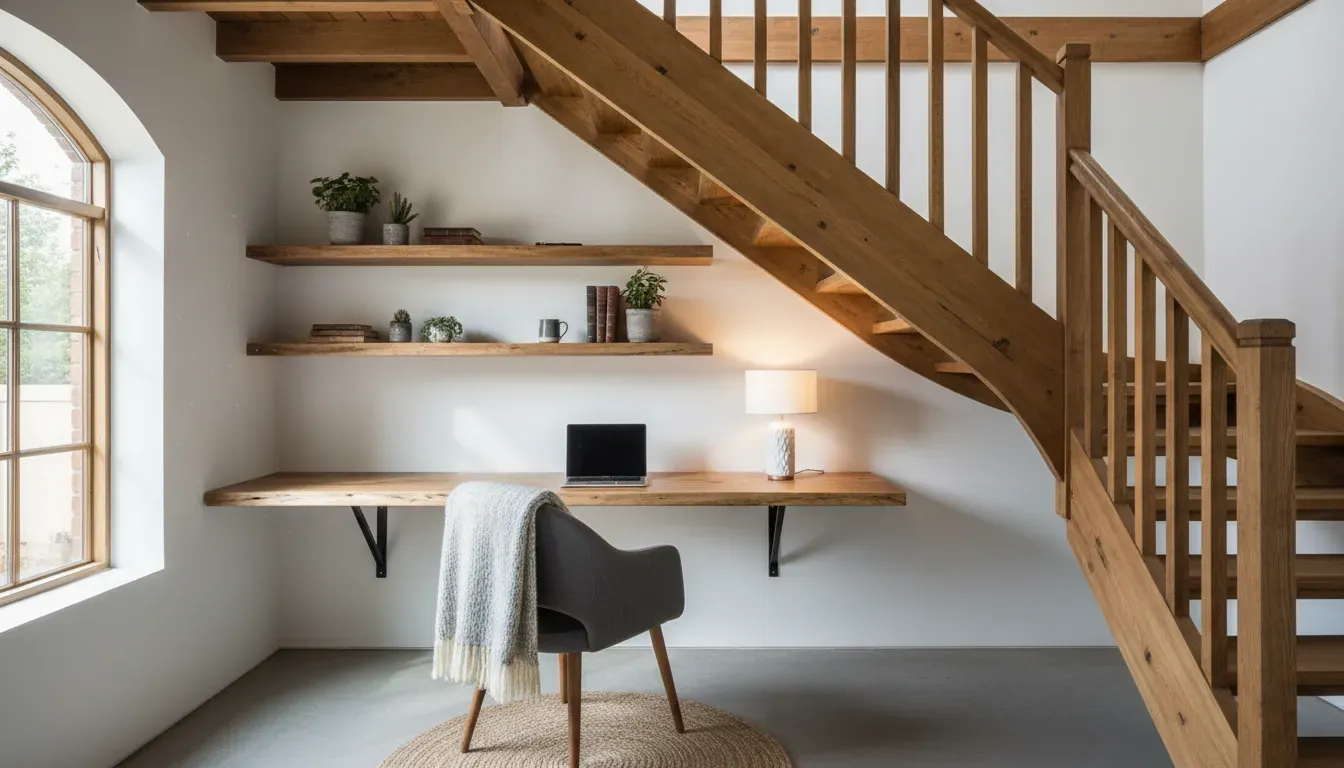
With the rise of remote work, finding space for a home office in a duplex can be challenging. If the entryway is wide enough, the under-stair area can be transformed into a “cloffice” (closet-office).
By installing a floating desk at standard table height (approximately 30 inches) in the section of the triangle that allows for headroom, you create a dedicated workspace. Upper shelves can handle filing and supplies. The key to making this work in an entryway is the ability to conceal it. Bi-fold doors or a high-quality curtain can hide the monitor and papers when guests arrive, instantly reverting the space to a hallway.
See our guide on Small Space Office Design for more detailed inspiration on integrating workspaces into transient areas.
Managing the Odd Angles
The geometry of the under-stair space is its defining feature and its greatest nuisance. The sharp angle where the stringer meets the floor is often deemed useless. However, in a tight apartment, no space should be wasted.
Custom Triangles
For the smallest corner of the triangle, consider custom-made triangular drawers or rolling bins on casters. This is the perfect location for:
- Pet Supplies: A feeding station or a hidden litter box enclosure.
- Seasonal Accessories: Umbrellas, winter boots, or rain gear.
- Recycling Center: Hidden bins for sorting paper and glass, keeping the kitchen clear.
Aesthetic Integration: Blending In vs. Standing Out
There are two distinct design philosophies when approaching under-stair storage: camouflage and contrast.
The Camouflage Approach
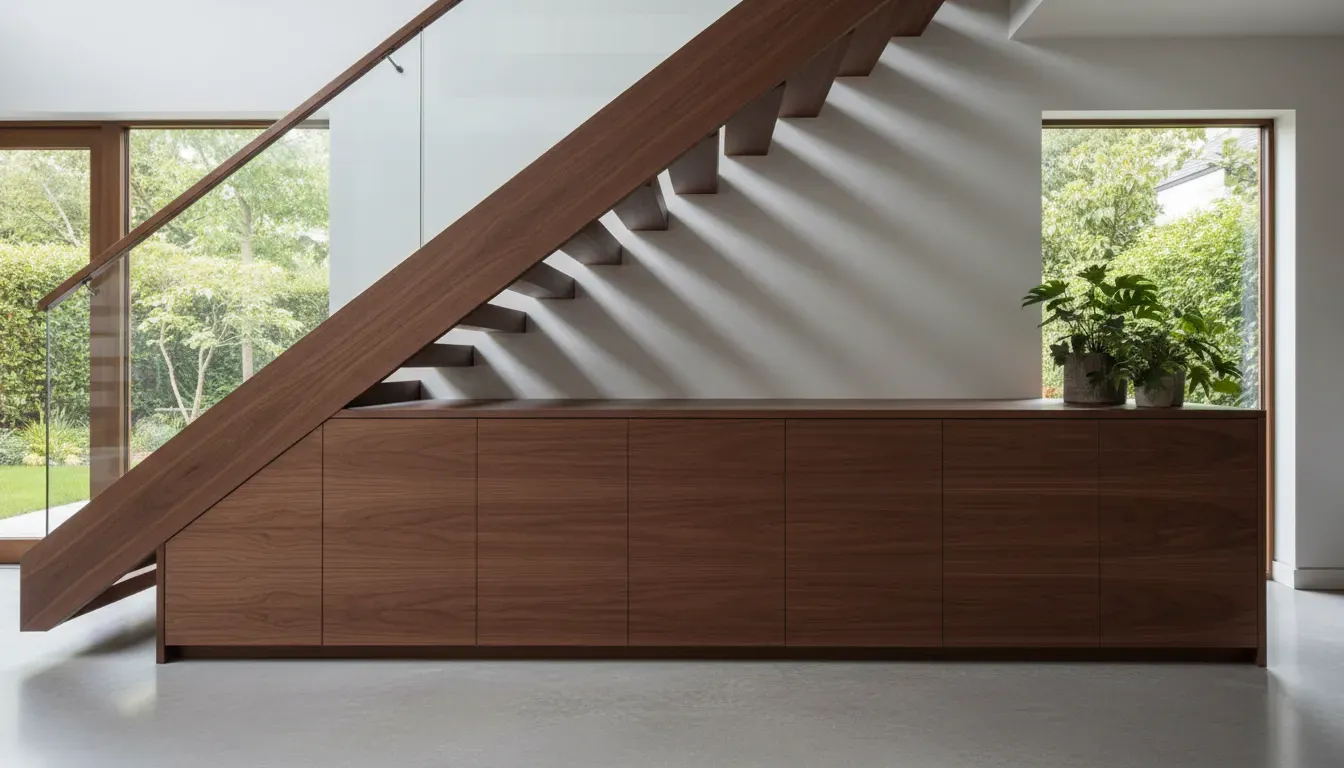
This approach aims to make the storage disappear. The doors or drawers are painted the exact same color as the surrounding walls. Hardware is push-to-open (handleless) to eliminate visual clutter. This is ideal for narrow duplex hallways where you want to maintain a sense of width and openness. By erasing the visual boundary of the storage, the hallway feels larger.
The Contrast Approach
Alternatively, one can treat the under-stair storage as a piece of furniture. Using a contrasting wood veneer (like walnut or oak) against white walls creates warmth. In industrial lofts, using metal mesh doors or distressed wood can tie the storage unit to the building’s raw materials, such as exposed brick or concrete beams.
Safety and Structural Considerations
When modifying the space under the stairs, particularly in older duplexes, one must be cognizant of what lies beneath.
- Utilities: The void under the stairs is a common route for plumbing pipes, electrical wiring, and HVAC ducts. Before cutting into drywall, use a stud finder with wire detection or consult a professional.
- Fire Safety: In many building codes, the space under a wooden staircase must be protected by fire-rated drywall if it is used for storage, to prevent a fire from accelerating up the stairs (which are the primary escape route). Do not store highly flammable chemicals (paint thinners, gasoline) in this area.
- Weight Limits: If you are hanging heavy shelving from the underside of the stairs (the stringers), ensure the staircase can support the additional load. It is generally safer to build up from the floor than to hang down from the stairs.
Specific Strategies for Narrow Duplexes
Duplexes often feature narrow, corridor-like entryways. In these scenarios, the depth of the storage is the limiting factor.
- Recessed Niches: Instead of full-depth cabinets, build shallow niches between the studs. These are perfect for keys, mail, and sunglasses.
- Angled Shoe Racks: Use shelves that tilt downward. This reduces the required depth of the cabinet to as little as 10 inches while still accommodating adult-sized shoes.
- Mirrored Doors: If enclosing the space, use mirrored door fronts. This is the oldest trick in the interior design book, but it remains effective. It doubles the perceived width of the hallway and reflects light, making a cramped entryway feel spacious.
Conclusion: Value Beyond Storage
Transforming the space under the stairs is more than a logistical exercise in fitting boxes into a triangle. It is about architectural empathy—listening to the needs of the home and the habits of its inhabitants.
In a duplex or loft, where every square foot commands a premium, the under-stair entryway storage is prime real estate. Whether you opt for the invisible sleekness of push-to-open custom cabinetry, the industrial charm of metal lockers, or the curated calm of open shelving with woven baskets, the result is the same: a home that greets you with order rather than chaos.
By maximizing this entry point, you set the tone for the rest of the residence. You move from the stress of the city into the serenity of your sanctuary, leaving the baggage—both literal and figurative—neatly tucked away beneath the stairs.
For further reading on optimizing difficult areas in your home, consider exploring our article on Vertical Storage Solutions for High Ceilings. Start looking at that “dead space” differently today; it might just be the most valuable corner of your apartment.