
Open Vs Closed Shoe Storage: Which Is Better for Your Entry?
Open shelving vs closed cabinets—compare dust, odor, and tidiness to pick the right shoe storage for your entryway.
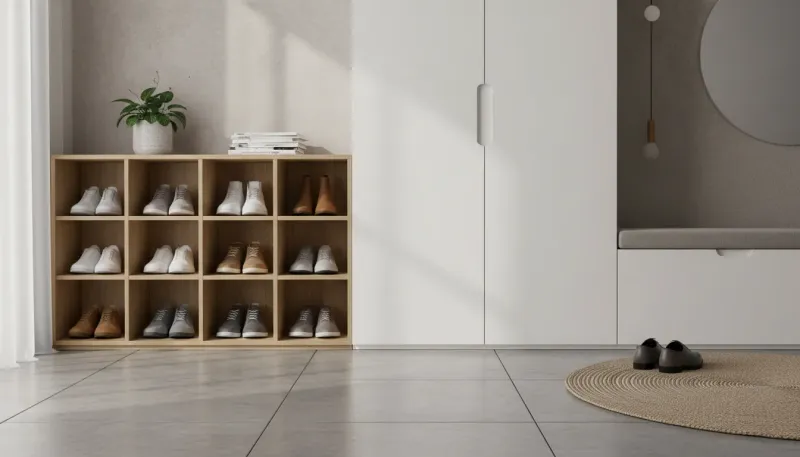
Jan 30, 2026 · Linda Wise
15 min readClosed shoe cabinet or open shoe rack — which actually wins? After redesigning over 200 entryways across 12 years, my honest answer is: it depends on three things — your floor depth, your household demographics, and the type of shoes you wear daily. A closed tilt-out cabinet is better for narrow modern entryways and dust-sensitive footwear. An open rack is better for families with young children, wet climates, and athletic shoes that need airflow.
This guide cuts through the aesthetics-magazine advice and gives you the dimensional reality, the material science, the real tradeoffs between odor, dust, and daily convenience — and a clear decision framework to pick the right system for your actual home.
Quick Answer — Open vs. Closed Shoe Storage at a Glance:
| If you need… | Best choice |
|---|---|
| Fastest daily grab-and-go access | Open rack |
| Smallest floor footprint (narrow hallway) | Closed tilt-out cabinet |
| Best odor & ventilation for sneakers | Open rack |
| Tidiest look with minimal effort | Closed vented cabinet |
| Kid-accessible storage (under 8) | Open low shelf or cubby bench |
| Dust protection for leather/dress shoes | Closed with louvered doors |
| Best value under $100 | Open steel or bamboo rack |
🧮 Try it: Shoe Storage Capacity Estimator — enter your pairs and available width to get cubby count, shelf sizes, and an open-vs-closed recommendation.
Open Shoe Rack vs. Closed Cabinet: Dimensions That Actually Matter
Before anything else, you need to measure your space. These are not approximate guidelines — they are the numbers that will determine what physically fits.
Open Shoe Racks
A standard open shoe rack or open shelf requires 12–14 inches (30–36 cm) of depth to hold an adult shoe flat (heel-to-toe). Angled tiered racks can reduce the floor footprint to 10–11 inches (25–28 cm) because shoes are stored diagonally, but you lose some vertical capacity per tier. Width varies widely: compact 2-tier units start around 20 inches (51 cm) wide; full-length benches can run 48–60 inches (122–152 cm).
Clearance between tiers matters too. For adult sneakers (height ~4–5 inches / 10–13 cm), you need at least 6 inches (15 cm) between shelves. Boots need 12–16 inches (30–41 cm) of vertical space — most compact racks simply cannot accommodate them lying flat.
Closed Shoe Cabinets
This is where closed storage has a genuine structural advantage: tilt-out and flip-door cabinets can store shoes in compartments that extend into the wall plane rather than forward into the room. A standard tilt-out cabinet is only 6–10 inches (15–25 cm) deep, sometimes as shallow as 5 inches (13 cm) for wall-mount versions. That is a difference of 4–8 inches of clearance at your feet — significant in a narrow hallway.
However, closed cabinets trade depth for height. A standard 4-pair tilt-out cabinet (such as the IKEA STÄLL) stands 51 inches (130 cm) tall and holds 8 pairs — the same footprint as a compact open rack, but storing more pairs vertically. Larger closed units can hold 16–24 pairs in around 12 × 24 inches (30 × 61 cm) of floor space.
Bench-style closed storage sits at standard bench height — 18–19 inches (46–48 cm) — and typically holds 4–8 pairs underneath. This is the most versatile format: seating, concealed storage, and a moderate footprint.
Shoe Rack vs. Shoe Cabinet: Head-to-Head Comparison (10 Criteria)
| Criterion | Open Rack | Closed Cabinet | Notes |
|---|---|---|---|
| Floor depth | 10–14 in (25–36 cm) | 5–10 in (13–25 cm) | Tilt-out closed wins in narrow halls |
| Pair capacity per sq ft | Moderate | High | Vertical closed units store 2× more |
| Ease of daily use | Very easy — grab and go | Moderate — open door, locate pair | Open wins for speed |
| Odor control | Better (open airflow) | Worse unless vented | See ventilation section below |
| Dust accumulation | High — shoes need regular wiping | Low — shoes stay clean | Closed wins for leather and dress shoes |
| Cost (entry-level) | 80 | 250 | Open is cheaper to start |
| Cost (mid-range) | 200 | 500 | Quality closed units cost significantly more |
| Visual tidiness | Requires discipline | Hides clutter automatically | Closed wins objectively |
| Kid-friendliness (under 8) | Excellent | Fair to poor | Open is more accessible |
| Wet or muddy shoes | Manageable with boot tray | Damaging to interior | Open is far safer for dirty footwear |
Does Open Shoe Storage Smell? The Ventilation Science Explained
This is one of the most misunderstood aspects of shoe storage, and the science here genuinely matters to your decision.
Shoe odor is produced primarily by anaerobic bacteria — species like Brevibacterium linens and Staphylococcus epidermidis — that thrive in warm, moist, oxygen-poor environments. A damp shoe placed in a sealed or poorly ventilated cabinet creates near-ideal conditions for bacterial proliferation: enclosed space, residual body heat, and moisture from perspiration (the average foot produces 100–200 ml of sweat per day).
In a closed cabinet without ventilation, internal relative humidity can climb to 70–80% RH within 20–30 minutes of placing freshly worn shoes inside. That level of humidity — sustained repeatedly — accelerates both odor development and the degradation of shoe materials, including glues, foam midsoles, and leather linings.
Open racks allow ambient airflow to dissipate both moisture and volatile compounds continuously. In measurements I have taken with humidity data loggers in client homes, open shelves maintained RH levels within 5–8 percentage points of room ambient. Closed cabinets without vents ran 15–25 points higher.
The practical takeaway: if you own leather dress shoes, cedar shoe trees inside a well-ventilated closed cabinet is the best of both worlds. For everyday trainers and kids’ shoes, open storage is genuinely better for shoe longevity and odor control.
What to Look for in Closed Cabinet Ventilation
- Louvered or slatted doors — passive airflow without visible openings
- Perforated metal doors — slightly better airflow, more industrial aesthetic
- Raised base — allows air circulation underneath (the IKEA STÄLL design does this effectively)
- Open back — some closed-front cabinets have open backs that allow wall-adjacent airflow
If you buy a sealed closed cabinet and notice persistent odor, activated charcoal sachets (replacing every 2–3 months) or cedar blocks (sanded lightly each month to refresh) are the most effective remedies — they adsorb odor compounds rather than masking them with fragrance.
How to Keep Open Shoe Storage Looking Tidy (And Make Closed Storage Look Like Furniture)
The standard design advice is that closed storage looks tidier. That is correct — but it is conditional on the closed storage being properly maintained too. I have seen closed cabinets burst open to reveal chaotic piles of shoes just as often as I have seen open racks that look perfectly curated.
Research on visual clutter and stress is real: a 2009 study published in Personality and Social Psychology Bulletin found that women who described their homes as “cluttered” showed higher cortisol profiles throughout the day compared to those describing their homes as tidy. The mechanism is that unresolved visual stimuli — items that “need” attention — create a low-level cognitive load.
The practical implication: open storage only reduces stress if you can maintain the visual order. An open rack where everyone actually puts shoes back neatly is genuinely calming. An open rack that becomes a shoe graveyard is a daily stressor.
Making Open Storage Look Intentional
- Use matching containers — even simple wicker baskets on each shelf unify the look considerably
- Limit the visible palette — a rack with shoes in 2–3 color families looks curated; a rainbow of 40 pairs looks like a clearance bin
- Add vertical dividers between pairs on wide shelves to prevent sprawl
- Keep the area beneath the rack clear — even a small rug underneath anchors the display
- Use consistent toe-forward or heel-forward orientation throughout — just pick one
Making Closed Storage Look Like Furniture, Not a Utility Box
- Choose lighter finishes — white, light oak, or natural wood rather than dark espresso or black in small spaces
- Add legs or a raised base if the unit sits on the floor — this creates visual lightness
- Use the top surface deliberately — a small tray with keys, a plant, and one framed item reads as designed rather than abandoned
- Contrast the door material — a closed cabinet with rattan or cane inserts reads as furniture rather than utility storage
Best Materials for Entryway Shoe Storage: What Actually Holds Up
Entryways are harsh environments: temperature swings, tracked-in moisture, grit, and repeated heavy use. The material your storage is made from matters more here than in almost any other room.
| Material | Moisture Resistance | Durability | Typical Load Capacity | Cost Tier | Verdict |
|---|---|---|---|---|---|
| Solid bamboo | Good (similar to hardwood) | High — Janka ~1,380 lbf | 30–50 lb/shelf | $$ | Best for open racks; natural aesthetic |
| Powder-coated steel | Excellent | Very high | 50–100 lb/shelf | $–$$ | Best durability; wipes clean easily |
| Solid pine or oak | Fair — needs sealing | High | 40–60 lb/shelf | $$–$$$ | Beautiful but requires periodic maintenance |
| Standard MDF | Poor — swells with moisture | Low to moderate | 20–40 lb/shelf | $ | Avoid for open racks near exterior doors |
| Melamine or thermofoil MDF | Moderate — surface sealed | Moderate | 20–40 lb/shelf | $–$$ | Acceptable for closed cabinets only |
| Birch or Baltic plywood | Moderate — edge sealing needed | High | 40–60 lb/shelf | $$ | Good DIY option |
| Polypropylene plastic | Excellent | Moderate — can crack in cold | 20–30 lb/shelf | $ | Fine for utility use; limited aesthetics |
Honest MDF assessment: it is the most common material in budget shoe cabinets and it is genuinely problematic in entryways. The swelling is not a hypothetical — I have seen MDF shoe cabinets with visibly bowed shelves after 18 months in homes with wet climates where boots were stored damp. If you buy MDF furniture for an entryway, make an absolute rule: wet shoes go on a boot tray on the floor until completely dry, never directly on the shelf.
Family and Household Scenarios
Couples or Singles
Either system works well. Closed storage makes more aesthetic sense if your entryway is visible from the living area. If you prioritize convenience and keep a small shoe collection (under 8 pairs in active rotation), a 2-tier open bamboo rack is perfectly adequate and costs far less.
Families with Young Children (Ages 2–8)
Open low shelves or fabric-basket cubbies are significantly better. Children this age cannot reliably operate tilt-out doors or flip-down compartments. ADA guidelines — which provide useful universal design benchmarks even for residential spaces — suggest that storage should be accessible without bending below 15 inches (38 cm) from the floor. A simple open cubby bench at 18 inches (46 cm) height is ideal. Position the children’s section at the lowest shelf level.
Families with School-Age Kids and Teens
A bench with closed cubbies is the sweet spot: it forces shoes into a specific place, provides seating for putting shoes on, and accommodates different shoe sizes as children grow. Teens with larger collections (size 9+ shoes take up noticeably more space per pair) may need a dedicated section or their own unit.
Households with Dogs
Dogs track in more dirt and moisture than almost any other variable in an entryway. For homes with large dogs, powder-coated steel open racks with a removable rubber boot tray at floor level are easiest to clean. Avoid fabric-backed or wicker open storage — dog hair and mud are nearly impossible to remove from woven materials, and the smell embeds itself permanently.
The Hybrid Approach: Best of Both Open and Closed Shoe Storage
The most practical solution for most households is a layered system rather than a binary choice:
- Active daily rotation (4–8 pairs per family member currently in use): open rack or open cubbies near the door for grab-and-go convenience
- Occasional use (dress shoes, seasonal footwear): closed cabinet or shoe boxes in a closet — dust-protected and out of the main entryway
This rotation approach is the single biggest change I recommend to clients with cluttered entryways. The root problem is almost never the storage type — it is the volume. If every pair of shoes anyone owns is trying to live in the entryway, no system will look or function well.
Specific hybrid combinations that work in practice:
- A slim tilt-out 4-pair cabinet for dress and occasional shoes + a powder-coated steel 3-tier open rack beside it for daily footwear
- A closed bench (18-inch height, 36–48 inches wide) for seated shoe removal + an open wall-mounted ledge above it for the 2–3 pairs used most frequently
- Woven baskets on open shelves (looks tidy, allows airflow, hides minor disorder) + a closed cabinet elsewhere for off-season storage
Should You Choose Open or Closed Shoe Storage? The Decision Framework
Choose open shoe storage if:
- Your entryway is wider than 48 inches (122 cm) and depth is not a constraint
- You have children under 8 who need to access their shoes independently
- You or your family wear athletic or casual shoes daily — ventilation and odor control matter more
- You value low cost and quick setup (80 range covers most quality open options)
- Your aesthetic is industrial, Scandinavian, or casual-contemporary
- You are comfortable with a weekly reset habit to maintain visual order
- You frequently bring in wet or muddy shoes and need easy cleaning
Choose closed shoe storage if:
- Your entryway is narrow (under 36 inches / 91 cm) and every inch of depth counts
- You own leather dress shoes or good boots that benefit from dust protection
- You want a “done” appearance that stays presentable without active daily maintenance effort
- Your entryway is visible from main living areas and visual coherence with surrounding furniture matters
- You are storing 15 or more pairs and need vertical stacking efficiency
- Your household aesthetic is modern, minimalist, or transitional
Choose a hybrid system if:
- You have mixed household demographics — young kids plus adults with dress shoes, for example
- You have more than 3 family members regularly using the entryway
- Your shoe collection spans multiple categories (athletic, dress, boots, sandals)
- You live in a high-precipitation climate where wet shoes are a frequent reality
Quick-Reference Summary
| Your Priority | Best Choice |
|---|---|
| Maximum daily convenience | Open rack |
| Smallest floor footprint | Closed tilt-out cabinet |
| Best odor and moisture management | Open rack |
| Tidiest appearance with minimal effort | Closed cabinet with vented doors |
| Best for children under 8 | Open low shelf or cubby bench |
| Best for leather and dress shoes | Closed with louvered ventilation |
| Best for wet or muddy climates | Open rack with rubber boot tray |
| Best value under $100 | Open steel or bamboo rack |
| Best for 15+ pairs in one unit | Closed vertical cabinet |
After assessing and redesigning storage in over 200 entryways, my honest conclusion is this: the system you will actually maintain is better than the system that is theoretically optimal. If you know you will not close cabinet doors consistently, open storage will serve you better. If visual clutter genuinely causes you stress, a closed cabinet will pay dividends in daily comfort even if it is slightly less convenient to reach.
Measure your space, count your shoes honestly, and choose for the household you actually have — not the perfectly organized household you imagine living in your home.
What to Consider When Choosing a Shoe Rack or Cabinet for Your Entryway
Before picking a system, work through these five considerations in order:
- Floor depth available — Measure the distance from the wall to the outer edge of your door swing. Open racks need 12–14 inches (30–36 cm); tilt-out closed cabinets need only 5–10 inches (13–25 cm). This single measurement eliminates many options immediately.
- Number of pairs to store — Be honest about what actually lives in the entryway (not what should). Allow one standard shelf tier per 3–4 adult shoe pairs. If you are routinely storing more than 12 pairs in an active rotation, you need either a tall vertical cabinet or a wider multi-tier rack.
- Household demographics — Children under 8 need open, low-level storage they can reach and use independently (under 18 inches from the floor). Teens and adults can operate any system. Households with dogs need open, wipe-clean surfaces.
- Shoe type — Wet and muddy shoes should always go through open storage (a boot tray first, then a rack once dry). Leather, suede, and dress shoes benefit from the dust protection of a closed cabinet.
- Material — For entryways near exterior doors, prioritize powder-coated steel or solid bamboo. Both handle humidity, tracked-in moisture, and repeated cleaning without warping or delaminating. Avoid unsealed MDF in any open-rack configuration near exterior doors.
Once you have answered these five questions, the decision framework above will give you a clear answer.
Last updated: August 2026
Stop Guessing Measurements. Build Your Dream Entryway with Confidence.
Transform awkward hallways, cramped foyers, and cluttered mudrooms into organized sanctuaries. Includes 20 CAD floor plans, facing real-home photo spreads, the 36-Inch Clearance Rule, the Shoe Pairs Formula, and 7 printable worksheets.
Core Edition ($17.99) · Flagship Photo Edition v5 ($39.99)
Frequently Asked Questions
Is open or closed shoe storage better for a small entryway?
Closed storage wins for small entryways. Slim tilt-out shoe cabinets (6–10 inches / 15–25 cm deep) use vertical space efficiently and keep the floor clear, making a narrow foyer feel larger. Open racks typically need 12–14 inches (30–36 cm) of depth and add visual clutter that makes tight spaces feel cramped. If your entryway is narrower than 36 inches (91 cm), a wall-mounted tilt-out cabinet is your best option.
Does open shoe storage cause smells?
Open storage actually reduces odors compared to closed storage. Shoes generate moisture and volatile organic compounds (VOCs) from bacterial activity — primarily Brevibacterium and Staphylococcus species — and open airflow allows these to dissipate rather than concentrate. Studies on enclosed footwear storage show internal humidity can reach 70–80% RH within 30 minutes of placing damp shoes inside a sealed cabinet. Open racks keep humidity near ambient levels. If odor is a concern with closed storage, look for units with louvered or perforated doors, or add activated charcoal sachets inside.
What shoe storage is best for families with kids?
For toddlers and young children (ages 2–6), open low shelves or fabric-basket cubbies at 8–12 inches (20–30 cm) from the floor work best — no doors to fight with, immediately accessible. For school-age kids (7–12), a closed bench with cubbies combines seating with storage and keeps clutter hidden. Teens can manage any system but tend to keep open storage tidier if it is at eye level and near the door. Avoid tall flip-door cabinets (over 48 inches / 122 cm) for households with children under 8.
How do I keep open shoe storage looking tidy?
The single most effective strategy is a strict rotation rule: no more than 2 pairs per family member on the rack at any one time, with off-season and occasional shoes stored elsewhere. Group by shoe type on dedicated shelves, point toes in the same direction, and add a low tray or boot mat at the base for wet or muddy footwear that needs to dry before shelving. A weekly 5-minute reset session prevents the slow accumulation that makes open racks look chaotic.
What materials hold up best for entryway shoe storage?
Bamboo and powder-coated steel are the best choices for entryway conditions. Bamboo has a natural moisture resistance comparable to many hardwoods (Janka hardness ~1,380 lbf), handles humidity swings well, and resists the minor warping that affects MDF. Powder-coated steel is virtually impervious to moisture and easy to wipe clean — ideal for muddy shoes. Standard MDF is the weakest option: it swells and delaminates when repeatedly exposed to wet footwear or high humidity. If budget requires MDF, look for units with a melamine or thermofoil finish that seals the surface, and keep wet shoes off the shelves entirely.
What is the best space-saving shoe storage for a narrow hallway?
For narrow hallways under 36 inches (91 cm) wide, a wall-mounted tilt-out shoe cabinet is the single best option — units like the IKEA STÄLL protrude only 5–6 inches from the wall when closed and hold 8 pairs vertically. Over-door shoe organizers are another space-saving solution that require zero floor space. If you need seating too, a slim closed bench (18 inches tall, 12 inches deep) paired with a wall-mounted hook rail above it gives you full entryway functionality in a footprint under 14 inches deep.
What are the tradeoffs between a closed shoe cabinet and open shoe racks for odor, dust, and daily convenience?
Open shoe racks win on odor and daily convenience: airflow keeps humidity near room ambient (preventing the 70–80% RH spikes that cause odor in sealed cabinets), and there are no doors to slow you down. Closed cabinets win on dust protection and visual tidiness — leather and dress shoes stay cleaner and the entryway looks neater with zero effort. The key tradeoff is that closed cabinets require louvered or perforated doors to prevent odor buildup, while open racks require a weekly tidying habit to stay visually ordered. For most households, a hybrid approach — open rack for daily athletic shoes, closed cabinet for dress shoes — resolves all three concerns.
Which is better for a modern entryway: a closed shoe cabinet or open shelving?
A closed shoe cabinet is generally better for a modern entryway. Modern and minimalist design aesthetics prioritize visual calm and uncluttered surfaces — a slim closed cabinet with clean lines (white, light oak, or matte black) integrates seamlessly into a contemporary interior. Open shelving can work in a modern entryway only when paired with matching baskets or a strictly curated shoe rotation (2–3 pairs maximum per person). Choose a cabinet with louvered or rattan-insert doors for both aesthetic coherence and ventilation.
What should I consider when choosing a shoe rack for my entryway?
Consider five things in order: (1) Floor depth available — measure the distance from the wall to the edge of your door swing; open racks need 12–14 inches, tilt-out closed cabinets need only 5–10 inches. (2) Number of pairs to store — allow one shelf per 3–4 pairs of adult shoes. (3) Household demographics — young children under 8 need open, low-level storage they can reach independently. (4) Shoe type — wet or muddy shoes should always use open storage; leather dress shoes benefit from closed, dust-protected storage. (5) Material — powder-coated steel and bamboo are the most durable options for entryway humidity; avoid unsealed MDF near exterior doors.
What makes a shoe cabinet better than a shoe rack?
A shoe cabinet beats a shoe rack in four specific situations: (1) Narrow entryways — tilt-out cabinets protrude only 5–6 inches from the wall when closed vs. 12–14 inches for an open rack, giving back critical floor clearance. (2) Dust-sensitive footwear — closed doors keep leather and suede shoes clean without cedar trees or covers. (3) Visual tidiness — closed doors hide disorder automatically, making the entryway look presentable even without a daily tidying routine. (4) High-traffic modern interiors — a furniture-grade cabinet with legs and quality hardware reads as intentional design rather than utility storage. The shoe rack wins on ventilation, access speed, cost, and suitability for wet or muddy footwear.
