
Scandinavian Mudroom Inspiration: Light Birch Designs for a Nordic Entryway
Discover how to transform your entryway with Scandinavian light birch designs. Master Nordic minimalism, spatial layouts, and functional mudroom aesthetics.
Apr 1, 2026 - Written by: Linda Wise

The entryway is a psychological airlock. It’s the transitional membrane between the chaotic, demanding outside world and the sanctuary of your home. When we look at Scandinavian mudroom inspiration—specifically leaning into light birch designs for a Nordic entryway—we aren’t just talking about aesthetics. We are talking about engineering a daily reset button.
I’ve personally found that the traditional American mudroom often devolves into a dark, heavy drop-zone cluttered with damp coats and a mountain of mismatched shoes. The Nordic approach flips this entirely. By leveraging the luminous, pale tones of birch wood, crisp minimalist lines, and an obsession with hyper-functional storage, you can build an entryway that actively lowers your blood pressure the moment you cross the threshold.
If you are planning an overhaul of your entry space, you need the right components. Before we get into the deep architecture of birch woodworking and spatial design, here is a breakdown of the foundational pieces that can instantly inject that Scandinavian ethos into your home.
Quick Comparison: Top Picks
The Anatomy of a Nordic Airlock
Scandinavian design is born out of necessity. In regions where winter plunges the landscape into darkness for the majority of the day, interior spaces must aggressively capture and amplify whatever light is available. This is the exact reason why light birch designs for a Nordic entryway are so historically prevalent.
Birch (Betula pendula or Silver Birch in European contexts) possesses a tight, closed-grain structure. Unlike the heavy, porous grain of oak or the deep, light-swallowing richness of walnut, birch acts almost like a subtle mirror. Its pale, creamy sapwood reflects ambient light, making cramped, windowless mudrooms feel expansive.
But it isn’t just about brightness. The Nordic mudroom is rooted in Hygge (comfort and coziness) intertwined with Lagom (just the right amount). You’ll notice that true Scandinavian spaces never feel sterile. They achieve a delicate tension between the rigid, mathematical geometry of the built-in cabinetry and the organic, tactile warmth of the wood itself.
Material Deep Dive: Why Light Birch Dominates
When selecting materials for a mudroom build, durability is just as vital as aesthetics. A mudroom takes a brutal beating. Heavy boots, wet umbrellas, abrasive sand, and frozen winter gear assault these surfaces daily.
Birch hits the sweet spot. With a Janka hardness rating of around 1,260 lbf (for Yellow Birch), it is remarkably resilient against dents and scratches—significantly harder than pine or alder, which are often mistakenly used in cheaper mudroom builds.
Solid Birch vs. Baltic Birch Plywood
Here’s the real kicker: if you are building custom mudroom lockers, you probably shouldn’t use solid birch lumber for the cabinet carcasses.
Solid wood moves. It expands and contracts with the wild humidity swings typical of a mudroom environment. Instead, high-grade Baltic Birch plywood is the industry gold standard. Constructed from multiple layers of solid birch veneer cross-banded together, it offers unmatched dimensional stability. The exposed edges of Baltic birch are so visually appealing that modern Nordic designers often leave them uncovered, celebrating the striped, structural aesthetic of the plies rather than hiding them behind edge-banding.
Pro Tip: If you want the authentic Scandinavian look, request “B/BB grade” Baltic Birch. This ensures the face veneer is a single, continuous piece of light, uniform wood with no patches, providing that flawless, minimalist canvas.
Spatial Calculus: Blueprinting the Entryway
The success of a mudroom lies entirely in its spatial geometry. You can use the most expensive Scandinavian timber on earth, but if the layout is cramped, the space will fail.
Micro-mudrooms require surgical precision. If you are dealing with a severely constrained footprint, you have to prioritize verticality. Taking your birch cabinetry all the way to the ceiling draws the eye upward, faking architectural volume while maximizing storage for out-of-season gear. For a comprehensive look at maximizing these tight footprints, I highly recommend consulting a detailed 5x6 mudroom guide to making the most of small spaces, which breaks down the exact millimeter clearances needed for maneuverability.
The Geometry of Storage
Nordic design dictates that everything has a specific, designated home. The human brain interprets visual noise—like a jumble of coats overlapping on a single peg—as stress.
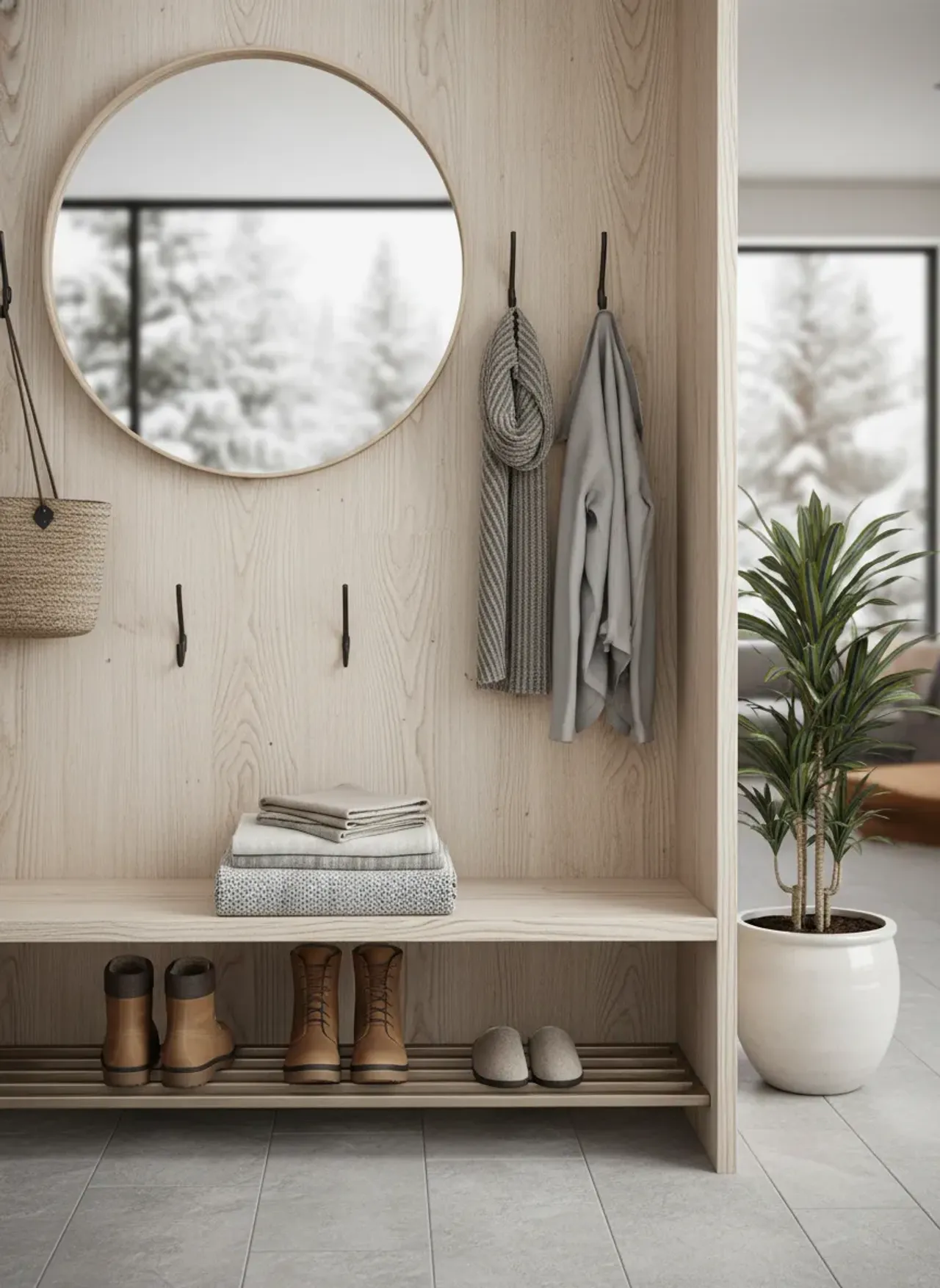
To prevent this, you need to understand ergonomic affordances. Bench seating should sit precisely at 18 inches off the floor. This allows the average adult to sit and tie their shoes comfortably without blowing out their knees. Above the bench, the paneling (often vertical birch slats to create texture) should rise to host your coat hooks.
But how do you position those hooks? Cramming them together ruins the minimalist aesthetic and prevents damp coats from drying. Figuring out the ideal spacing: how far apart should coat hooks be is critical. A standard rule of thumb for bulky winter parkas is a minimum of 8 to 12 inches between hook centers. For a lighter, summer-weight Nordic setup, you can tighten this to 6 inches, but never closer.
Curating the Storage Arsenal
A well-designed Scandinavian mudroom operates on the 80/20 rule of visibility: 80% of your items should be hidden behind clean, flat-panel birch doors, while 20% of beautifully curated, frequently used items remain visible.
The Built-in Bench
The birch bench is the anchor of the Nordic entryway. It serves as both the visual focal point and the primary functional zone.
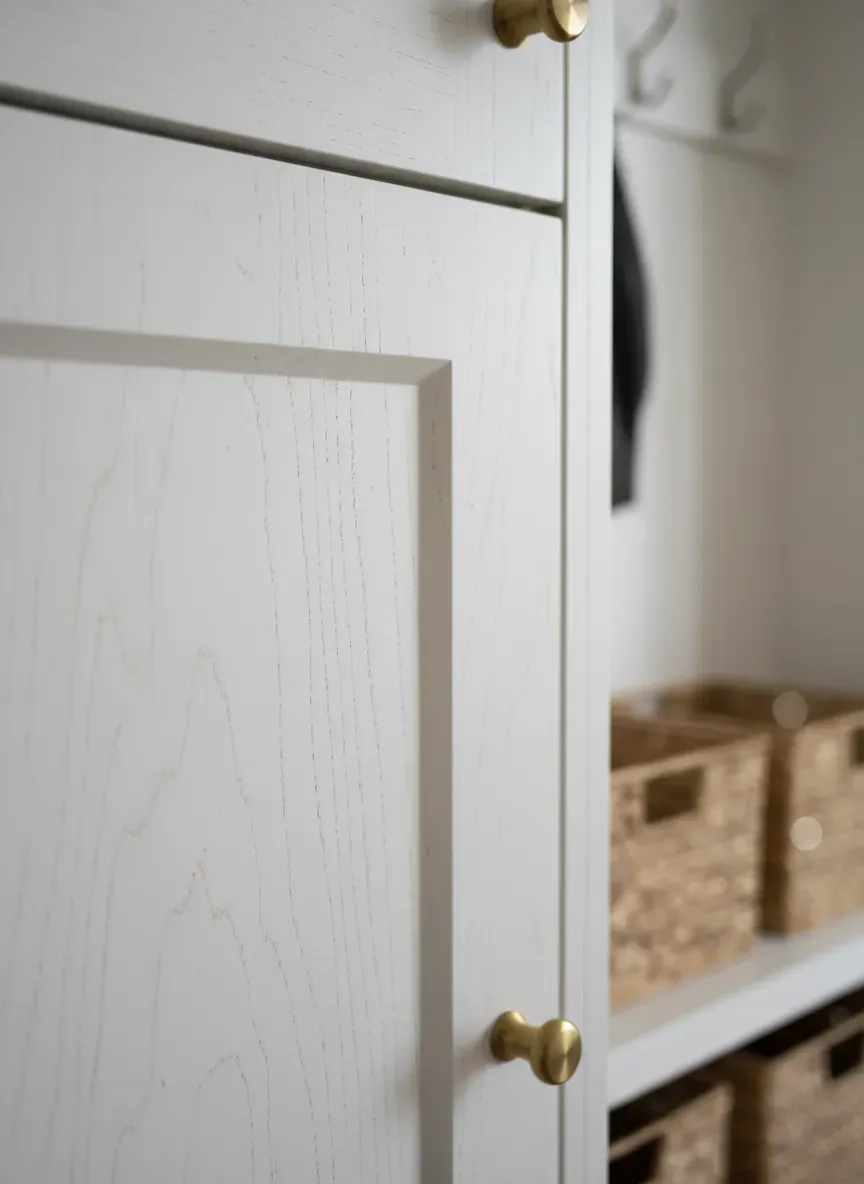
Instead of leaving open cubbies underneath the bench—which inevitably become dark caves of dirty outsoles—opt for deep, heavy-duty drawers. Face these drawers with flat-panel birch, utilizing integrated finger pulls rather than protruding hardware. This maintains the sleek, unbroken lines characteristic of Scandinavian minimalism.
If you must have open shoe storage, elevate the bench entirely. A floating birch bench bolted directly into the wall studs creates a shadow line underneath, giving the illusion that the heavy wood is weightless. This also allows a robotic vacuum to easily slide underneath to clean up dried mud and salt.
Integrating Minimalist Hardware
Birch is a quiet wood. It doesn’t scream for attention. Therefore, your hardware needs to offer a sharp, deliberate contrast.
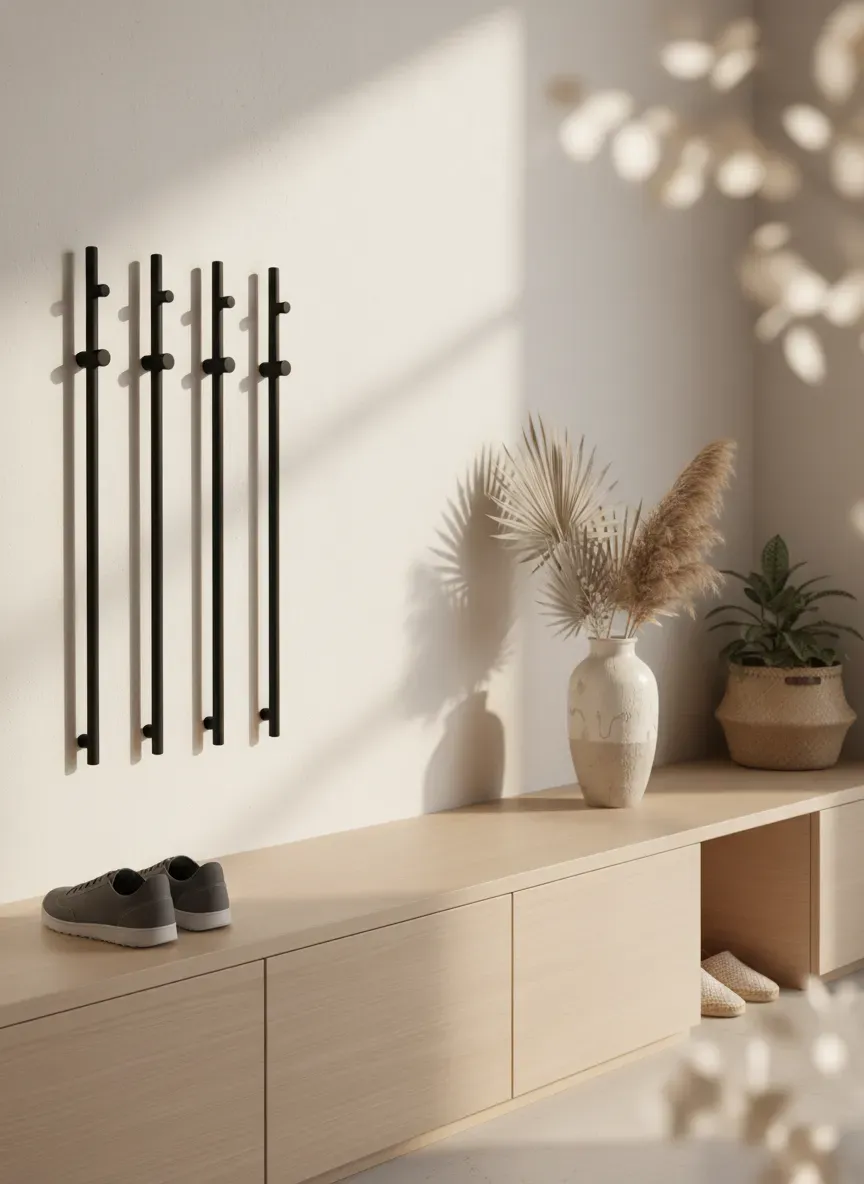
Matte black, brushed nickel, or powder-coated white hooks are the standard. Avoid ornate, traditional brass or oil-rubbed bronze, which violently clash with the modern Nordic ethos. You want hardware that looks like an architectural punctuation mark. Look for simple cylindrical pegs or sharply angled geometric hooks. Upgrading your hardware is an easy win, and sourcing a set of Heavy-Duty Matte Black Geometric Wall Hooks can instantly modernize a tired space.
Textural Counterpoints: Warming up the Birch
A common trap people fall into when chasing the Scandinavian aesthetic is creating a room that feels like a surgical ward. Light birch, white walls, and clean lines can quickly cross the boundary from serene to sterile.
The secret to authentic Nordic design is texture. You must introduce organic, contrasting materials to ground the airy lightness of the birch.
Flooring Selections
Do not put wood floors in your mudroom. Not only does it create a visually overwhelming “wood-on-wood” effect when paired with birch cabinetry, but it’s also a functional nightmare for a wet zone.
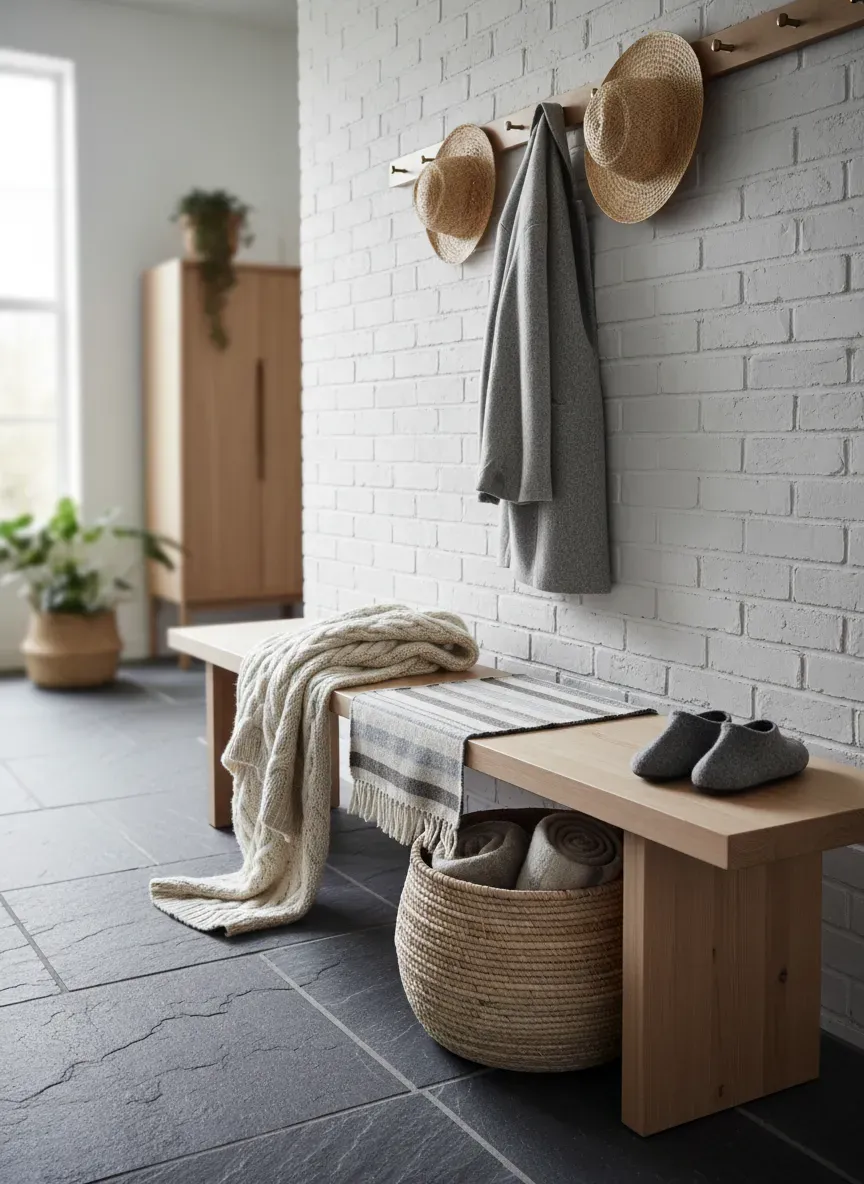
Instead, look to the earth. Large-format slate tiles in deep charcoal or natural cleft bluestone provide a heavy, grounding visual weight. The dark, textured stone hides dirt effortlessly and makes the pale birch cabinets pop in brilliant contrast. If you want to push the Scandinavian vibe further, install radiant floor heating beneath the slate. Stepping out of winter boots onto a warm stone floor is the absolute peak of Hygge.
Soft Furnishings
You need textiles to absorb sound and soften the hard right angles of the woodworking. A genuine sheepskin throw casually draped over the birch bench is a classic Nordic styling trick. It adds immediate visual warmth and tactile luxury. On the floor, a tightly woven wool runner with a subtle, geometric pattern can define the walking path. Wool is naturally antimicrobial and highly durable, making it the perfect fiber for high-traffic entryways.
Illuminating the Nordic Space
Lighting a Scandinavian mudroom is an exercise in layering. Because the design philosophy originates in a light-starved climate, lighting is never an afterthought—it is a core architectural element.
Harnessing Natural Light
If your mudroom has a door to the outside, maximize its glass surface area. Frosted or reeded glass allows natural light to flood the space while maintaining privacy from the street. If you are building an addition, consider a tubular skylight over the entry bench to wash the birch in pure, natural daylight.
Artificial Lighting Strategies
When the sun goes down, your artificial lighting must take over without ruining the natural tones of the wood.
The color temperature of your bulbs is non-negotiable. Aim strictly for 3000K (Warm White). Anything higher (4000K+) will cast a harsh, blue hospital glare that turns beautiful birch into a cheap-looking laminate. Anything lower (2700K) will cast a yellow, amber hue that makes the clean white walls look dingy and aged.
Avoid the standard “boob light” flush mount fixture at the center of the ceiling. Instead, layer your lighting. Use recessed LED cans for ambient fill light, and flank the mudroom mirror or artwork with minimalist wall sconces. Sconces bring the light source down to eye level, casting flattering, horizontal light that highlights the subtle grain variations in the birch paneling.
The Chemistry of Finishes: Protecting the Pale Aesthetic
Here is where many DIYers and even professional contractors completely ruin a Scandinavian mudroom.
Birch has a natural tendency to yellow over time when exposed to UV light. This process is called photo-oxidation. If you take beautifully pale, raw birch and coat it in a standard oil-based polyurethane, you will instantly turn it a sickly, amber-orange color. Within a year, it will look like a 1990s kitchen cabinet.
How to Keep Birch Looking Raw
To preserve the icy, pale look of Nordic birch, you have to use modern finishing chemistry.
- White-Washing (Bleaching): Many high-end Scandinavian cabinet makers treat the raw wood with a subtle lye wash or a specialized wood bleach before finishing. This neutralizes the red and yellow tannins in the wood, locking in a bone-white baseline.
- Water-Based Polyurethane: If you want a traditional film-building finish, strictly use a high-quality, non-yellowing water-based polyurethane in a flat or dead-flat sheen. Glossy finishes have no place in a Nordic mudroom; the wood should look bare.
- Hardwax Oils: My personal favorite approach is using a two-part hardwax oil, specifically one tinted with a microscopic amount of white pigment (like Rubio Monocoat “Cotton White” or “White 5%”). The oil penetrates the wood fibers, protecting them from moisture from the inside out, while the subtle white pigment counteracts the natural wet-look of the oil, leaving the birch looking completely raw and beautifully matte.
Seasonal Rotation: The Functional Core of Nordic Living
A true Scandinavian mudroom isn’t a static display piece. It is a highly functional machine that adapts to the shifting seasons.
During the winter, the priority is bulk management. Heavy parkas, snow pants, and insulated boots require volume. Your bottom drawers need to be deep enough to hold thick wool scarves and heavily insulated gloves. Wet boot trays are mandatory. Look for heavy-duty rubber or powder-coated steel trays with raised ridges so your boots aren’t sitting in puddles of melting snow. A Premium Heavy-Duty Rubber Boot Tray tucked discreetly under a floating bench protects your slate floors from salt damage.
When the spring thaw arrives, the mudroom must transition. The heavy gear is vacuum-sealed and moved to the upper, hard-to-reach cabinets near the ceiling. The easily accessible lower hooks and drawers are swapped to accommodate light rain shells, canvas tote bags, and gardening clogs.
This seasonal ritual is essential. If you try to keep all your winter gear and all your summer gear accessible year-round, you violate the core principle of Lagom. The space will become cluttered, and the calming magic of the minimalist design will evaporate.
Key Takeaways for Your Build
- Prioritize Baltic Birch: Use high-grade Baltic Birch plywood for dimensional stability in your cabinet carcasses, reserving solid birch for face frames and bench tops.
- Hide the Clutter: Adhere to the 80/20 rule. Hide 80% of your gear behind flat-panel doors to maintain visual serenity.
- Contrast is Crucial: Pair the pale, warm tones of the wood with dark, textured slate floors and matte black hardware to ground the space.
- Protect the Color: Never use oil-based finishes on birch. Utilize water-based poly or white-tinted hardwax oils to prevent ambering over time.
- Layer the Lighting: Combine natural light, 3000K recessed ceiling lights, and eye-level sconces to eliminate harsh shadows.
Execution: Building Your Own Birch Sanctuary
Transforming your entryway into a flawless, light-filled Nordic sanctuary is entirely achievable, but it requires precision. The beauty of Scandinavian design lies in its simplicity, which means there is nowhere to hide sloppy joinery or poorly planned layouts.
When you strip away the heavy moldings, ornate trim, and distracting paint colors, the craftsmanship itself becomes the focal point. Every cut must be square. Every door reveal must be perfectly even.
If you are intimidated by the prospect of paying a custom cabinetmaker tens of thousands of dollars to build out your mudroom, you are not alone. Building it yourself is an incredibly rewarding endeavor, provided you have the right blueprints. You don’t need a massive commercial woodshop; you just need clear, mathematically sound plans that take the guesswork out of the structural engineering.
The Bottom Line: Don’t let your entryway remain a chaotic stress-inducer. You have the vision, and the materials are readily available at any quality lumberyard.
If you are ready to construct your own flawless built-in bench, floating shelves, or custom mudroom lockers, you need professional schematics to guide your cuts. I highly recommend checking out Ted’s Woodworking. You’ll get instant access to over 16,000 step-by-step woodworking plans—including incredibly detailed mudroom and cabinetry blueprints that perfectly align with this Scandinavian aesthetic. Right now, they are offering a massive 75% discount, making it an absolute no-brainer for anyone serious about elevating their home’s interior architecture. Grab the plans, source your light birch, and start building the serene entryway you actually deserve.