
Sizing Secrets: Choosing the Perfect Entryway Benches with Storage Dimensions
Master the art of entryway spatial planning. Learn how to measure, select, and style the perfect storage bench using expert dimension secrets.
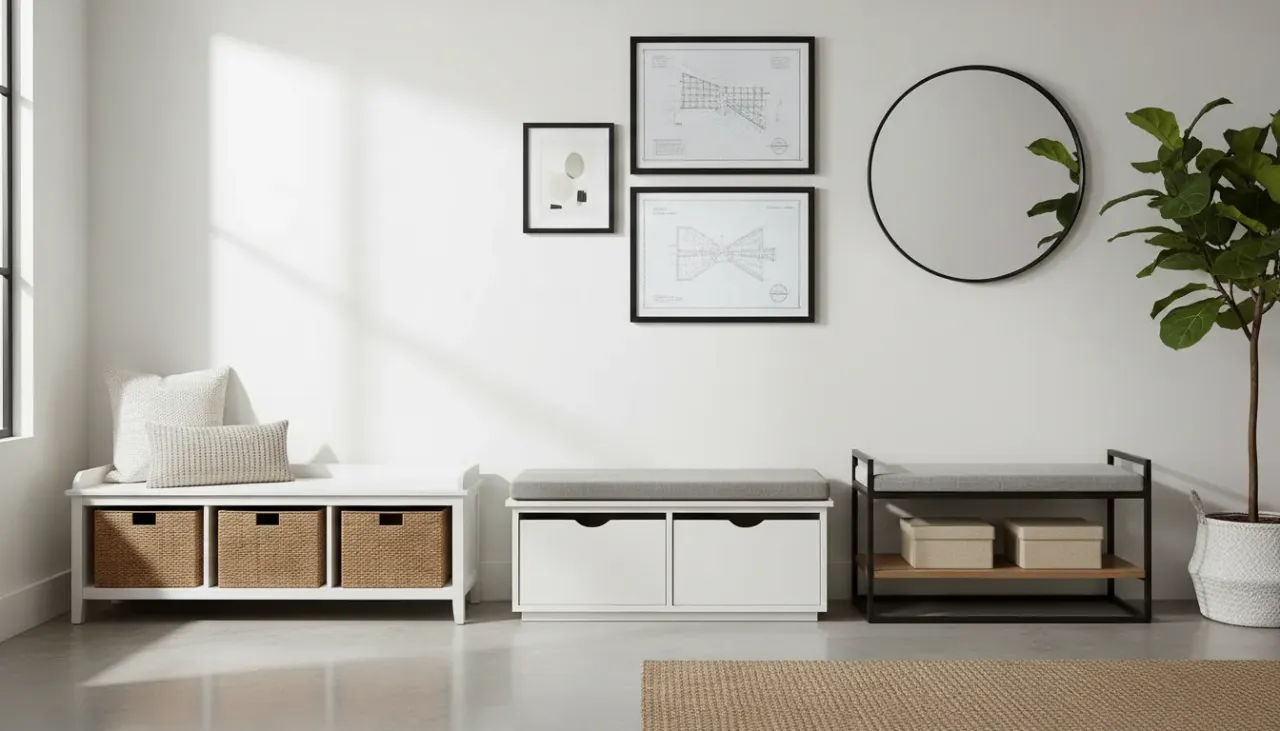
Feb 3, 2026 - Written by: linda wise

The entryway is the handshake of the home. It is the first interaction a guest has with your interior space and the final touchpoint before you step out into the world. Despite its importance, the foyer is often a victim of neglect, becoming a catch-all for discarded mail, scattered shoes, and wayward umbrellas. The solution to this chaos is often a storage bench—a piece of furniture that marries the utilitarian need for organization with the comfort of seating.
However, selecting a bench is not merely a matter of finding a design that complements your aesthetic. It is fundamentally a mathematical challenge. A bench that is too deep can obstruct traffic flow; one that is too low can be uncomfortable for adults; and one with inadequate internal dimensions will fail to store the very clutter you aim to hide.
This guide delves into the precise sizing secrets required to choose the perfect entryway bench. We will move beyond general advice and explore the anthropometrics, spatial planning rules, and dimensional nuances that distinguish a cluttered hall from a curated gallery.
The Mathematics of First Impressions
Before browsing catalogs or visiting showrooms, one must understand the canvas upon which they are working. The scale of your furniture must correlate directly with the volume of your room. In interior design, this is known as visual equilibrium.
A grand foyer with cathedral ceilings requires a substantial piece of furniture to anchor the space. Conversely, a narrow apartment corridor demands a piece that is visually light and physically shallow. The goal is to achieve functionality without sacrificing the “breathability” of the room.
Defining the Traffic Lane
The most critical measurement in any entryway is the traffic lane. This is the path of travel from the front door into the main living areas.
Standard architectural guidelines suggest a minimum walkway width of 36 inches to allow for comfortable passage. In high-traffic zones, or homes with accessibility requirements, 42 to 48 inches is preferable. When you place a bench against the wall, you are subtracting from this width.
If your hallway is 48 inches wide, a standard 18-inch deep bench leaves you with a 30-inch walkway. This may feel claustrophobic and creates a “pinch point” in the home’s circulation. In such instances, a shallow depth bench (12 to 14 inches) is the only viable option to maintain flow.
Measuring Your Canvas: The Pre-Purchase Ritual
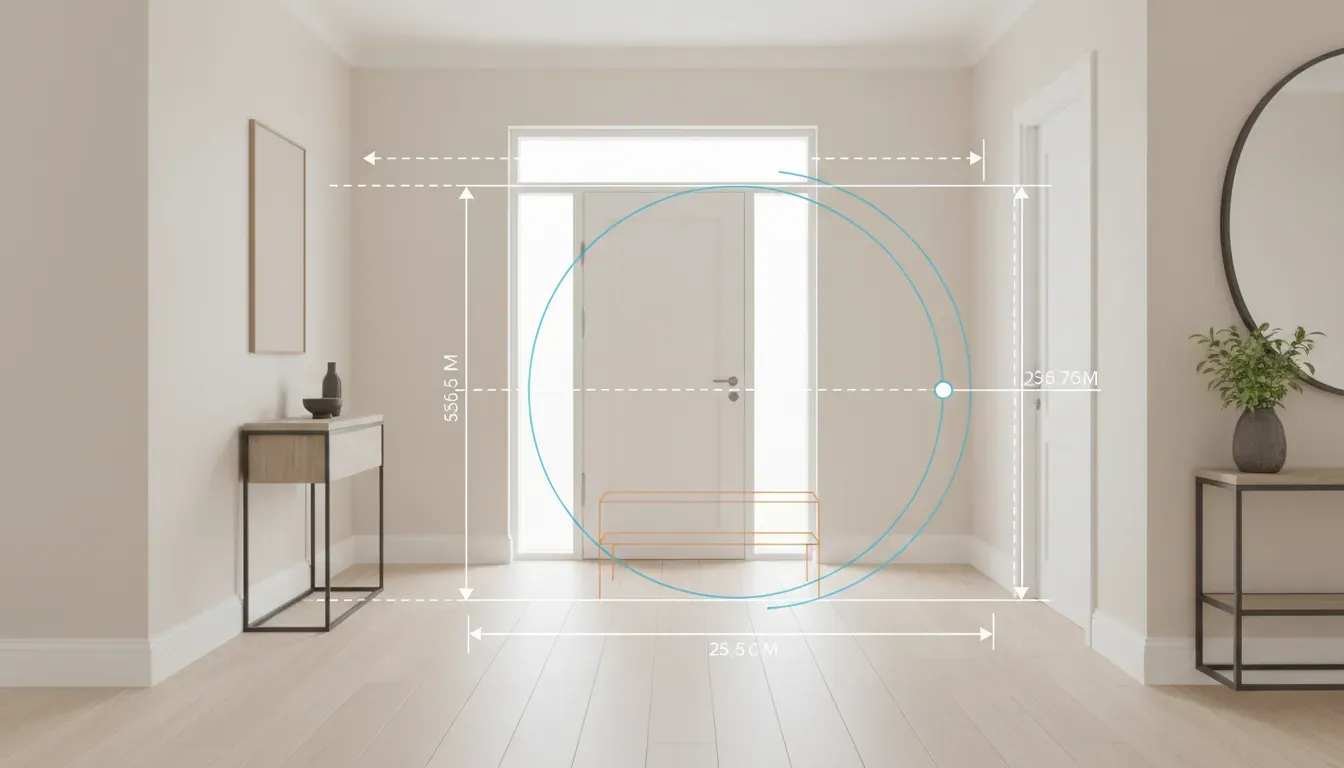
To ensure a perfect fit, you must measure your space with forensic accuracy. Do not rely on visual estimation, as empty spaces often appear larger than they are.
- Measure the Wall Length: Determine the maximum length of the wall where the bench will reside. However, do not plan to fill the entire length. Leaving 6 to 12 inches of “breathing room” on either side of the bench prevents the furniture from looking squeezed.
- Measure the Door Swing: If the bench is placed near the door, open the door fully. Measure the radius of the door swing. The bench must not encroach upon this arc. A collision between the front door and your furniture will damage both the finish and the hinges over time.
- Identify Obstructions: Note the location of baseboards, electrical outlets, light switches, and HVAC vents. A bench should not block a heating register, nor should it render an essential outlet inaccessible.
Standard Bench Dimensions Explained
While custom furniture exists, most retail options fall within standard dimensional ranges. Understanding these standards helps you filter your search effectively.
The Golden Standard for Depth
Depth is the measurement from the front edge of the seat to the wall. This is usually the deal-breaker dimension.
- Standard Depth: 15 to 18 inches. This accommodates the average adult comfortably.
- Shallow Depth: 12 to 14 inches. These are designed specifically for narrow corridors. While they offer less storage volume, they are essential for tight spaces.
- Deep Depth: 20+ inches. These are generally reserved for large mudrooms or foot-of-the-bed applications. In a standard foyer, a 20-inch depth can feel intrusive.
The Ergonomics of Height
Seat height determines comfort. If a bench is strictly for storage, height is less critical. However, if you intend to sit while putting on shoes, ergonomics play a vital role.
- Standard Seat Height: 18 to 20 inches. This mimics the height of a standard dining chair, allowing for a 90-degree knee angle which is optimal for leverage when standing up.
- Low Profile: 14 to 16 inches. Lower benches can be helpful for children but may be difficult for elderly guests or tall adults to rise from.
Length and Proportion
The length of the bench should relate to the wall it sits against and any artwork hung above it.
- Compact: 30 to 40 inches. Suitable for small apartments or nooks.
- Standard: 42 to 50 inches. This usually accommodates two adults sitting side-by-side.
- Long: 60+ inches. These make a statement in large foyers and offer significant storage.
Storage Capacity: Internal Dimensions vs. External Footprint
A common frustration among homeowners is purchasing a bench that fits the hallway but fails to fit the shoes. External dimensions are not indicative of internal capacity. The thickness of the wood, the hardware of the drawers, and the clearance for hinges all reduce usable space.
The Boot Challenge
If you intend to store winter boots or high-top sneakers, you must verify the internal height of the storage compartment.
- Ankle Boots: Require 5 to 7 inches of vertical clearance.
- Mid-Calf Boots: Require 9 to 12 inches.
- Tall Boots: Require 14+ inches (often necessitating a flip-top bench rather than cubbies).
When viewing product specifications, look specifically for “internal drawer dimensions” or “shelf clearance.” If these are not listed, assume the usable space is at least 2 inches less than the external measurement in every direction.
For those needing a versatile solution that balances seating with verified storage capacity, consider a classic flip-top design.
https://www.amazon.com/s?k=Flip+Top+Storage+Bench&tag=hats0f8-20
The Cubby vs. Drawer vs. Flip-Top Debate
The type of storage mechanism you choose dictates the necessary clearance space around the bench. This is a dimensional factor often overlooked until delivery day.
1. The Drawer Bench
Drawers offer excellent organization for small items like gloves, leashes, and mail. However, they require “pull-out clearance.”
- The Measurement: Measure the depth of the drawer. You need at least that amount of space plus 20 inches for a person to stand in front of it and open it. If your hallway is narrow, a drawer that opens into the opposing wall is useless.
2. The Flip-Top Bench
This style maximizes internal volume, utilizing the entire cavity of the bench.
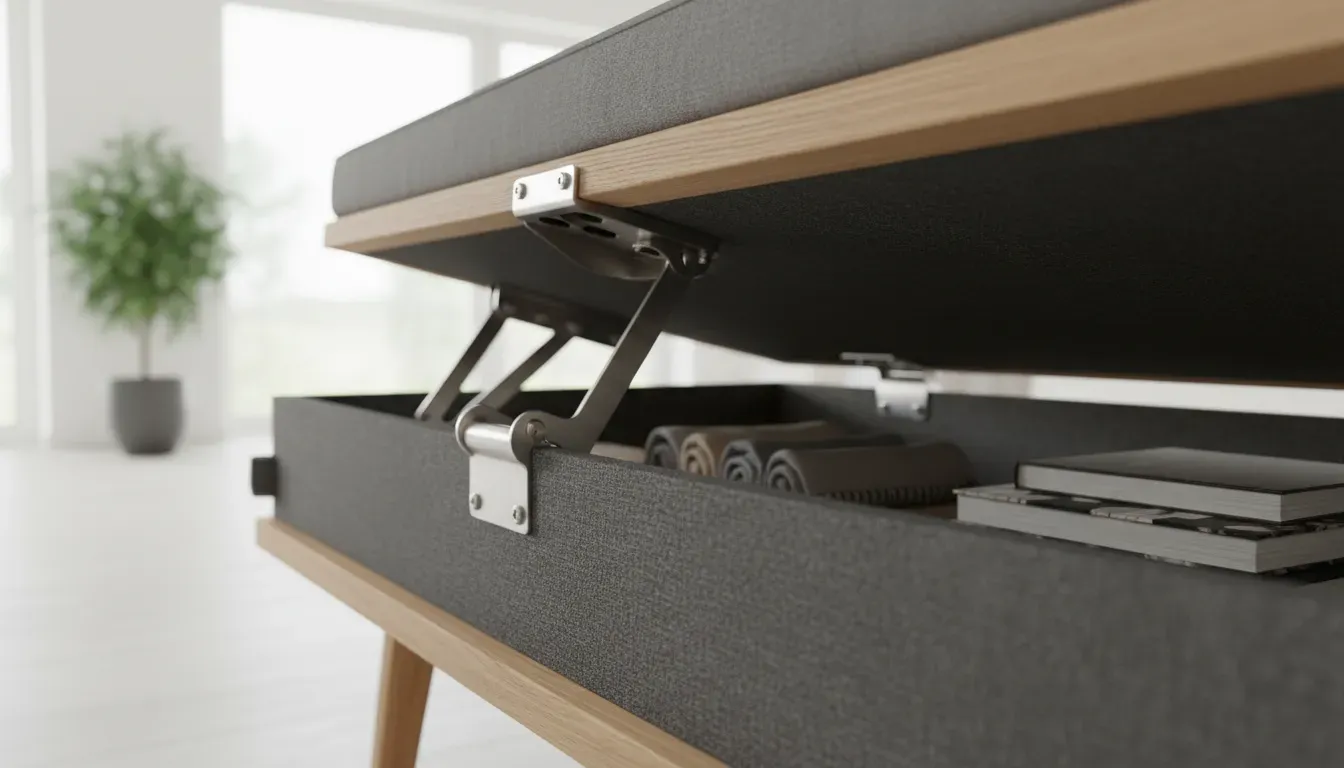
- The Constraint: The wall behind. Many flip-top benches require clearance behind the lid to open fully. If placed flush against a wall, the lid may scrape the paint or fail to stay open. Look for “zero-clearance” hinges or plan to pull the bench 2 to 3 inches away from the wall.
- The Utility: Best for bulky items like blankets or off-season coats.
3. The Cubby Bench
Open shelves or cubbies are highly efficient because they require no mechanical clearance.
- The Dimension to Watch: The standardized basket size. Most cubbies are designed to fit 11x11 or 12x12 inch fabric bins. If the cubbies are non-standard sizes, finding replacement baskets later can be a nightmare.
Visual Weight and Materiality
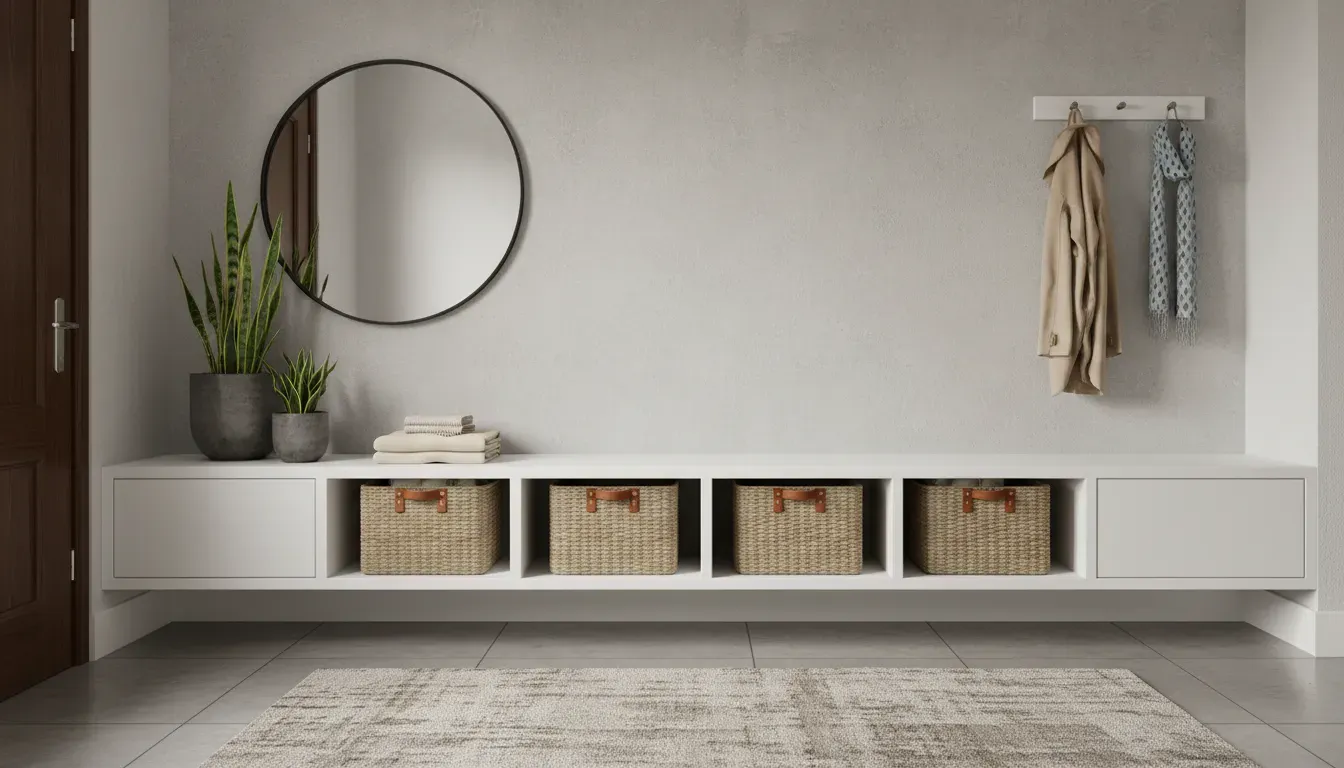
Dimensions are physical, but “visual weight” is psychological. Two benches with identical measurements can impact a room very differently based on their materials and design.
A solid wood bench with a closed base (no legs visible) has a high visual weight. It feels heavy, permanent, and grounded. This is excellent for large spaces that need anchoring but can overwhelm a small hallway.
Conversely, a bench with tall, slender legs and an upholstered top has low visual weight. The ability to see the floor beneath the bench tricks the eye into perceiving the room as larger. If your entryway is cramped, opt for a bench with legs rather than a solid box design.
For a modern aesthetic that reduces visual bulk while offering comfort, a metal-frame option is often the superior choice.
https://www.amazon.com/s?k=Metal+Frame+Upholstered+Bench&tag=hats0f8-20
Scaling to Your Space: Specific Scenarios
Different home layouts require different dimensional strategies. Here is how to adapt your sizing based on your specific architecture.
The “Landing Strip” Hallway
In many urban apartments, the entryway is merely a long, narrow corridor.
- Strategy: Prioritize depth over length. Look for “console depth” benches (12-14 inches).
- Verticality: Utilize the space above the bench. Since the bench must be narrow, install wall hooks or a floating shelf above it to maximize utility without encroaching on the floor plan.
- Color: Match the bench color to the wall color to make it recede visually.
The Split-Level Foyer
Split-level homes often have a small landing that immediately leads to stairs.
- Strategy: Clearance is king. Ensure the bench does not block the pathway to the stair railings.
- Safety: Round corners are preferable here to prevent painful collisions in a high-traffic turning zone.
The Open Concept Entry
When the front door opens directly into the living room, the bench acts as a room divider.
- Strategy: Choose a bench with a finished back. Many storage benches have cardboard or unfinished plywood backs meant to face a wall. In an open concept, the bench must be aesthetically pleasing from 360 degrees.
- Height: A slightly taller bench can help visually separate the “entry zone” from the “living zone.”
For homes where shoe organization is the primary concern, particularly in open layouts where clutter is immediately visible, a dedicated shoe rack bench with slatted shelves maintains airflow and order.
https://www.amazon.com/s?k=Bamboo+Shoe+Rack+Bench&tag=hats0f8-20
Advanced Sizing: Baseboards and Vents
A nuance often missed by amateur decorators is the impact of baseboards. Standard baseboards are 0.5 to 1 inch thick. Quarter-round molding adds another 0.75 inches.
If you purchase a bench that is exactly the depth of your recessed nook, it may not fit because the width at the floor level (between baseboards) is 2 inches narrower than the width at waist height.
The Solution: Always measure the width of a niche at the absolute narrowest point—usually the floor molding.
Furthermore, if your bench covers an HVAC vent, you are compromising your home’s climate control. If placement over a vent is unavoidable, select a bench with open legs and a minimum of 6 inches of clearance from the floor to allow air to circulate. Alternatively, use a magnetic air deflector to direct airflow out from under the furniture.
Styling Ratios: The Rule of Thirds
Once the bench is sized correctly, styling it requires an understanding of proportion. A common mistake is hanging artwork or mirrors that are too small or too large relative to the bench.
The Mirror Rule: If hanging a mirror or art above the bench, the width of the art should be approximately two-thirds (66%) to three-quarters (75%) the width of the bench.
- Example: If your bench is 48 inches wide, the mirror above it should be roughly 32 to 36 inches wide. This creates a balanced triangular composition that feels stable to the human eye.
The Rug Connection: If placing the bench on an entryway rug, ensure the bench legs sit entirely on the rug or entirely off it. A bench with two legs on and two legs off creates an uneven surface, causing the bench to wobble and compromising the structural integrity of the joints over time. For more on coordinating floor coverings, read our guide on choosing the right rug for high-traffic areas.
The Installation Reality Check
Before finalizing your purchase, there is one final dimension to check: the package dimensions.
- The Scenario: You have found the perfect bench for your third-floor walk-up or your narrow hallway.
- The Problem: The box it comes in won’t fit through the stairwell or the elevator door.
Always check the “shipping dimensions” listed on the product page. If the bench comes fully assembled, this is critical. Flat-pack furniture (RTA - Ready to Assemble) is generally safer for tight access points, but verifying the box size saves you the hassle of a return.
Conclusion: Measure Twice, Order Once
Selecting the perfect entryway bench is a balancing act between the physical constraints of your architecture and the functional needs of your household. It requires shifting your mindset from purely aesthetic to highly analytical.
By respecting the traffic lane, understanding the difference between external and internal dimensions, and considering the visual weight of materials, you can select a piece that feels custom-made for your home.
Remember that storage is only valuable if it is accessible. A bench that is too deep to walk past or too cramped to hold your winter boots serves no purpose. Use painter’s tape to outline the dimensions of your potential purchase on the floor before you buy. Live with the outline for a day. Walk past it. Open the front door. This physical simulation is the ultimate test of your sizing strategy.
With these sizing secrets in hand, you are equipped to transform your entryway from a cluttered pass-through into an organized, welcoming, and perfectly proportioned introduction to your home.