
Sleek Modern Mudroom Designs: Minimalist Cubbies and Flat Panel Storage
Transform your entryway with sleek modern mudroom designs. Discover expert strategies for minimalist cubbies, flat panel storage, and seamless organization.
Apr 1, 2026 - Written by: Linda Wise

I’ve personally found that the mudroom is the most psychologically taxing room in the house. It’s the architectural equivalent of a hard day’s residue. You walk through the door, and immediately, you are confronted by a chaotic jumble of wet boots, tangled dog leashes, and jackets slung haphazardly over hooks. For years, the standard response was to build massive, heavy, traditional lockers. But heavy visual weight only adds to the mental clutter.
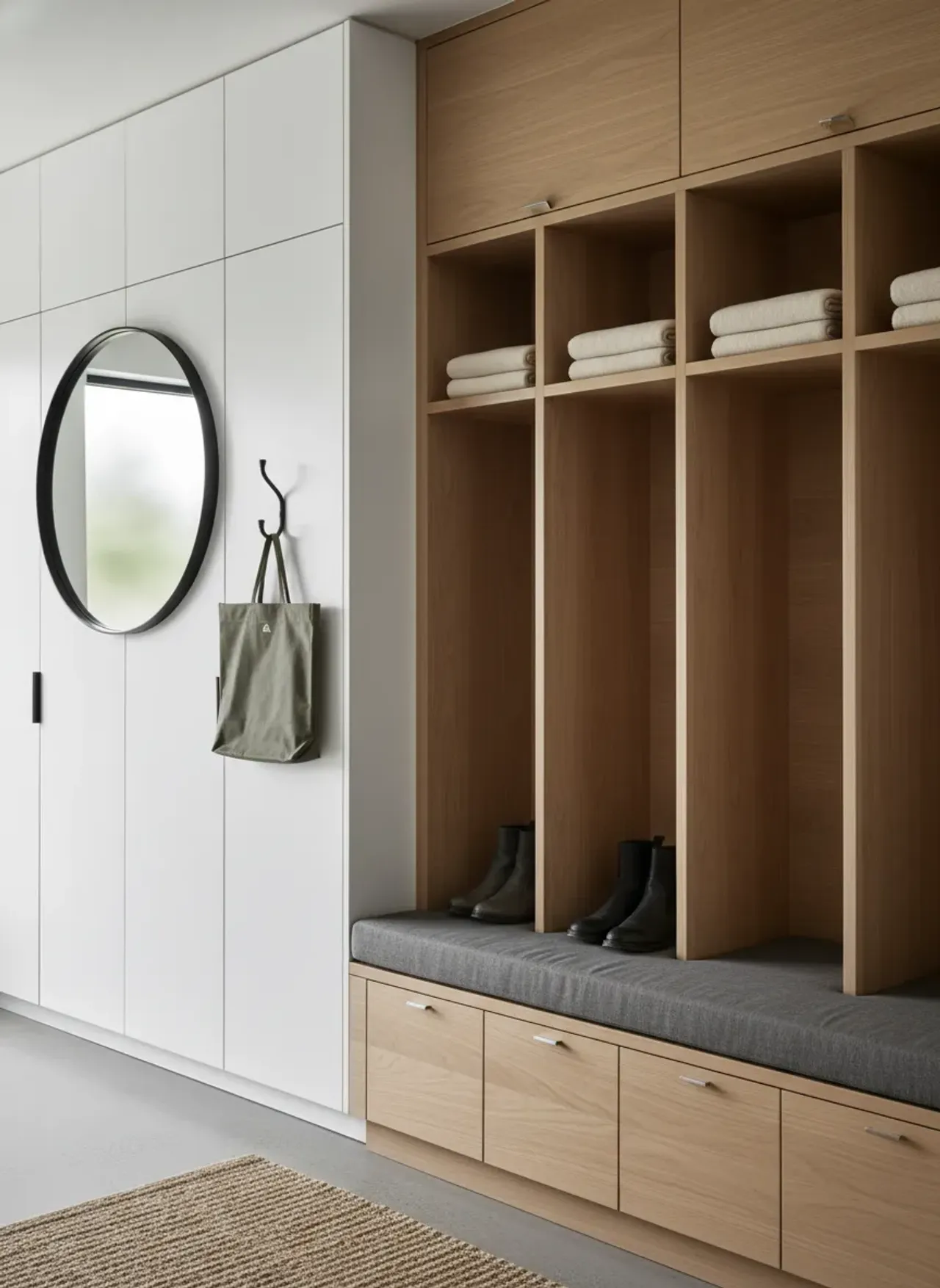
Today, we are witnessing a complete paradigm shift in entryway architecture. Sleek modern mudroom designs—specifically those leveraging minimalist cubbies and flat panel storage—are revolutionizing how we handle transitional spaces. By hiding the chaos behind unadorned, seamless facades and organizing the rest into stark, geometric grids, you completely neutralize the visual noise.
Here’s the real kicker: pulling off a truly minimalist aesthetic is actually highly technical. Without crown molding or heavy face frames to hide your mistakes, your tolerances must be absolute. Let’s break down exactly how to engineer a flawless, modern drop zone that looks like it belongs in a high-end architectural digest, yet functions perfectly for a muddy family of five.
Quick Comparison: Top Picks
| Product | Rating | Check Price |
|---|---|---|
| Blum Frameless Push-to-Open Hinges | ⭐⭐⭐⭐⭐ | View on Amazon |
| Edge Pull Minimalist Cabinet Handles | ⭐⭐⭐⭐½ | View on Amazon |
| COB LED Strip Lights 4000K | ⭐⭐⭐⭐⭐ | View on Amazon |
The Evolution of the Drop Zone
Historically, mudrooms were pure utility. Placed near the garage or back door, they were afterthoughts fitted with leftover kitchen cabinets or basic beadboard and shaker-style trims. The problem with traditional millwork in a high-traffic utility space is dust. Every groove, every shaker profile, and every piece of decorative baseboard acts as a microscopic shelf for dirt, lint, and dried mud.
The modern aesthetic strips all of that away. We are moving toward frameless European cabinet construction. By eliminating the face frame entirely, we maximize the interior storage volume while presenting a completely flush, monolithic exterior.
When you look at a well-executed modern mudroom, your eye shouldn’t catch on hardware or heavy trims. It should glide across an unbroken plane of matte finish or continuous wood grain. This is intentional psychological design. It tells your brain that the house is in order, even if there are twelve pairs of dirty cleats hidden just millimeters behind those panels.
Mastering Minimalist Cubbies
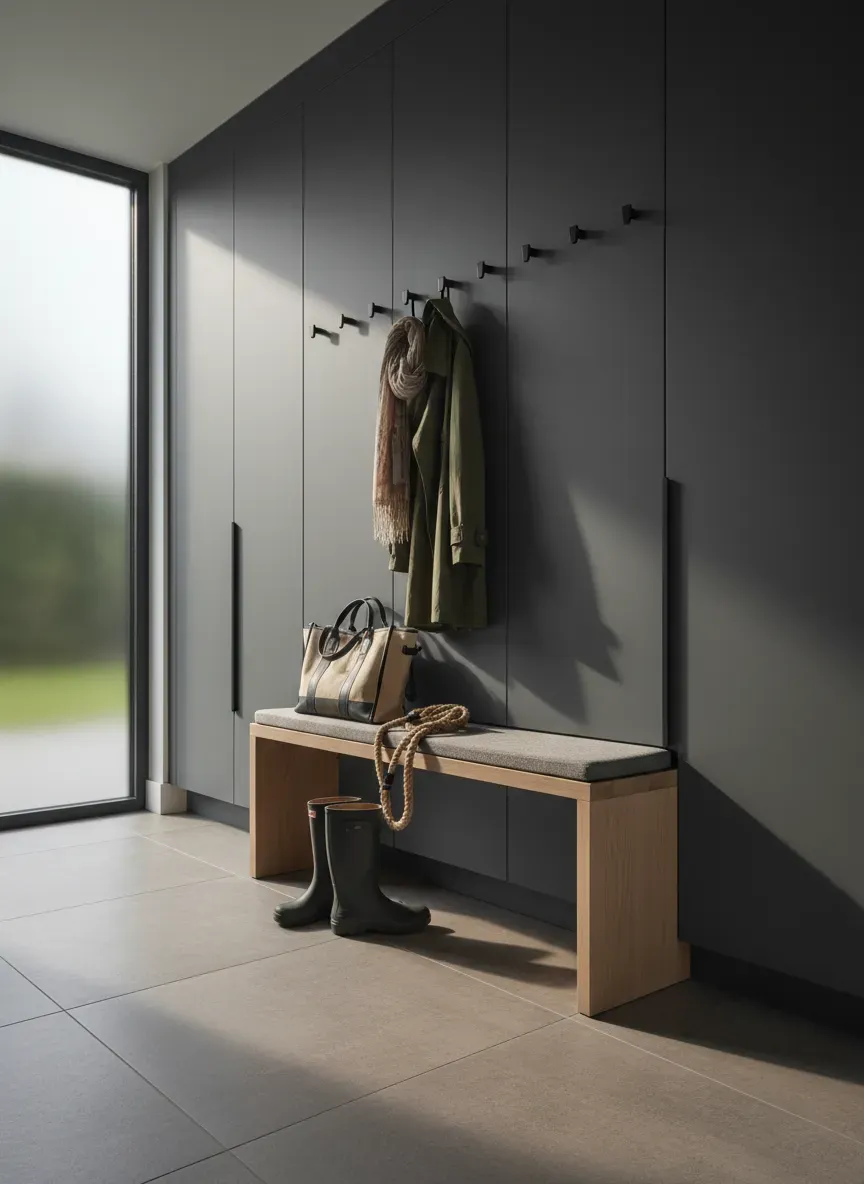
Open storage is unavoidable in a mudroom. You need immediate access to items you use daily. However, the line between “curated open storage” and “cluttered mess” is razor-thin. Minimalist cubbies solve this by utilizing rigid geometry and negative space.
The Power of Negative Space
You’ll notice that high-end modern designs rarely pack a wall floor-to-ceiling with tight, restrictive boxes. Instead, they use asymmetrical grids and leave generous amounts of negative space. A bench seat shouldn’t just be a thick slab of wood; it should appear to float.
To achieve this floating effect, designers often recess the toe kick significantly—sometimes up to six inches back from the front edge of the bench. Paint the recessed baseboard matte black, and suddenly, your heavy plywood bench looks like it’s hovering in mid-air.
Sizing, Ergonomics, and the Grid
A grid fails when it isn’t mathematically mapped to the items it holds. Standardizing your cubby sizes might seem easier during the build, but it results in wasted space. Winter boots require completely different vertical clearances than running shoes.
When mapping out your grid, understanding the ideal spacing between hooks and dividers is critical to maintaining that clean, uncluttered look without sacrificing functionality. I usually recommend a minimum width of 14 inches for individual locker sections, but the height is where you play.
Key Takeaways for Cubby Dimensions:
- Shoe Cubbies: Keep them tight. 6 to 8 inches high prevents the dreaded “shoe pile” because there simply isn’t room to stack them vertically.
- Backpack Zones: Aim for 18 inches of width and 24 inches of height.
- Drop Zones: Create a specific, shallow tray-like cubby at waist height (around 36 inches off the floor) specifically for keys, mail, and sunglasses.
Material Selection: The Frameless Advantage
To get that ultra-sleek look, you cannot use traditional face frames. You must build frameless cabinet boxes. This requires highly stable materials. Standard construction pine or cheap C-grade plywood will warp, throwing off your delicate reveal lines.
I strongly advise using high-density MDF (Medium Density Fiberboard) if you plan to paint, or pre-finished Baltic Birch plywood if you want a natural wood interior. MDF routes beautifully, offering crisp, sharp edges that you simply edge-band with a PVC or wood veneer tape. The result is a seamless box that looks like it was injection-molded rather than built from sheet goods.
Pro Tip: If you are painting MDF, the cut edges will absorb primer like a sponge, leading to a rough finish. Seal the raw edges with a mixture of wood glue and water, or a specialized high-build automotive primer, before applying your topcoat. Sand it to 320-grit for a glass-like edge.
Flat Panel Storage: The Unsung Hero of Modern Aesthetics
While open cubbies handle the daily drivers, flat panel (or slab) doors hide the off-season gear, the dog food bins, and the awkwardly shaped sports equipment. Slab doors are the defining characteristic of modern cabinetry.
Why Flat Panels Work
A flat panel door is exactly what it sounds like—a solid, un-profiled slab. Without the rails and stiles of a shaker door, a slab door reflects light more evenly, making tight entryways feel significantly larger and brighter.
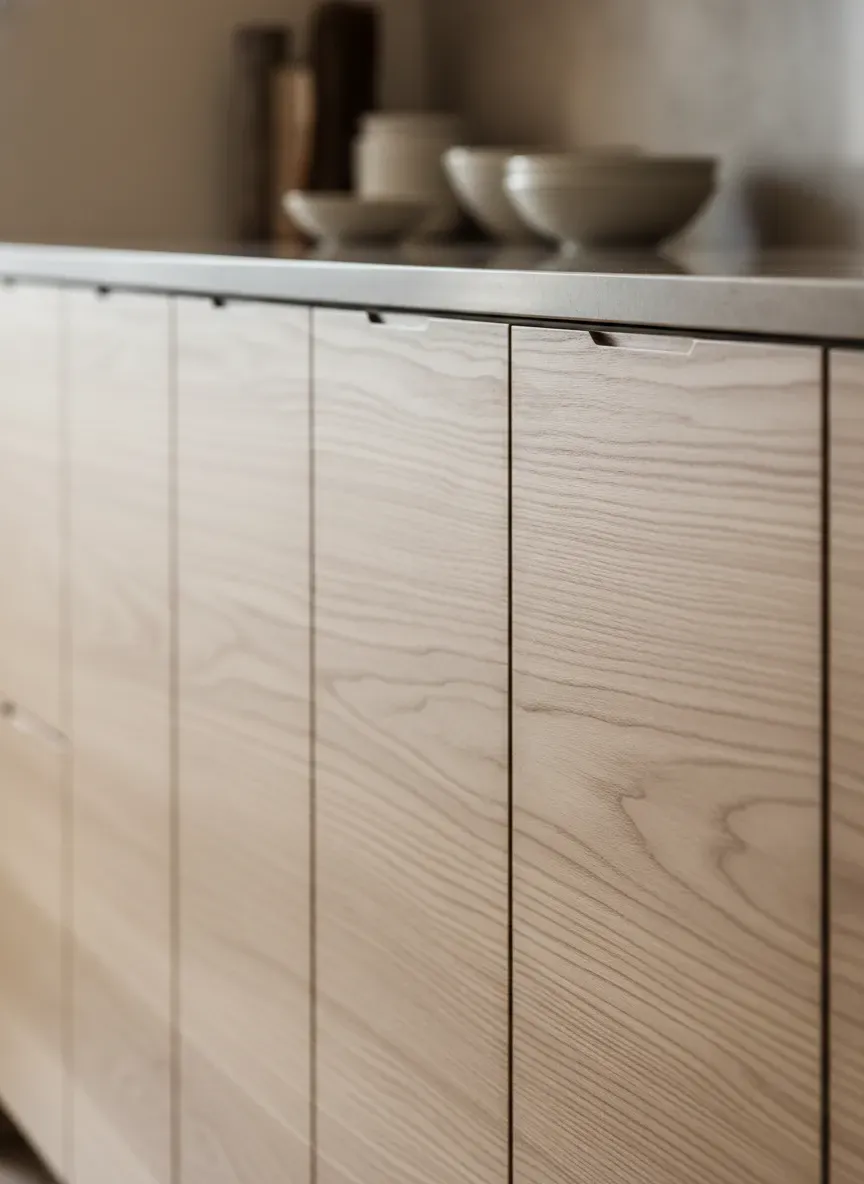
Furthermore, if you are using a wood veneer—such as white oak or walnut—slab doors allow for “continuous grain matching.” This is a premium technique where the wood grain flows continuously from one cabinet door to the door directly above or below it, treating the entire wall as a single, beautiful canvas of timber. It takes meticulous planning during the cutting phase, but the visual payoff is astronomical.
Engineering the Hardware
Sleek modern mudroom designs live and die by their hardware—or lack thereof. Traditional knobs and pulls disrupt the visual plane. To maintain the illusion of a monolithic wall, you have three primary options:
- Push-to-Open Mechanisms: These are the holy grail of minimalist design. Utilizing heavy-duty magnetic pistons mounted inside the cabinet, you simply press the corner of the door, and it pops open.
- Edge Pulls: If you prefer a tactile grip, edge pulls (or finger pulls) are routed into the top or side edge of the door, or screwed to the back, wrapping just barely over the front lip. They offer functionality with almost zero visual footprint.
- Integrated J-Pulls: This involves routing a J-shaped groove directly into the top edge of the MDF or wood door. It requires specialized router bits and finishing techniques, but it eliminates metal hardware entirely.
Maximizing Tight Footprints
Not everyone has a sprawling, 200-square-foot dedicated mudroom. Most of us are trying to carve functionality out of a cramped hallway or a tiny alcove off the garage. Minimalist design is uniquely suited for small spaces because it eliminates the visual bulk that makes tight quarters feel claustrophobic.
If you’re dealing with a micro-space, my comprehensive 5x6 mudroom guide breaks down exact strategies for squeezing every square inch out of a tiny footprint. But the core philosophy remains the same: go vertical.
Vertical Storage Strategies
When floor space is at a premium, your only option is to build up to the ceiling. Flat panel doors are perfect for this. By running a slab door from the top of the bench all the way to a shadow line at the ceiling, you force the eye upward, exaggerating the height of the room.
Inside those towering cabinets, utilize drop-down hydraulic closet rods. These allow you to store winter coats at the very top of the cabinet, pulling them down to eye level only when needed. The lower sections can be dedicated to pull-out drawers for shoes. Drawers behind doors are a staple of high-end European design; they keep the exterior lines clean while offering supreme organization inside.
Recommended Hardware and Materials Deep Dive
Let’s look closer at the gear that makes this aesthetic possible. You can’t execute a sleek modern mudroom with off-the-shelf hinges from a big box store. The tolerances are too tight.
Precision Hinges
To achieve an even 1/8-inch reveal (the gap between doors) across a massive wall of cabinetry, you need 6-way adjustable hinges. The Blum Frameless Push-to-Open Hinges are the industry gold standard. They allow you to tweak the door up, down, left, right, in, and out with a simple turn of a screwdriver. This micro-adjustability is mandatory when dealing with perfectly flush slab doors.
Subtle Grip
If push-to-open feels too finicky for a high-traffic mudroom, go with an Edge Pull Minimalist Cabinet Handle. Finished in matte black or brushed brass, these sit flush against the back of the door and peek over the top edge. They give you the leverage to yank open a heavy door laden with coats, without ruining the flat-panel aesthetic.
Seamless Illumination
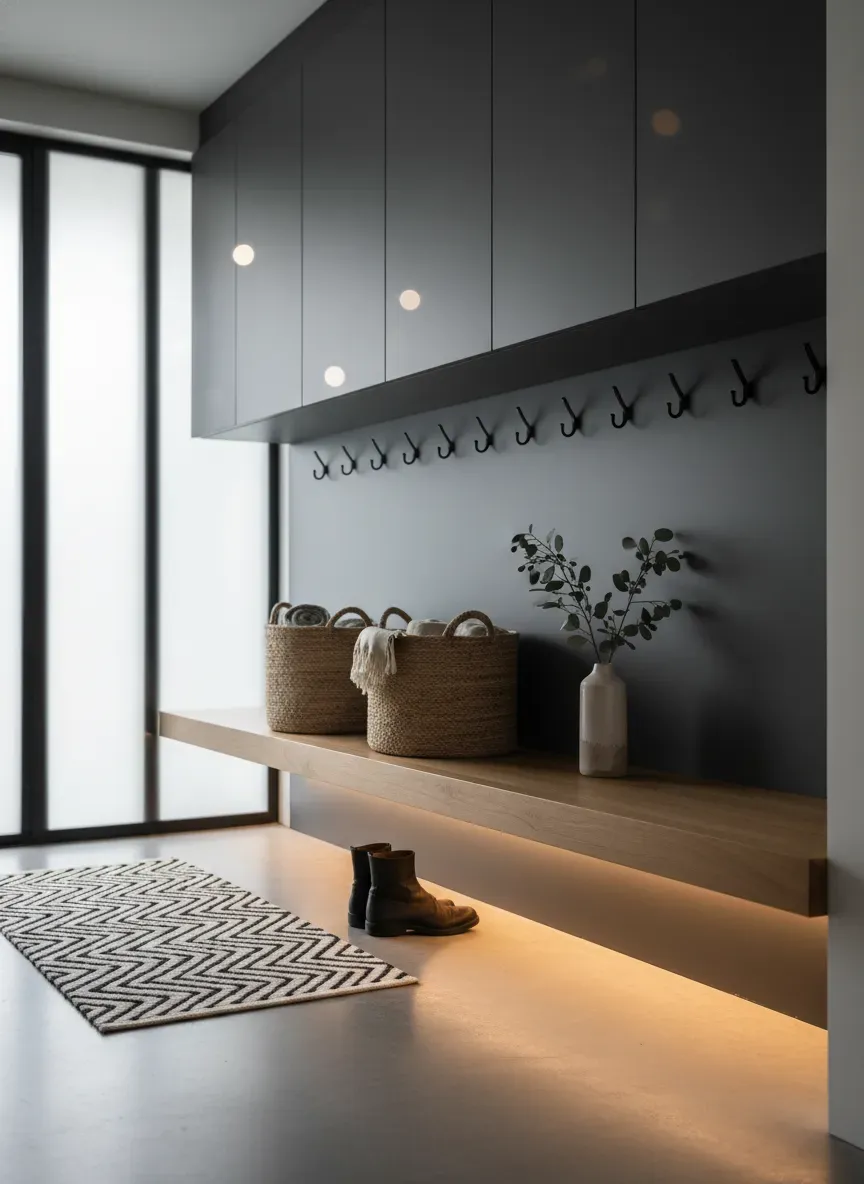
Lighting transforms a space from “built-in” to “bespoke.” I never build a mudroom without integrating COB LED Strip Lights 4000K. Unlike older LED strips that look like dotted airport runways, COB (Chip on Board) technology provides a completely solid, uninterrupted line of light. Routing a shallow channel under the floating bench and running these strips creates an incredible nighttime ambiance. The 4000K temperature is crucial—it’s a neutral, clean white that accurately renders the colors of your clothing and paint without feeling clinically blue or dingy yellow.
Lighting and Finishing Touches
A minimalist design relies heavily on texture and light because it lacks decorative ornamentation. The way light washes down a perfectly smooth, flat panel door is what gives the room its luxurious feel.
The Paint Strategy
You cannot use standard latex wall paint on custom mudroom cabinetry. It lacks the chemical hardness to withstand the abuse of keys, zippers, and heavy bags. It will chip, and it will remain slightly tacky, causing doors to stick.
You need a cabinet-grade coating. Waterborne alkyd enamels or 2K (two-part) polyurethanes are the way to go. They cure to a hard, plastic-like shell.
When choosing a sheen, modern designs heavily favor dead-flat or matte finishes. Gloss reflects too much light and highlights every minor imperfection in your sanding. A matte finish absorbs light, softening the sharp geometric lines of the cubbies and giving the cabinetry a velvety, high-end appearance. Just ensure the matte paint you select is highly washable, as mudrooms see endless fingerprints.
Integrated Lighting Details
Beyond the under-bench lighting mentioned earlier, consider vertical lighting inside the tall cabinets. Recessing an aluminum LED channel vertically down the inside wall of a locker, triggered by a hidden motion sensor when the door opens, is a massive quality-of-life upgrade. It allows you to find that black umbrella in a dark cabinet at 6:00 AM without turning on the harsh overhead room lights.
Common Pitfalls to Avoid in Modern Mudroom Design
Even seasoned DIYers and contractors stumble when pivoting to minimalist, modern designs. The simplicity is an illusion; it hides a complex framework of tight tolerances and careful planning. Here are the traps you need to dodge.
Overcomplicating the Grid
It’s tempting to look at a blank wall and decide to build twenty tiny, highly specific cubbies. Don’t. A grid with too many intersecting lines looks incredibly busy, defeating the entire purpose of a minimalist aesthetic. Stick to broader, wider bays. Use baskets or internal dividers hidden inside the larger cubbies to handle the micro-organization.
Ignoring Ventilation for Wet Gear
Flat panel doors that sit perfectly flush with a 1/8-inch reveal look incredible. They are also practically airtight. If you throw a damp rain jacket or snowy boots into that cabinet and shut the door, you are creating an incubator for mold and mildew.
The Bottom Line: You must plan for passive airflow. Leave a discreet one-inch gap at the top of the cabinet box, hidden behind a slightly oversized door. Alternatively, route a series of sleek, linear slots into the toe-kick or the base of the cabinet to allow air to circulate from the bottom up.
Flimsy Backing Material
In a traditional built-in, you might get away with using thin 1/4-inch beadboard or hardboard for the back of the cabinets because the face frames provide structural rigidity. In a frameless, modern build, the cabinet box relies heavily on a solid back to stay perfectly square. Always use at least 1/2-inch, or preferably 3/4-inch, plywood for the backs of your mudroom lockers. If the box racks (leans out of square) by even a fraction of an inch, your flat panel doors will never line up perfectly, and the minimalist illusion will be shattered.
Bringing the Vision to Life
Transitioning your mudroom from a chaotic dumping ground into a sleek, highly organized architectural feature completely changes the tone of your home. It creates an airlock of calm between the outside world and your private sanctuary. By leaning into minimalist cubbies, you force intentionality into your open storage. By utilizing flat panel doors, you build an impenetrable, beautiful wall against visual clutter.
The math must be precise, the hardware must be high-quality, and the finishing must be immaculate. But the result—a space that looks effortless, modern, and perfectly tailored to your life—is worth every ounce of effort.
I get asked constantly about where to find reliable, professional-grade blueprints for these kinds of precise built-ins. Trying to reverse-engineer frameless cabinetry from Pinterest photos usually ends in frustration and wasted lumber. If you are serious about tackling a project of this caliber, you need exact cut lists, precise hardware placement guides, and step-by-step schematics. I’ve personally found that the fastest way to master these builds is by accessing a massive, curated library of plans. I highly recommend checking out Ted’s Woodworking. You get instant access to over 16,000 meticulously detailed woodworking plans, and right now, they are offering a massive 75% discount. It takes all the guesswork out of the structural engineering, leaving you free to focus on nailing that perfect, sleek modern finish.