
Where Exactly Should You Place Entryway Benches with Storage for Optimal Flow?
Discover the precise placement strategies for entryway storage benches to maximize space, enhance traffic flow, and elevate your home's interior design.
Feb 4, 2026 - Written by: linda wise

The entryway is the handshake of the home. It is the transitional space where the outside world is shed and the sanctuary of the interior begins. However, without strategic planning, this critical zone often descends into chaos—a clutter of shoes, bags, and coats that disrupts the visual harmony of your living space. The storage bench is the quintessential solution to this ergonomic puzzle, marrying the utility of containment with the comfort of seating.
Yet, simply purchasing a bench is only half the battle. The true art lies in placement. A bench positioned incorrectly can become a hurdle rather than a helper, impeding traffic flow and shrinking the perceived size of the room. To achieve optimal flow, one must consider architectural lines, traffic patterns, and the subtle psychology of arrival. This comprehensive guide will dissect the spatial dynamics of entryway furniture, helping you determine exactly where to place your storage bench for maximum efficiency and aesthetic impact.
Understanding the Physics of Entryway Flow
Before selecting a location for your furniture, it is imperative to understand the invisible currents of movement within your home. Interior designers refer to this as “circulation.” In an entryway, the primary circulation path is the line from the front door to the main living area.
Optimal flow requires that this path remains unobstructed. A minimum clearance of 36 inches is the standard recommendation for main traffic thoroughfares, though 42 to 48 inches is preferable in a foyer to accommodate multiple people entering simultaneously. Your storage bench must exist outside this primary artery. It should serve as an “eddy”—a place to pause and settle—without blocking the river of movement.
When analyzing your space, consider the “landing strip” concept. This is the sequence of actions a person takes upon entering: open door, step inside, close door, set down keys, remove coat, remove shoes. Your bench placement should logically support the final step of this sequence without forcing the individual to backtrack across the dirty floor they just walked on.
Placement Strategy 1: The Immediate Flank
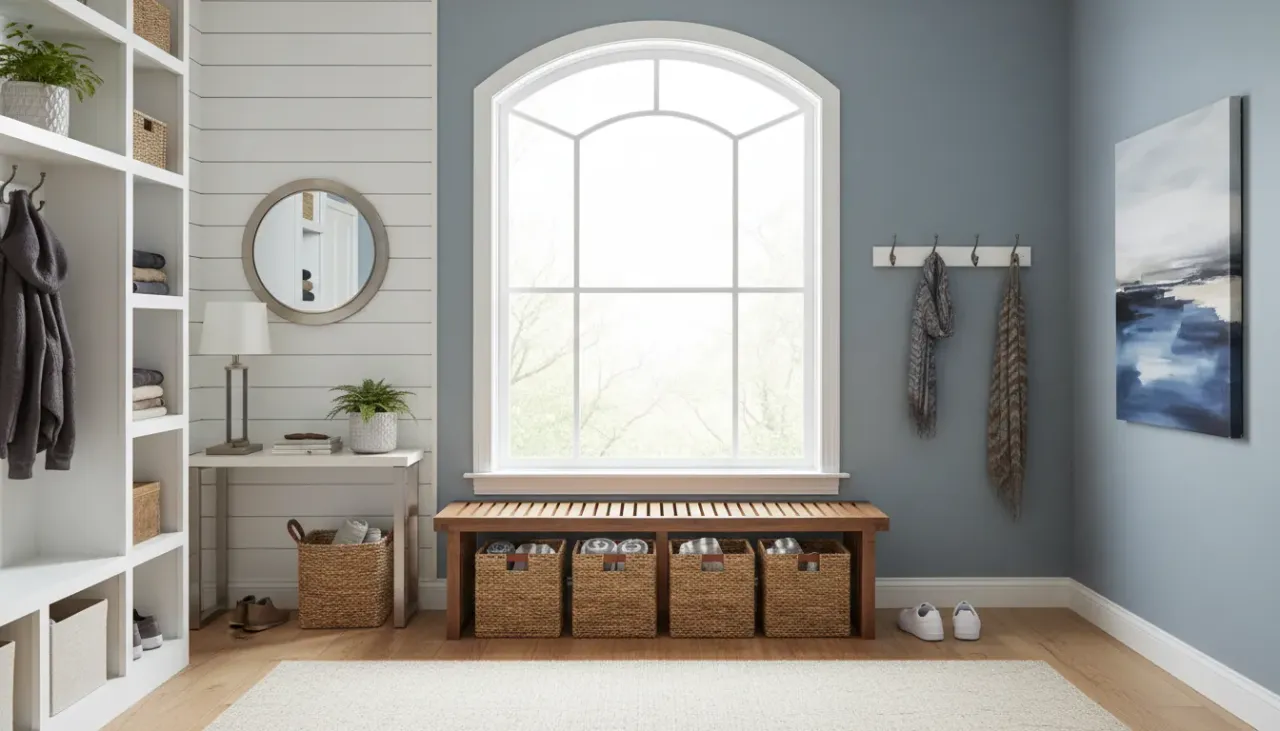
The most intuitive and common placement for an entryway bench is on the immediate wall adjacent to the door handle side. This position creates a dedicated “drop zone” the moment one steps inside.
The Ergonomics of the Flank
Placing the bench on the same side as the door handle allows for a natural transition. As the door opens, the guest steps in and naturally turns toward the open space. If the bench is placed on the hinge side, the door itself becomes a barrier, trapping the guest or forcing them to walk around the door sweep to reach the seat.
When utilizing the flank position, ensure there is adequate clearance for the door to open fully (at least 90 degrees, preferably 110 degrees). A standard interior door is 36 inches wide; therefore, your bench should not encroach upon the arc of the door swing. If your foyer is tight, measure the distance from the corner of the room to the door frame. If this depth is less than the depth of your desired bench, this placement will visually crowd the entrance.
Visual Anchoring
A bench placed on the immediate flank requires vertical anchoring to prevent it from looking like it is floating aimlessly. Pair the bench with a row of wall hooks, a large mirror, or a piece of statement art above it. This creates a vertical vignette that defines the area as a purposeful mudroom station rather than just a piece of furniture pushed against a wall.
Placement Strategy 2: The Hallway Extension
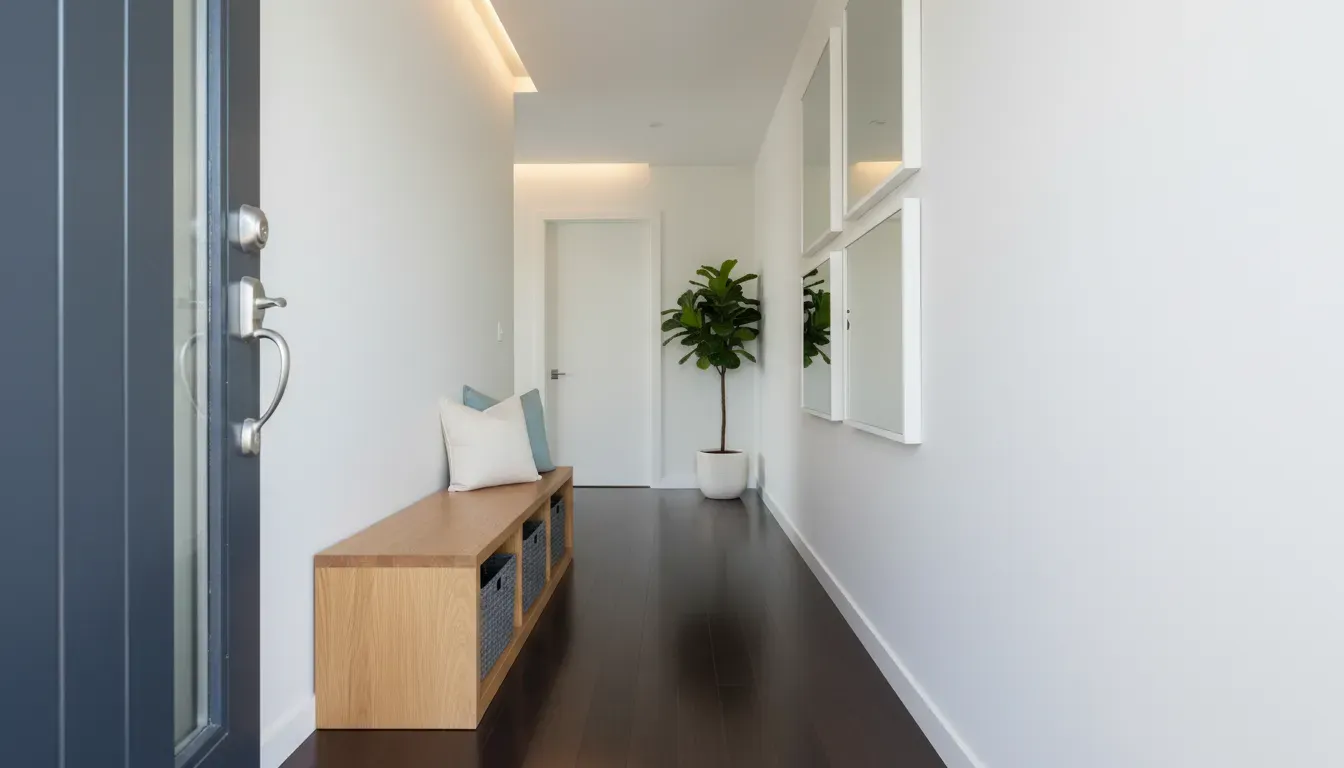
For homes where the front door opens into a long, narrow corridor rather than a square foyer, the placement rules shift. Here, width is your most valuable commodity. A bulky bench in a narrow hall creates a “tunnel effect,” making the space feel claustrophobic.
The Slim Profile Solution
In these scenarios, the bench should be placed further down the hall, past the immediate swing of the door, and must feature a slim profile. Look for benches with a depth of 12 to 15 inches. The goal is to maintain that crucial 36-inch walking path. If a standard bench protrudes too far, it becomes a shin-busting hazard.
For narrow spaces, consider a bench that combines vertical shoe storage with seating to maximize utility per square inch.
Search for Slim Shoe Storage Bench on Amazon
Visual Elongation
When placing a bench in a hallway extension, align it with the architectural lines of the floorboards or a runner rug. This guides the eye forward. Avoid placing the bench directly across from a doorway leading to another room (like a powder room or coat closet), as this creates a traffic jam where two circulation paths intersect.
Placement Strategy 3: The Staircase Nook
In two-story homes, the area beneath the staircase is often widely underutilized “dead space.” This triangular alcove is, arguably, the most efficient location for an entryway bench with storage.
Maximizing Vertical Volume
Placing the bench under the stairs tucks the furniture away from the main traffic flow entirely. It utilizes floor space that is generally not walkable due to the descending ceiling height. This placement turns an awkward architectural remnant into a cozy, custom-feel reading nook or preparation station.
However, be mindful of head clearance. Position the bench in the taller section of the spandrel (the space under the stairs) so that an adult can sit up straight without grazing the sloped ceiling. A good rule of thumb is to ensure there is at least 60 inches of vertical clearance from the seat of the bench to the slope above for comfortable sitting.
Lighting Considerations
The area under stairs can often be shadowed and dark. If you choose this placement, it is essential to integrate lighting. A wall sconce or a small table lamp on a side table can illuminate the area, making it welcoming rather than cavernous. This also highlights the entryway decor you choose to display.
Placement Strategy 4: The Open Concept Divider
Modern architecture frequently favors open floor plans where the front door opens directly into the living room. In these spaces, there are no walls to define the “entryway.” Here, the storage bench serves a dual purpose: furniture and partition.
Creating a Pony Wall Effect
Place the bench perpendicular to the wall, with its back to the living area (or facing the living area, depending on the desired orientation). This creates a low visual barrier—a “pony wall”—that psychologically separates the entry zone from the relaxation zone.
By floating the bench in the room, you dictate the traffic pattern, forcing movement around the “foyer” area before entering the main lounge space. This prevents dirt and grit from being tracked directly across the living room carpet.
The Sofa Table Alternative
Another sophisticated option in open concepts is to place the storage bench against the back of a floating sofa that faces away from the door. This utilizes the sofa’s back as a “wall” for the bench. It is an excellent space-saving technique that layers furniture to create depth and complexity in the room’s layout.
Placement Strategy 5: Opposite the Console
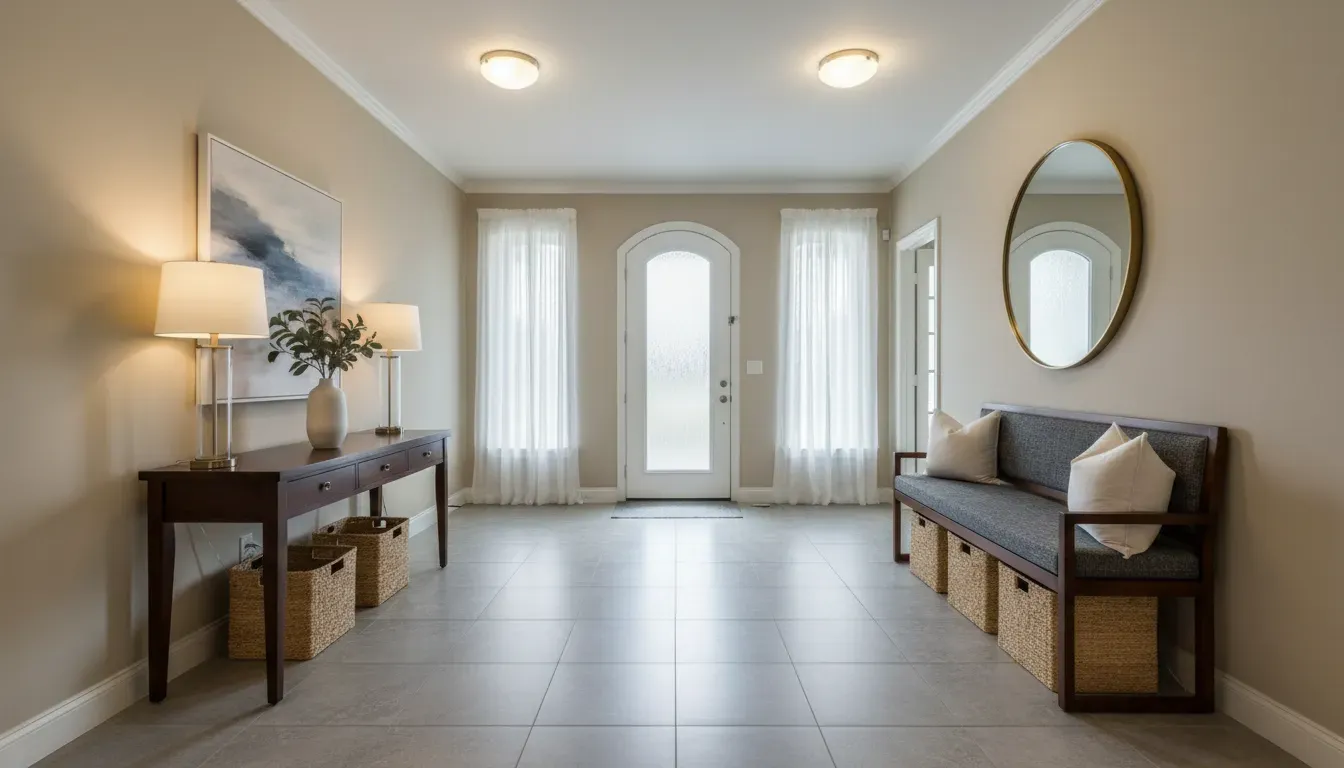
If you are fortunate enough to have a wide, grand foyer, symmetry becomes a powerful design tool. A common and elegant layout involves placing a console table on one side of the room and a storage bench on the opposite wall.
Balancing Visual Weight
This placement is about equilibrium. A console table tends to be visually “light” (often with legs and open space beneath), while a storage bench is visually “heavy” (solid, boxy, grounded). Placing them opposite one another balances the room.
Ensure that the distance between the two pieces of furniture allows for a generous flow. In a grand foyer, the center of the room might be occupied by a round table or a statement rug. The bench should be accessible but peripheral, framing the central feature.
Determining the Ideal Bench Dimensions
Placement is irrelevant if the scale is wrong. A bench that is too large dominates the space; one that is too small looks like an afterthought.
Length and Proportion
The length of your bench should be proportional to the wall it rests against. Ideally, the bench should cover about two-thirds of the wall length or be centered nicely under a window or architectural feature. If placing it at the foot of a staircase, it should not extend past the bannister.
Depth and Clearance
As mentioned, depth is critical for flow. Standard benches range from 15 to 20 inches deep.
- Narrow Hallway (3-4 ft wide): Max bench depth of 12-14 inches.
- Standard Foyer (5-7 ft wide): Max bench depth of 16-18 inches.
- Grand Foyer (8+ ft wide): Bench depth of 18-22 inches.
Also, consider the mechanics of the storage. If the bench features pull-out drawers, you need to measure the depth of the drawer plus the space for a person to stand in front of it to open it. This usually requires an additional 20 to 24 inches of clearance in front of the bench.
Search for Storage Bench with Drawers on Amazon
The Mechanics of Storage: Flip-Top vs. Cubbies vs. Drawers
The “flow” of an entryway isn’t just about walking; it’s about the workflow of usage. The type of storage mechanism you choose dictates where the bench can be placed.
Flip-Top Benches
These offer deep storage for seasonal items like blankets or winter gear. However, they require the user to stand up and clear the surface of the bench to access the contents.
- Placement Implication: Do not place these under low-hanging hooks or shelves that would block the lid from opening fully. Also, avoid placing them in high-traffic zones where daily shoe retrieval is needed, as the flip-top mechanism is cumbersome for everyday use.
Cubby Benches
Open cubbies are excellent for high-frequency items like daily shoes. They allow for a “kick-off and slide-in” workflow.
- Placement Implication: These are best placed in the most immediate drop zone. Because the contents are visible, they require discipline to keep tidy. If the bench is visible from the formal living room, open cubbies might create visual clutter.
Drawer Benches
Drawers hide the mess and offer organized segmentation.
- Placement Implication: As noted, these require frontal clearance. They are ideal for hallways where the messy look of shoes needs to be concealed to maintain a sleek corridor aesthetic.
Integrating the Bench with Other Entryway Elements
A bench does not exist in a vacuum. Its placement must coordinate with other functional elements of the entryway.
The Rug Relationship
Should the bench sit on the rug or off it?
- On the Rug: If you have a large area rug in the foyer, the front legs (or all legs) of the bench should sit on the rug to anchor it. This creates a cohesive “room” feel.
- Off the Rug: If you use a runner, the bench usually sits on the hard floor parallel to the runner. Do not place a bench so that it half-overlaps a thick runner, causing it to wobble.
Interference with Heat Registers and Outlets
A common oversight is blocking HVAC vents or electrical outlets. Placing a solid-base storage bench over a floor register can damage the furniture and disrupt the home’s climate control. If you must place a bench over a vent, use a model with legs and open space beneath to allow airflow. Similarly, if you plan to have a lamp on your bench or nearby, ensure the placement doesn’t cover the only available outlet.
Materiality and Durability in High-Traffic Zones
The entryway experiences the highest foot traffic and the most exposure to elements. Rain, mud, road salt, and grit are constant threats. The material of your bench dictates its longevity and placement.
If your bench is placed immediately next to the door, it is more susceptible to moisture. Avoid delicate velvets or untreated leathers in this “splash zone.” Instead, opt for performance fabrics, solid hardwoods, or metal and wood combinations that can withstand an occasional damp coat or wet umbrella.
For benches placed further into the home (under the stairs or down the hall), you have more freedom with luxurious textiles.
Search for Industrial Wood and Metal Bench on Amazon
Styling for Vertical Flow
Placement includes the vertical dimension. A bench low to the ground draws the eye down. To create optimal visual flow, you must draw the eye back up.
The Triangle of Design
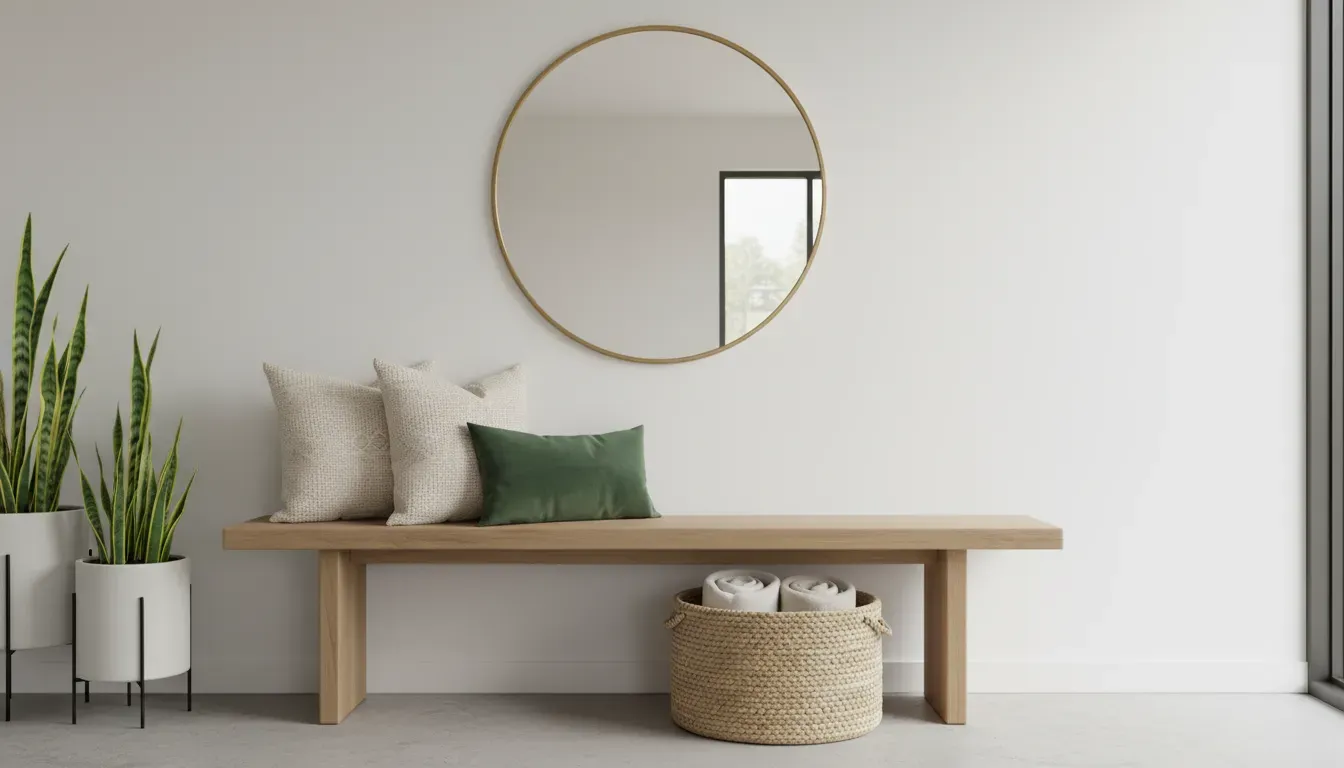
Create a visual triangle. The bench forms the base. Above it, artwork or a mirror forms the peak. Accessories like throw pillows or a tall plant beside the bench fill out the sides. This structure keeps the eye moving and prevents the entryway from feeling bottom-heavy.
When placing a mirror above the bench, ensure it is hung high enough that a person sitting doesn’t hit their head on the frame, but low enough to connect visually with the furniture. A gap of 8 to 12 inches between the top of the bench cushion and the bottom of the mirror frame is standard.
Obstacles to Avoid
In the pursuit of storage, homeowners often commit placement errors that ruin functionality.
- The “Shin-Buster”: Placing a bench that protrudes into the door swing radius.
- The Light Blocker: Placing a tall-backed bench in front of a sidelight window, reducing natural light in the foyer.
- The Closet Blocker: Placing a bench too close to the coat closet, making it difficult to open the closet bi-fold or swing doors.
- The Visual Wall: Placing a high-backed bench in an open concept space where it cuts off the line of sight to the rest of the home.
Conclusion: Balancing Form and Function
The placement of your entryway storage bench is a decision that impacts the daily rhythm of your household. It is not merely about finding a spot where the furniture fits; it is about finding the spot where the furniture flows. By respecting the 36-inch clearance rule, analyzing your specific traffic patterns, and choosing a bench scale that harmonizes with your architecture, you can transform your entryway from a cluttered pass-through into a sophisticated, organized welcome.
Remember that the optimal flow is one that feels intuitive. If you find yourself constantly walking around the bench, or if the bench collects clutter rather than containing it, re-evaluate the placement. The perfect spot is one where the bench feels like it has always belonged there—quietly supporting the transition from the busy world outside to the comfort of home.
For more insights on maximizing your home’s potential, consider exploring our guide on organizing small mudrooms to complement your new bench setup.