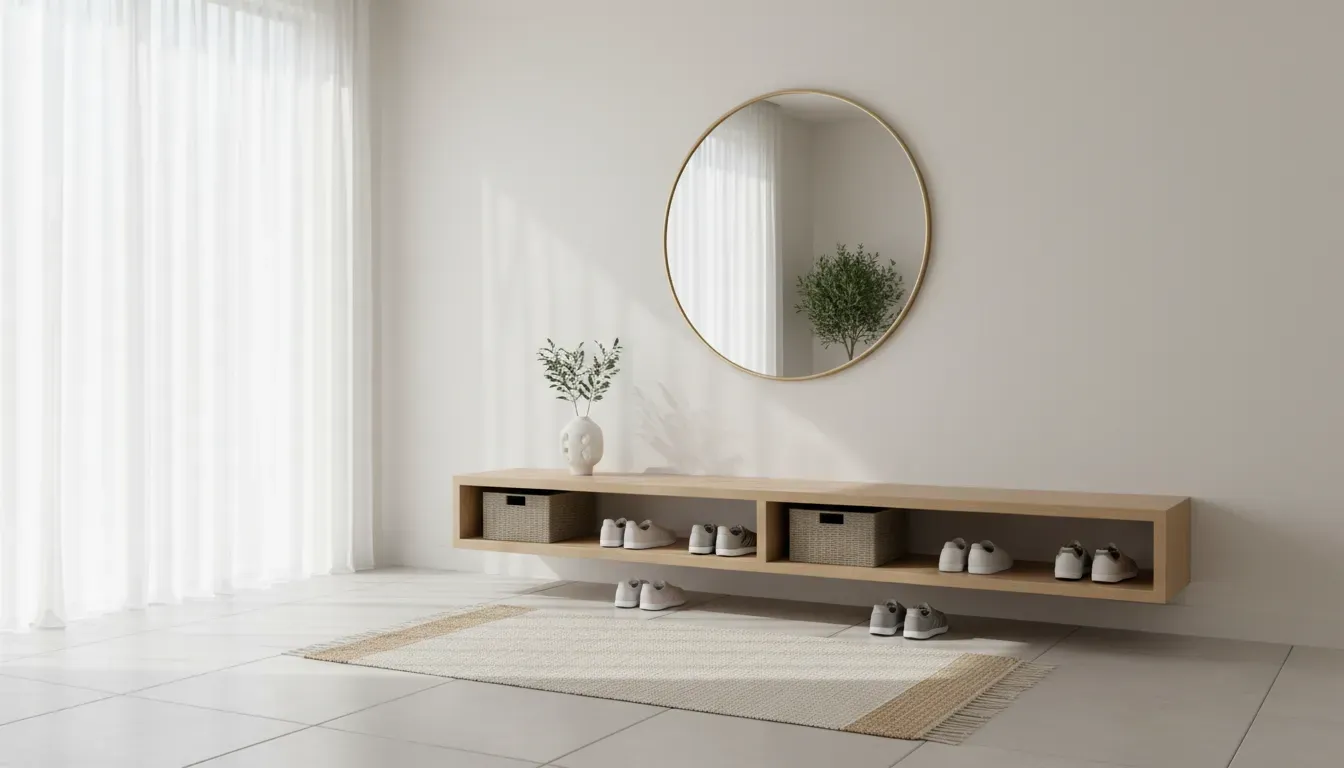
The Ergonomics of Entryway Benches with Storage: Seating Height and Depth
Discover how seating height and depth affect comfort and functionality in entryway storage benches. A complete guide to ergonomic foyer design.
Feb 4, 2026 - Written by: linda wise

The entryway is the handshake of the home. It is the first space to greet you and the last to bid you farewell. While aesthetic appeal often dictates the selection of furniture in this transitional zone, the functional mechanics of the space are paramount. Specifically, the entryway bench serves a unique dual purpose: it is a vessel for organization and a station for transition. Unlike a lounge chair designed for hours of relaxation, an entryway bench is a task-oriented seat. It facilitates the specific biomechanical actions of putting on or removing footwear, managing heavy coats, and organizing daily carry items.
When selecting an entryway bench with storage, the dimensions of height and depth are not merely measurements of spatial fit; they are the determinants of comfort, safety, and utility. This guide explores the sophisticated ergonomics behind entryway seating, dissecting how anthropometry intersects with interior design to create a space that functions as beautifully as it looks.
The Biomechanics of the Transition Zone
To understand the ideal dimensions of a bench, one must first analyze the physical movements performed in an entryway. This is not a space for static sitting. The primary activities involve bending at the waist, reaching toward the floor, lifting legs to tie laces, and transitioning from a seated to a standing position. These movements require a stable base of support and a geometry that encourages natural spinal alignment.
Ergonomics, the study of people’s efficiency in their working environment, applies heavily here. If a bench is too low, the act of standing up requires excessive quadriceps force and knee strain. If it is too high, the feet dangle, reducing stability while leaning forward to tie a shoe, which can lead to a precarious center of gravity. Furthermore, the integration of storage—whether drawers, cubbies, or flip-top compartments—alters the structural footprint of the furniture, often forcing compromises in seating depth that must be carefully managed.
Optimal Seating Height: The Goldilocks Zone
The standard height for dining chairs and office seating typically falls between 17 and 19 inches. However, the entryway bench operates under different parameters. The ideal height is contingent on the user’s popliteal height—the distance from the floor to the underside of the knee when the foot is flat.
For the average adult, a bench height between 18 and 20 inches is generally recommended. This slightly elevated position compared to a lounge sofa facilitates the “sit-to-stand” movement. When you are rushing out the door, the mechanical advantage of a higher seat allows for a quick exit without the struggle of hoisting oneself up from a deep squat.
The Shoe-Tying Factor
The specific task of tying shoes changes the equation. When you bend forward to reach your feet, your center of gravity shifts. A seat that is too low forces the knees above the hips, compressing the abdomen and making it difficult to breathe or reach the feet comfortably. Conversely, a seat that is too high forces the user to hunch over excessively to reach the floor.
For households with taller individuals or those with limited mobility, aiming for the upper end of the spectrum (19-21 inches) can preserve joint health. This height minimizes the degree of knee flexion required to sit and stand.
If you are looking for a robust solution that balances standard ergonomic height with substantial capacity, consider looking for solid wood options with reinforced joinery.
Shop Entryway Storage Benches on Amazon
Adjusting for Cushion Compression
A critical oversight in bench selection is failing to account for cushion compression. A bench frame might measure 17 inches, but with a 3-inch high-density foam cushion, the resting height sits at 20 inches. However, depending on the foam density, that height will decrease when occupied.
When calculating your ideal height, always factor in a 50% compression rate for standard foam. If the total uncompressed height is 20 inches, expect the functional sitting height to be closer to 18.5 inches. For storage benches with integrated upholstery, look for firm, high-resilience foam which maintains its structure better than softer polyester fills, ensuring the ergonomic height remains consistent over time.
Seating Depth: The Balance of Volume and Access
While height dictates the ease of movement, seating depth dictates stability and circulation. In the world of upholstery, seat depth is the measurement from the front edge of the seat to the backrest. However, many entryway benches are backless, or “back-optional,” which changes how we perceive depth.
The standard ergonomic depth for a seat is roughly 15 to 17 inches. This dimension accommodates the buttock-popliteal length (the horizontal distance from the rearmost part of the buttocks to the back of the lower leg).
The “Cutting” Sensation
If a bench is too deep (exceeding 20 inches) and has a backrest, a user sitting all the way back will find the front edge of the seat pressing into the back of their knees. This cuts off circulation and forces the user to slouch to let their knees clear the edge.
However, in an entryway context, deep benches are often desired to maximize the internal storage volume. A 24-inch deep bench offers significantly more storage for bulky winter boots or bins than a 15-inch bench. To reconcile this, one must treat a deep bench as a “perch” rather than a chair. Users will naturally sit on the front edge to tie their shoes.
The danger arises with deep, slick surfaces. If a bench is 24 inches deep and made of polished wood, sitting on the edge can feel unstable. In these scenarios, the use of a back bolster or decorative pillows is not just aesthetic; it is an ergonomic intervention. By placing firm pillows against the wall or backrest, you artificially shorten the seat depth, pushing the user forward to a comfortable position while retaining the storage volume underneath.
For those attempting to organize a narrow hallway, understanding the relationship between bench depth and walkway clearance is vital. You can read more about spatial planning in our guide to maximizing narrow corridor storage.
Storage Mechanics and Body Posture
The method of accessing storage within the bench profoundly influences the ergonomics of the piece. There are three primary configurations: the flip-top, the cubby, and the drawer.
The Flip-Top Constraint
The flip-top bench offers the cleanest aesthetic, hiding clutter completely. However, it presents a significant ergonomic hurdle: you cannot access the storage while seated. To retrieve a scarf or bag, the user must stand, step back, and lift the lid. This requires clear floor space in front of the bench. If your entryway is tight, the bending and lifting motion required to open a heavy wooden lid can be awkward. Flip-tops are best suited for long-term storage of off-season items rather than daily essentials.
Cubbies and Open Shelves
Open cubbies located beneath the seat allow for passive ergonomics. You can sit on the bench and reach down to slide your shoes into the compartment without standing up. This is the most efficient design for high-traffic households. However, it requires a bench height sufficient to accommodate tall boots, or the user will be forced to lay boots sideways, which can damage the footwear structure.
Drawers: The Middle Ground
Drawers offer the visual calm of a flip-top with the accessibility of a cubby. Ergonomically, high-quality drawer slides are essential. A drawer that sticks requires force to open, which can be difficult to manage while balancing on the bench. Soft-close mechanisms are ideal here to prevent jarring movements.
When selecting a bench with drawers, ensure the hardware does not protrude sharply, as this can scrape the back of the calves when the user pulls their feet back to stand up.
Shop Entryway Benches with Drawers on Amazon
The Child and Senior Variant
Ergonomics is not one-size-fits-all. A household often contains members with vastly different anthropometric needs.
Designing for Children
For children, a standard 19-inch bench is a climbing obstacle. Their feet will not touch the floor, making the task of putting on shoes unstable. While you cannot buy a miniature bench if adults also use it, you can modify the environment. A step stool tucked under a standard bench allows children to stabilize their feet. Alternatively, look for split-level benches that offer a tiered design, providing a lower seating surface for little ones and a higher perch for adults.
Designing for Seniors
For elderly users, the priority is stability and leverage. A bench that is too low is a fall risk. Furthermore, the surface texture becomes critical. Seniors require a high-friction material (like textured fabric or matte wood) rather than slippery leather or gloss finishes, to prevent sliding during the sit-to-stand transition.
Armrests are a game-changer for this demographic. While rare on simple storage chests, benches with integrated arms provide the leverage needed to push off into a standing position, significantly reducing the load on the hips and knees. If your bench lacks arms, ensure there is a stable console table or wall-mounted handle nearby.
Materiality and Structural Integrity
The materials chosen for an entryway bench affect both the durability of the piece and the comfort of the user. In high-traffic zones, the bench must withstand static loads (sitting) and dynamic loads (dropping heavy bags).
The Rigidity of Wood vs. Metal
Solid wood benches offer warmth and can be contoured for comfort, but they are unforgiving. A flat wooden seat can cause pressure points on the ischial tuberosities (sit bones) after just a few minutes. Metal benches, often industrial in style, are colder and harder.
If opting for a hard-surface bench for its durability and ease of cleaning, consider the edge profile. A “waterfall” edge—where the front of the seat curves downward—is superior to a sharp 90-degree angle. The sharp angle presses into the underside of the thigh, compressing nerves and impeding blood flow.
Upholstery Considerations
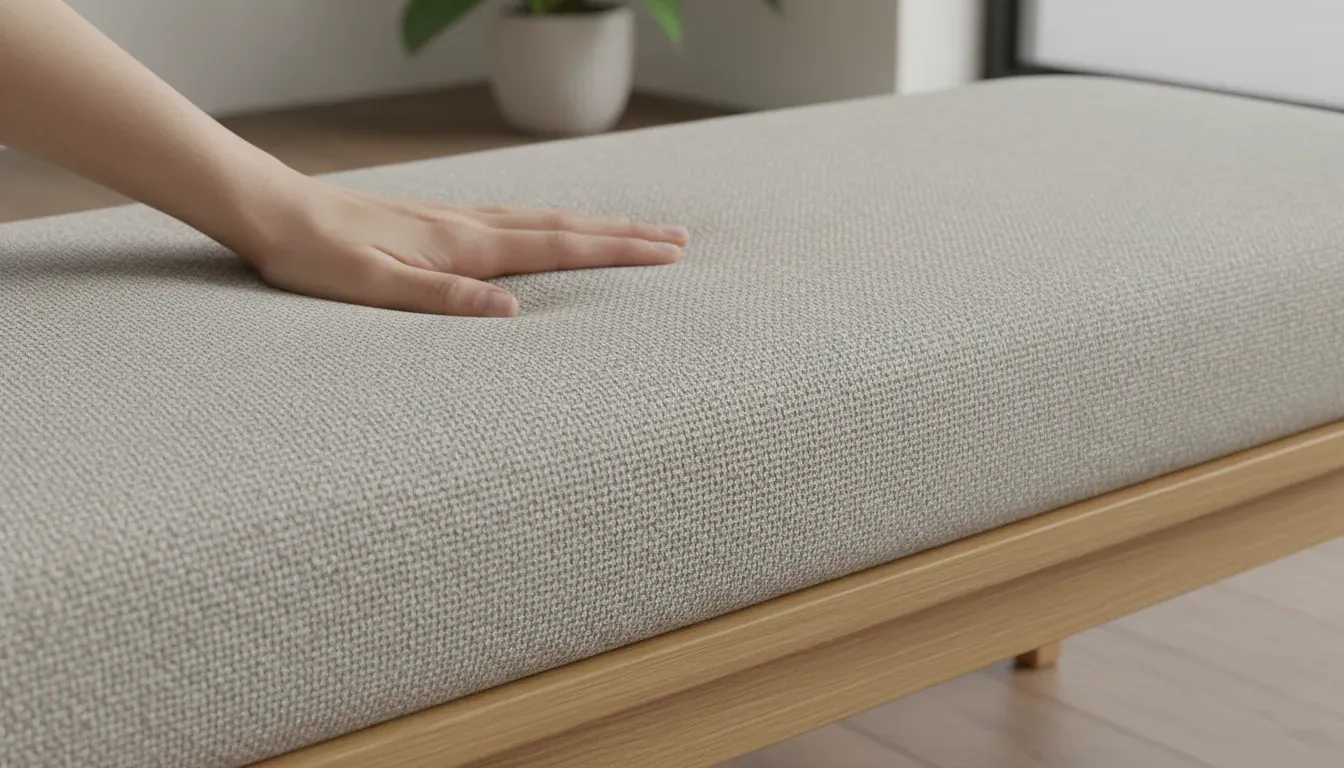
Upholstered benches introduce the variable of maintenance. In an entryway, mud, rain, and road grit are inevitable. From an ergonomic standpoint, the fabric should be taut. Loose fabric can bunch up, creating an uneven surface. Performance fabrics like Crypton or solution-dyed acrylics offer the softness of indoor furniture with the resilience needed for a mudroom.
Spatial Ergonomics: Clearance and Flow
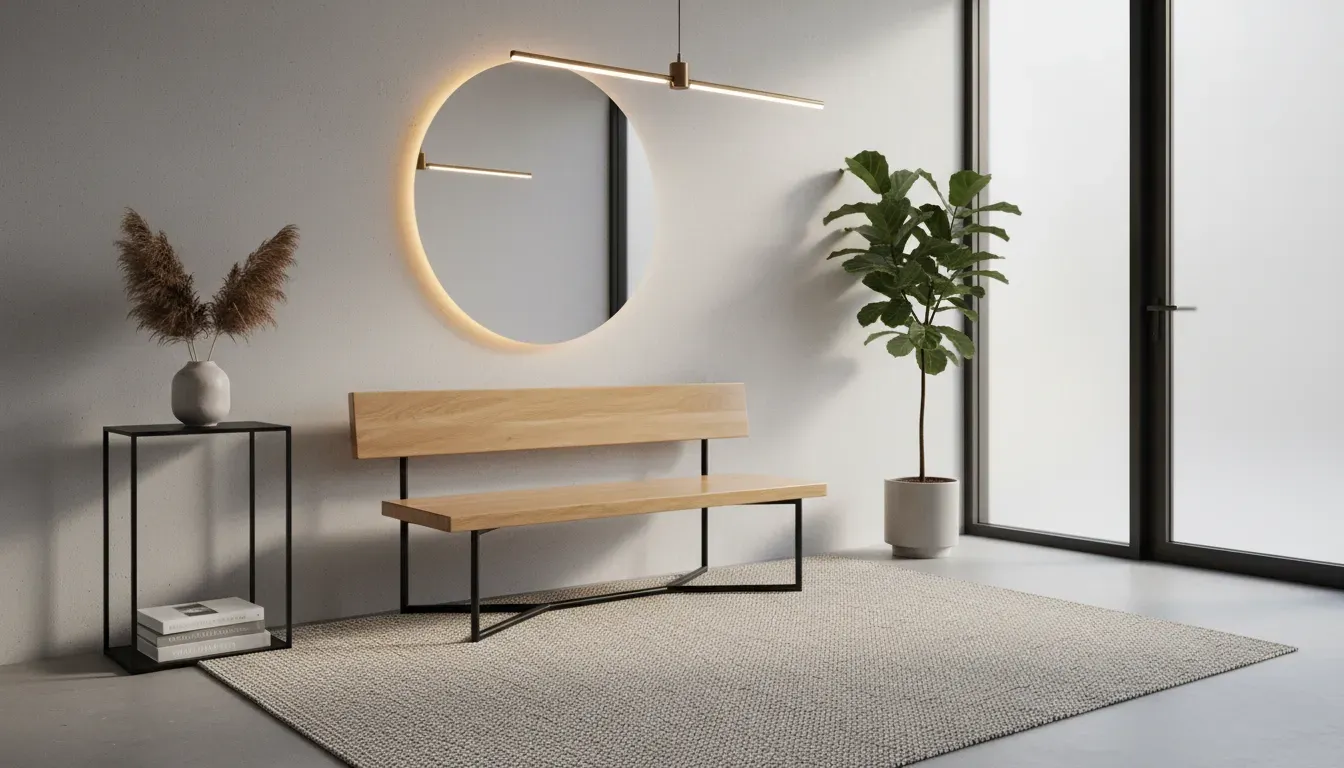
The bench does not exist in a vacuum; it exists in relation to the door, the walls, and the traffic flow. The “zone of use” extends beyond the physical footprint of the furniture.
The Knee Clearance Rule
When a person sits on a bench to tie their shoes, their knees protrude forward, and their head dips even further. You generally need 24 to 30 inches of clear space in front of the bench to allow a person to bend over comfortably without hitting a wall or an opposite console table. In a narrow hallway, a shallow bench (12-14 inches deep) may be necessary to preserve this clearance, even if it sacrifices some sitting comfort.
Door Swing Radius
A common error in entryway planning is placing the bench within the swing radius of the front door. Not only does this risk collision, but it also creates a psychological feeling of being cramped. Ergonomically, the user should be able to sit and remove shoes without blocking the entry for others entering behind them.
If your space is extremely limited, consider vertical solutions to supplement a smaller bench. You can explore ideas in our article on vertical storage integration.
Selecting the Right Bench for Your Anatomy
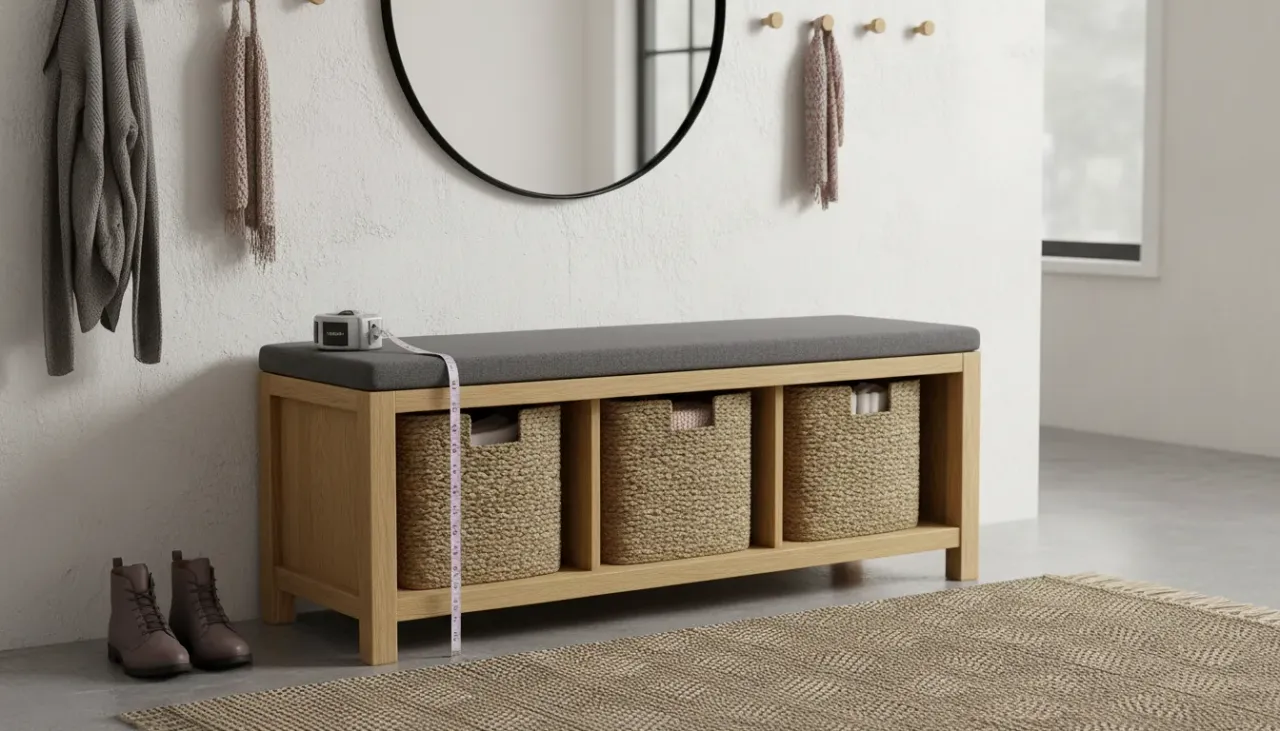
When shopping for an entryway bench, bring a tape measure and, if possible, test similar heights in person. Here is a checklist to ensure ergonomic compatibility:
- Measure Your Popliteal Height: Sit on a chair that feels comfortable. Measure from the floor to the crease of your knee. This is your target bench height.
- Account for Shoe Height: Remember that you are often wearing shoes when sitting down, adding 1-2 inches to your leg length, but barefoot when standing up. A compromise height is key.
- Check the “Toe Kick”: Does the bench have a solid base that goes all the way to the floor, or is it raised on legs? Benches raised on legs allow you to tuck your feet underneath the seat as you stand up, which provides better leverage and balance than a solid box base that forces your feet forward.
For a bench that offers a blend of ergonomic height, reasonable depth, and aesthetic versatility, upholstered options with raised legs are often the superior choice for body mechanics.
Shop Upholstered Storage Benches on Amazon
The Impact of Lighting and Visibility
While not a physical dimension of the bench, lighting plays a crucial ergonomic role. The entryway bench is a workspace for fine motor skills—buckling sandals, tying laces, and finding keys. Poor lighting forces the user to hunch lower to see what they are doing, compromising posture.
Ensure that your bench area is lit from above or the side. Avoid placing the light source directly behind the seated user, as this casts a shadow over the feet and the contents of the storage unit. If the bench has deep cubbies, the interior can become a “black hole.” Lighter-colored interiors or small motion-sensor puck lights inside the cubbies can drastically improve usability without requiring physical strain to search for items.
Customization: The Ultimate Ergonomic Solution
For those with specific orthopedic needs or non-standard entryway dimensions, custom or semi-custom solutions may be required. Floating benches—mounted directly to the wall—allow for perfect height customization. You can mount the bench exactly at your ideal ergonomic height. Furthermore, floating benches clear the floor space entirely, allowing for shoes to be kicked underneath without obstruction, and making it easier to clean the floor—an often overlooked aspect of home maintenance ergonomics.
However, floating benches require significant structural reinforcement in the wall (blocking) to handle the cantilevered load of a sitting adult. This is a project where the intersection of carpentry and ergonomics is most visible.
Conclusion
The entryway bench is a humble workhorse, but its design impact is profound. It supports us during the transition between the sanctuary of home and the demands of the outside world. By prioritizing ergonomics—specifically the interplay of seating height and depth—you transform a piece of furniture into a tool for daily living.
A well-chosen bench respects the body’s mechanics. It rises to meet you, supports you as you bend, and assists you as you stand. It hides the clutter of life without creating physical barriers to access. Whether you opt for a sleek modern flip-top or a rustic open-cubby design, let the measurements of the human body guide your choice. When form follows function, the result is an entryway that is not only organized but effortlessly welcoming.