
Maximizing Entryway Storage in the Absence of a Coat Closet
Transform your closet-less foyer into a functional organization hub. Discover expert strategies for maximizing entryway storage through furniture, hooks, and design.
Feb 2, 2026 - Written by: linda wise

The entryway sets the tone for the entire home. It is the transitional threshold between the chaotic outside world and your personal sanctuary. However, for many homeowners and apartment dwellers, this crucial zone lacks a fundamental architectural feature: the coat closet. Without a dedicated space to conceal outerwear, shoes, and daily accouterments, the front door area can quickly devolve into a cluttered obstacle course.
The absence of a built-in closet, however, should not be viewed as a deficit. rather, it presents a unique opportunity to curate a storage system that is both highly functional and visually arresting. By employing strategic furniture choices, utilizing vertical wall space, and implementing organizational psychology, you can create a “drop zone” that rivals any traditional closet in utility. This comprehensive guide will explore advanced strategies for maximizing entryway storage where no architectural footprint exists.
Assessing the Spatial Dynamics
Before purchasing furniture or drilling holes, one must conduct a thorough audit of the available space. Entryways without closets often fall into two categories: the narrow hallway or the open-concept entry that bleeds immediately into the living room.
The Traffic Flow Analysis
Measure the width of your entryway. In a narrow corridor, depth is your enemy. Furniture protruding too far into the walkway creates a claustrophobic effect and impedes traffic flow. Ideally, you should maintain a minimum of 36 inches of clearance for comfortable walking. For tighter spaces, look for furniture with a depth of 12 to 15 inches. In open-concept spaces, your storage solutions will need to serve as room dividers or visual anchors that define the entry zone without erecting walls.
Identifying Vertical Potential
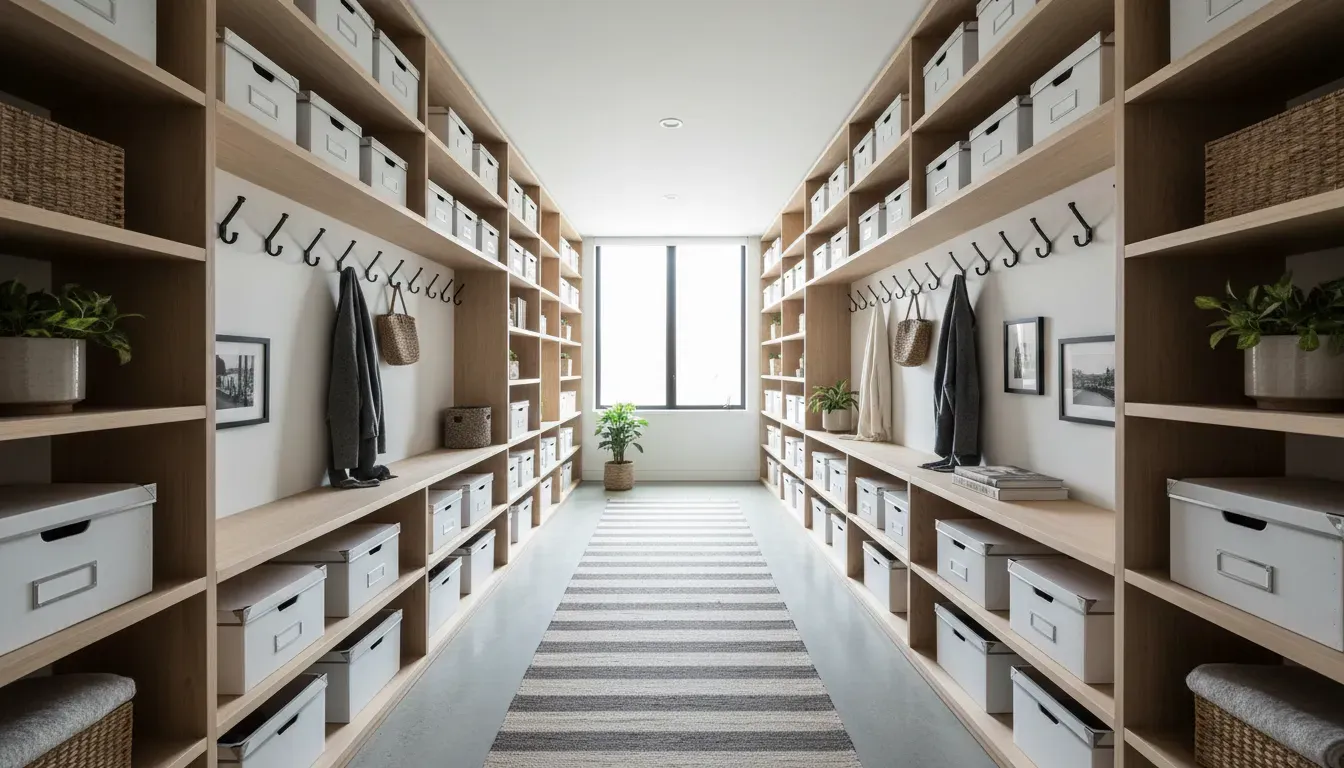
When floor space is at a premium, the only direction to expand is upward. The space between eye level and the ceiling is frequently underutilized. High shelving can house seasonal items, while mid-level storage handles daily essentials. Visualizing the wall as a grid allows you to layer storage solutions—shoes at the bottom, keys and mail at waist height, coats at eye level, and long-term storage above.
The Anchor Pieces: Furniture as Infrastructure
To replace a closet, you need furniture that mimics its function. These pieces serve as the “anchor” of your design, providing the bulk of the storage capacity.
The Hall Tree: An All-in-One Solution
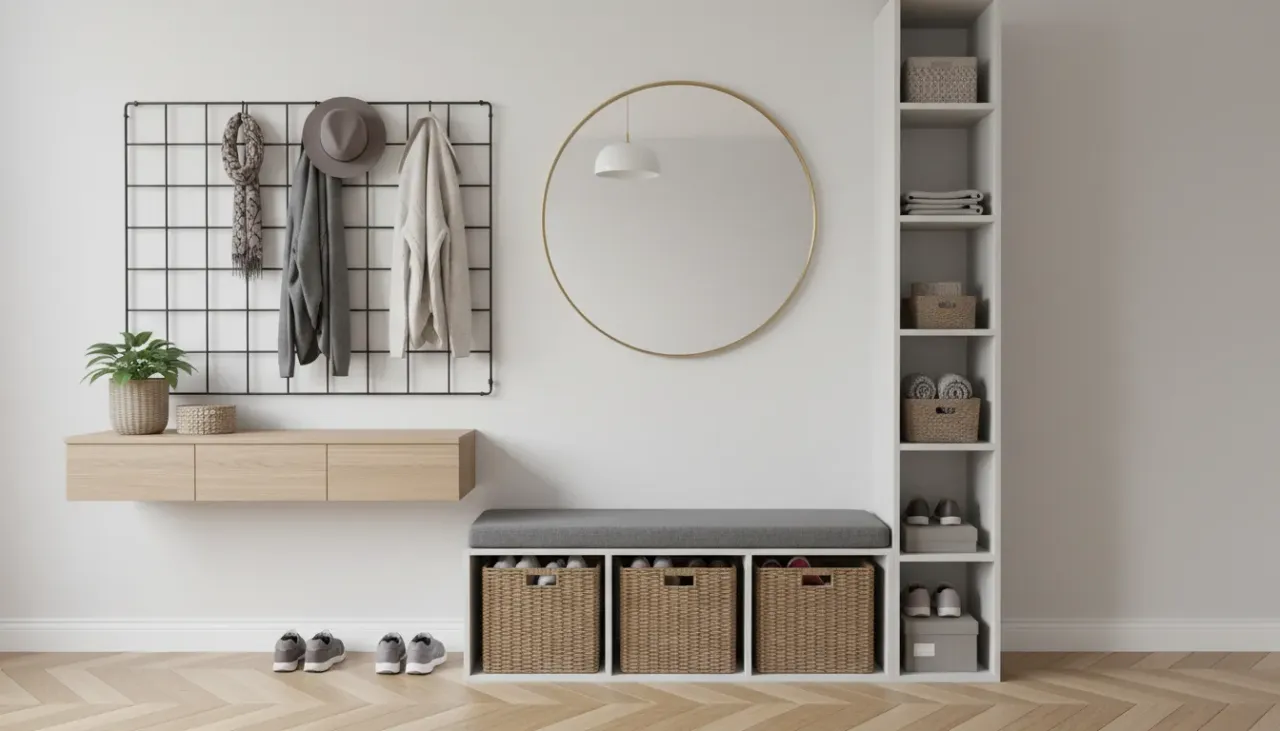
The hall tree is perhaps the most efficient standalone substitute for a closet. It combines a bench, hooks, and often upper or lower shelving into a single unit. When selecting a hall tree, aesthetics are paramount as this will be a dominant visual element.
For modern homes, opt for sleek metal and wood combinations that feel open and airy. For traditional spaces, a solid wood unit with beadboard backing offers a built-in look. If you have the width, choose a unit with a bench that lifts to reveal deep storage for bulky items like backpacks or winter blankets.
If you are looking for a robust solution that balances form and function, consider investing in a high-quality hall tree that fits your specific dimensions.
Shop Entryway Hall Trees with Storage
The Slim Shoe Cabinet
One of the greatest challenges in a closet-less entry is managing footwear. Piles of shoes create visual noise and tripping hazards. Traditional shoe racks often look messy and collect dust. The superior solution is the tipping-drawer shoe cabinet.
These cabinets are remarkably slim, often protruding less than 10 inches from the wall, yet they can hold a dozen or more pairs of shoes. The enclosed design keeps footwear out of sight, reducing visual clutter instantly. The top surface of the cabinet doubles as a console table for keys, mail, and decorative elements like a vase or table lamp.
The Console Table with Drawers
If your coat storage is handled by wall hooks, a console table is essential for the smaller items that usually end up on the kitchen counter. Look for tables with drawers to hide unsightly necessities like dog leashes, sunglasses, and wallets. The space beneath a console table is prime real estate for placing structured baskets or ottomans that can hold additional shoes or umbrellas.
For more ideas on selecting the right furniture for narrow spaces, read our guide on Choosing Slim Furniture for Tight Hallways.
Wall-Mounted Mastery: Hooks and Rails
When you cannot sacrifice floor space, the walls must work harder. Wall-mounted solutions are the most space-efficient way to handle coats, bags, and scarves.
The Peg Rail System
Inspired by Shaker utility, the continuous peg rail is a design favorite for good reason. Running a peg rail along the entire length of an entryway wall allows for flexible storage. You are not limited to a specific number of hooks; the entire perimeter becomes a storage opportunity.
This linear approach draws the eye horizontally, which can make a narrow hall feel longer. You can hang coats, canvas tote bags for returns or recycling, and even decorative items like dried flowers or mirrors directly on the pegs.
Staggered Hook Placement
A common mistake is installing a single row of hooks at one height. This limits capacity and often results in bulky coats covering up bags or scarves. A more effective strategy is staggered placement.
- The High Line (60-65 inches): Install heavy-duty hooks here for long trench coats and heavier winter parkas.
- The Mid Line (45-50 inches): This height is perfect for handbags, scarves, and lighter jackets.
- The Low Line (30-36 inches): Accessible hooks for children’s backpacks and coats encourage independence and keep kid-clutter off the floor.
Accordion and Vertical Racks
For tight corners behind the door, accordion racks expand to fit the available space and offer multiple hanging points. Vertical coat racks that mount to the wall are another sculptural option, looking like art when empty but holding substantial weight when needed.
Hidden in Plain Sight: Basket and Bin Organization
Open storage requires discipline. Without the ability to close a closet door on the mess, every item visible must be curated or contained. Baskets and bins are the uniform that brings order to the chaos.
Material consistency
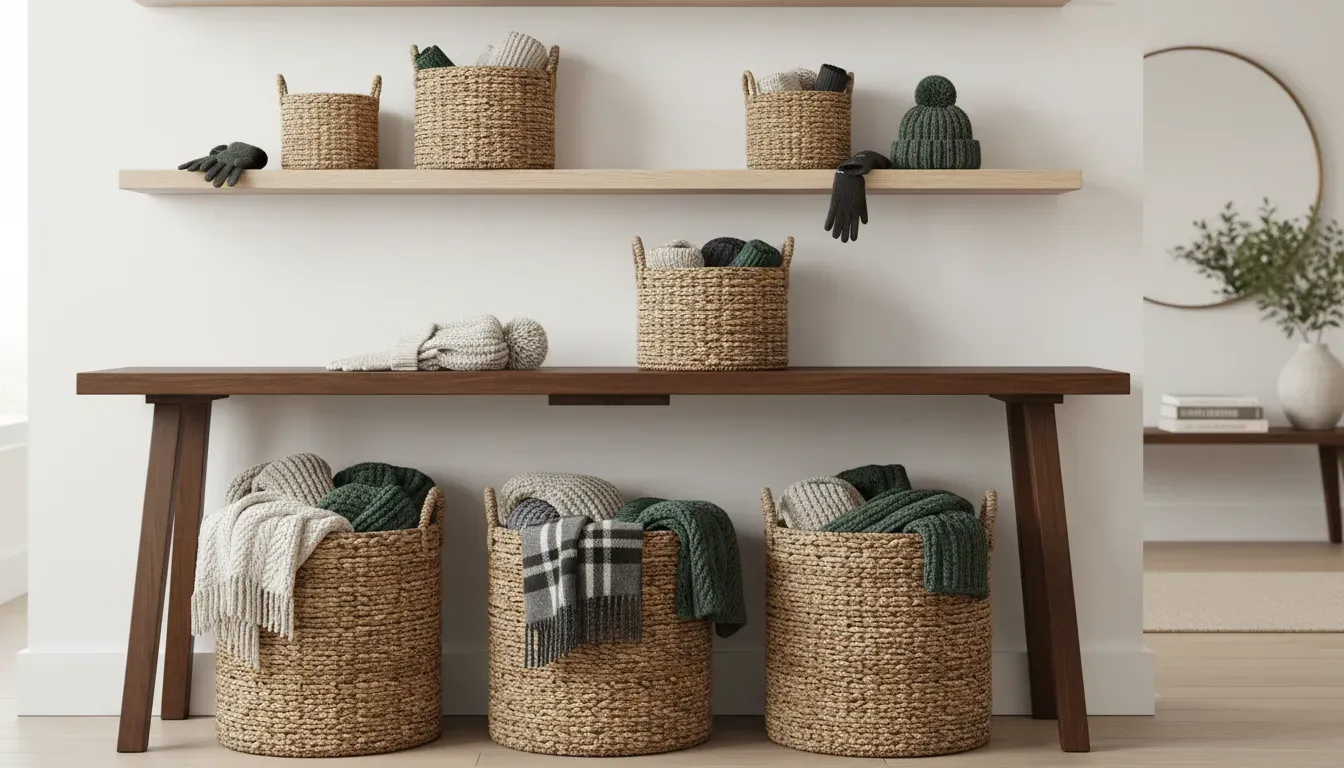
To maintain a sophisticated look, choose storage vessels made from consistent materials. Woven seagrass, felt, or wire baskets add texture to the space. If you mix materials, ensure they share a color palette. Uniformity creates a sense of calm and intentionality.
Categorization
Assign specific baskets to specific categories.
- The “Out the Door” Bin: Sunscreen, bug spray, and umbrellas.
- Winter Accessories: Hats, gloves, and thick socks.
- Pet Station: Leashes, waste bags, and treats.
Place these baskets on the high shelves of your hall tree or beneath your console table. For open shelving, consider opaque bins to completely hide the visual noise of the contents.
The Faux Built-In: Using Wardrobes
If you have a recessed wall or a sufficiently wide hallway, you can create the closet you never had using freestanding wardrobes. This is a common strategy in European homes where built-in closets are rare.
Large, standalone wardrobes (such as the PAX system from IKEA) can be anchored to the wall to serve as a coat closet. To elevate the look, add baseboard molding around the bottom and crown molding at the top to bridge the gap between the unit and the ceiling. This “hack” makes the furniture appear as if it were part of the original architecture.
Inside the wardrobe, you have full control over customization. Install double hanging rods to maximize coat storage, or designate one side for cleaning supplies and the other for outerwear. The doors can be fitted with mirrors to serve a dual purpose, reflecting light and allowing for a final outfit check.
Micro-Organization for Daily Essentials
The entryway is the primary landing pad for the pockets’ contents. Without a designated spot, keys and wallets migrate to the dining table or sofa.
The Catch-All Tray
A beautiful bowl or leather tray on your console or shoe cabinet is non-negotiable. It signals exactly where keys belong. This simple addition prevents the panic of lost keys during the morning rush.
Wall Pockets and Mail Sorters
Paper clutter is a silent killer of entryway aesthetics. Install a slim wall pocket or mail sorter near the light switch. Sort mail immediately upon entry: junk goes to the recycling bin (ideally hidden in a basket), and bills go into the sorter.
Managing the Seasonal Rotation
A closet-less entryway cannot store everything you own. It is a transit zone, not a storage unit. Success depends on a rigorous seasonal rotation strategy.
During the summer, heavy wool coats and snow boots must be relocated to under-bed storage, the attic, or a secondary closet in a guest room. Only current-season footwear and jackets should occupy the entryway. This “active storage” approach prevents the area from becoming overwhelmed.
Implement a “one in, one out” rule. If a new pair of shoes enters the rotation, an old pair must be moved to long-term storage or donated. This maintenance is critical when physical space is finite.
For tips on managing household clutter beyond the entryway, see our article on The Psychology of Decluttering.
Lighting and Mirrors: expanding the Visual Field
While not strictly storage, lighting and mirrors are essential components of a functional entryway, especially one that feels cramped due to added furniture.
Strategic Reflection
A large mirror is a non-negotiable element in a small entryway. It bounces natural light around the space, making a narrow hall feel twice as wide. Furthermore, it adds a vertical element that breaks up the heaviness of storage furniture.
Consider a large round mirror above a shoe cabinet or console. The curves soften the harsh lines of rectangular storage units and doors.
Layered Lighting
Dark corners feel cluttered. Ensure your entryway is well-lit with a combination of overhead lighting and accent lighting. A table lamp on a console adds warmth and makes the space feel like a room rather than a passage. Wall sconces flanking a mirror can provide even illumination without taking up table space.
Design Cohesion: Making It Beautiful
Functionality is the priority, but aesthetics ensure you enjoy the space. Since your storage is open and visible, it must be part of the decor.
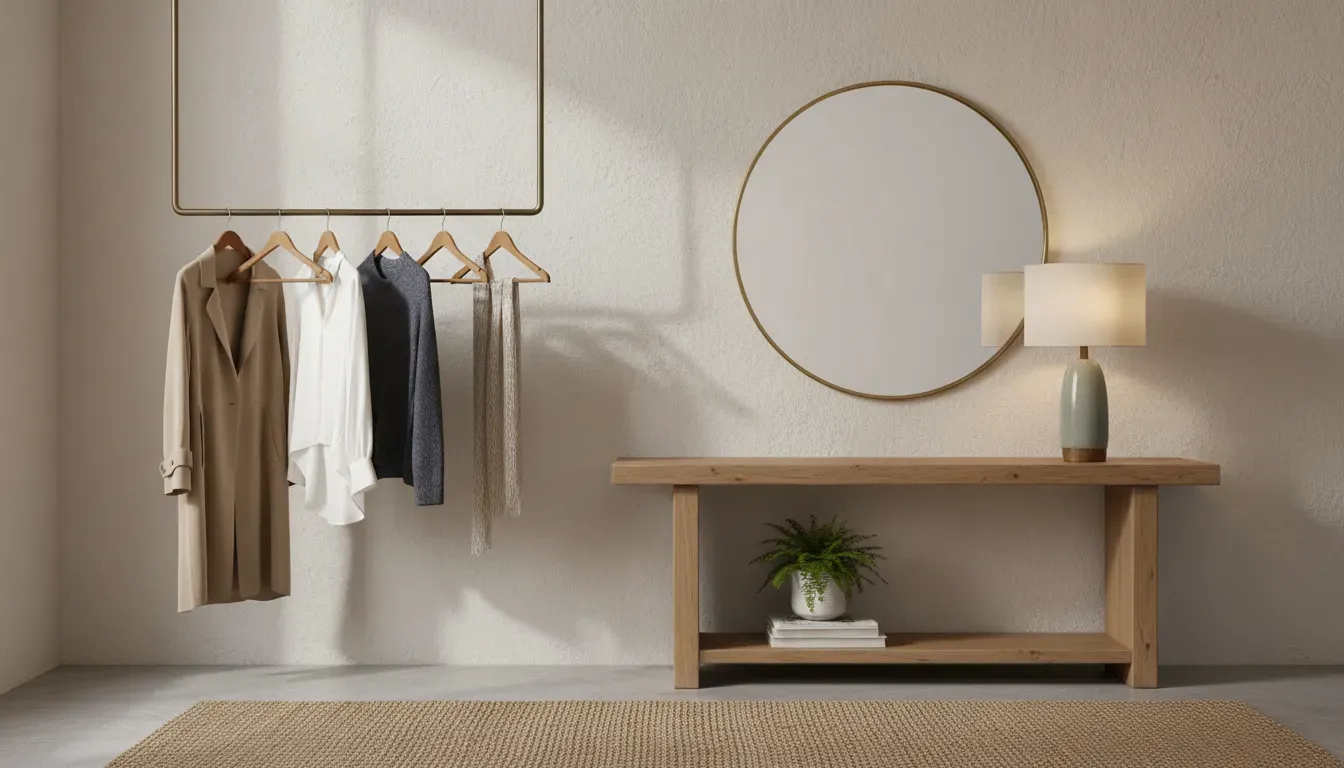
- Coordinating Hangers: If you use an open clothing rail, invest in high-quality wooden or metal hangers. Matching hangers turn a row of coats into a display rather than a mess.
- Rug Selection: A durable runner leads the eye into the home and defines the walkway. Choose materials like wool, jute, or polypropylene that can withstand heavy foot traffic and moisture.
- Greenery: A tall, slender plant or a small potted succulent on a shelf breathes life into the area and softens the utilitarian nature of the storage.
Conclusion
Living without a coat closet does not consign you to a life of clutter. It requires a shift in perspective—viewing your entryway not as a deficit, but as a blank canvas for creative problem-solving. By selecting multi-functional furniture like hall trees and tipping shoe cabinets, utilizing vertical wall space with pegs and shelves, and adhering to a strict seasonal rotation, you can construct an entryway that is efficient and elegant.
The key lies in the curation. Every hook, basket, and bench serves a purpose. When everything has a designated home, the architecture becomes secondary to the system you have built. Your entryway can be welcoming, organized, and beautiful, regardless of square footage or closet space.
Recommended Products Recap
- For All-in-One Storage: Entryway Hall Tree with Storage Bench
- For Footwear Management: Slim Shoe Storage Cabinet
- For Visual Space: Large Round Wall Mirror