
Organizing Seasonal Gear: Maximizing Entryway Storage for Winter Coats and Boots
Master the art of winter entryway organization. Learn expert strategies to store bulky coats, manage wet boots, and maximize space in your home's busiest zone.
Feb 2, 2026 - Written by: linda wise

The transition from the mild days of autumn to the harsh realities of winter presents a unique logistical challenge for homeowners. As temperatures drop, the volume of necessary daily gear expands exponentially. Lightweight windbreakers are replaced by heavy down parkas, canvas sneakers give way to insulated boots, and a myriad of accessories—scarves, gloves, and hats—suddenly require immediate accessibility. Without a strategic approach to organization, the entryway can quickly devolve into a chaotic bottleneck of wet fabrics and muddy footwear.
Maximizing entryway storage for winter gear is not merely about tidiness; it is about preserving the structural integrity of your home and maintaining a seamless flow for your household. A well-organized entry protects flooring from moisture damage, preserves the lifespan of expensive winter garments, and reduces the stress associated with morning departures. This comprehensive guide will explore high-density storage strategies, vertical optimization techniques, and furniture selections designed to handle the bulk and weight of seasonal necessities.
Assessing the Winter Volume: A Spatial Audit
Before purchasing bins or installing hooks, one must conduct a thorough audit of the entryway’s capacity versus the household’s actual needs. Winter gear is inherently bulky. A single winter coat can occupy the same closet rod space as four summer shirts. Furthermore, winter items are often wet or damp, requiring air circulation to dry properly, which precludes tightly packed storage solutions.
Begin by calculating the “active load” of your household. Count the number of heavy coats, pairs of boots, and accessory sets used on a daily basis. This inventory dictates the hardware requirements. If a family of four requires daily access to heavy wool coats, a standard tension rod may fail under the weight; instead, heavy-duty anchors and reinforced joinery become necessary.
Consider the traffic patterns of the space. In narrow hallways, protruding coat racks can impede movement. In such scenarios, recessed storage or flat-laying wall systems are superior. Acknowledging these spatial constraints is the first step toward a functional design.
The Coat Conundrum: Vertical Storage Optimization
The primary antagonist in entryway clutter is the winter coat. Whether it is a structured wool peacoat or a voluminous puffer jacket, outerwear demands significant vertical and horizontal space.
Implementing Heavy-Duty Wall Systems
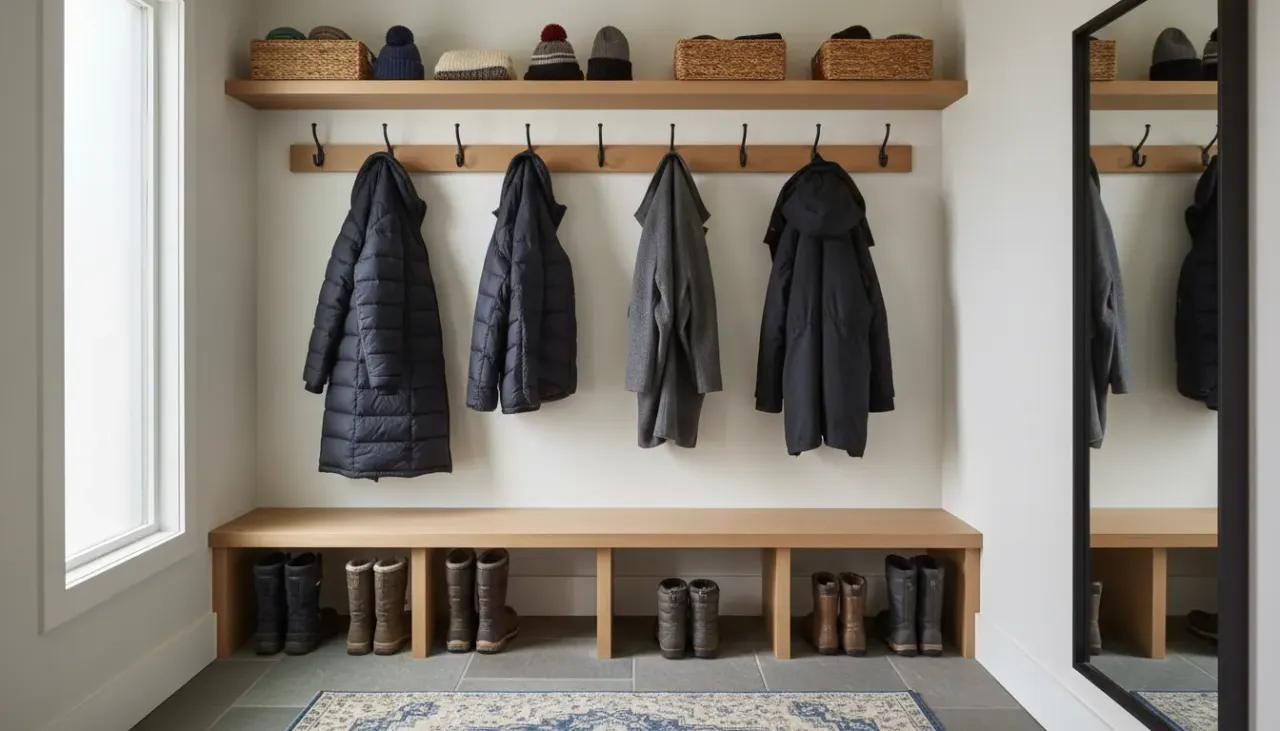
For homes lacking a dedicated coat closet, or for those where the closet is already at capacity, the wall becomes the primary storage asset. Standard hooks often fail to hold the hood, neck loop, and bulk of a heavy winter jacket simultaneously.
Invest in double-pronged, industrial-strength hooks mounted into studs or used with high-weight drywall anchors. Spacing is critical; install hooks at staggered heights to allow coats to hang without overlapping excessively. This staggering technique not only maximizes wall usage but also facilitates better airflow between wet garments.
For a streamlined aesthetic that handles heavy loads, consider installing a dedicated wall-mounted organizer. These units often combine hooks with upper shelving, providing a dual-function solution that utilizes the “air rights” of the room—the often-underused space near the ceiling.
Buy on Amazon: Wall Mounted Entryway Organizer
Optimizing Existing Closets
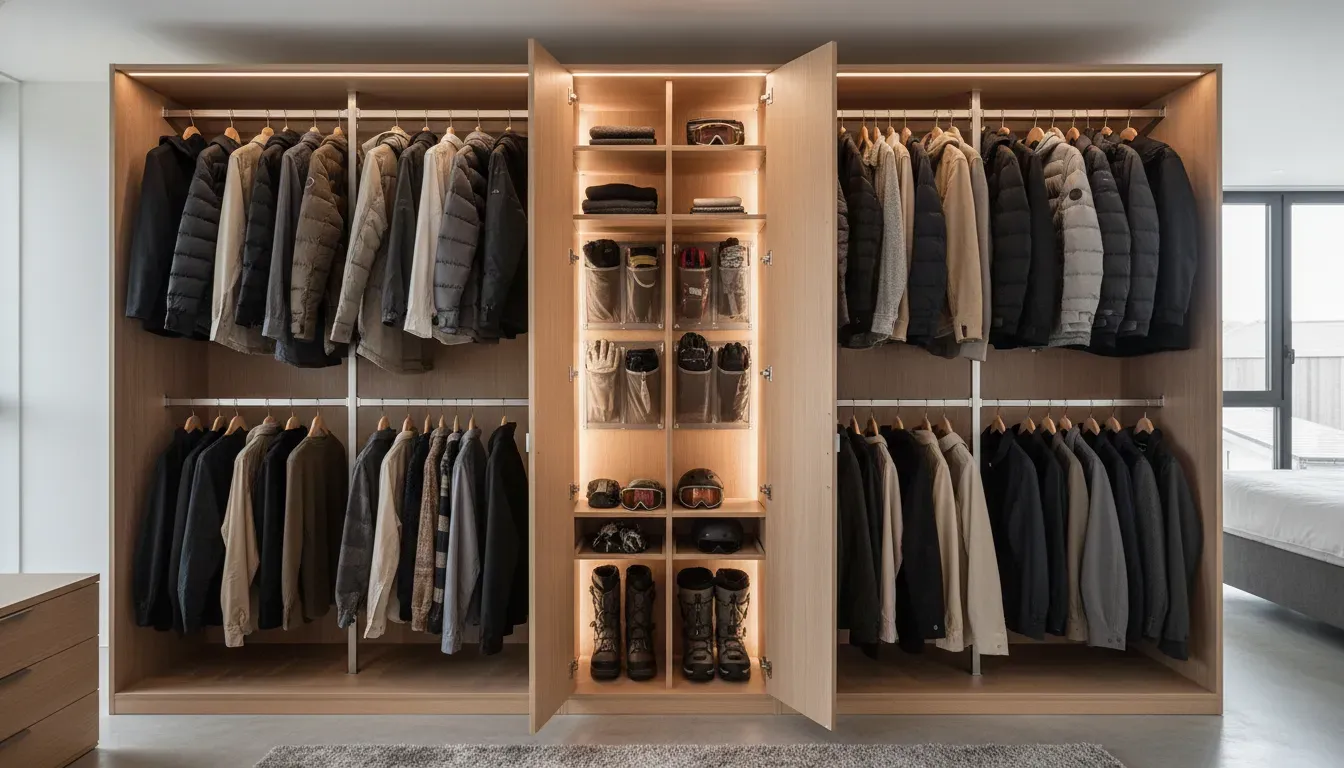
If your home features an entryway closet, the standard single-rod configuration is rarely sufficient for winter optimization. To maximize this space, consider raising the existing rod to accommodate longer trench coats and installing a secondary, lower rod for shorter jackets or children’s outerwear.
Door-mounted storage is another underutilized asset. Over-the-door racks or heavy-duty command hooks on the interior of the closet door can hold lighter jackets, leaving the main rod free for the heaviest items. This distribution of weight prevents the “crushed coat” phenomenon and makes retrieval easier. For more insights on dealing with limited square footage, read our guide on maximizing small entryway spaces.
Boot Management: Protecting Floors and Saving Space
Winter footwear poses a dual threat: it is bulky, consuming valuable floor space, and it carries moisture, salt, and grit that can damage hardwood and carpeting. Effective boot storage must address containment and drying simultaneously.
The Trapping Zone: Boot Trays
The most essential element of winter entryway preservation is the boot tray. However, a simple plastic mat is often insufficient for melting snow. Look for trays with raised ridges or internal grids. These features elevate the boot soles above the pooling water, allowing air to circulate beneath the shoe and speeding up the drying process. This prevents the formation of mold and odors associated with perpetually damp footwear.
For households with high boot volume, consider a multi-tier boot rack placed over a drip tray. This utilizes vertical space, clearing the floor area for traffic flow while ensuring that muddy run-off is contained.
Buy on Amazon: Waterproof Boot Tray Mat
Vertical Boot Organizers
Tall boots, such as riding boots or Wellingtons, present a stability challenge; they tend to topple over, creating a messy pile. Inverted boot racks, which hold the boot by the shaft upside down, are excellent for maintaining the shape of the footwear while ensuring maximum drainage. Alternatively, wall-mounted boot racks can lift footwear entirely off the floor, which is particularly effective in narrow corridors where floor space is at a premium.
Furniture with Function: The Storage Bench
The entryway bench is a staple of mudroom design, but in winter, it must serve as a workhorse of organization. A bench provides a necessary seating area for putting on and taking off difficult winter boots, but its potential for storage is often wasted if one relies on a simple open-legged design.
Closed Storage vs. Open Cubbies
For visual tranquility, a bench with a flip-top lid or deep drawers offers the ability to hide visual clutter. This is an ideal location for storing bulky items that are not used daily, such as backup scarves or heavy wool blankets.
However, for daily use items, open cubbies beneath the bench are often more practical. They allow for the quick “kick-off” of shoes and provide immediate visual inventory. If using open cubbies, utilize appropriately sized baskets to contain the chaos while maintaining accessibility.
When selecting a bench, prioritize materials that are resistant to moisture or are easily wipeable. Upholstered benches should be treated with high-performance, stain-resistant fabrics to withstand the inevitable exposure to wet outerwear.
Buy on Amazon: Hall Tree Storage Bench
The Accessory Station: Coralling Small Items
The primary source of frustration in a winter entryway is often not the large coats, but the small, easily displaced accessories. Gloves, mittens, beanies, and earmuffs require a granular organization system to prevent loss and mismatching.
The Basket Strategy
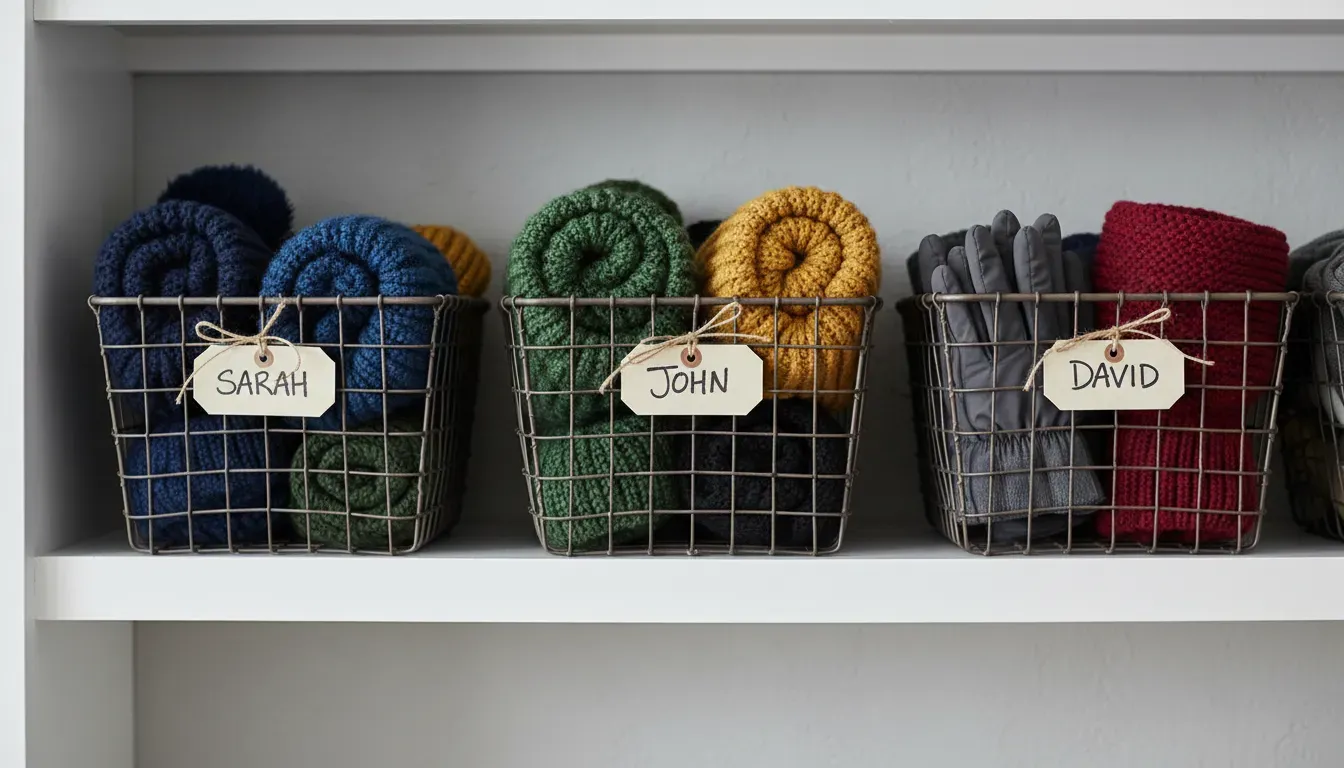
Assign a specific basket or bin to each family member. This personalizes the responsibility of organization and prevents cross-contamination of gear. Place these baskets on high shelves above the coat rack or in the cubbies of a console table. For wet gloves, wire baskets are superior to wicker or fabric bins, as they promote airflow and reduce drying time.
Drawer Dividers and Sorting
If your entryway furniture includes a console table with drawers, utilize rigid dividers to separate items by category. Create dedicated zones for “pairs” to ensure that gloves remain matched. A small, designated dish or tray for drying keys and hand warmers prevents moisture damage to the furniture surface.
For those interested in how these small details contribute to the overall aesthetic, consider exploring our article on seasonal entryway decor ideas, which discusses integrating function with style.
Seasonal Rotation: The Key to Year-Round Order
The most effective way to maximize winter storage is to remove non-winter items. The entryway is prime real estate; it should not be occupied by sandals, light windbreakers, or baseball caps during the months of December through March.
The Swap Protocol
Establish a strict “one-in, one-out” seasonal protocol. As the heavy coats come out of deep storage, the denim jackets and trench coats must be cleaned and relocated to secondary closets or under-bed storage containers. This rotation reduces the density of items in the entryway, making the space feel larger and more manageable.
Deep Storage Maintenance
Before rotating winter gear into the entryway, inspect it for wear and tear. Use this transition period to waterproof boots and dry-clean coats. Conversely, when storing summer gear away, ensure it is spotless. Storing soiled clothing invites pests and sets permanent stains. Vacuum-sealed bags are an excellent solution for compressing bulky off-season items, allowing you to store significant volumes of clothing in minimal space elsewhere in the home.
Moisture Control and Ventilation
Winter storage is inextricably linked to moisture management. An entryway filled with wet wool and damp leather can quickly develop a musty odor and increase the humidity levels of the immediate area.
Passive and Active Drying
Beyond the use of wire baskets and elevated boot trays, consider the airflow of the entryway itself. If the space is enclosed, such as a vestibule, ensure there is adequate ventilation. Leaving the interior door slightly ajar can help equalize temperature and humidity. For high-traffic mudrooms, a small dehumidifier or a boot dryer can be a game-changer, actively removing moisture from the most difficult-to-dry items.
Material Selection
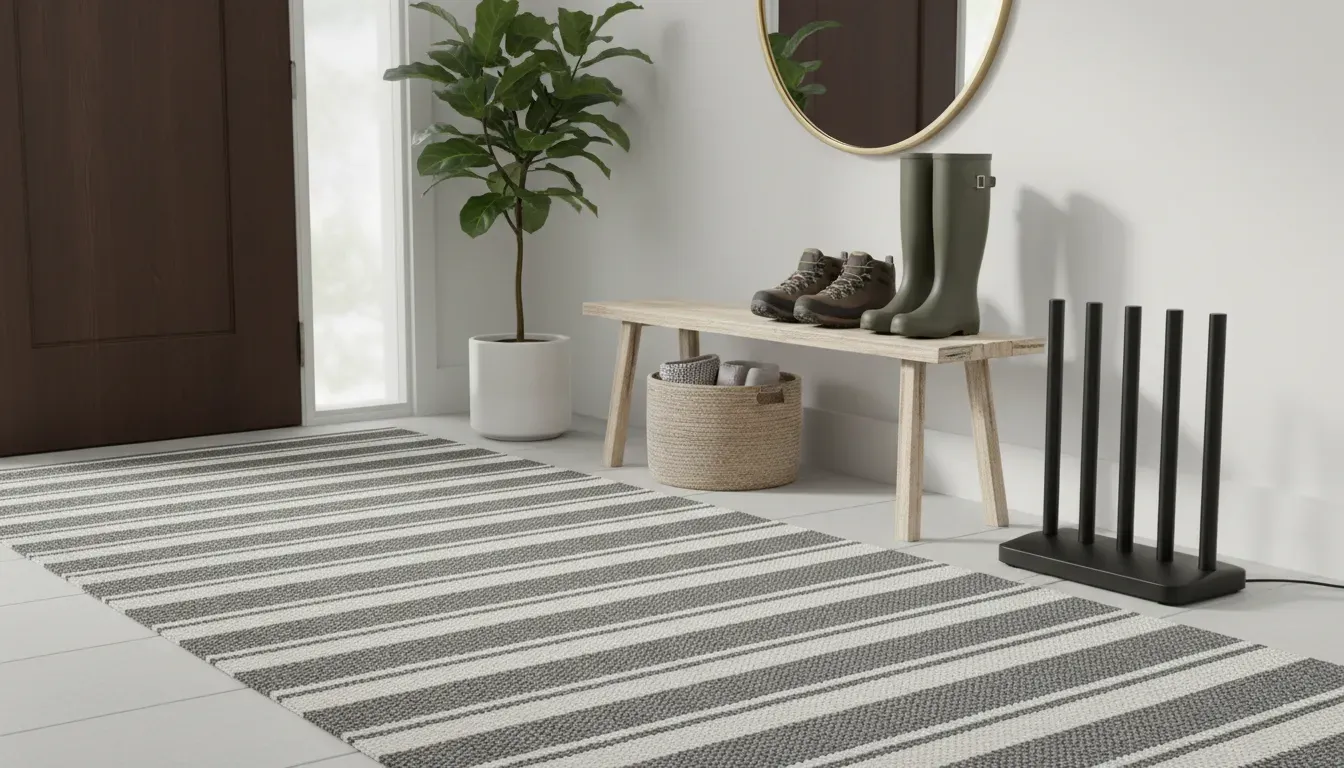
When choosing rugs and mats for the winter entryway, avoid natural fibers like jute or sisal, which retain water and rot. Opt for synthetic fibers like polypropylene or nylon, which are hydrophobic and resist mold growth. Washable runner rugs are particularly effective, as they can be cycled through the laundry to remove salt buildup and dirt.
Kid-Friendly Systems: Encouraging Independence
For families, the success of an entryway system depends entirely on its usability for children. If hooks are too high or drawers are too heavy, the gear will inevitably end up on the floor.
Lowered Expectations (literally)
Install a secondary row of hooks at a height accessible to your children. This simple adjustment empowers them to hang up their own coats and backpacks. Similarly, open baskets on the floor level are more effective for children than high shelves. If a child can easily drop their mittens into a designated bin, they are more likely to comply with the organizational system.
Visual Cues and Labeling
Utilize clear labeling for baskets and bins. For younger children, picture labels can be highly effective. Color-coding is another powerful tool; assigning a specific color hanger or basket to each child reduces confusion and arguments over misplaced items.
Maintaining the Aesthetic: Style Meets Utility
Functional winter storage need not look utilitarian or industrial. The market offers a plethora of sophisticated hardware options that blend seamlessly with modern, farmhouse, or traditional decor.
Integrating Decor
Treat your storage hardware as part of the design scheme. Brass or matte black hooks can serve as sculptural elements on a wall. A vintage wooden crate can serve as a stylish boot tray when lined with a plastic sheet. By selecting storage pieces that complement the home’s architecture, the entryway remains a welcoming space rather than just a storage depot.
Lighting the Way
Dark winter mornings and evenings make lighting a crucial component of organization. Ensure that the entryway is well-lit, not just for ambiance, but for functionality. A dark closet or dim corner encourages clutter, as items are tossed blindly into the shadows. Motion-sensor lights inside closets or cabinets can illuminate the depths of storage areas, ensuring that nothing is lost in the back corners.
Conclusion
Organizing seasonal gear is an exercise in logistics and spatial planning. By recognizing the specific volume and physical requirements of winter coats and boots, homeowners can create a system that withstands the heavy demands of the season. From vertical wall optimization and moisture-managing boot trays to the strategic rotation of seasonal items, every element plays a role in maintaining a serene and functional entryway.
Implementing these strategies transforms the entryway from a source of winter stress into a streamlined transition zone. When every coat has a hook, every boot has a tray, and every glove has a bin, the daily departure becomes efficient, and the return home becomes a welcoming relief from the cold. Preparation is the antidote to chaos; with the right systems in place, your entryway will remain elegant and orderly, regardless of the weather outside.