
From West Elm to Article: Comparing the Year's Top Mid-Century Entryway Benches
A deep dive comparing the build quality, aesthetics, and value of top mid-century modern entryway benches from West Elm, Article, and hidden gems.

Feb 22, 2026 - Written by: Linda Wise

The entryway is the handshake of your home. It’s the first thing guests see, but more importantly, it’s the transition zone where you shed the armor of the outside world. I’ve always argued that the entryway bench is the unsung hero of interior design. It has to be sturdy enough to handle your weight while you wrestle off rain boots, yet stylish enough to set the tone for the entire house.
For the last decade, Mid-Century Modern (MCM) has choked out almost every other design language in this space. Why? Because MCM furniture, with its tapered legs and raised profiles, allows light to pass underneath. It creates “visual airiness.” In a cramped foyer, seeing the floor extend beneath the furniture tricks the brain into thinking the room is larger than it is.
But here is the dilemma I see my clients face constantly: Do you drop $700 on the ubiquitously popular West Elm mid-century bench? Do you gamble on the direct-to-consumer darling, Article? Or can you find a piece on Amazon that doesn’t look like it was glued together with hope and particle board?
I’ve spent the last six months analyzing the grain patterns, cushion densities, and joinery of the year’s top contenders. We aren’t just looking at pretty pictures here; we are looking at longevity, value, and that elusive “wow” factor.

The Heavyweights: West Elm vs. Article
When you start Googling “mid-century bench,” these are the two giants that dominate your feed. They represent two different eras of furniture buying: the established retail showroom and the digital-native disruptor.
The West Elm Experience
West Elm’s “Mid-Century Bench” is essentially the Toyota Camry of the design world. It is reliable, everyone recognizes it, and it holds its resale value surprisingly well.
The Aesthetic: They usually nail the “Acorn” finish. It’s that warm, honey-toned brown that pairs effortlessly with cool grays and vibrant greens. The silhouette is classic 1950s—clean lines, slightly angled legs, and usually a canvas or velvet cushion.
The Reality Check: Here is where I get frustrated. While the legs are often solid eucalyptus or rubberwood, the main body frequently utilizes engineered wood with a veneer. Now, veneer isn’t inherently bad—it prevents warping—but when you are paying a premium, you expect a certain tactile weight that is sometimes missing here.
Pro Tip: If you are buying from West Elm, check the lead times. I’ve seen clients wait four months for a bench that was listed as “in stock” because their inventory management can be disjointed.
The Article Approach
Article, on the other hand, operates without brick-and-mortar overhead. Their “Nord” or “Cenia” lines often compete directly with West Elm.
The Build Quality: I’ve found Article tends to use more solid wood in their construction relative to the price point. Their walnut finishes often feel deeper, more three-dimensional than the flatter finishes of some high-street competitors. The cushioning on their upholstered benches is usually firmer, utilizing high-density foam that doesn’t collapse after six months of daily shoe-tying.
The Logistics: Shipping is flat-rate, and boxes usually arrive faster. However, you are acting as your own quality control. If a leg arrives scratched, you are the one boxing it back up.
The Material Science: Why Some Benches Wobble
To understand value, you have to look past the marketing fluff. The difference between a bench that lasts two years and one that becomes an heirloom lies in the joinery and the materials.
The Wood Hierarchy
- Solid Hardwood (Walnut, Oak, Teak): The gold standard. If you scratch it, you can sand it. It ages and develops a patina.
- Solid Softwood (Pine, Rubberwood): Common in mid-tier MCM furniture. It’s solid, but it dents easily. If you have a chaotic household with kids throwing cleats around, rubberwood might look beaten up quickly.
- Veneer over MDF: This is a thin slice of real wood glued over compressed sawdust. It looks great on day one. But if water gets under that veneer (say, from a wet umbrella), it bubbles. Game over.
Upholstery Rub Counts
If you choose a padded bench, ask about the “double rub” count. This is a standardized test where a machine rubs the fabric back and forth until it wears through.
- Residential Grade: 15,000+ rubs.
- Commercial Grade: 30,000+ rubs.
Many “budget” MCM benches use fabrics rated for 10,000 rubs or less. They look bald within a year.
The Hidden Gems: Top Alternatives You Can Buy Right Now
Not everyone wants to wait twelve weeks or spend a mortgage payment on a place to sit for thirty seconds. I’ve scoured the market for alternatives that hit that sweet spot of MCM aesthetics and surprising durability. These are the pieces I recommend when the budget is tight but taste is high.
1. The Purist’s Choice
If you want that architectural, slat-bench look famously associated with George Nelson, you don’t need to buy a museum piece. I recently sourced the Modway Engage Mid-Century Bench for a client’s narrow hallway. The cherry-stained rubberwood legs are surprisingly substantial, and the tufted upholstery mimics the high-end look perfectly. It has that distinct sloping arm that creates a sculptural element, rather than just being a flat surface.
2. The Storage Workhorse
Mid-century design often sacrifices storage for silhouette. However, real life requires a place to hide dog leashes. The Simpli Home Ottomon Bench is a rare find that keeps the tapered legs and retro vibe but includes a flip-top compartment. The fabric quality here surprised me—it has a linen-like weave that resists pilling better than some benches double its price.
3. The Solid Wood Stunner
For those who prefer a hard surface (easier to clean, especially in muddy climates), check out the Vasagle Solid Wood Entryway Bench. While it leans slightly more industrial-MCM, the build is incredibly rigid. It lacks the complex joinery of a $1,000 piece, but it doesn’t wobble. Styling this with a sheepskin throw softens the look instantly.
The Functional Dilemma: Storage vs. Aesthetics
This is the eternal struggle. The defining characteristic of mid-century design is minimalism—floating forms and negative space. The defining characteristic of a functional entryway is clutter management.
When you buy a bench like the West Elm Mid-Century, you are buying a surface. There is no drawer. There is no shelf. Your shoes have to go somewhere else. If you pile them underneath, you ruin the “airiness” you paid for.
If you absolutely need to hide footwear, you have to look for hybrid designs. I’ve seen excellent setups where a simple bench is paired with a wall-mounted floating cabinet above, or where the bench has a discrete, slatted lower shelf.
If you are struggling to balance the clean lines of MCM with the reality of a pile of sneakers, I recommend reading our deep dive on blending style with utility in mid-century entryway benches with storage. It covers specific configurations that hide the mess without blocking the light.
Styling Your Bench: The “Drop Zone” Psychology
Buying the bench is only step one. A bench sitting alone against a white wall looks like a waiting room. You have to anchor it.
The Anchor Rug
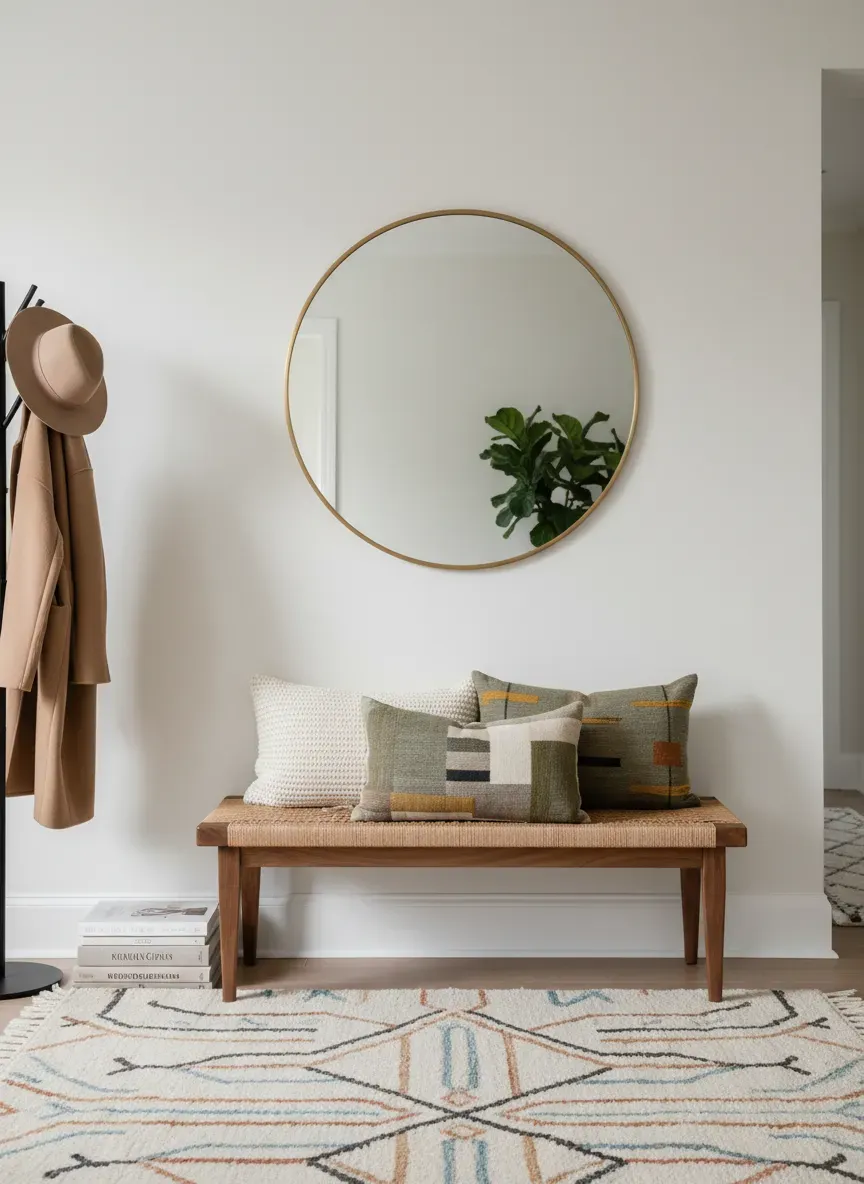
Because MCM benches have legs rather than a solid base, they can feel like they are floating away. You need a rug to ground them.
- Size Matters: The rug should be wider than the bench by at least 12 inches on either side.
- Texture: Since MCM surfaces are smooth (wood, velvet, leather), go for high texture in the rug. A chunky wool loop or a vintage Kilim adds necessary friction to the design.
The Vertical Element
You need something above the bench to draw the eye up. A round mirror is the classic MCM pairing—it breaks up the linear geometry of the bench. Alternatively, a row of Shaker-style hooks or a bold piece of abstract art works well.
Lighting
Don’t rely on the overhead hallway light. It casts shadows on your face when you check your reflection. Flanking the bench with wall sconces creates a warm, inviting pool of light that highlights the wood grain of your bench.
When Mid-Century Isn’t the Right Fit
I love MCM. It’s timeless. But I’ll be the first to admit it can feel a bit… sterile. It lacks the coziness of more rustic styles. If your home has a lot of shiplap, exposed heavy beams, or distressed finishes, a sleek walnut bench might look like a spaceship landed in a barn.
It’s crucial to respect the architecture of your home. If the clean lines of MCM feel a bit too cold or disconnected for your foyer, you might find more warmth by exploring our guide on the best farmhouse entryway benches for a cozy welcome. Sometimes, a chunky, reclaimed wood bench is exactly what a space needs to feel grounded.
Navigating Small Spaces
The biggest advantage of the mid-century aesthetic is its scalability. The “leggy” nature of these benches makes them ideal for narrow apartments or homes where the front door opens directly into the living room.
However, standard sizes (usually 48 to 60 inches) can still dominate a tight hallway. You need to look for “loveseat” sized benches or even large ottomans that mimic the bench profile.
Key Takeaways for Small Spaces:
- Depth is Key: Look for a bench depth of 15 inches or less. Standard depth is 18-20 inches, which can choke a hallway.
- No Arms: Benches with armrests add bulk and make it harder to slide onto the seat from the side.
- Visual Transparency: A bench with a woven rope seat or light-colored upholstery takes up less visual weight than a black leather block.
For those of you dealing with truly tight square footage, I’ve compiled a list of compact entryway benches that maximize storage without sacrificing that designer look.
Durability and Maintenance: Keeping the Look Alive
You’ve bought the bench. Now, how do you keep it from looking like a scratching post?
The Walnut Shell Trick
Most MCM benches feature dark wood tones (Walnut, Acorn, Espresso). When you inevitably scratch a leg with a vacuum cleaner or a boot zipper, don’t panic. Take a literal walnut meat (the nut, not the shell), break it, and rub the oil into the scratch. It darkens the wood instantly and masks the damage better than most markers.
Tightening the Bolts
This is the number one failure point I see. Mid-century legs are often angled outward. This puts significant torque on the connection point when you sit down. Every six months, flip the bench over and tighten the hex bolts. If they keep coming loose, a drop of blue Loctite thread locker is your best friend.
Sun Damage
MCM finishes, particularly on vintage or high-end reproduction pieces, can be sensitive to UV light. If your entryway has a sidelight window, the sun hitting one side of the bench will fade it unevenly over a year. Rotate the bench occasionally, or apply a UV-protective window film to your door.

The Bottom Line
Choosing between West Elm, Article, or a budget-friendly alternative isn’t just about the logo. It’s about how you live.
Choose West Elm if: You want the brand recognition, you are matching other pieces in their collection, and you are willing to wait for delivery. Their finishes are consistent, and the resale value is high.
Choose Article if: You want a slightly better price-to-quality ratio, prefer solid wood components, and want it delivered quickly. You are comfortable with a more streamlined, online-only customer service experience.
Choose the Alternatives if: You are smart with your money. The Modway Engage Mid-Century Bench and the Simpli Home Ottomon Bench offer 90% of the aesthetic for 50% of the price. If you have pets, kids, or a rental property, these are the logical choices. They allow you to achieve the look without weeping when someone spills coffee on them.
Your entryway sets the stage. Whether you go with the high-end teak or the clever budget find, the goal is the same: creating a space that welcomes you home with style and stability. Don’t overthink the brand name; focus on the materials, the dimensions, and how it makes you feel when you walk through the door.