
10 Best Sites to Download High-Quality Free Workbench Plans
Discover the top 10 resources for downloading premium, free workbench plans. Expert insights on design, materials, and workshop ergonomics.

Mar 25, 2026 - Written by: Linda Wise

Every woodworker’s journey begins with a flat surface. I remember my first workbench vividly—a wobbly, terrifying contraption held together by drywall screws and sheer stubbornness. It racked every time I pushed a hand plane, and the top was about as flat as a potato chip. You learn very quickly that a workbench isn’t just a table; it’s a three-dimensional clamping system. It is the most important tool in your shop.
Building your own bench is a rite of passage. But winging the design is a recipe for wasted lumber and perpetual frustration. You need a proven blueprint. The internet is flooded with half-baked DIY diagrams, but finding structurally sound, meticulously engineered schematics takes digging. I’ve spent years analyzing, building, and modifying shop fixtures, and I’ve curated the definitive list of the 10 best sites to download high-quality free workbench plans.
Before we tear into the resources, let’s gear up. A solid bench requires serious hardware to function properly.
Quick Comparison: Top Picks
| Product | Rating | Check Price |
|---|---|---|
| Heavy Duty Retractable Workbench Casters | ⭐⭐⭐⭐⭐ | View on Amazon |
| Yost 7-Inch Woodworking Vise | ⭐⭐⭐⭐½ | View on Amazon |
| Kreg K4 Pocket-Hole Jig | ⭐⭐⭐⭐⭐ | View on Amazon |
The 10 Best Sites for Free Workbench Plans
Finding the right plan depends entirely on your workflow. A power-tool user needs a vastly different surface than a traditional hand-tool purist. Here are the absolute best digital archives available today.
1. Fine Woodworking
Fine Woodworking is the undisputed heavyweight champion of the craft. Their archives read like a masterclass in structural integrity. When you download a free plan from their site, you aren’t just getting cut lists; you’re receiving graduate-level education on grain direction, seasonal wood movement, and advanced joinery.
Their plans typically feature massive, heirloom-quality benches—think traditional Roubo designs with thick, laminated hard-maple tops, massive sliding deadmen, and sophisticated leg vises. If you want a bench that your grandchildren will inherit, this is your starting line.
2. Popular Woodworking
If Fine Woodworking is the Ivy League, Popular Woodworking is the gritty, practical trade school. Thanks heavily to the historical research of former editor Christopher Schwarz, this site is a goldmine for traditional, utilitarian workbenches that rely on mass and geometry rather than expensive hardware.
Look specifically for their plans on the Nicholson bench or the Anarchist’s Workbench. These designs utilize affordable construction lumber (like Southern Yellow Pine) and rely on massive mortise and tenon joints to eliminate racking.
3. Woodsmith Plans
You’ll notice that Woodsmith takes a highly systematic approach to their blueprints. Their free workbench plans are famous for hyper-detailed, exploded isometric illustrations. It’s nearly impossible to make a wrong cut if you follow their guides.
They excel at hybrid benches—designs that incorporate MDF tops, T-track systems, and integrated storage solutions. If your shop leans heavily on routers, track saws, and modern jigs, Woodsmith offers the perfect structural foundations.
4. Family Handyman
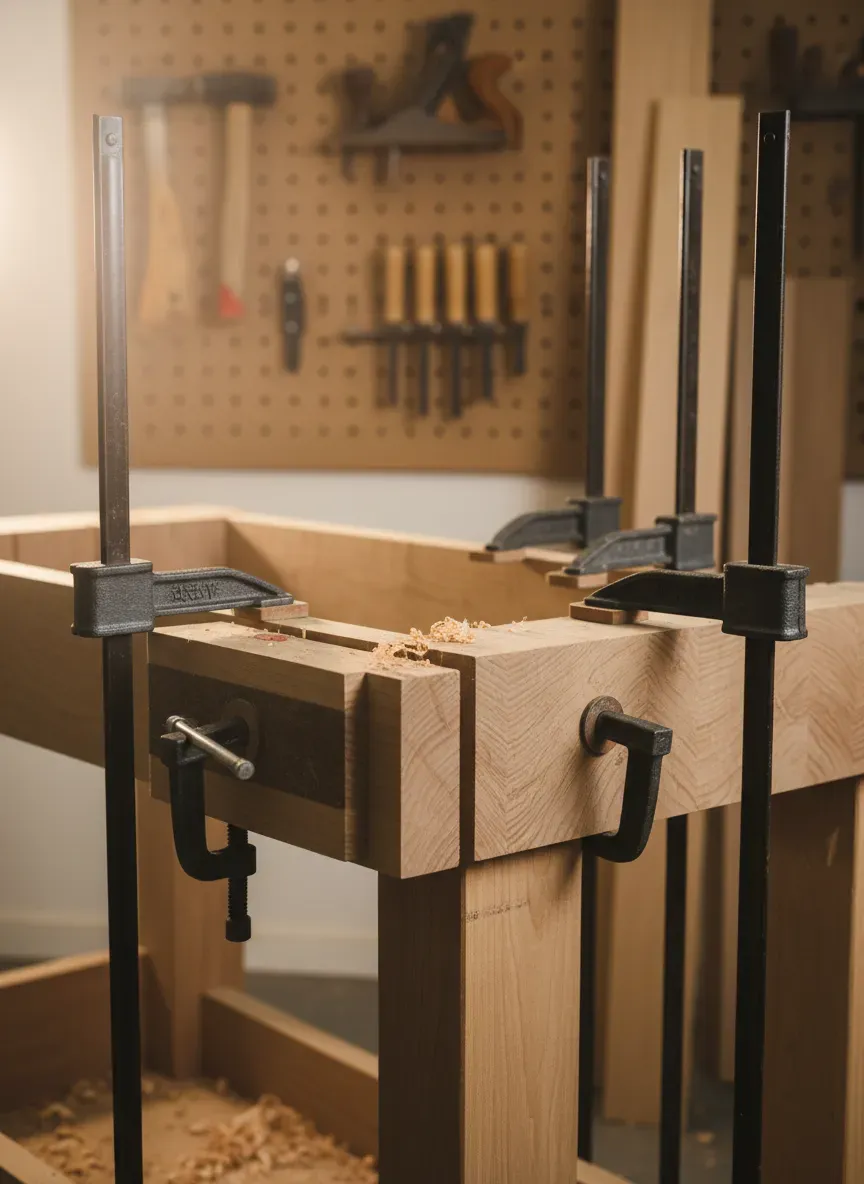
Not everyone has the time, tools, or desire to laminate 40 board feet of hard maple. Family Handyman caters beautifully to the weekend warrior. Their free plans emphasize accessibility, utilizing standardized dimensional lumber and basic fasteners.
You’ll find brilliant designs for fold-down wall benches, rolling tool carts that double as assembly tables, and sturdy 2x4 benches that can be built in a single Saturday. The brilliance here lies in the engineering; they use clever overlapping joints to achieve rigidity without requiring you to chop complex mortises.
5. Instructables
Instructables is the wild west of DIY, which means you have to filter through some noise. However, the gems you find here are wildly innovative. Because the plans are community-generated, you get solutions to highly specific, real-world shop problems.
I’ve personally found incredible plans here for torsion-box assembly tables, micro-benches for apartment dwellers, and ingenious recycled-material builds. The step-by-step photographic journals provided by the creators offer a raw, unfiltered look at the build process, including the mistakes they made along the way.
6. Paul Sellers’ Woodworking Masterclasses
Paul Sellers is a living legend in the hand-tool community. While his premium courses are paid, he frequently offers the foundational plans for his iconic English Joiner’s bench for free.
This bench is a masterpiece of efficiency. Built entirely with hand tools from standard big-box store pine, it features a tool well and an integrated apron that absolutely kills any chance of structural racking. If you want to learn how to dimension lumber with a No. 5 jack plane while building your bench, Sellers is your guide.
7. Ana White
Ana White has single-handedly brought a massive wave of new builders into the craft. Her free workbench plans are unapologetically simple, relying heavily on pocket-hole joinery and basic miter saw cuts.
While a hand-tool purist might scoff at a bench held together by screws, these designs are incredibly practical for an assembly table or a miter saw station. They get you off the floor and working quickly. Her cut lists are precise, and the shopping lists are dummy-proof.
8. Kreg Tool Projects
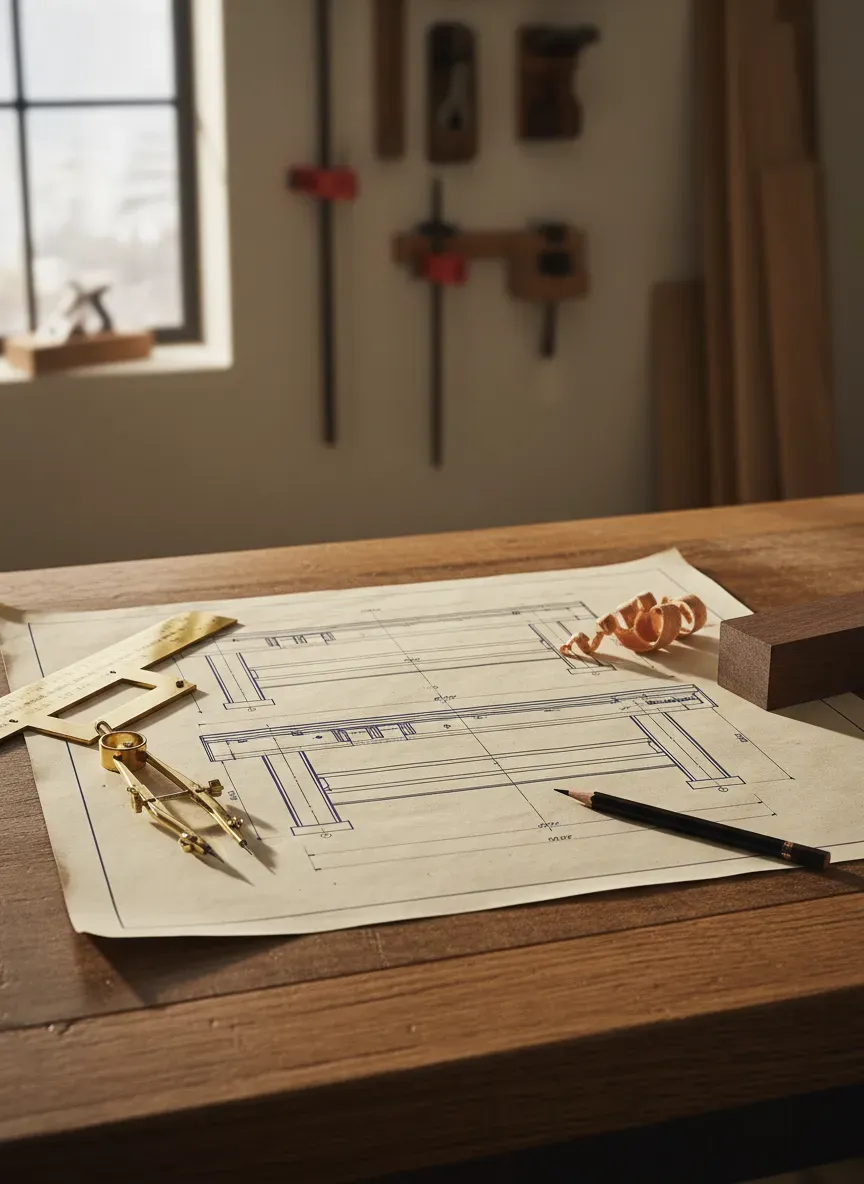
Unsurprisingly, Kreg offers a massive database of free plans engineered specifically to showcase their pocket-hole jigs and hardware. What makes their workbench plans stand out is the modularity.
They offer fantastic plans for mobile workstations equipped with integrated dog holes, flip-top tool stands, and expansive outfeed tables for your table saw. If you just purchased your first Kreg Jig and want to put it to the test, their workbench section is the ideal playground.
9. The Wood Whisperer
Marc Spagnuolo, known as The Wood Whisperer, blends traditional craftsmanship with modern power tool efficiency. While much of his project library is hidden behind a paywall, he occasionally releases free foundational plans.
His approach to workbench building often involves hybrid materials—using heavy plywood for the base to ensure stability while utilizing solid hardwood for the top and edge banding. His accompanying video tutorials provide invaluable context to the PDF plans.
10. Woodcraft
As a major woodworking retailer, Woodcraft provides a surprising amount of free educational content. Their free plan library includes several robust workbench designs meant to showcase the vises, bench dogs, and holdfasts they sell.
These plans strike a great balance between the extreme complexity of Fine Woodworking and the sheer simplicity of Family Handyman. They offer solid, middle-of-the-road designs that incorporate great workholding solutions without requiring a decade of joinery experience.
The Anatomy of a Bulletproof Workbench
Downloading a plan is only the first step. To truly execute the build, you need to understand why the designer made certain choices. A workbench is subjected to immense physical stress. Planing, chiseling, and hammering all transfer dynamic kinetic energy directly into the frame.
Mass is Non-Negotiable
Here’s the real kicker: a light workbench is a useless workbench. If your bench skips across the concrete floor when you push a hand plane against a piece of rough oak, you lose all your mechanical advantage.
Mass absorbs vibration. This is why traditional plans call for tops that are three to four inches thick. If you are building on a budget and can’t afford thick hardwood, you can achieve mass by laminating multiple layers of 3/4-inch MDF or high-density particleboard. It won’t look like a 19th-century antique, but it will function beautifully as a dead-flat, heavy assembly surface.
Eradicating Racking
“Racking” is the side-to-side wobble that plagues poorly built furniture. In a workbench, racking is public enemy number one. When you examine high-quality plans from the sites listed above, pay attention to how the legs attach to the top and the stretchers.
Pro Tip: Never rely solely on lag bolts or screws to prevent racking in a heavy-duty workbench. Fasteners will inevitably loosen over time as the wood expands and contracts. True rigidity comes from deep mortise and tenon joints, or massive, wide aprons bolted securely to the leg structures.
Workholding: The 3D Clamping System
A bench is only as good as its ability to hold your project still. Before committing to a plan, consider your workholding strategy.
- Face Vises: Essential for holding boards horizontally to work on their edges.
- Tail Vises: Used in conjunction with bench dogs to pinch boards flat against the benchtop for face planing.
- Holdfasts: Traditional, L-shaped pieces of iron that drop into holes drilled in the top. A quick whack with a mallet wedges them tight, securing your work instantly.
Ensure the plan you select accommodates the specific hardware you intend to use. You cannot easily add a massive tail vise to a bench top that wasn’t designed with the proper overhang and structural support.
Critical Design Considerations Before You Build
It is incredibly tempting to print off the first gorgeous plan you see and rush to the lumberyard. But a workbench must be tailored to your physical body and the constraints of your physical shop.
Dialing in the Perfect Height
There is no universal standard for workbench height. A bench that is perfect for a 6’2” woodworker will destroy the lower back of someone who is 5’5”.
A common rule of thumb for traditional hand-tool work is to make the bench top even with the crease of your wrist when your arms are hanging relaxed at your sides. This allows you to lock your elbows and use your lower body to push a plane, rather than relying on your triceps.
Conversely, if you predominantly use power tools, routers, and perform delicate detail work or carving, you will want the bench significantly higher—closer to your elbow height—so you don’t have to hunch over.
Storage Integration vs. Clear Clearance
Many modern plans include banks of drawers or cabinets built directly into the base of the workbench. This is a brilliant way to maximize space in a tight garage and add necessary mass to the structure.
However, if you plan to sit at your bench on a stool for detailed work, you must leave an opening for your knees. Furthermore, if you are designing custom base cabinets to fit underneath the benchtop, you must calculate your dimensions carefully. I highly recommend studying understanding the proper depth for mudroom lockers and custom cabinetry. The principles of toe-kicks, drawer clearances, and hardware spacing apply directly to shop furniture. You do not want to build a beautiful bank of drawers only to realize the handles block your holdfasts from dropping through the benchtop.
Workshop Ergonomics and Spatial Flow
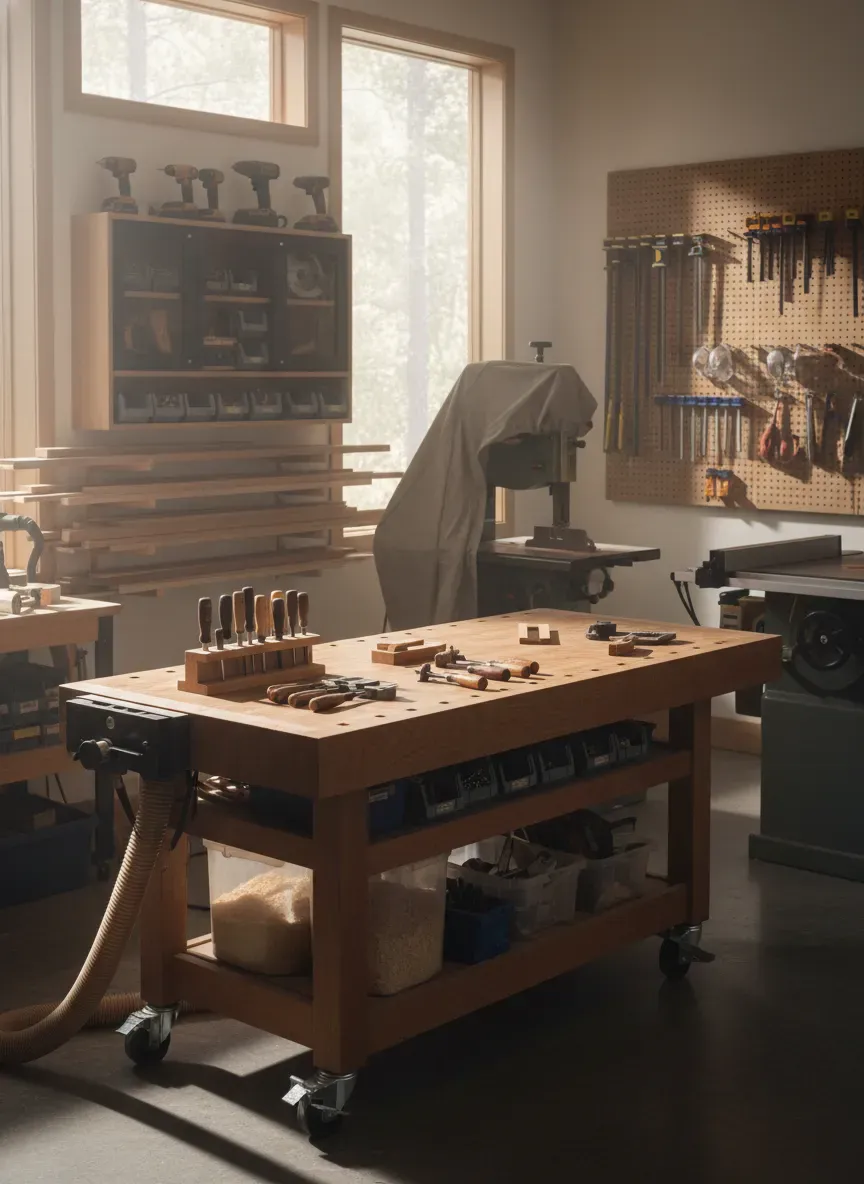
A workbench is the sun of your workshop solar system; everything else orbits around it. Placing your bench against a wall might save floor space, but it instantly eliminates your ability to work on all four sides of a project.
Whenever possible, a primary workbench should be placed in the center of the room. This requires careful planning of your outfeed tables, jointer clearance, and material storage. Figuring out the ideal spacing to keep workstations far apart ensures you have the physical clearance to maneuver an 8-foot sheet of plywood or swing a long bar clamp without knocking over your drill press.
Always factor in the “swing radius” of your largest typical project. Leave at least three feet of clearance on all actionable sides of the workbench.
Material Selection: Balancing Cost and Performance
The plans you download will suggest specific materials, but you are the ultimate project manager. Wood selection drastically alters the price and performance of your build.
Hardwoods: Ash, Beech, and Maple
The historical standards. These woods are incredibly dense, heavy, and resistant to denting. A hard maple top will take a beating for decades and can be re-flattened with a jointer plane every few years to look brand new. The drawback? Cost. A solid hardwood bench can easily require $500 to $1,000 in raw lumber alone.
Softwoods: Southern Yellow Pine and Douglas Fir
Do not underestimate construction softwoods. Christopher Schwarz has built a career advocating for Southern Yellow Pine workbenches. It is cheap, surprisingly heavy, and plenty stiff if designed correctly. Yes, it will dent if you drop a hammer on it. But it’s a workbench, not a dining room table. Dents give it character. The trick is to let the lumber acclimate in your shop for a few weeks before milling, as construction lumber is notoriously wet and prone to warping.
Engineered Sheet Goods: MDF and Plywood
For assembly tables, outfeed tables, and power-tool benches, engineered materials are superior. MDF is dead flat straight from the factory and incredibly heavy. Two layers of 3/4-inch MDF glued together, wrapped in a hardwood edge banding, and coated in polyurethane makes a phenomenal, budget-friendly top that resists glue and takes a beating.
Key Takeaways for Your Build
- Prioritize Flatness: Your work will only ever be as flat as the surface it was built on. A twisted bench guarantees twisted projects.
- Overbuild the Base: You can always replace a damaged top, but a racking, wobbly base is essentially unfixable. Use massive joinery.
- Customize the Hardware: Don’t feel locked into the vises shown in a free plan. Adapt the dog hole spacing and vise locations to match how you actually work.
- Accept Imperfection: Your first bench will have flaws. That is part of the process. It is a tool meant to help you build better things, not a museum piece.
The Bottom Line
Building your own workbench is an incredibly rewarding undertaking that fundamentally elevates your capabilities as a craftsman. By leveraging the deep archives of sites like Fine Woodworking, Woodsmith, and Popular Woodworking, you bypass the painful trial-and-error phase of structural engineering. You secure a blueprint that guarantees rigidity, mass, and utility. Take the time to study the joinery, adapt the height to your specific ergonomics, and choose materials that fit your budget and workflow.
Ready to stop endlessly searching for reliable blueprints?
I’ve personally found that while hunting down individual free plans is a great way to start, it eventually becomes a massive time sink. If you want instant access to a lifetime supply of perfectly engineered projects—not just workbenches, but shop cabinets, jigs, heirloom furniture, and outdoor builds—you need a centralized library.
I highly recommend checking out Ted’s Woodworking. You get instant digital access to over 16,000 step-by-step woodworking plans, complete with exact cut lists, detailed schematics, and 3D diagrams. It completely eliminates the guesswork from your shop time. Right now, they are offering a 75% discount for new builders. Stop scouring the internet for half-finished PDFs and get the ultimate archive today.