
10 Entryway Shelf With Hooks Designs
Transform your chaotic foyer into a highly functional drop zone. We break down ten brilliant entryway shelf designs, hardware secrets, and installation truths.
Mar 15, 2026 - Written by: Linda Wise
The threshold of your home is a high-stakes psychological battleground. You walk through the front door, arms burdened with mail, keys, damp jackets, and a half-empty travel mug. Without a dedicated structural anchor to catch this daily debris, your foyer immediately devolves into an anxiety-inducing dumping ground. I’ve spent years observing how families interact with their entryways, and the consensus is glaringly obvious: a flat surface paired with vertical hanging capacity is the non-negotiable foundation of home organization.
We aren’t just slapping a piece of pine on the drywall and calling it a day. The alchemy of a truly functional drop zone requires a calculated balance of structural integrity, spatial awareness, and architectural harmony.
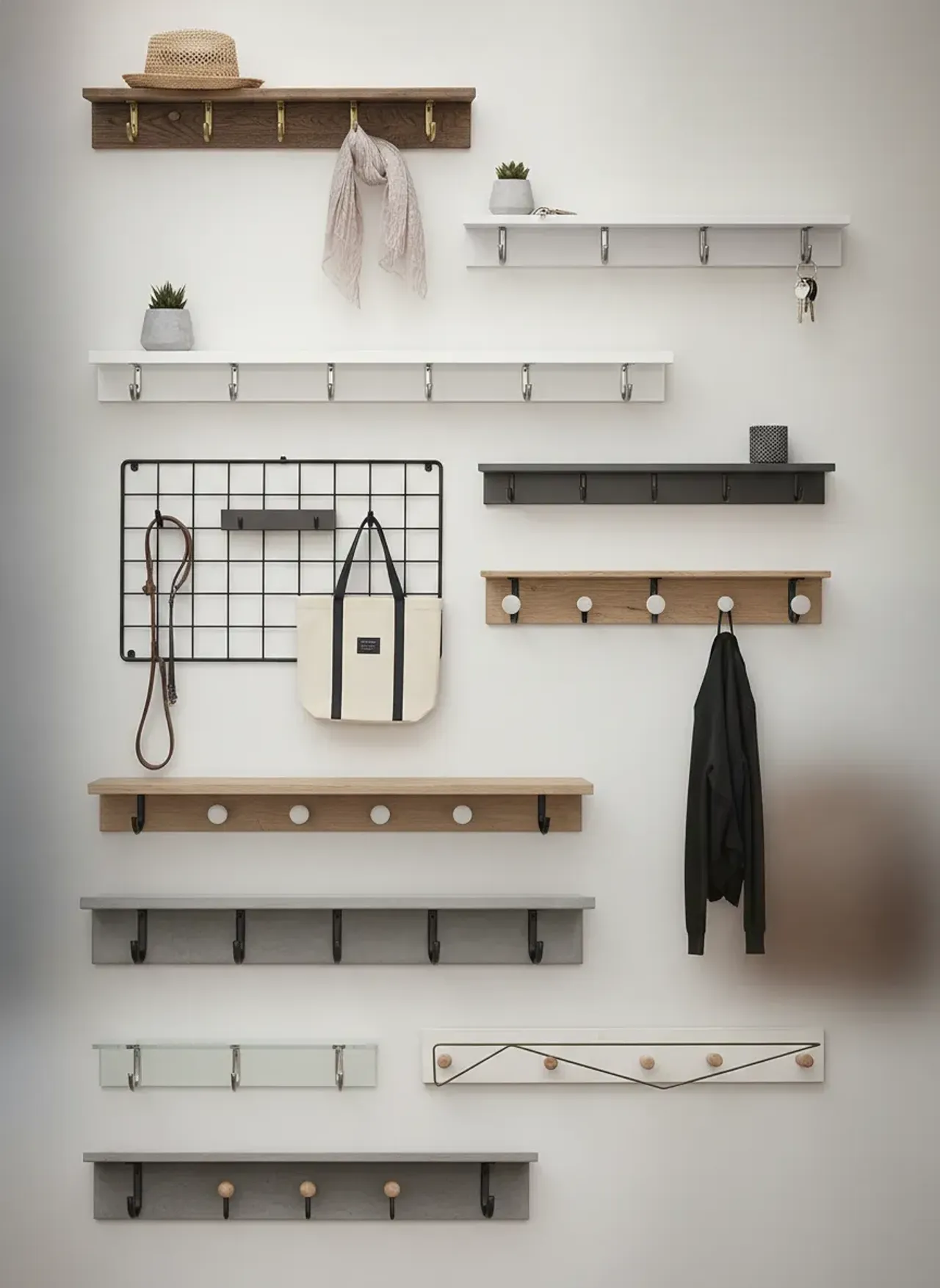
Before we dissect the nuanced engineering behind my favorite configurations, here is a breakdown of a few commercially available units that consistently perform well in real-world scenarios.
Quick Comparison: Top Picks
The Spatial Psychology of the Drop Zone
Why do certain mudrooms feel effortlessly clean while others look like a textile explosion? It comes down to threshold friction. If putting away a coat requires opening a closet door, navigating a sea of wire hangers, and zipping something up, the human brain simply defaults to throwing the coat on the nearest chair.
An open shelf with hooks entirely eliminates this friction. It offers immediate, zero-barrier storage. You walk in. You drop the keys. You hang the coat. Done.
To achieve this seamless choreography, the physical design must match your household’s specific rhythm. A family of five navigating brutal winters requires drastically different load-bearing hardware than a single professional living in a mild, arid climate.
Here is a masterclass in 10 entryway shelf with hooks designs, breaking down exactly how and why they succeed.
10 Entryway Shelf With Hooks Designs
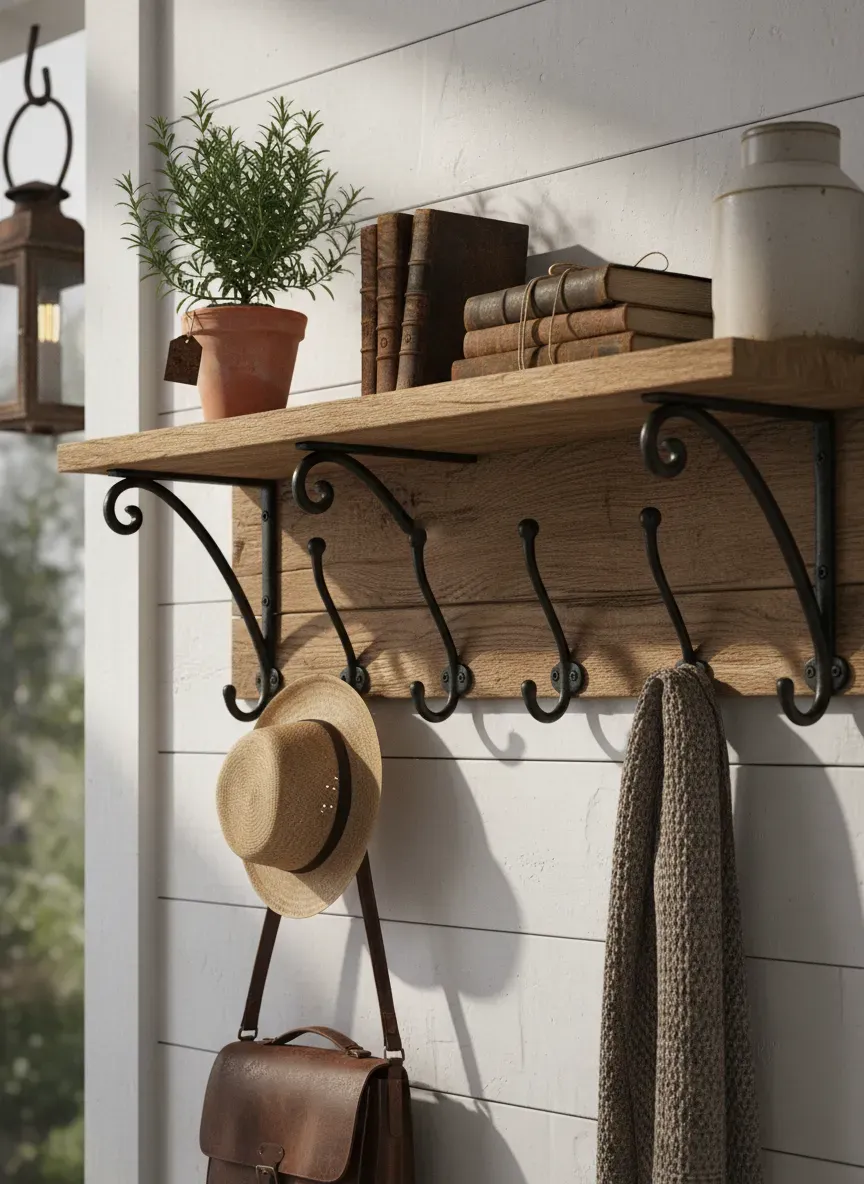
1. The Heavy-Timber Farmhouse Beam
There is an undeniable gravitational pull to raw, thick-cut wood. The farmhouse beam design relies on a singular, substantial piece of timber—often reclaimed oak, douglas fir, or distressed pine—measuring no less than three inches thick.
Structural Realities: You cannot mount a 40-pound slab of reclaimed barn wood using standard plastic drywall anchors. This design absolutely demands structural ledger boards or heavy-duty lag bolts driven directly into wall studs. Hardware Pairing: I’ve personally found that forged, matte black cast-iron double hooks are the only hardware capable of visually anchoring such a massive piece of wood. The top shelf serves as a display for trailing plants or woven baskets, while the heavy hooks below easily handle wet canvas barn coats and laden leather satchels.
2. The Minimalist Floating Cubby
For contemporary spaces where visual clutter is the enemy, the floating cubby presents a sleek, geometric solution. Instead of a single flat board, this design features an enclosed box—or a series of segmented pigeonholes—that hides mounting hardware completely.
Spatial Advantage: The cubbies provide compartmentalized storage for gloves, sunglasses, and mail. The hooks are typically mounted underneath the bottom edge of the cubby box. Aesthetic Execution: Keep the lines razor-sharp. Baltic birch plywood with exposed, sanded edges paired with brushed nickel or powder-coated white hooks creates a brilliant Scandinavian aesthetic. The secret here is utilizing a French cleat system for mounting, ensuring the unit sits dead flush against the drywall without sagging under the weight of heavy wool peacoats.
3. The Industrial Pipe and Reclaimed Wood Hybrid
Urban lofts and transitional homes benefit immensely from the rugged juxtaposition of black iron plumbing pipes and warm, weathered wood.
Engineering the Build: The shelf itself rests upon two or more iron pipe brackets (usually 1/2-inch or 3/4-inch diameter black gas pipe) secured to the wall via circular floor flanges. The hooks can either be standard iron hooks screwed into the wood, or you can use actual pipe fittings—like T-joints and caps—extending downward to act as brutalist coat pegs. Proportion Control: If you are integrating this into a larger entryway system, proportion is everything. Misjudging the projection of your shelf can choke your hallway. Reviewing a comprehensive mudroom locker depth guide will prevent you from building a shelf that dangerously encroaches on your walkway.
4. The Mid-Century Modern Angled Peg Rail
Nostalgia meets high utility in the mid-century peg rail. This design eschews traditional metal hooks entirely. Instead, a sleek backing board—usually rich walnut or warm teak—features wooden dowels inserted at a sharp 45-degree upward angle.
The Craftsmanship: This is a woodworker’s dream. The pegs are glued into precisely drilled angled holes, creating a continuous, organic silhouette. Usage Constraints: While breathtakingly beautiful, be aware that smooth wooden pegs do not grip fabric as aggressively as hooked metal. Jackets without sturdy hanging loops might slip off. To counter this, I highly recommend adding a slight groove or a wider cap to the end of each peg. The top shelf on these designs is typically shallow, ideal for leaning framed artwork or staging outgoing mail.
5. The High-Capacity Board and Batten Wall
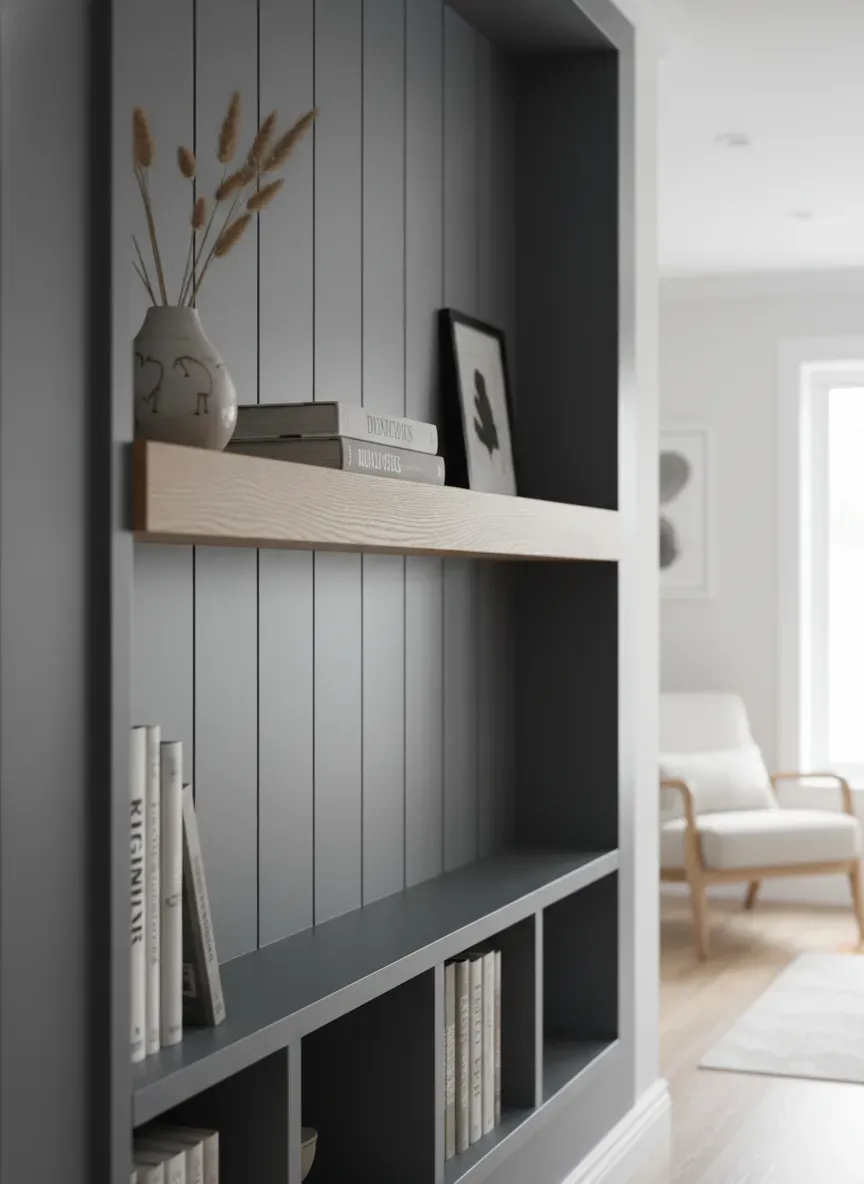
When a solitary shelf isn’t enough, you escalate to an architectural intervention. This design extends the shelving unit downward, utilizing vertical strips of wood (battens) to create paneled sections on the lower wall.
The Execution: The shelf acts as the capping rail for the board and batten wainscoting. Hooks are installed not just under the shelf, but occasionally directly onto the vertical battens themselves, creating a staggered, multi-tiered hanging system. Why It Works: This completely transforms a plain drywall hallway into a bespoke architectural feature. It also protects your walls from the inevitable scuffs and scratches of wet boots and swinging backpacks. You paint the entire wood assembly a unified color—perhaps a moody charcoal or a deep hunter green—to create a striking, monolithic drop zone.
6. The Slimline Scandi Profile
What happens when your entryway is essentially just the swing radius of your front door? You have to get ruthless with your dimensions. The slimline profile features a shelf depth of barely four inches.
Navigating the Squeeze: When dealing with exceptionally tight corridors, understanding the constraints of your floor plan is paramount. Nailing down the precise 12 to 24-inch storage sweet spot can be the difference between a functional transition zone and a maddening bottleneck. Hardware Tactics: Because the shelf is too shallow for large baskets, it becomes a dedicated ridge for keys, wallets, and phones. The hooks below must be low-profile, pivoting fold-down hooks, or minimalist brass knobs. When not in use, they practically disappear into the wood grain, keeping the physical footprint negligible.
7. The Faux Built-In Nook
You don’t need a dedicated mudroom room to achieve the built-in aesthetic. By flanking a sturdy shelf-and-hook combo with two tall, narrow storage towers (or even just floor-to-ceiling trim), you trick the eye into perceiving custom cabinetry.
The Illusion: Run a piece of crown molding along the top edge of the shelf to marry it to the ceiling or the adjacent faux-cabinetry. Add a sturdy bench directly underneath, perfectly mirroring the width of the shelf above. The hooks sit inside this newly created “alcove,” keeping bulky winter gear contained within the vertical borders of the flanking trim.
8. The Vintage Expanding Accordion Rack Upgrade
We all remember those cheap, diamond-patterned expanding wood racks from the 1990s. The modern interpretation takes that brilliant mechanical concept and elevates the materials.
The Modern Twist: Instead of flimsy pine, imagine thick, solid white oak connected by brass rivets. This accordion rack is then suspended beneath a solid, static floating shelf. Flexibility: The genius here is modularity. As your family grows, or as winter approaches and you need more hanging points, you simply expand the lower rack. It offers a dynamic visual texture that rigid horizontal designs lack, bringing a kinetic energy to the entryway.
9. The Dual-Tier Family Command Center
Families generate an astonishing amount of paperwork and miscellaneous gear. A single shelf gets overwhelmed in hours. The dual-tier design solves this by stacking two shelves vertically, separated by about ten inches of space.
Organizational Supremacy: The top shelf is reserved for long-term or seasonal display—vases, hats, decorative boxes. The lower shelf becomes the high-traffic sorting zone. Mail goes in designated trays here. Below the second shelf sits a heavy-duty backboard populated with a dense row of hooks. Proximity Warning: Ensure the gap between the hooks and the bottom shelf is generous enough to accommodate the thick collars of winter coats without scraping knuckles against the wood above.
10. The Hidden-Hardware Magnetic Ledge
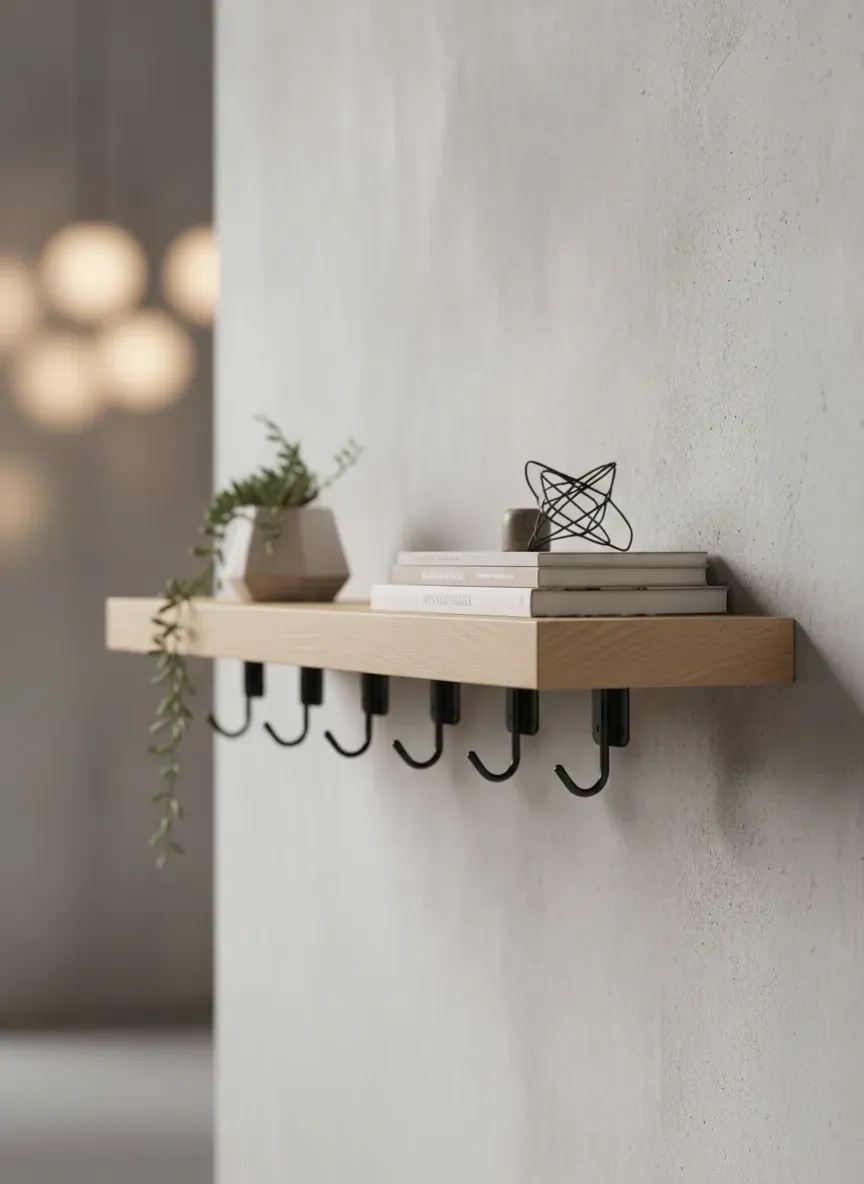
This is the absolute bleeding edge of minimalist entryway design. From the front, it looks like a solid block of floating wood. There are no visible hooks.
The Magic Trick: Powerful rare-earth neodymium magnets are embedded flush into the underside of the shelf. You use sleek, metallic hanging loops or magnetic pucks that snap violently into place when you bring a coat hanger near the bottom of the wood. Alternative Mechanism: If magnets aren’t your style, piano-hinged fold-down wooden slats sit flush inside the bottom of the shelf. You press a slat, and it drops down at an angle to become a temporary hook. It is an engineering marvel that leaves guests completely baffled and deeply impressed.
Practical Applications: Installation and Hardware Realities
It doesn’t matter how breathtaking your walnut slab is if the entire assembly rips out of the drywall the moment you hang a wet wool trench coat on it. The physics of the entryway drop zone are unforgiving.
The Myth of Drywall Anchors
Let’s establish a hard truth: plastic ribbed drywall anchors are useless for entryway shelves. They possess decent shear strength (resistance to sliding straight down the wall), but terrible pull-out strength. When you hang a heavy coat on a hook that projects three inches outward, it creates a lever. That lever exerts tremendous rotational force, actively pulling the top of the shelf away from the wall.
Pro Tip: If you absolutely cannot hit a wooden stud, abandon plastic anchors immediately. Upgrade to heavy-duty toggle bolts (SnapToggles). A 1/4-inch toggle bolt can hold upwards of 250 pounds in standard half-inch drywall, dispersing the levered force across a wide surface area behind the wall.
The French Cleat Superiority
For any design that features a boxed back or a thick profile (like the Floating Cubby), a French cleat is the undisputed king of mounting hardware. You rip a piece of wood at a 45-degree angle. One half screws into the wall studs (pointing up and away from the wall). The other half attaches to the back of your shelf (pointing down and toward the wall). Gravity does the rest, locking the shelf flush against the drywall with zero visible hardware and massive weight distribution.
Hook Spacing Physics
A common novice mistake is buying a beautiful piece of 36-inch wood and cramming eight hooks onto it, spaced four inches apart.
- Summer Jackets: 4-inch spacing works perfectly.
- Winter Parkas: A puffy down jacket easily consumes 8 to 10 inches of horizontal space.
If you space your hooks too closely, the coats will overlap, bunch up, and inevitably push each other off the hooks onto the floor. Map out your hook placement based on your heaviest seasonal garments. Staggering hooks—one high, one low—can effectively double your capacity in the same horizontal footprint without causing coat-clash.
Common Pitfalls to Dodge When Planning Your Entryway
Even armed with the right aesthetic and heavy-duty hardware, projects can still fail through lack of foresight. Watch out for these operational hazards:
- Ignoring the Swing Radius: Before mounting anything, open your front door completely. If the door handle strikes the shelf, or if a hanging coat prevents the door from opening fully, your placement is disastrously wrong.
- The “Junk Drawer” Shelf Sickness: A deep shelf (anything over 10 inches) invites chaos. People will drop bulkier items on it, stacking mail endlessly until it becomes an eyesore. Keep the shelf shallow to force intentionality. It should hold keys, sunglasses, and perhaps a small plant. Nothing more.
- Inadequate Lighting: Entryways are often plagued by terrible shadows. If you are building a deep cubby system or a dark board and batten wall, consider routing a channel underneath the shelf for an LED light strip. It adds a high-end wash of illumination over your coats and makes finding the right set of keys in the dark infinitely easier.
Key Takeaways
- Match the Mount to the Mass: Never trust standard drywall anchors for a coat rack. Find studs or use heavy toggle bolts.
- Respect the Puffer: Space hooks a minimum of 6 to 8 inches apart if you live in cold climates to accommodate heavy winter gear.
- Friction is the Enemy: Choose designs that require zero effort to use. If a drop zone is complicated, your family will bypass it and use the floor.
The Bottom Line: A well-designed entryway shelf acts as a domestic filtration system. It catches the chaos of the outside world before it can penetrate the sanctuary of your living room. By marrying robust structural engineering with an aesthetic that complements your home’s architecture, you completely alter the daily experience of walking through your own front door.
Crafting Your Own Bespoke Solution
I’ve personally found that buying off-the-shelf solutions usually leaves you compromising. The wood isn’t quite the right tone, the dimensions are off by two annoying inches, or the hardware feels cheap and mass-produced. You’ll notice that the truly spectacular entryways—the ones that look like they grew organically out of the architecture—are almost always custom-built.
Here’s the real kicker: constructing a high-end, heirloom-quality entryway shelf is incredibly straightforward if you have the right blueprints. You don’t need to be a master carpenter to achieve professional results; you just need exact measurements, material lists, and step-by-step schematics.
If you are ready to stop settling for flimsy, overpriced particle board and want to build a stunning, structural drop zone that will outlast your house, you need to look at Ted’s Woodworking. With over 16,000 meticulously detailed woodworking plans, you will find the exact schematics for everything from floating minimalist cubbies to massive farmhouse beam racks.
Stop guessing with your dimensions and start building with confidence. Grab the incredible 75% discount on the entire database of 16,000 plans today and transform your chaotic entryway this weekend: Click here to get instant access to Ted’s Woodworking.