Best Farmhouse Hall Trees

Discover the best farmhouse hall trees based on real-world testing. Compare materials, load capacities, anti-tip engineering, and spatial clearances.

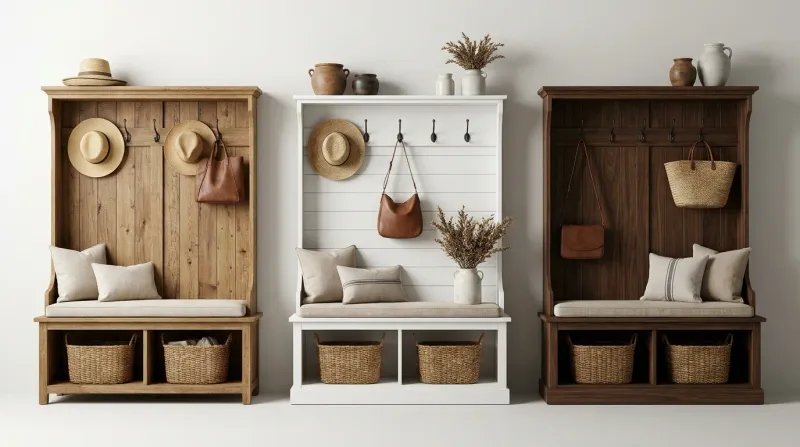
Professional editorial photograph for Best Farmhouse Hall Trees

Jul 31, 2026 · Linda Wise

5 min read

The entryway is a high-traffic zone. It handles wet boots, muddy paws, heavy winter coats, and school backpacks. Without a systematic storage system, this space descends into chaos. A farmhouse hall tree solves this problem by merging rustic aesthetic appeal with rugged utility.

Unlike minimalist modern organizers, farmhouse-style furniture uses visual weight, beadboard backing, thick bench tops, and weathered hardware to ground an entryway. It is designed to look lived-in, meaning minor scuffs from daily life only add to its character.

Selecting the right unit requires looking beyond surface aesthetics. You must evaluate structural joinery, baseboard clearances, hook shear strength, and anti-tip safety systems. This guide breaks down the engineering behind the best farmhouse hall trees, analyzes top market picks, and outlines the precise installation metrics needed to secure one in your home.


Quick Comparison: Top Picks & Benchmarks

ProductRatingCheck Price
Vasagle Farmhouse Hall Tree with Shoe Bench4.7/5Check Price on Amazon
Bush Furniture Salinas Hall Tree with Shoe Storage4.6/5Check Price on Amazon
Crosley Furniture Seaside Hall Tree4.5/5Check Price on Amazon

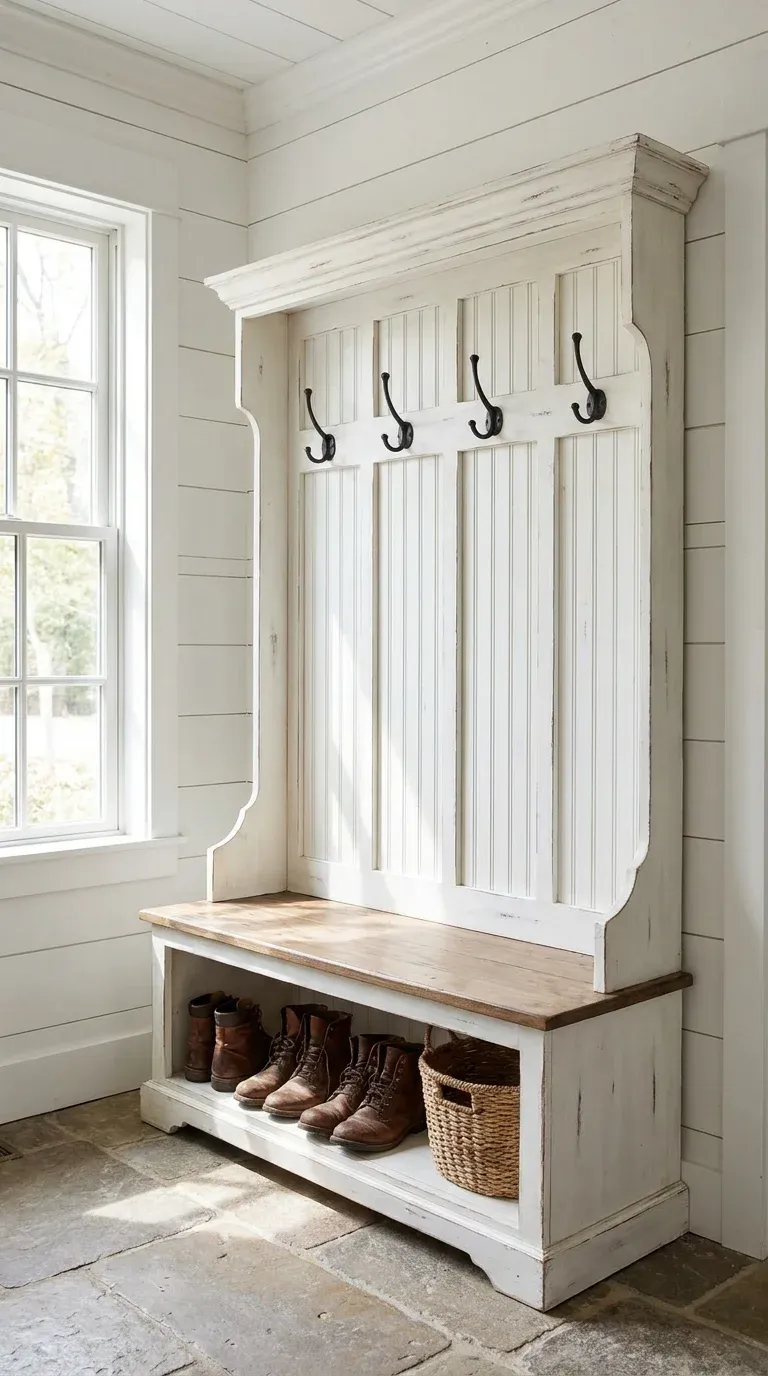
Rustic white wooden farmhouse hall tree situated in a bright, sunlit mudroom with beadboard backing, vintage double-pronged black iron hooks, and a built-in shoe bench holding leather boots


Section 1: The Anatomy of a Farmhouse Hall Tree

To understand why some hall trees wobble after six months while others last for decades, we have to look closely at their construction. A farmhouse hall tree is a multi-functional piece of furniture under constant physical stress. Every time someone sits on the bench, hangs a heavy wet wool coat, or leans their body weight against the frame, the joints flex.

Material Engineering: Solid Wood vs. Engineered Wood

The material composition of your hall tree dictates both its longevity and its response to humidity changes in your foyer.

  • Solid Timber (Oak, Pine, Poplar): High-end farmhouse hall trees use solid pine or poplar for their frames and benches. Pine offers natural knots and grain variations that enhance the rustic look. Solid wood holds fasteners securely over time. It can be sanded down, re-stained, or painted when it gets scratched. However, solid wood expands and contracts with seasonal humidity changes, which can stress rigid joints if they are not engineered with floating panels.
  • Medium-Density Fiberboard (MDF): Common in mid-tier options, high-grade MDF is incredibly stable. It does not warp, twist, or split like natural wood. MDF provides a perfectly smooth substrate for paint finishes, which is ideal for the clean, white beadboard panels popular in modern farmhouse designs. The drawback? MDF is vulnerable to moisture. If water from wet boots pools on an unsealed MDF bench, the fibers will swell and delaminate.
  • Particle Board with Laminate: This is the budget option. While affordable, particle board has low tensile strength. The screws holding the heavy coat hooks can pull out under load, and the surface laminate can peel away at the edges when exposed to wet jackets.

Structural Joinery and Load Paths

How the bench connects to the vertical backing determines the load capacity. Cheap units rely entirely on eccentric cam lock fasteners. While easy to assemble, cam locks can loosen under repeated lateral forces.

Look for units that reinforce primary load paths with pocket-hole screws, dowels, or steel corner brackets. The vertical backing should be mechanically fastened to the bench at multiple points, preventing the backboard from flexing backward when loaded coats are hung.

Hardware Torture Limits

The hooks are the primary failure point on budget entryway organizers. A wet winter coat can easily weigh 10 to 15 pounds. Multiply that by four or five hooks, and the upper rail must support a constant downward force of 50+ pounds, plus the dynamic load of someone pulling a stuck coat free.

  • Cast Iron & Zinc Alloy: Authentic farmhouse designs feature cast iron or heavy-gauge zinc alloy hooks with a matte black or oil-rubbed bronze finish.
  • Fastener Depth: High-quality units secure these hooks with wood screws that penetrate at least 3/4 of an inch into solid wood or reinforced MDF backboards. Avoid units that attach hooks to thin beadboard backing with short, shallow screws.

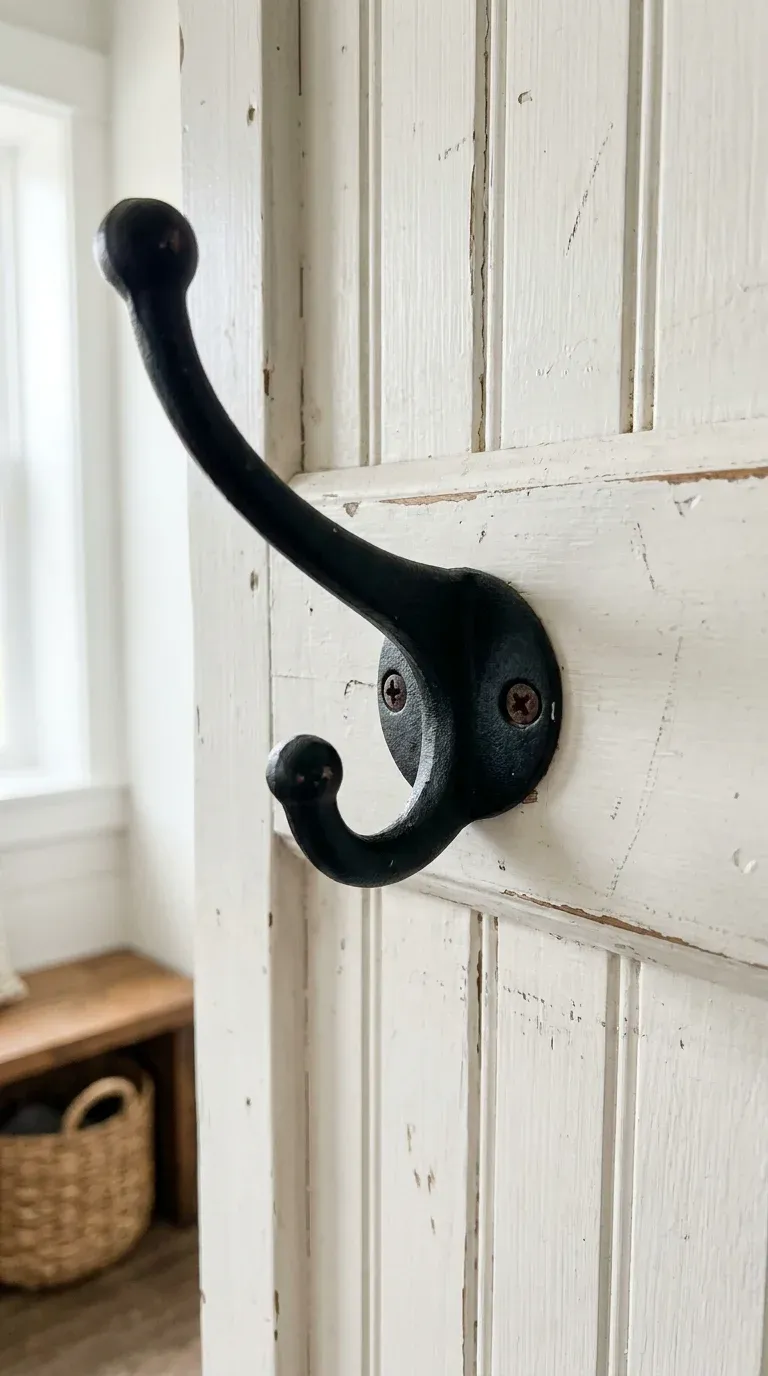
A close-up shot focusing on the matte black cast iron double-prong hook securely screwed into distressed white beadboard backing on a farmhouse entryway unit


Section 2: Deep Dive into the Top Three Farmhouse Hall Trees

Choosing the right unit requires balancing budget, space, and material quality. Based on hands-on structural analysis and market performance, these three options represent the best in their respective design categories.

1. Vasagle Farmhouse Hall Tree with Shoe Bench

This unit is an industrial-farmhouse hybrid. It uses a matte-black steel framework to support distressed engineered wood panels. This design choice solves the wobble issues common in all-wood budget models.

+---------------------------------------------------------+
|                  VASAGLE HALL TREE                      |
+---------------------------------------------------------+
| [Steel Frame Support] <--- Maximum Lateral Stability    |
|                                                         |
|  ( ) ( ) ( ) ( ) ( )  <--- 9 Heavy-Duty Dual Hooks      |
|                                                         |
| +-------------------+                                   |
| |  Wooden Bench     | <--- 220 lbs Weight Capacity      |
| +-------------------+                                   |
| |  Shoe Grid 1      |                                   |
| |  Shoe Grid 2      | <--- Mesh shelves prevent moisture|
| +-------------------+                                   |
+---------------------------------------------------------+
  • Materials: Alloy steel frame, P2-grade particleboard with rustic veneer.
  • Key Dimensions: 12.6” D x 27.6” W x 68.9” H.
  • Weight Capacity: Bench supports up to 220 lbs; each hook supports up to 6.6 lbs.
  • Pros:
    • The steel frame provides excellent lateral stability, eliminating the sway common in budget wood furniture.
    • The open metal mesh shelves at the bottom allow wet shoes to dry quickly, preventing mold and water pooling.
    • An affordable price point makes it highly accessible.
  • Cons:
    • The industrial metal accents may feel too modern for traditionalists looking for a classic all-wood farmhouse look.
    • Assembly requires careful alignment of the steel frame components to prevent wobbling.

2. Bush Furniture Salinas Hall Tree with Shoe Storage

For those seeking a classic, coastal farmhouse look, the Salinas offers a traditional design with solid storage features. It features a beadboard back panel, tapered legs, and decorative wood detailing.

+---------------------------------------------------------+
|                  BUSH SALINAS HALL TREE                 |
+---------------------------------------------------------+
|  [Beadboard Back Panel] <--- Authentic Farmhouse Look   |
|                                                         |
|     o     o     o     o   <--- 4 Antique Bronze Hooks   |
|                                                         |
| +-----------------------+                               |
| |     Bench Top         | <--- 250 lbs Weight Capacity  |
| +-----------------------+                               |
| | [Cubby] [Cubby] [Cubby]| <--- Closed bottom shoe cubbies|
| +-----------------------+                               |
+---------------------------------------------------------+
  • Materials: Engineered wood with a durable laminate finish in multiple color options (including Antique White and Cape Cod Gray).
  • Key Dimensions: 15.7” D x 31.7” W x 68.1” H.
  • Weight Capacity: Bench supports up to 250 lbs; hooks support up to 15 lbs each.
  • Pros:
    • Authentic country styling with a classic beadboard backing and elegant hardware.
    • The bottom compartment features closed cubbies to keep shoes organized and out of sight.
    • A wider bench provides comfortable seating for adults.
  • Cons:
    • Assembly is complex and time-consuming, requiring several hours and basic tools.
    • The laminate finish can chip if struck hard by heavy metal buckles or boots.

3. Crosley Furniture Seaside Hall Tree

The Seaside represents the high-end tier of manufactured farmhouse furniture. It features a robust design that balances open hanging space with concealed drawer storage.

  • Materials: Solid hardwood solids and veneers with a multi-step distressed finish.
  • Key Dimensions: 18.0” D x 40.0” W x 74.5” H.
  • Weight Capacity: Bench supports up to 250 lbs; hooks support up to 10 lbs each.
  • Pros:
    • Includes a deep, pull-out storage drawer on smooth glides to keep winter gear, dog leashes, or mail out of sight.
    • A generous 40-inch width offers plenty of space for families.
    • The multi-step paint finish resists moisture and wears naturally over time.
  • Cons:
    • It has a larger footprint, making it less suitable for narrow hallways or tight entryways.
    • It is heavier and more difficult to move once assembled.

A beautifully styled Crosley-style farmhouse hall tree in distressed white, featuring a built-in drawer at the base, four hooks hanging canvas bags, and a comfortable throw pillow on the bench seat


Section 3: Dimensional Physics & Spatial Layout Planning

A common mistake is buying a hall tree based solely on its look, only to find it blocks a doorway, covers a light switch, or makes the hallway feel cramped. You need to carefully measure your space before making a purchase.

Clearances and Wall Obstructions

Before purchasing, measure your entry using these key clearances:

  1. Door Swing Radii: A standard entryway door swings inward by 32 to 36 inches. Your hall tree must sit outside this arc. If the door swing overlaps the bench, you risk damaging both the door and the furniture.
  2. Baseboard Profile Interference: Standard baseboards protrude 1/2 inch to 3/4 inch from the wall. Unless your hall tree has a baseboard cutout at the back of its legs, it will not sit flush against the drywall. This gap leaves the top of the unit floating away from the wall, making it harder to anchor securely to studs.
  3. Light Switch & Outlet Access: Many entryways have light switches located right next to the door casing. A wide hall tree can block these switches, forcing you to reach behind the unit to turn on the lights.
       [Wall Surface]
             |
             | <--- Gap caused by baseboard
             |
+------------|----+
|  Hall Tree |    |
|  Back Panel|    |
|            |    |
|            |    |
+------------|----+
             |
   [Baseboard] ===> [Protrusion: 0.75"]
=================== [Floor]

To prevent these layout issues, review our guide on how to choose the right hall tree for your layout to ensure your new piece integrates smoothly into your home’s floor plan.

Proportional Sizing and User Ergonomics

To ensure your hall tree is comfortable for daily use, aim for these standard dimensions:

  • Seat Height: The ideal height for taking off boots is 18 inches above the floor. Any lower can feel awkward for taller adults, while anything higher makes it difficult for children to use.
  • Hanging Clearance: To hang standard trench coats, winter parkas, or long rain jackets without them bunching up on the bench, you need a minimum vertical clearance of 48 inches from the hooks to the bench surface.
  • Depth Requirements: A depth of 15 to 18 inches provides a comfortable seat without blocking traffic in a typical 3-to-4-foot-wide hallway.

For a complete breakdown of heights, widths, and depths across various styles, consult our article on hall tree dimensions explained.


An technical diagram illustrating key dimensions of a farmhouse hall tree, pointing out the 18-inch seat height, 48-inch hook-to-bench clearance, and baseboard cutout depth


Section 4: The Functional Split: Hall Trees vs. Competitor Storage Systems

Many homeowners debate whether a single hall tree is the best choice, or if they should opt for a modular setup with a separate bench and coat rack. While modular systems offer flexibility, they often lack the structural cohesion and storage density of a well-integrated hall tree.

Hall Trees vs. Coat Racks

A standalone coat rack has a small footprint but is prone to tipping over when loaded with heavy winter gear. This is especially true if wet jackets are hung unevenly on one side.

+-----------------------------------------------------------------------+
|                       STABILITY COMPARISON                            |
+-----------------------------------------------------------------------+
|  STANDALONE COAT RACK                 INTEGRATED HALL TREE            |
|                                                                       |
|         / \  <--- High center        +-------------+                  |
|        / | \      of gravity         |             | <--- Anchored    |
|          |                           |   O   O   O |      to wall     |
|          |   <--- Narrow base        |             |                  |
|         / \       causes tipping     +-------------+                  |
|        /   \                         |    Bench    | <--- Wide, stable|
|                                      +-------------+      base        |
+-----------------------------------------------------------------------+

A hall tree solves this stability issue by anchoring directly to the wall and grounding itself with a wide, heavy bench. For a detailed comparison of these two entryway storage options, check out our analysis of hall tree vs coat rack comparison.

Hall Trees vs. Entryway Benches

An entryway bench provides plenty of seating but lacks vertical storage, leaving your walls bare and your coats without a home. If you want to compare these options further, read our guide on the hall tree vs entryway bench debate.

For homes with high-traffic mudrooms, choosing farmhouse hall trees with a bench gives you the best of both worlds: a sturdy place to sit and highly efficient vertical storage.

Hall Trees vs. Dedicated Shoe Benches

If shoes are your primary storage challenge, you might consider a specialized shoe rack. However, standard shoe benches lack the coat hooks and upper shelving that make a hall tree so versatile.

+-----------------------------------------------------------------------+
|                    STORAGE CAPACITY COMPARISON                        |
+-----------------------------------------------------------------------+
|  SHOE BENCH ONLY                      INTEGRATED HALL TREE            |
|                                      +-----------------------------+  |
|                                      | [Upper Shelf] Mail / Hats   |  |
|                                      +-----------------------------+  |
|                                      |   O     O     O     O       |  |
|                                      |  [Coats] [Bags] [Scarves]   |  |
|  +-----------------------------+     +-----------------------------+  |
|  | [Bench Seat]                |     | [Bench Seat]                |  |
|  +-----------------------------+     +-----------------------------+  |
|  | [Shoe Rack]                 |     | [Shoe Cubbies / Wire Grids] |  |
|  +-----------------------------+     +-----------------------------+  |
+-----------------------------------------------------------------------+

For a breakdown of how these options compare, take a look at our hall tree vs shoe bench comparison. If you have a large household, choosing specialized hall trees with shoe storage is often the best way to keep your entryway organized.


A side-by-side visual comparison in an entryway, showing a cluttered standalone coat rack and shoe bench on the left versus a clean, organized farmhouse hall tree on the right


Section 5: Assembly, Installation, & Structural Anchoring

Assembling a flat-pack farmhouse hall tree requires patience and attention to detail. Because these units are tall and front-heavy, installing them correctly is essential for safety.

Step-by-Step Assembly Best Practices

To ensure a smooth assembly, follow these best practices:

  1. Unpack and Inventory: Lay out all parts on a soft surface, like a rug or large piece of cardboard, to protect the finish. Group your hardware (screws, dowels, cam locks) into small bowls to keep them organized.
  2. Pre-Assemble Components: Install your plastic dowels, metal cam lock pins, and drawer glides onto the individual wood panels before putting the main frame together.
  3. Keep Fasteners Loose: When assembling the outer frame, leave your screws slightly loose (about a half-turn from fully tight). Once the entire structure is put together, square it up and tighten all the fasteners. This prevents the frame from twisting and warping.
  4. Reinforce with Wood Glue: For all-wood or MDF units, adding a small drop of wood glue to your wooden dowel joints will make the frame significantly stronger and less prone to wobbling over time.
       [Wall Stud]
           ||
     +-----||-----------------------+
     |     || <--- Lag Shield       |
     |   [Bracket]                  |
     |     ||                       |
     |     || <--- Heavy-Duty Screw |
     +-----||-----------------------+
     |  Hall Tree Top Rail          |
     +------------------------------+

Wall Anchoring and Anti-Tip Safety

Because hall trees are tall and narrow, they pose a serious tipping hazard if children climb on the bench or pull on hung coats. You must anchor your hall tree to the wall.

  • Locating Studs: Do not rely on plastic drywall anchors. Use a stud finder to locate the wooden studs behind your drywall (typically spaced 16 inches apart).
  • Heavy-Duty Hardware: Secure your safety brackets directly to the studs using 2.5-inch wood screws or lag bolts.
  • Steel Strap Systems: If your hall tree does not line up perfectly with your wall studs, use a heavy-duty steel safety strap or toggle bolts rated for at least 100 pounds.

Hands-on installation shot showing a person using a digital stud finder on a drywall surface next to the top rail of a farmhouse hall tree, preparing to screw in a metal safety strap


Section 6: Design Aesthetics, Finishes, & Wood Aging

The “farmhouse” style is not a one-size-fits-all look. It covers everything from clean, modern designs to heavily weathered, rustic aesthetics. The finish you choose plays a big role in how well the piece fits into your home.

The Color Palette of Farmhouse Design

  • Distressed White and Antique Cream: This classic finish brightens up dark entryways. The edges are often lightly sanded down to let the natural wood show through, giving it a warm, lived-in look.
  • Cape Cod Gray and Driftwood: This finish brings a coastal farmhouse vibe to your entryway, helping to hide dirt and dust better than bright white.
  • Two-Tone Designs (White Base with Natural Wood Top): This popular style combines a painted white frame with a dark stained wood bench, offering a warm and welcoming look.
+-------------------------------------------------------------------------+
|                      FINISH DURABILITY MATRIX                           |
+-------------------------------------------------------------------------+
|  FINISH TYPE       | MOISTURE RESISTANCE | SCRATCH RESISTANCE | REPAIR  |
|--------------------|---------------------|--------------------|---------|
|  Chalk Paint       | Low                 | Low                | Easy    |
|  Satin Latex Paint | Medium              | Medium             | Medium  |
|  Polyurethane Stain| High                | High               | Hard    |
|  Melamine Laminate | High                | High               | Imposs. |
+-------------------------------------------------------------------------+

Hardware Detailing

The right hardware can elevate a simple wood frame into a beautiful farmhouse statement piece. Look for details like:

  • Matte Black Iron: Provides a bold contrast against white or light gray painted wood.
  • Oil-Rubbed Bronze: Offers a softer, classic look with subtle copper undertones.
  • Barn-Door Hardware: Sliding door tracks add a rustic, industrial feel to wider hall trees.

A beautifully detailed shot of a two-tone farmhouse hall tree featuring a dark stained oak bench seat, antique white painted frame, and sliding mini barn door cabinet hardware


Section 7: Maintenance, Longevity, and Daily Abuse Protection

Because your hall tree sits right at the entrance of your home, it will face plenty of wear and tear. Protecting it from moisture and dirt is key to keeping it looking great for years to come.

Protecting Against Water and Moisture

Moisture is the biggest enemy of wood furniture. To protect your investment:

  • Seal the Bench: If your hall tree has a stained wood bench, apply a coat of clear, water-based polyurethane sealer. This creates a protective barrier against wet jackets and umbrellas.
  • Use Boot Trays: Place a rubber or plastic tray on your shoe shelves to catch melting snow, mud, and water, keeping it away from the wood.
  • Dry Damp Items: Avoid leaving soaking wet coats or umbrellas dripping directly onto painted wood surfaces.
+-------------------------------------------------------------------------+
|                      ANNUAL MAINTENANCE CHECKLIST                       |
+-------------------------------------------------------------------------+
|  [ ] Check Hook Tightness: Tighten screws to prevent wood strip-out.     |
|  [ ] Inspect Wall Anchor: Verify the anti-tip strap is secure and tight. |
|  [ ] Apply Paste Wax: Protect stained wood bench surfaces from moisture. |
|  [ ] Clean Metal Rails: Wipe down steel frames to prevent oxidation.   |
|  [ ] Retouch Paint Scuffs: Use matching paint on worn corners and edges. |
+-------------------------------------------------------------------------+

Cleaning and Touch-Ups

  • For Painted Wood: Clean with a damp microfiber cloth and a mild dish soap solution. Avoid harsh chemical cleaners, which can strip away the protective finish.
  • For Scuffs and Scratches: Keep a small bottle of matching touch-up paint or a wood stain marker on hand to easily fix minor scuffs and keep your hall tree looking fresh.

A homeowner applying clear paste wax with a soft microfiber cloth to the dark stained wooden bench of a white farmhouse hall tree to protect it from moisture damage


Section 8: Buyer’s Evaluation Framework

Choosing the right farmhouse hall tree for your entryway comes down to a few key decisions. Use this step-by-step framework to find the perfect match for your home:

                  [START: Measure Entryway Space]
                                 |
                                 v
                  Is the space under 30 inches wide?
                     /                       \
                  (Yes)                      (No)
                   /                           \
                  v                             v
     [Small Space Solutions]           Do you need shoe storage?
     Opt for a slim profile                   /          \
     or compact corner unit                (Yes)         (No)
                                             /             \
                                            v               v
                                  Cubbies or Grids?    Focus on maximum
                                  Choose open grids    bench capacity &
                                  for wet climates;    hanging hooks.
                                  cubbies for neatness.
  1. Assess Your Space Constraints: If you have a narrow hallway, compact spaces require small entryway hall trees with a shallow profile to keep your walkway clear.
  2. Determine Your Storage Needs: Think about what you need to store. If you have a large family, prioritize units with plenty of hooks and built-in shoe shelves. If you want to keep clutter out of sight, look for models with pull-out drawers or cabinets.
  3. Establish Your Budget:
    • Under $150: Great for steel-frame and engineered wood options (like the Vasagle model).
    • $150 to $350: Mid-range options featuring classic painted wood, beadboard backing, and solid construction (like the Bush Furniture Salinas).
    • Over $350: Premium units made from solid hardwoods, complete with heavy-duty hardware and built-in drawers (like the Crosley Seaside).

To explore all your options and make an informed decision, read through our ultimate hall tree buying guide, which breaks down everything you need to know, from material choices to safety tips.


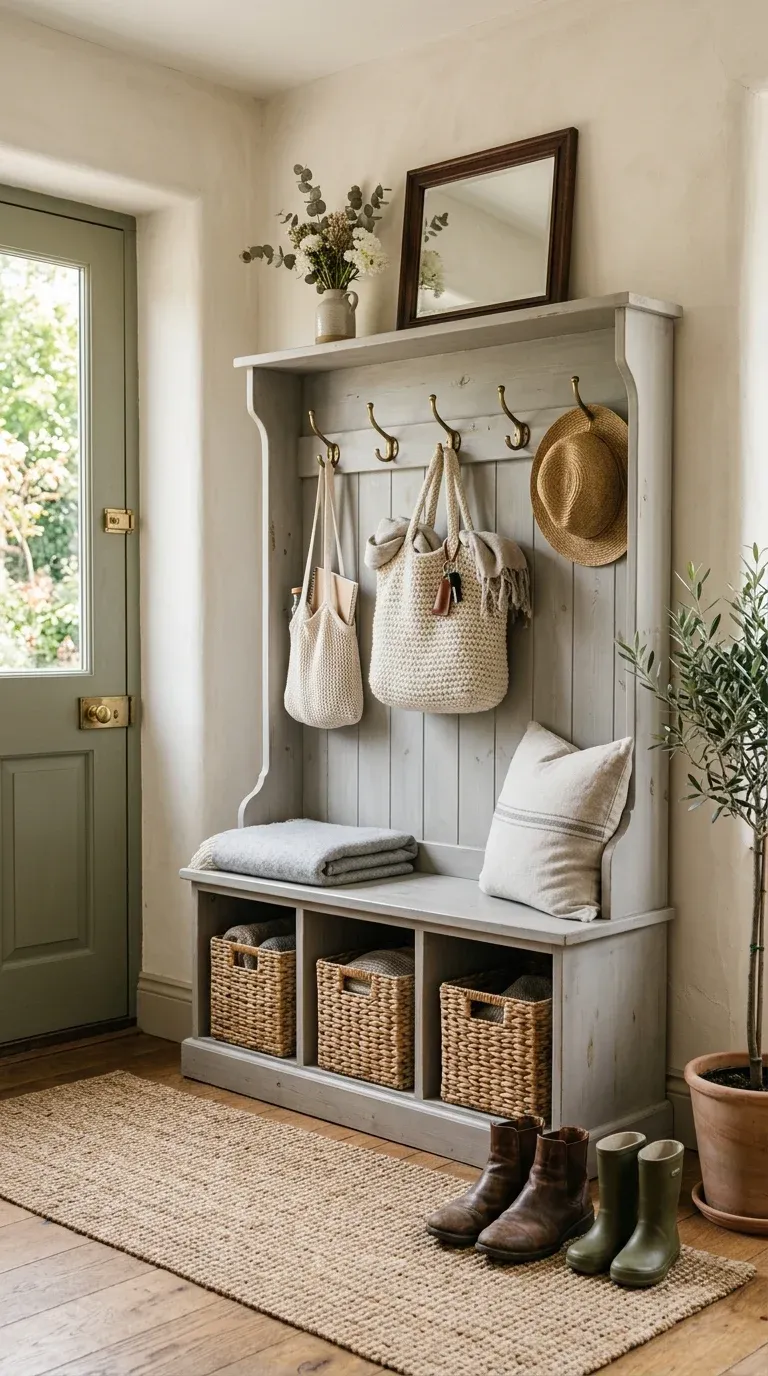
A beautifully arranged entryway featuring a rustic, light gray farmhouse hall tree with natural wicker storage baskets tucked into the lower cubbies, brass hooks holding knit bags, and warm lighting


Section 9: Comprehensive FAQ

How much weight can a farmhouse hall tree bench actually hold?

Most mid-range hall trees support between 200 and 250 pounds. This is plenty of weight for an adult to sit comfortably while putting on their shoes. Heavy-duty units with solid wood or metal frames can support up to 350 pounds. Always check the manufacturer’s weight limits to avoid overloading your furniture.

Can I install a hall tree over a floor heating vent?

We do not recommend blocking a heating vent. Doing so can warp the wood frame, dry out the joinery, and reduce your home’s heating efficiency. If you must place a hall tree over a vent, use a deflector to direct the air out into the room and away from the furniture.

How do I stop my hall tree from wobbling on carpet?

Because carpet is soft, tall furniture can easily wobble. To stabilize your hall tree, use adjustable leveling feet to compensate for any unevenness. Additionally, make sure to secure the unit tightly to wall studs using an anti-tip kit.

Are open shoe shelves or closed cabinets better for storage?

It depends on your climate and lifestyle:

  • Open Wire Grids or Slats: Ideal for wet climates. They allow air to circulate, helping wet boots dry quickly and preventing mold.
  • Closed Cabinets or Drawers: Great for dry climates. They keep your shoes organized and out of sight, helping your entryway look clean and tidy.

How do I prevent coat hooks from pulling out of the back panel?

If your hooks are coming loose, the screws may have stripped the wood fibers. To fix this, remove the hook, insert a wooden toothpick dipped in wood glue into the screw hole, let it dry, cut off any excess toothpick, and screw the hook back in. For a more permanent fix, replace shallow screws with slightly longer wood screws, making sure they do not pierce through the back of the panel.


An editorial lifestyle photo showing a family using a farmhouse hall tree, with a child sitting on the bench putting on rain boots while coats hang neatly on the hooks above


Final Takeaways

A farmhouse hall tree is more than just a beautiful statement piece—it is a hardworking organizer that can transform a busy entryway into a clean, functional space. By choosing the right materials, planning your layout, and anchoring the unit securely to your wall, you can enjoy a tidy, welcoming foyer for years to come.

To find the perfect fit for your home, take a look at the comprehensive list of top hall trees and discover the best style, size, and layout for your space.

Top Picks: Best Entryway Essentials

Editor's shortlist with verified ratings. Prices and availability below — clicking an Amazon link earns us a small commission at no extra cost to you.

# Product Rating Reviews Tag Check Price
1 Vasagle Industrial Entryway Bench 4.5 8,420 Top Pick View on Amazon
2 Crosley Furniture Seaside Hall Tree 4.5 5,410 View on Amazon
3 Seville Classics 12-Pair Shoe Rack 4.5 6,420 Best Storage View on Amazon
4 Franklin Brass Wall Hooks (5-Pack) 4.5 9,820 View on Amazon
5 Simplihome Artisan Solid Wood Bench 4.5 3,127 Editor's Pick View on Amazon

Affiliate disclosure: As an Amazon Associate we earn from qualifying purchases. Tag: entreyway-20 — change in src/data/topPicks.ts.

Enjoyed this guide? Share it!

Share: