
Cozy Staircase Decor Ideas | Warm Lighting & Minimal Wall Styling
Transform your transitional zones into warm, minimalist sanctuaries. Discover expert techniques for warm staircase lighting, curated low-profile wall styling, and high-impact tactile accents.
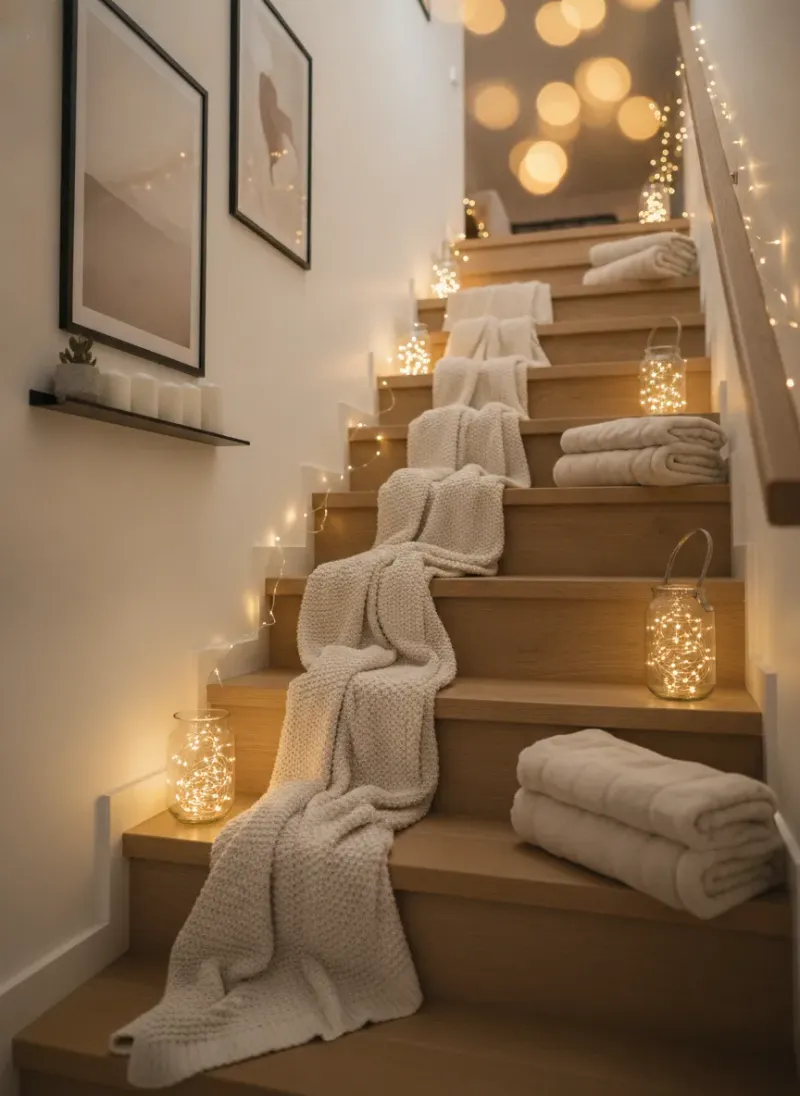
Jun 8, 2026 · Linda Wise
15 min readStaircases are the unsung workhorses of residential architecture. We traverse them dozens of times a day, yet we routinely relegate them to design afterthoughts—sterile, Echo-heavy transition zones that serve only to get us from point A to point B.
I’ve personally found that treating a staircase as an architectural palate cleanser, rather than a mere utility, completely shifts how a home feels. When you balance soft, low-glare illumination with restrained, intentional wall styling, this vertical corridor transforms. It becomes an inviting, atmospheric spine that knits your living spaces together.
To turn these high-traffic thresholds into cozy, sophisticated passages, we must move away from builder-grade overhead lighting and cluttered gallery walls. Instead, we want to embrace high-end lighting science, textured surfaces, and editing discipline. This guide dissects how to execute a warm, minimal staircase redesign that feels both grounding and effortlessly elevated.
Before we dive deep into the spatial theories and step-by-step styling mechanics, here is a curated selection of essential elements that immediately elevate any transitional staircase project.
The Design Philosophy of Cozy Staircases
Most homeowners treat staircases like an awkward hallway tilted at a 35-degree angle. They slap some family photos on the wall, leave a generic flush-mount fixture on the ceiling, and call it a day. The resulting space often feels cramped, visually chaotic, or starkly institutional.
To design a truly cozy staircase, we have to look at the psychological experience of movement. A staircase is a slow, vertical journey. Because you are moving through a narrow, enclosed space, your proximity to walls and light sources is significantly closer than in a standard room. This means every texture, frame profile, and light bulb temperature is magnified.
[Visual Compression: Narrow Walls]
 │ ▲ │
 │ │ │ <-- Close proximity demands high-tactility materials
 │ ■¼ │
[Warm, Low-Level Lighting] --> Lowers visual center of gravity for safety & comfort
To create comfort here, we need to solve three distinct spatial challenges:
- Visual Compression: The walls are close to your shoulders. Heavy, dark frames or busy patterns make the space feel like a subterranean tunnel.
- Acoustic Harshness: Hardwood steps and drywall create a megaphone effect, bouncing sound up and down the house.
- Vertical Glare: Looking up a staircase directly into an unshielded bulb is a jarring sensory experience.
By shifting our focus to soft, low-level illumination and highly curated, minimal wall art, we can expand the perceived volume of the staircase while making it feel deeply cocooning.
Warm Lighting Masterclass for Staircases
Lighting is the single most critical factor in creating ambiance, yet it is almost universally misapplied in stairwells. A glaring pendant hanging from a two-story ceiling does not create warmth; it creates harsh shadows and makes the descent feel treacherous.
To build a warm, sanctuary-like environment, we need to layer light sources and pay meticulous attention to technical specifications.
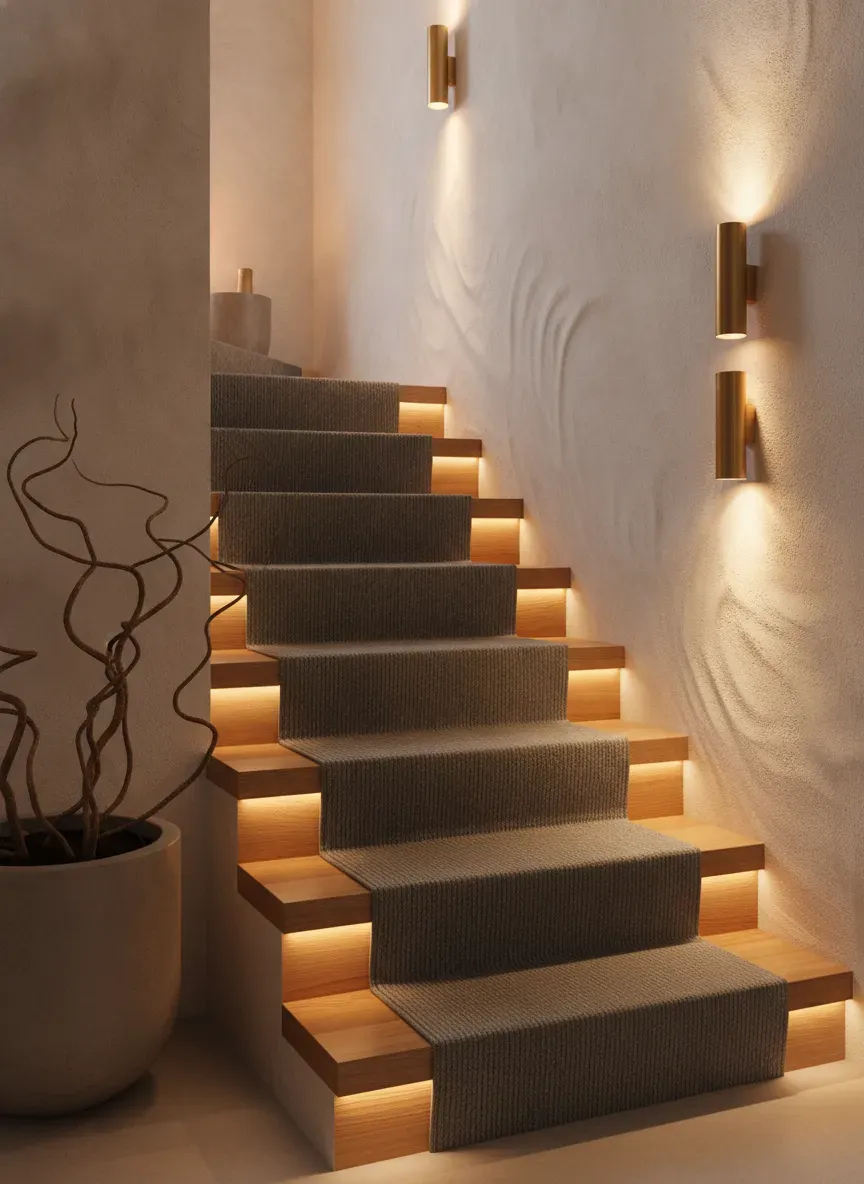
The Magic of Color Temperature and Color Rendering Index (CRI)
You cannot achieve a cozy atmosphere with standard, blue-white LED bulbs. When selecting bulbs or integrated fixtures for your staircase, look for two numbers on the packaging:
- Kelvin (K) Rating: You want to aim strictly for 2700K (Warm White) or even 2400K (Warm Candlelight) if you want an ultra-moody, historic feel. Anything above 3000K will feel like a corporate stairwell or a hospital wing.
- Color Rendering Index (CRI): Choose fixtures with a CRI of 90 or higher. This ensures that the natural wood tones of your treads, the rich colors of your art, and the undertones of your wall paint look rich and true, rather than washed out and gray.
Layering Light: Riser, Low-Level, and Wall Sconces
To create a balanced, glare-free ascent, light should be distributed across different heights.
Integrated Riser and Tread Lighting
Placing light below knee level is a highly effective way to guide the foot safely while keeping the upper field of vision soft and dark. Flush-mounted step lights installed into the drywall just above every third or fourth tread cast a gentle pool of light across the steps.
For a seamless, high-end look, consider installing the Cloudy Bay Dimmable LED Step Lights. These fixtures sit flush against your drywall, throwing light downward to eliminate harsh shadows and prevent trip hazards without shining directly into your eyes.
Low-Profile, Indirect Wall Sconces
If cutting into drywall for step lights isn’t feasible, wall sconces are your best alternative. However, standard sconces often stick out too far, creating a physical hazard for anyone carrying laundry baskets up the stairs.
Look for ADA-compliant sconces, which are designed to protrude no more than four inches from the wall. Furthermore, choose fixtures that are “fully shielded” or “up-and-down” lights. These hide the bulb from direct view, washing the wall with a soft glow rather than casting blinding light sideways.
Smart Controls and Motion Sensors
The transition from a dark bedroom to a brightly lit bathroom or kitchen at night should be gentle. Integrating smart dimmers or discreet motion sensors into your staircase lighting allows the system to operate at a soft 10% to 20% brightness during late-night hours.
This provides just enough illumination for safety without shocking your circadian rhythm back into awake mode.
Pro Tip: If you’re renting or don’t want to rewire your walls, look for rechargeable, magnetic LED sconces. You can mount them with damage-free adhesive strips, and many models feature wave-to-turn-on sensors and warm 2700K settings.
Minimalist Wall Styling: Less is Exquisite
Once your lighting is dialed in, the walls require careful editing. The vertical climb of a staircase naturally draws the eye upward, making the walls prime real estate for visual storytelling.
The goal here is not to fill every square inch, but to use negative space to give your eyes a place to rest.
CLUTTERED VS. MINIMALIST WALL DESIGN

[Cluttered: Gallery Chaos] [Minimalist: Elevated Curated]
┌──────────────────────────┐ ┌──────────────────────────┐
│ [■] [ ] [■] [ ] │ │ │
│ [ ] [■] [ ] [■] │ VS. │ [ TRIPIYCH ] │
│ [■] [ ] [■] [ ] │ │ [ ART ] │
│ │ │ │
└──────────────────────────┘ └──────────────────────────┘
(Visual noise, claustrophobia) (Balanced negative space, calming)
The Trap of the Cluttered Gallery Wall
We have all seen staircases lined with dozens of small, mismatched frames holding snapshots of varying sizes and colors. While sentimental, this approach creates extreme visual noise in a narrow space. Your brain struggles to process so many disparate focal points as you walk, making the ascent feel frantic.
Instead of a chaotic grid, try one of these two minimalist alternatives:
1. The Power of the Triptych
Three identical, large-format frames hung in a perfect, stepping sequence that mimics the incline of the stairs. This creates a rhythmic, architectural flow.
To keep the look clean and elevated, use a high-quality frame like the Minimalist Thin Metal Picture Frames. The ultra-narrow bezel allows the artwork—ideally black-and-white photography or minimalist line art—to take center stage, while the generous white matting provides essential breathing room.
2. The Single Statement Piece
On a staircase with a landing, skip the side walls entirely. Leave them bare to maximize the sense of width. Then, hang a single, oversized, commanding piece of art on the landing wall.
As you walk up, this piece acts as a visual destination, drawing you forward and upward. It simplifies the design, reduces visual clutter, and instantly elevates the home’s aesthetic.
Embracing Negative Space
Negative space—the blank wall area around your decor—is not “wasted” space. It is an active design element. In a narrow staircase, empty walls allow the eye to relax, making the space feel wider and airier.
If you have twelve stairs, you do not need twelve pieces of art. Two or three beautifully framed, thoughtfully spaced pieces are infinitely more powerful than a wall packed to the ceiling with frames.
Adding Depth with Textured Wall Treatments
If plain drywall feels too cold or sterile, but you still want to keep the wall styling minimal, turn to texture instead of decor. Textured walls catch light beautifully, creating organic shadows that add depth without adding physical clutter.
- Roman Clay or Limewash: These breathable, mineral-based finishes have a soft, chalky texture and subtle color variation. When washed with warm light from a sconce, the walls take on a velvety, old-world depth that feels incredibly cozy.
- Subtle Vertical Shiplap or Beadboard: Running vertical wood paneling up the staircase draws the eye upward, accentuating the ceiling height. Painted in a soft cream or warm beige, it provides a quiet, tactile backdrop that feels rich even without a single piece of art hanging on it.
Architectural Accents & Tactile Details
To round out the sensory experience of your staircase, look to the physical touchpoints. The materials underfoot and beneath your hand play a major role in establishing a cozy, grounded atmosphere.
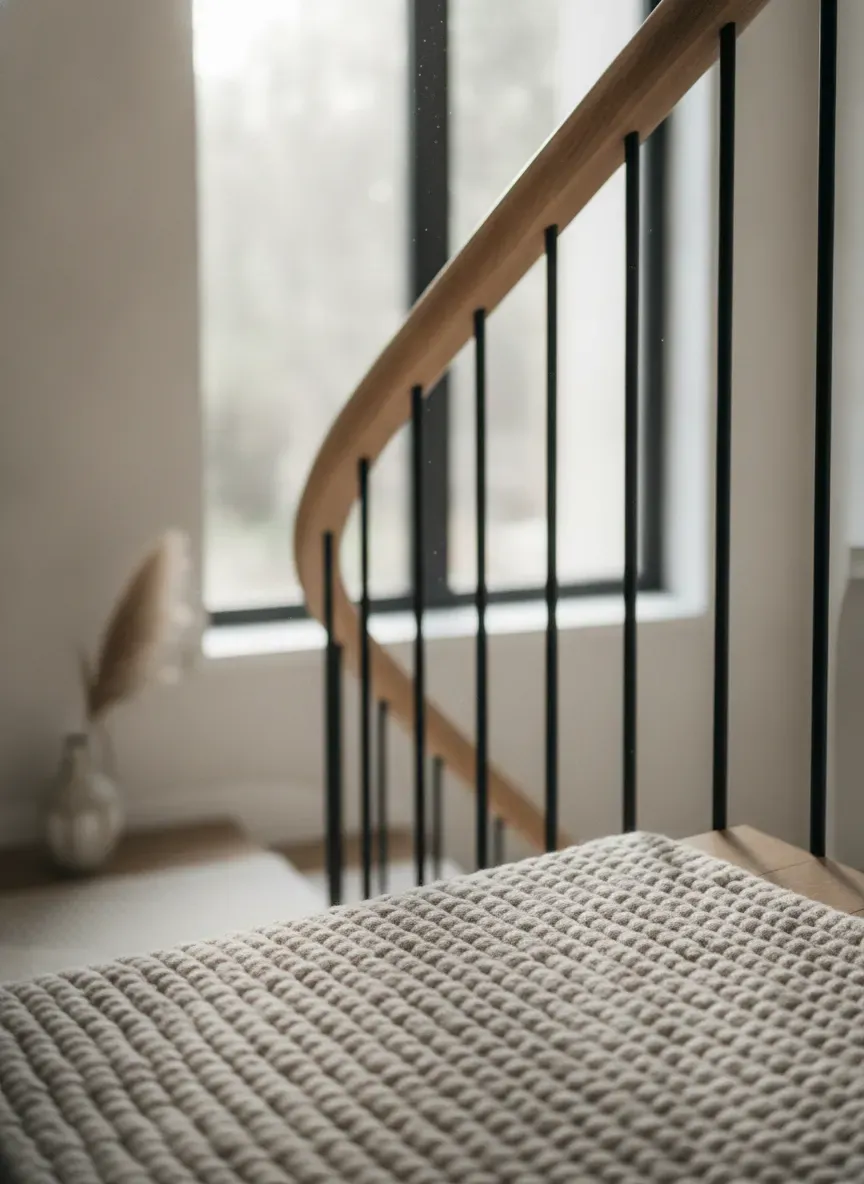
Stair Runners: Visual Softness and Acoustic Dampening
Hardwood steps are undeniably beautiful, but they can be loud and physically cold. A runner is the ultimate tool for introducing soft texture, reducing echoes, and adding a layer of physical comfort.
Material Selection
For a high-traffic zone like a staircase, synthetic fibers can quickly flatten and look dirty. Natural fibers are vastly superior:
- Wool: The gold standard. It is naturally stain-resistant, incredibly resilient, soft underfoot, and absorbs sound beautifully.
- Sisal or Jute: These materials bring an organic, earthy texture to the home. However, pure sisal can feel rough on bare feet and can be slippery if not tightly woven.
A fantastic, durable compromise is a tightly woven natural fiber rug like the Safavieh Natural Fiber Runner. It offers that sought-after organic, raw texture while remaining structurally sound under heavy foot traffic.
STAIR RUNNER INSTALLATION OPTIONS

 [Waterfall Method] [Hollywood Method]
 ┌────────┐ ┌────────┐
 │ ▲ │ │ ▲ │
 │ │ │ (Flows straight │ _│_ │ (Tucked tightly under
 └───┼────┘ over nose) └───┼────┘ the tread nose)
 │ │
When installing a runner, you have two primary styling options:
- The Waterfall Method: The carpet flows straight over the nose of the tread down to the next step. This is a cleaner, more modern look that highlights the pattern of the weave.
- The Hollywood Method: The carpet is wrapped tightly around the nose of the tread and stapled directly under the lip, contouring to the architecture of the stair. This is more traditional and tailored, ideal for showing off the crisp profile of your woodwork.
Handrails: Elevating the Primary Touchpoint
Your handrail is the one thing everyone physically interacts with on a staircase. If yours is a basic, builder-grade piece of orange-varnished oak held up by flimsy brass brackets, swapping it out is a low-effort, high-impact upgrade.
Consider these high-tactility handrail combinations:
- Matte Black Steel: Sleek, cold to the touch but visually grounding. It provides a crisp, graphic line that anchors a minimalist space.
- Raw, White Oak: Sanded smooth and sealed with a matte, non-yellowing finish. It feels incredibly warm and organic in the hand.
- Leather-Wrapped Rails: For an ultra-luxurious, bespoke feel, wrap your handrail in stitched cognac or dark brown leather. It ages beautifully, developing a rich patina over time that feels remarkably cozy.
Integrating Greenery and Sculptural Forms
If your staircase features a landing or a wide turn, you have an opportunity to introduce organic shapes. Avoid tiny, clutter-prone trinkets. Instead, opt for singular, high-impact natural elements.
- A Statement Floor Vase: Place a heavy, textured ceramic or terracotta vase on the landing. Populate it with a few tall, dried branches—like eucalyptus, quince, or olive branches. This introduces height, organic lines, and a touch of nature without the maintenance requirements of a live plant in a low-light area.
- Discreet Hanging Plants: If floor space is non-existent, a single, minimalist ceramic planter hanging from the ceiling above a landing can soften the harsh angles of the stairwell. Choose cascading varieties like a Pothos or a Heartleaf Philodendron that will gently drape downward over time.
Step-by-Step Implementation Guide & Common Mistakes
Transforming your staircase doesn’t have to happen all at once. By breaking the project down into logical phases, you can ensure that each element works in harmony with the next.
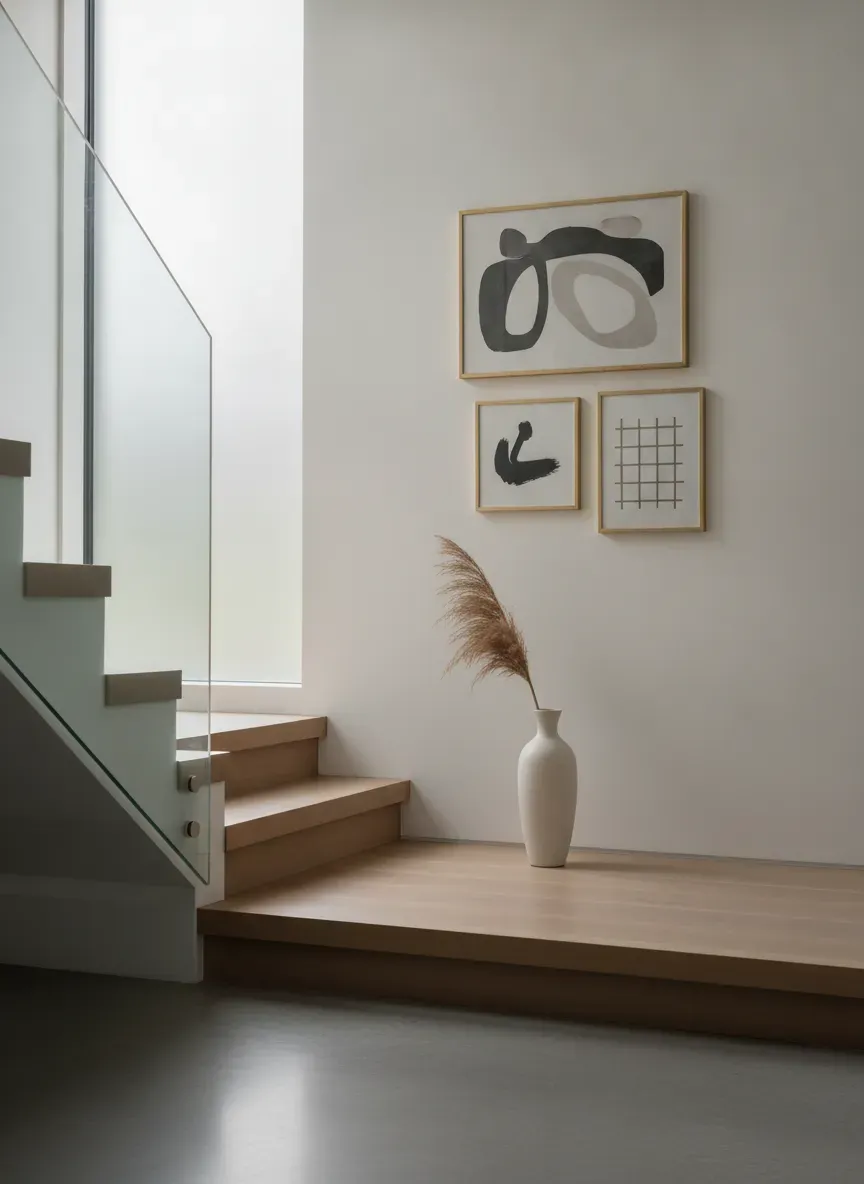
Phase 1: Lighting First
Before you paint or hang art, fix the lighting. Install your low-profile sconces or step lights. Observe how the light washes over the walls at night. This will dictate where you should hang your artwork, as you want to align your frames with the natural pools of light created by your new fixtures.
Phase 2: Paint and Texture
Apply your chosen paint, limewash, or paneling. Stick to warm, reflective neutrals—think soft creams, warm grays, or muddy beiges. These tones bounce the warm 2700K light around the space, amplifying the cozy feeling without making the stairwell feel dark or closed-in.
Phase 3: The Runner and Hardware
Install your runner to soften the acoustics, then update your handrail and brackets. Matching your handrail brackets to the finish of your light fixtures or art frames creates a cohesive, highly intentional design narrative.
Phase 4: Curated Wall Decor
Hang your art using the negative space rules discussed above. Step back, walk up and down the stairs, and adjust. If a piece feels like it is “crowding” you as you walk past, remove it. Less is always more in a tight vertical space.
Key Takeaways
- Prioritize Warmth: Use 2700K bulbs with a 90+ CRI to prevent a cold, institutional feel.
- Go Low-Profile: Keep sconces and frames flush to the wall to maintain physical space and safety.
- Embrace Negative Space: Opt for a few large, beautifully matted frames rather than a cluttered gallery.
- Soften the Acoustics: A wool or natural fiber runner quietens the home and adds deep physical comfort.
- Add Organic Textures: Elevate drywall with limewash or vertical wood paneling to catch warm light beautifully.
Common Pitfalls to Avoid
- Over-decorating the Side Walls: If you find yourself brushing against frames or dodging hanging decor as you carry laundry, your walls are too busy. Clear the pathways.
- Neglecting the View from the Top and Bottom: Stand at the very bottom of your stairs and look up. Stand at the top and look down. These are your primary sightlines. Ensure that what you see from these vantage points is clean, balanced, and inviting.
- Using Cool-Toned LED Bulbs: White or blue-toned light (4000K+) instantly flattens texture, highlights wall imperfections, and ruins any cozy ambiance you are trying to build.
The Bottom Line: A cozy staircase is not about adding more things; it is about choosing the right things. By pairing soft, downward-directed warm lighting with highly curated, minimal wall styling and comforting tactile materials underfoot, you transform a forgotten transition zone into one of the most serene, beautiful journeys in your entire home.

Stop Guessing Measurements. Build Your Dream Entryway with Confidence.
Transform awkward hallways, cramped foyers, and cluttered mudrooms into organized sanctuaries. Includes 20 measured floor plans, facing photo spreads, the 36-inch planning rule, the shoe pairs formula, and 7 printable worksheets.
Core Edition ($17.99) · Flagship Photo Edition v5 ($39.99) — compare editions
