
The Future of Home Organization: 5 AI-Driven Custom Storage Trends for 2025
Discover how algorithmic spatial mapping, kinetic furniture, and generative design are revolutionizing custom home storage in 2025. Expert insights inside.

Mar 12, 2026 - Written by: Linda Wise
I’ve spent the better part of two decades tearing down drywall, designing custom millwork, and obsessing over the millimeter-perfect placement of drawer slides. You’ll notice that the conversation around home organization usually revolves around folding techniques, acrylic bins, or minimalist philosophies. Here’s the real kicker: we are standing on the precipice of a seismic technological shift. By 2025, artificial intelligence won’t just write your emails or curate your playlists; it will dictate the spatial geometry of your closets, pantries, and garages.
The era of static, “dumb” shelving is drawing to a close. We are entering an age where your home infrastructure actively participates in the management of your physical possessions. Predictive algorithms, kinetic architecture, and machine-learning-driven material science are converging to create storage ecosystems that anticipate your needs before you even articulate them. I’ve personally found that once you experience a truly responsive environment, going back to standard cabinetry feels like trading a smartphone for a rotary dial.
Below, I am breaking down the five foundational AI-driven custom storage trends that will dominate home architecture in 2025. But first, if you want to start bridging the gap between traditional storage and the automated future today, I’ve curated a few transitional tools that rely on early-stage smart tech.
Quick Comparison: Top Picks
| Product | Rating | Check Price |
|---|---|---|
| Bosch Blaze Smart Laser Measure | ⭐⭐⭐⭐⭐ | View on Amazon |
| Fleximounts Motorized Garage Storage Lift | ⭐⭐⭐⭐½ | View on Amazon |
| Phomemo AI-Assisted Bluetooth Label Maker | ⭐⭐⭐⭐ | View on Amazon |
Trend 1: Algorithmic Spatial Mapping (The Death of the Tape Measure)
For centuries, custom storage design has relied on a highly fallible human element: the tape measure. Even seasoned carpenters occasionally misread a fractional hash mark or fail to account for the subtle bowing of a seemingly flat wall. By 2025, the very concept of manual measurement will be rendered obsolete by AI-driven spatial mapping.
How LiDAR and Neural Networks Rebuild Room Topography
Modern smartphones are already equipped with rudimentary LiDAR (Light Detection and Ranging) sensors, but the incoming generation of spatial AI takes this technology from a neat party trick to an architectural powerhouse. When you scan a room, the AI doesn’t just record distances; it generates a highly dense point cloud, effectively creating a digital twin of your space.
Neural networks then analyze this negative space. The software automatically identifies structural anomalies, locates hidden studs via electromagnetic density mapping, and calculates the exact degree to which your floor is out of level. If you’ve ever spent a weekend framing and fabricating a bespoke entryway drop zone, you know the agonizing reality of out-of-plumb walls. Algorithmic mapping eliminates this friction entirely.
The software uses this flawless topographical data to instantly generate parametric storage designs. You simply input your desired storage volume, and the AI morphs the cabinetry dimensions to seamlessly hug the exact, imperfect contours of your drywall.
Pro Tip: When utilizing spatial scanning apps, always scan your room under varying lighting conditions. The AI relies heavily on photogrammetry alongside LiDAR, and harsh shadows can occasionally corrupt the depth perception of the neural net.
The Eradication of “Dead Zones”
We all have them. That awkward, narrow gap between the refrigerator and the wall, or the sloping ceiling beneath a staircase that renders standard box store shelves useless. Algorithmic mapping actively targets these dead zones. Because the AI designs parametrically—meaning it adjusts the entire 3D model based on shifting variables rather than fixed dimensions—it can engineer bespoke, micro-storage solutions for crevices you previously thought were uninhabitable.
Trend 2: Predictive Inventory Management Systems
Imagine standing in your kitchen, wondering if you have enough arborio rice for risotto. Instead of rummaging through opaque containers, your pantry informs you—via your smart glasses or an ambient audio cue—that you have exactly 400 grams left, but it expires in two weeks. This is predictive inventory management.

The Sentient Pantry and Hyper-Aware Closets
The technology driving this trend is a fusion of ultra-low-profile load cells, computer vision, and passive RFID tracking. The shelves themselves become sensory organs. High-fidelity weight sensors embedded directly into the millwork continuously monitor the mass of the objects resting upon them.
These algorithmic systems constantly monitor shelf deflection. Long before a catastrophic failure, the AI warns you—eliminating the guesswork involved in evaluating shelf capacity and structural physics. But it goes far beyond structural integrity. When paired with micro-cameras strategically embedded in the cabinet stiles, the AI learns your consumption habits. It tracks the depletion rate of your pantry staples, automatically drafts grocery orders, and even suggests recipes based on the ingredients that are closest to spoiling.
Behavioral Organization Algorithms
The true brilliance of predictive inventory lies in its ability to reorganize your life based on behavioral data. The system logs how frequently you retrieve specific items. Over time, your digital home assistant will prompt you with actionable insights.
It might suggest migrating your heavy winter coats to a secondary closet because you haven’t touched them in eight months, or recommend moving your baking supplies to an eye-level shelf because its analytics show a spike in your baking activity every autumn. It removes the cognitive burden of organizing; the house simply tells you what makes the most ergonomic sense.
Trend 3: Modular Robotics and Kinetic Furniture
I’ve personally found that the biggest barrier to maximizing vertical space is human nature. We are inherently lazy creatures. No matter how beautifully designed a 10-foot-high custom closet is, the items stored on the top tier will inevitably fall into a state of neglect because retrieving a step stool is an annoying extra step.
Storage That Comes to You
In 2025, we bypass human laziness through kinetic architecture. High-bay automated retrieval systems—the kind utilized by massive Amazon fulfillment centers—are being miniaturized and sanitized for residential applications.
Rather than walking into a cavernous walk-in closet, you interact with a sleek, minimalist interface. You select “Gym Clothes,” and a silent, motorized carousel embedded within the walls delivers the exact bin to a waist-height retrieval port. The ceiling height no longer dictates accessibility.
If you are eager to dabble in this automation now rather than waiting for fully integrated wall systems, adding a Fleximounts Motorized Garage Storage Lift to your garage is an excellent primer. It allows you to reclaim your floor space by sending heavy, seasonal bins up to the ceiling with the push of a button, giving you a taste of the kinetic future.
Dynamic Reconfiguration
Kinetic storage isn’t just about bringing items to you; it’s about the physical space adapting to the time of day. Imagine a home office where the desk and filing cabinets physically retract into the wall at 5:00 PM, seamlessly replaced by a fold-down Murphy bed and ambient lighting panels for guests. AI schedules and choreographs these physical transformations based on your daily routines, creating multi-functional micro-apartments that feel twice as large as their square footage suggests.
Key Takeaways on Kinetic Storage:
- Safety First: Modern robotic storage utilizes biometric sensors and LiDAR to instantly halt moving parts if a child or pet enters the operational radius.
- Maintenance: Brushless motors and self-lubricating polymer tracks ensure these systems operate silently and require virtually zero homeowner maintenance.
- Power Redundancy: High-end systems feature battery backups, ensuring you can still retrieve your passport or medication during a power grid failure.
Trend 4: Biomimetic and Climate-Responsive Materials
The conversation around storage usually focuses on spatial geometry, but the materials themselves are undergoing an AI-driven renaissance. Artificial intelligence is accelerating material science, allowing engineers to develop polymers and engineered woods that react dynamically to their localized environment.
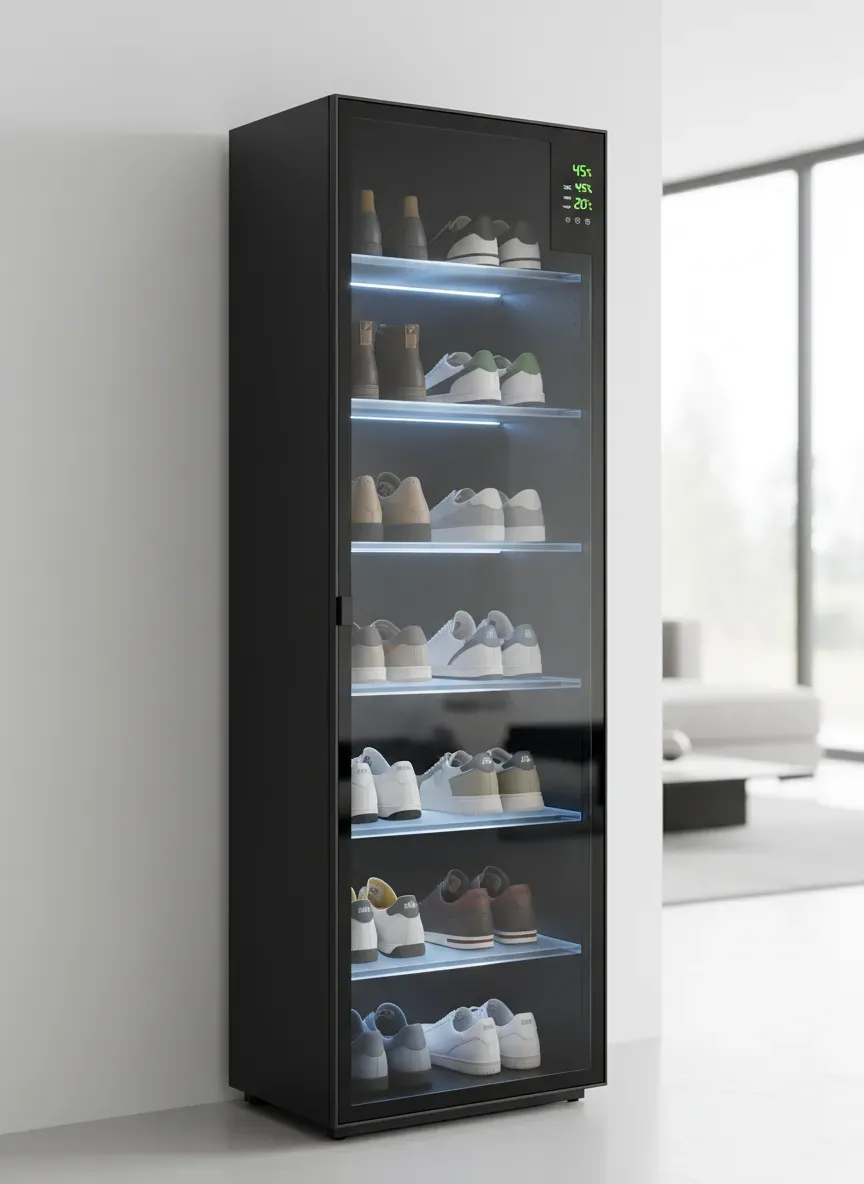
Algorithmic Material Science
Think about the environment inside your closets. It fluctuates wildly depending on the season, ambient humidity, and whether the HVAC system is running. High humidity breeds mold on leather goods; extreme dryness cracks wooden instruments.
By 2025, premium custom storage will feature biomimetic surfaces—materials designed to mimic biological responses. We are seeing the introduction of hygroscopic polymers that physically change their porosity based on the moisture in the air. If the ambient humidity spikes, the microscopic pores in the cabinet backing open up to facilitate passive airflow.
This completely revolutionizes the age-old debate surrounding the breathability of concealed footwear cabinetry versus exposed racks, as the AI dictates real-time air exchange without requiring mechanical fans. Your shoes are protected from dust behind closed doors, but the cabinet actively “exhales” trapped moisture from sweaty gym sneakers.
Piezoelectric Organizational Surfaces
Another fascinating development is the integration of piezoelectric materials into shelving units. These materials generate a tiny electrical charge in response to applied mechanical stress (like the weight of a book or a tool). AI uses these localized electrical pulses to map exactly where items are placed without requiring expensive optical cameras.
This creates a highly durable, privacy-centric method of tracking inventory. Because there are no cameras involved, homeowners feel much more comfortable utilizing these responsive shelves in private areas like bedrooms and master baths.
Trend 5: Generative Design for Micro-Habitats
We’ve discussed the macro—the walls, the moving cabinets, the materials. Now we must look at the micro. The inside of a drawer has traditionally been a chaotic wasteland, tamed only temporarily by generic, off-the-shelf plastic dividers that never quite fit the dimensions of your specific utensils or tools.
3D Printing Meets Algorithmic Sorting
Generative design software flipped the industrial engineering world upside down, and it is now targeting your junk drawer. The process is incredibly elegant. You dump the contents of your messy drawer onto a neutral-colored mat. You take a single photograph with your smartphone.
The AI instantly recognizes the objects—a pair of scissors, three specific pens, a tape measure, and a spare set of keys. It calculates their dimensions and generates a 3D model of a custom insert perfectly contoured to hold those specific items, optimized to fit the exact interior dimensions of your drawer.
You then send this file to your desktop 3D printer (or a local fabrication hub), and a few hours later, you have a bespoke, micro-habitat for your belongings. Every single item has a physically indented home.
While we wait for ultra-fast, consumer-grade generative extruders to become commonplace, using an AI-assisted Phomemo Bluetooth Label Maker helps categorize your current storage. The AI accompanying the app can suggest categorization trees and automatically format text based on the barcode of the items you are storing.
The Evolution of the “Everything Drawer”
This generative approach completely eliminates the concept of the “everything drawer.” When every object requires a deliberate, digitally sculpted cavity, it forces a profound level of intentionality. You can’t just toss a random battery into the drawer because there is no slot for it. The physical architecture of the insert acts as a psychological barrier against clutter.
Pro Tip: When utilizing generative design for tool or kitchen drawers, always program a 5% dimensional tolerance into the AI prompt. Tools expand slightly in the heat, and a perfectly tight friction-fit can become a nuisance when trying to quickly retrieve a screwdriver.
The Psychological Shift: Living with Sentient Storage
Adopting these technologies requires more than just a financial investment; it demands a fundamental shift in how we relate to our domestic spaces. For generations, the burden of organization has rested squarely on our shoulders. We sort, we fold, we purge, we categorize. It is a never-ending cycle of cognitive load.

Delegating Cognitive Load
When your home actively manages your inventory, maps its own topography, and brings items directly to your hands, you experience a profound liberation from decision fatigue. You no longer have to remember where you put the holiday decorations or whether you have enough coffee beans for tomorrow morning. The house knows.
This delegation of cognitive load frees up mental bandwidth. I’ve noticed a distinct sense of calm in clients who pilot these early automated systems. The home transforms from a passive container into an active collaborator in their daily routines.
The Bottom Line: The true value of AI in home organization isn’t necessarily the flashy robotics or the laser mapping. It is the gift of time and mental clarity. It is the peace of mind that comes from knowing your physical environment is working quietly in the background to support your lifestyle.
Navigating Privacy and Over-Engineering
We cannot discuss sentient storage without addressing the elephant in the room: data privacy. When your closets know exactly what you own, and your pantry knows exactly what you eat, that data becomes incredibly valuable to advertisers.
When vetting smart storage ecosystems in 2025, local processing is paramount. The best systems operate on Edge AI—meaning the neural network processing happens on a localized hub within your house, rather than beaming your behavioral data to a corporate cloud server.
Furthermore, there is a risk of over-engineering. Not every drawer needs to be motorized. The goal is to eliminate friction, not to complicate simple tasks. A beautifully crafted, solid walnut drawer on premium soft-close undermount slides will always have a place in the home. AI should be deployed tactically to solve complex organizational problems, not as a gimmick to replace fundamentally sound mechanical design.
Implementation Strategy: Preparing Your Home Architecture for 2025
If you are planning a renovation or a new build today, you must design with the algorithmic future in mind. Retrofitting smart cabinetry into a house with outdated infrastructure is an expensive nightmare.
Infrastructure Over Aesthetics
Stop worrying about the color of your cabinet faces and start worrying about your electrical backbone.
- Wire Your Closets: Traditional closets only feature a single overhead light. Future-proofing requires installing standard 120V outlets inside the actual cabinet boxes. Kinetic tracks, RFID sensors, and biometric locks require continuous power.
- Network Density: Smart storage relies on a robust, low-latency network. Ensure your home features hardwired Ethernet backhauls to multiple wireless access points. A motorized pantry carousel is useless if it drops its Wi-Fi connection.
- Reinforce the Framing: High-bay retrieval systems and motorized lifts generate dynamic loads. When framing out new storage spaces, double up the studs and use structural-grade plywood backing instead of standard drywall. This provides a rock-solid anchor point for heavy robotic tracks.
By laying this foundational infrastructure now, you ensure that your home is ready to plug-and-play when the next generation of generative, kinetic, and predictive storage systems hits the mainstream market.
Parting Thoughts on the Algorithmic Home
We are leaving behind the era of static wooden boxes. The intersection of artificial intelligence, material science, and residential architecture is birthing a new paradigm where our homes are deeply attuned to our behaviors, our physical dimensions, and our shifting needs.
Embracing these five trends—spatial mapping, predictive inventory, kinetic delivery, responsive materials, and generative micro-design—will not just tidy up your living room. It will fundamentally redefine what it means to be organized, transforming the chaotic chore of tidying into a seamless, invisible, and highly elegant background process. Prepare your infrastructure, protect your data, and get ready to experience a home that truly takes care of you.