
When to Hire a Pro vs. DIY: Cost Analysis for Custom Entryway Organization
Thinking about tackling a custom entryway storage project? Here is the raw, unfiltered cost breakdown of doing it yourself versus hiring a professional carpenter.

Mar 11, 2026 - Written by: Linda Wise
I remember standing in my hallway three years ago, staring blankly at a chaotic mountain of muddy boots, discarded backpacks, and dog leashes. The sheer friction of trying to leave the house every morning had reached a boiling point. I knew I needed a custom entryway organization system. What I didn’t know was whether I should build it myself or write a heavy check to a local carpenter.
If you are currently staring down your own disorganized drop zone, you are likely weighing the exact same dilemma. Custom cabinetry is notoriously expensive. Building it yourself seems like a brilliant way to save thousands of dollars—until you factor in the value of your weekends, the cost of specialized tools, and the inevitable reality of out-of-plumb walls.
I’ve personally built custom built-ins from scratch, and I’ve also hired out complex casework. I know the hidden costs of both routes. We need to strip away the glossy Pinterest illusions and look at the raw, unfiltered math behind custom entryway organization.
Quick Comparison: Top Picks
| Product | Rating | Check Price |
|---|---|---|
| Prepac Wide Hall Tree | ⭐⭐⭐⭐½ | View on Amazon |
| Kreg Jig K4 Pocket Hole System | ⭐⭐⭐⭐⭐ | View on Amazon |
| DEWALT 20V Max Cordless Drill Combo | ⭐⭐⭐⭐⭐ | View on Amazon |
The Psychological Weight of the Entryway
Before we start calculating the price of birch plywood, we need to talk about why this specific space matters so much. Your entryway sets the subconscious tone for your entire home. Coming home to a wall of intelligently designed cubbies instantly lowers cortisol. Tripping over a pair of rogue soccer cleats spikes it.
Sometimes, the grand vision of floor-to-ceiling custom lockers blinds us to the immediate, smaller fixes. Before you tear up your baseboards and start framing a massive mudroom bench, ask yourself if a lighter intervention might solve 80% of your frustration. Often, finding the perfect system to keep your keys off the counter and a heavy-duty shoe rack will buy you the mental bandwidth to carefully plan a larger renovation.
But if you are firmly committed to permanent, built-in architecture, the fork in the road is clear: sweat equity or professional execution.
The DIY Route: Sweat Equity and Sawdust
Social media has completely warped our perception of DIY cabinetry. A sixty-second time-lapse makes building a flawless mudroom look like a casual weekend endeavor. It isn’t.
Building high-quality, durable entryway storage requires precision. You aren’t just nailing boards together; you are building casework. You are dealing with dado joints, edge banding, and scribe molding.

The True Cost of DIY Materials
Let’s break down the actual hard costs for a standard 6-foot wide, floor-to-ceiling entryway system featuring a bench, lower shoe cubbies, upper cabinets, and a shiplap backing.
If you are building this right, you aren’t using cheap particle board. You need cabinet-grade 3/4-inch plywood (usually Birch or Maple veneer) for the structural boxes.
- Plywood: 4 to 5 sheets at $90 each = $450
- Hardwood Face Frames: Poplar or Maple boards = $150
- Hardware: Heavy-duty drawer slides, soft-close hinges, hooks = $200
- Trim & Molding: Baseboards, crown molding, casing = $120
- Paint & Finish: Primer, high-grade cabinet enamel (like Benjamin Moore Advance), wood filler, caulk = $150
- Consumables: Screws, brad nails, wood glue, sandpaper = $50
Estimated DIY Material Total: $1,120
That looks incredibly appealing, right? Barely over a thousand bucks for custom architecture. But here’s the real kicker: that number assumes you already own a fully equipped woodshop.
The Hidden Tool Tax
If you try to build precise cabinetry with just a circular saw and a prayer, you will end up with gaps, wobbly boxes, and intense frustration. Professional results require specific tools. If you are starting from scratch, you need to factor these into your budget.
You’ll quickly realize that investing in a Kreg Jig K4 Pocket Hole System is non-negotiable for securing face frames seamlessly. You’ll also need a high-quality track saw (or a very reliable table saw) to break down large sheet goods perfectly square. Add in a brad nailer, an air compressor, an orbital sander, and a reliable DEWALT 20V Max Cordless Drill Combo.
Tool acquisition can easily add another $600 to $1,500 to your project. Yes, you get to keep the tools, but your upfront cash outlay has now doubled.
The Value of Your Time
This is where the DIY fantasy usually crumbles. A skilled carpenter might knock out a custom entryway in three days. A DIYer working on evenings and weekends? You are looking at three to six weeks of living in a construction zone.
Your hallway will be coated in a fine layer of dust. Your garage will be unusable. You will make mistakes. You will mismeasure a piece of expensive plywood and have to make a humiliating return trip to the lumberyard.
Pro Tip: Never underestimate the difficulty of scribing cabinets to a wall. No house is perfectly square. Your walls are wavy, your floor slopes, and your corners are not 90 degrees. A professional knows how to use a compass and a block plane to scribe a piece of trim so it perfectly hugs an uneven wall. A novice will just pump the gap full of caulk, which inevitably cracks and looks cheap a year later.
When DIY Makes Perfect Sense
You should tackle this project yourself if you genuinely enjoy the process of woodworking. If spending a Saturday measuring, cutting, and sanding sounds like therapy rather than a chore, the DIY route is incredibly rewarding. It is also the only viable option if your absolute maximum budget is $1,500 and you refuse to settle for freestanding, big-box store furniture.
Hiring a Professional: The Premium Route
Let’s switch gears. You value your weekends. You want flawless seams, durable lacquer finishes, and a project that starts on Monday and is completely wrapped by Thursday. You need a pro.
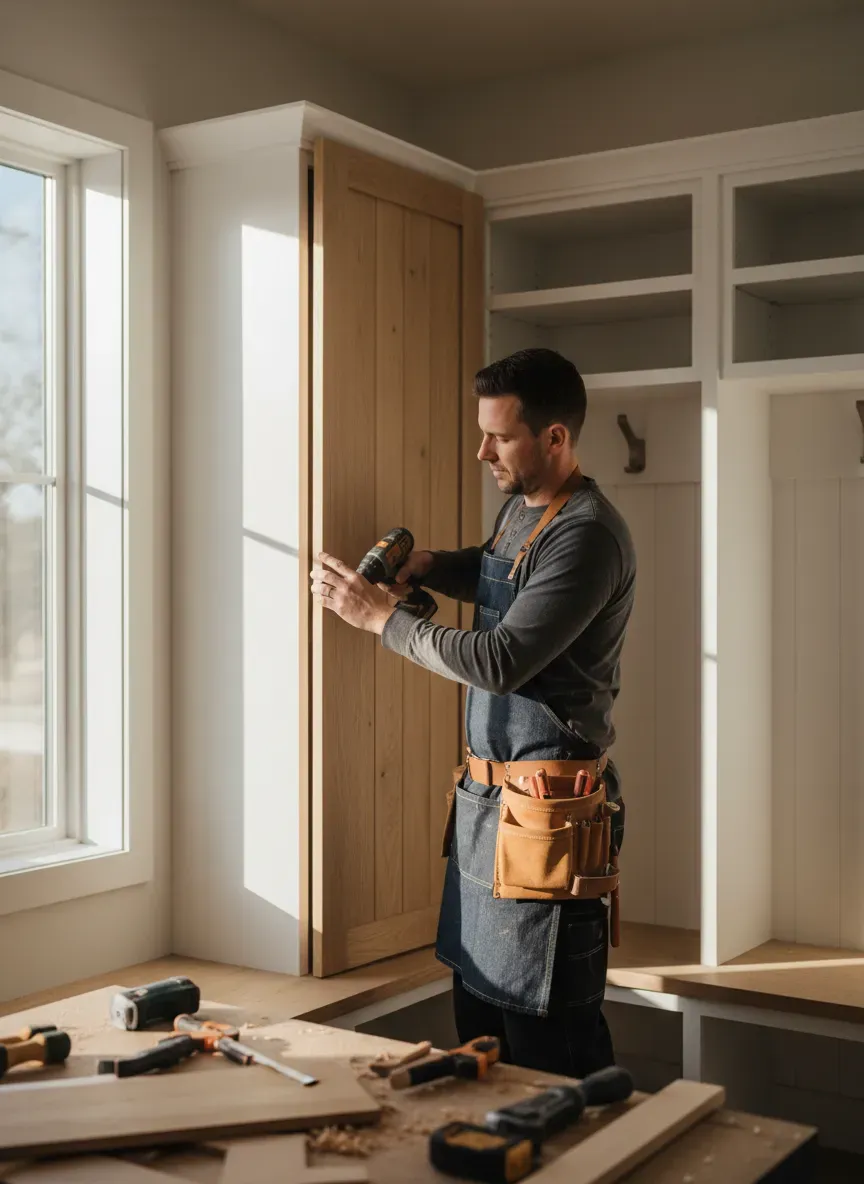
Breaking Down the Professional Quote
When you call a custom cabinet maker or a specialized finish carpenter for that exact same 6-foot wide mudroom system, the quote will likely land between $4,500 and $7,500.
I’ve seen homeowners scoff at these numbers. “How can they charge $6,000 when the wood only costs $1,100?”
It’s crucial to understand what you are actually paying for. You aren’t just buying wood. You are buying decades of specialized knowledge, commercial-grade machinery, insurance, and speed.
- Labor: Usually calculated at $75 to $150 an hour.
- Shop Overhead: They are building the boxes in a climate-controlled shop using $10,000 table saws and industrial edge-banders.
- Commercial Finishes: Pros don’t use a roller and a can of latex paint. They spray specialized, catalyzed lacquers or two-part polyurethanes in a spray booth. This creates a factory-hard finish that will actually survive a wet winter boot being kicked against it daily.
- Design Expertise: Pros know exactly how to scale casework. They won’t make the rookie mistake of building units too shallow for winter coats or too deep for the hallway. If you’re attempting this yourself, you need a rigid understanding of proper mudroom locker dimensions so you don’t eat up walkable floor space.
The Assurance of Accountability
When you hire a reputable professional, the risk transfers from you to them. If they miscut a sheet of $150 white oak veneer plywood, they absorb the cost. If a drawer slide fails three months after installation, you make a phone call, and they fix it under warranty.
Furthermore, a professionally built entryway adds tangible resale value to your home. Appraisers and potential buyers can spot a poorly executed DIY job from ten feet away. Sloppy caulk lines, doors that don’t sit flush, and visible screw heads drag down the perceived quality of your entire house. A masterfully crafted built-in, however, becomes a massive selling feature.
The Hybrid Approach: Hacking the System
What if you don’t have $6,000 to drop on a custom carpenter, but you also lack the skills and tools to build from scratch? Enter the hybrid method.
This has become the go-to strategy for savvy homeowners. You purchase high-quality, pre-manufactured cabinetry and customize it to look built-in.
The “IKEA Hack” Strategy
Using systems like IKEA PAX or Sektion cabinets as your base structural boxes is a brilliant shortcut. You assemble the basic frames, secure them to the wall, and then spend your time and budget on custom touches.
You can frame around the generic boxes with custom MDF or Poplar trim, run your home’s existing baseboard across the bottom to anchor it to the room, and add crown molding to the ceiling. You can even order custom-painted drawer fronts and doors from third-party companies designed specifically to fit standard flat-pack furniture.
If you don’t want to deal with assembly at all, purchasing a high-end freestanding unit like the Prepac Wide Hall Tree and having a local handyman secure it, trim it out, and paint it to match your walls gives you a custom look for a fraction of the cost.
Outsourcing the Hard Parts
Another form of the hybrid approach is doing the rough carpentry yourself but hiring out the finishing stages. You can build the plywood boxes and secure them, but hire a professional painter who owns an HVLP spray gun to come in and lay down a flawless, glass-like finish.
Alternatively, if your entryway design involves moving a light switch or heating vent to accommodate the new cabinets, hire licensed electricians and HVAC technicians for those specific tasks, while handling the woodworking yourself.

Advanced Spatial Planning: Multi-Use Entryways
Modern homes are asking entryways to do more heavy lifting than ever before. It isn’t just about coats and shoes anymore. Depending on your home’s layout, your mudroom might need to double as a laundry sorting area, a pet feeding station, or even a transition zone for fitness equipment.
I’ve seen homeowners try to make their mudroom double as a workout area. If you’re blending these zones, mapping out a low-profile workout gear storage system requires professional-level spatial planning.
When you start stacking functions—mixing heavy, damp winter gear with clean gym equipment or delicate electronics—the ventilation, material durability, and load-bearing requirements skyrocket. A DIYer might use standard drywall anchors to hang a heavy bag bracket inside a mudroom locker. A pro will open the wall, add solid wood blocking between the studs, and seamlessly patch the drywall before the cabinet ever goes up.
Cost-Benefit Analysis Matrix
To crystallize this decision, you need to run your specific situation through a strict cost-benefit matrix. Grab a piece of paper and answer these four questions honestly:
1. What is your “Opportunity Cost” hourly rate? If you make $75 an hour at your day job, and building this system takes you 80 hours of weekend time, the “cost” of your time is $6,000. Add that to your $1,200 materials budget, and your DIY project just cost you $7,200 in lost time and resources. If you would otherwise spend those 80 hours watching television, the time cost is zero. If you would spend it bonding with your kids or doing freelance work, the cost is immense.
2. How long will you live in this house? If this is your forever home, investing $6,000 in bulletproof, professionally sprayed custom cabinetry makes sense. You will interact with this furniture multiple times a day for the next twenty years. If you are flipping the house or moving in three years, the hybrid “IKEA hack” approach provides the best return on investment.
3. What is your tolerance for chaos? A professional crew will mask off your floors, set up zip-wall dust barriers, and vacuum before they leave every afternoon. A DIY project means living with a miter saw in your dining room for a month.
4. Do you have a structural safety net? If you accidentally drill into a water pipe hidden behind the entryway drywall, do you know how to shut off the main, splice PEX, and fix the damage? Pros carry liability insurance for exactly this reason.
Key Takeaways
- DIY Material Costs Are Deceiving: Expect to spend $1,000+ on quality wood and hardware, but budget an additional $500–$1,500 if you need to acquire proper tools like track saws and pocket hole jigs.
- Professional Quotes Include Hidden Value: A $6,000 quote isn’t price gouging; it covers shop overhead, commercial-grade catalyzed finishes, warranties, and rapid installation times.
- Scribing is the True Test: The difference between a cheap-looking DIY job and a pro job is how the cabinets meet the walls and floor. Homes are not perfectly square.
- The Hybrid Method Wins for Budgets: Modifying pre-fabricated flat-pack cabinetry with custom trim and high-end paint offers an 80% visual match to custom work at 30% of the price.
- Resale Risk: Bad DIY detracts from your home’s appraisal value. If you can’t execute the finish carpentry to a high standard, you are better off buying premium freestanding furniture.
The Bottom Line
Deciding whether to hire a professional or tackle your entryway storage yourself comes down to a brutal assessment of your skills, your schedule, and your bank account.
Do not let the romanticized idea of building something with your own hands blind you to the reality of the labor involved. Woodworking is an exact science wrapped in an art form. If you possess the patience, the tools, and the drive, creating your own custom drop-zone is an incredibly proud achievement that you will admire every time you walk through the front door.
But if you are already overwhelmed by the clutter, stretched thin on time, and simply want the problem solved beautifully and permanently, write the check. Hiring a master carpenter isn’t a luxury expense; it is an investment in your home’s equity and your family’s daily sanity. Make the call, pick your paint colors, and reclaim your entryway.