
From IKEA to Ori: Which Custom Storage Solution Actually Fits Your Lifestyle?
Navigate the complex world of modern organization, from flat-pack modular systems to robotic spatial architecture. Find out which storage solution truly matches your space and habits.

Mar 12, 2026 - Written by: Linda Wise
You stare at the bedroom wall, measuring tape in hand, paralyzed by the sheer volume of “stuff” you need to hide, organize, and access. We’ve all been there. The architectural standard for a residential closet—a rigid, drywall-encased box with a single wire shelf—is woefully inadequate for modern consumption habits. We simply own more specialized gear, seasonal wardrobes, and hobby equipment than our floor plans were designed to handle.
Finding a remedy usually triggers a frantic dive into a fragmented market. On one end of the spectrum, you have the ubiquitous flat-pack giants, demanding your weekend and your patience. On the bleeding edge, kinetic architectural systems promise to physically shift your walls at the push of a button. Bridging the gap are dozens of semi-custom and luxury bespoke options.
I’ve spent the better part of a decade ripping out wire shelving and installing everything from basic MDF boxes to high-voltage robotic wardrobes. I’ve personally found that the highest price tag doesn’t automatically equate to the smartest solution. Your choice shouldn’t just depend on your budget; it demands a hard look at your lease terms, your floor leveling, and your tolerance for structural disruption.
Here is a breakdown of the prevailing tiers of organization hardware to help you pinpoint exactly where you belong.
Quick Comparison: Top Picks
| Product | Rating | Check Price |
|---|---|---|
| Tribesigns Modular Freestanding Closet | ⭐⭐⭐⭐½ | View on Amazon |
| Rubbermaid Configurations Custom Closet | ⭐⭐⭐⭐ | View on Amazon |
| Prepac Wide Hall Tree Organizer | ⭐⭐⭐⭐ | View on Amazon |
The Evolution of Domestic Logistics
Before we tear into specific brands, we need to understand why the storage market exploded into a multi-billion dollar industry. Fifty years ago, a home’s primary storage consisted of a few built-in dressers and a coat closet. Today, the concept of “volumetric efficiency” drives interior design. Urbanization has forced us into smaller square footages, yet e-commerce ensures we acquire physical goods at unprecedented rates.
This creates a spatial bottleneck. When your square footage is locked, the only way to expand is through smarter subdivision. We are no longer just putting things away; we are engaging in micro-warehousing.
Pro Tip: Stop thinking about storage in terms of floor space (square feet) and start visualizing it as volume (cubic feet). Most homes waste 40% of their vertical volume by leaving the space between the top shelf and the ceiling completely empty.
Material Science: What Are You Actually Buying?
The dirty secret of the custom closet industry is that 90% of it relies on the exact same substrate: particleboard. The differentiation comes from the density of that particleboard, the quality of the melamine or veneer bonded to it, and the engineering of the hardware (hinges, slides, and tracks).
High-end systems utilize thermally fused laminates (TFL) over high-density fiberboard (HDF), preventing the sagging you see in cheap big-box store alternatives. When evaluating any solution, you are primarily paying for three things: material durability, aesthetic finish, and the engineering required to hold it all together under sheer weight.
Tier 1: The Modular Juggernauts (IKEA PAX & Beyond)
If there is a gateway drug to custom organization, it is the IKEA PAX system. It dominates the market for a very specific reason: it democratizes the look of a built-in wardrobe at a fraction of the cost of a carpenter.
Anatomy of the PAX Ecosystem
The brilliance of PAX lies in its restrictive standardization. You get specific heights (typically 79” or 93”) and specific depths (13” or 22”). By limiting the outer shell dimensions, IKEA can produce a dizzying, endlessly swappable array of interior fittings—the KOMPLEMENT line.
You want soft-close jewelry drawers with felt inserts? Glass-fronted display shelves for your sneaker collection? Pull-out pant hangers? You snap them into the pre-drilled 32mm system holes. It’s adult Legos.
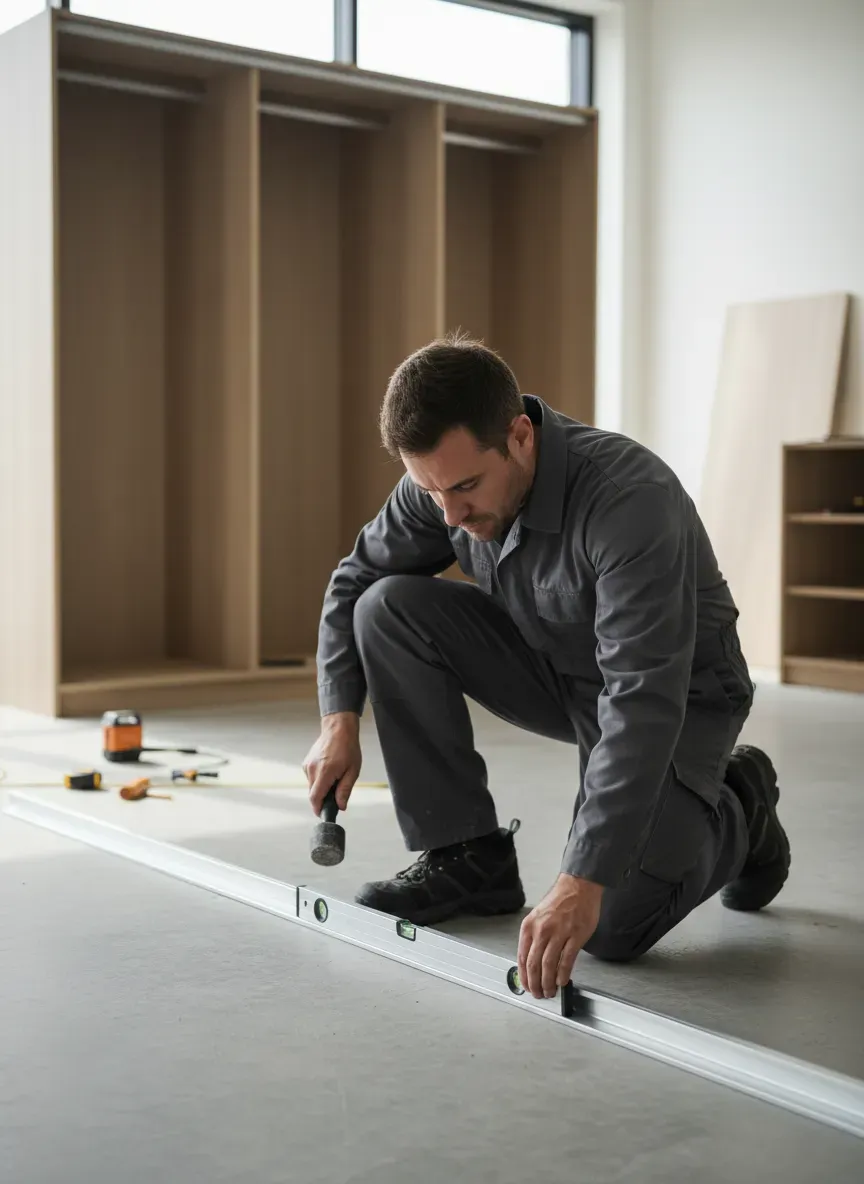
However, the reality of living with PAX reveals its inherent limitations. The frames are constructed from foil-wrapped particleboard. They are incredibly heavy but structurally fragile until fully assembled and anchored to a wall. If your floors are heavily sloped—a common issue in historical homes—you will spend hours shimming the bases to get the doors to hang plumb.
The Elvarli Alternative
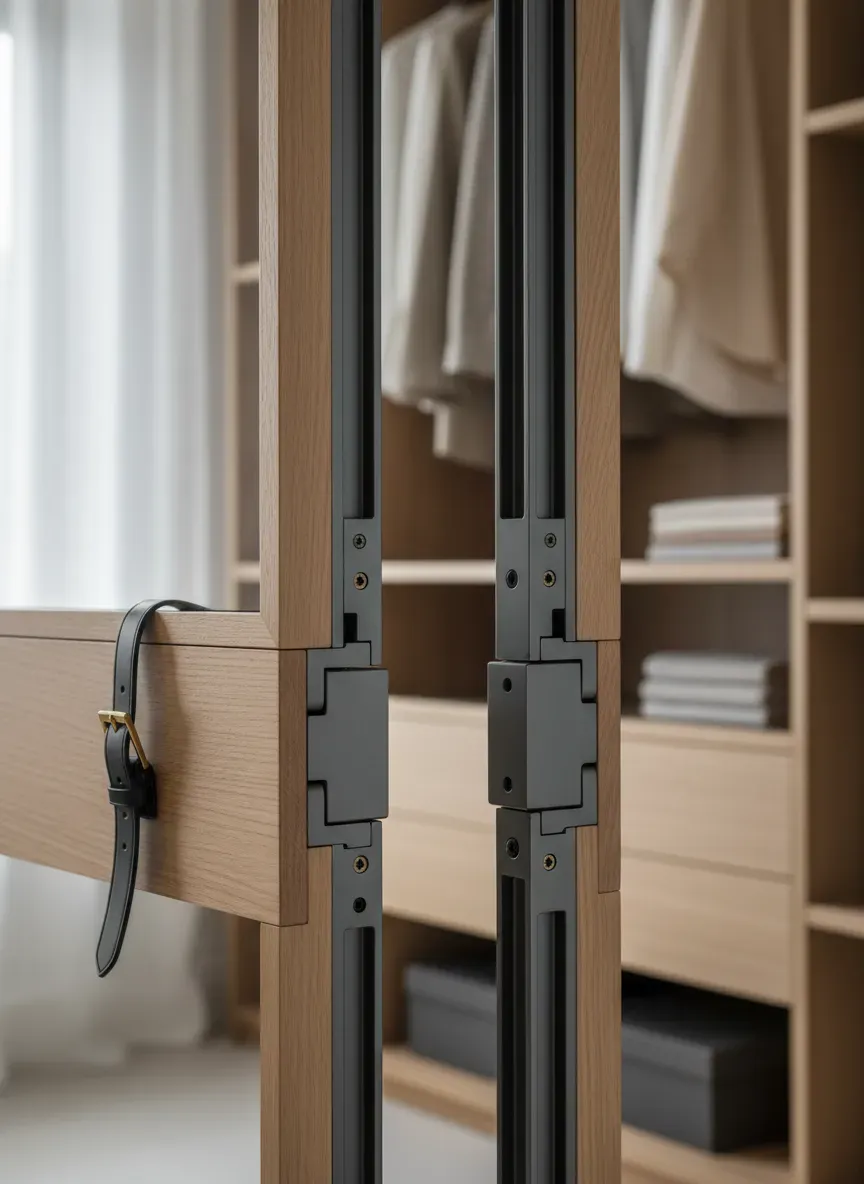
For those who find PAX too heavy or visually oppressive, aluminum-extrusion systems like IKEA’s ELVARLI offer an open-concept alternative. These tension-mounted poles stretch from floor to ceiling, suspending shelves and drawers in mid-air. This aesthetic mimics high-end Italian retail displays. It’s perfect for renters because it minimizes wall damage, relying on vertical tension rather than heavy lateral anchors.
But beware of the visual noise. Open systems demand relentless tidiness. If you struggle with maintaining an immaculate fold on your sweaters, you’ll quickly realize the psychological benefit of doors. It’s the classic dilemma of deciding between visible curation and hidden containment—a choice that dictates not just your room’s look, but your daily stress levels.
When Modularity Meets Reality
Here’s the real kicker with flat-pack modularity: the “savings” are paid in sweat equity. Assembling a linear 10-foot run of PAX wardrobes takes an average of 14 hours for a novice, not including the trip to the store, the complex loading of 400 pounds of flat boxes into a vehicle, and the inevitable realization that you forgot to buy the hinges.
Key Takeaways for Tier 1:
- Best for: Renters, budget-conscious homeowners, and aggressive DIYers.
- The Catch: Assembly is grueling. Frames are susceptible to water damage and cannot be easily disassembled and moved.
- Expected Lifespan: 5 to 10 years, depending on use and load weight.
Tier 2: The Bespoke Bridge (California Closets & The Container Store)
When your budget expands and your patience for Allen wrenches evaporates, you enter the mid-tier bespoke market. Brands like California Closets, The Container Store (TCS Closets / Elfa), and EasyClosets operate on a “we design, we install” model.
The Illusion of Total Customization
The term “custom” here is slightly malleable. These companies aren’t milling raw lumber in your driveway. They are taking proprietary modular components and cutting them to exact millimeter tolerances in an off-site factory so they fit your specific wall dimensions perfectly.
This eliminates the awkward three-inch gaps that plague IKEA installations. The trim work goes wall-to-wall and floor-to-ceiling, creating a seamless architectural feature.
I’ve closely examined the edge-banding on these systems. High-end providers use 2mm PVC edge banding applied with PUR (polyurethane) adhesive. This creates an almost waterproof, impact-resistant edge that will never peel—a sharp contrast to the iron-on paper tape used in budget flat-packs.
Load Displacement and Structural Integrity
One massive advantage of this tier is structural reliability. Instead of resting entirely on the floor, many of these systems utilize a steel suspension track bolted directly into your wall studs. The entire weight of the closet hangs from this track.
This means you need absolute confidence in your home’s framing. If you live in a mid-century home with questionable plaster or metal studs, calculating the structural limits of your walls becomes a critical safety prerequisite before authorizing a 500-pound hanging installation.
The Consultation Dance
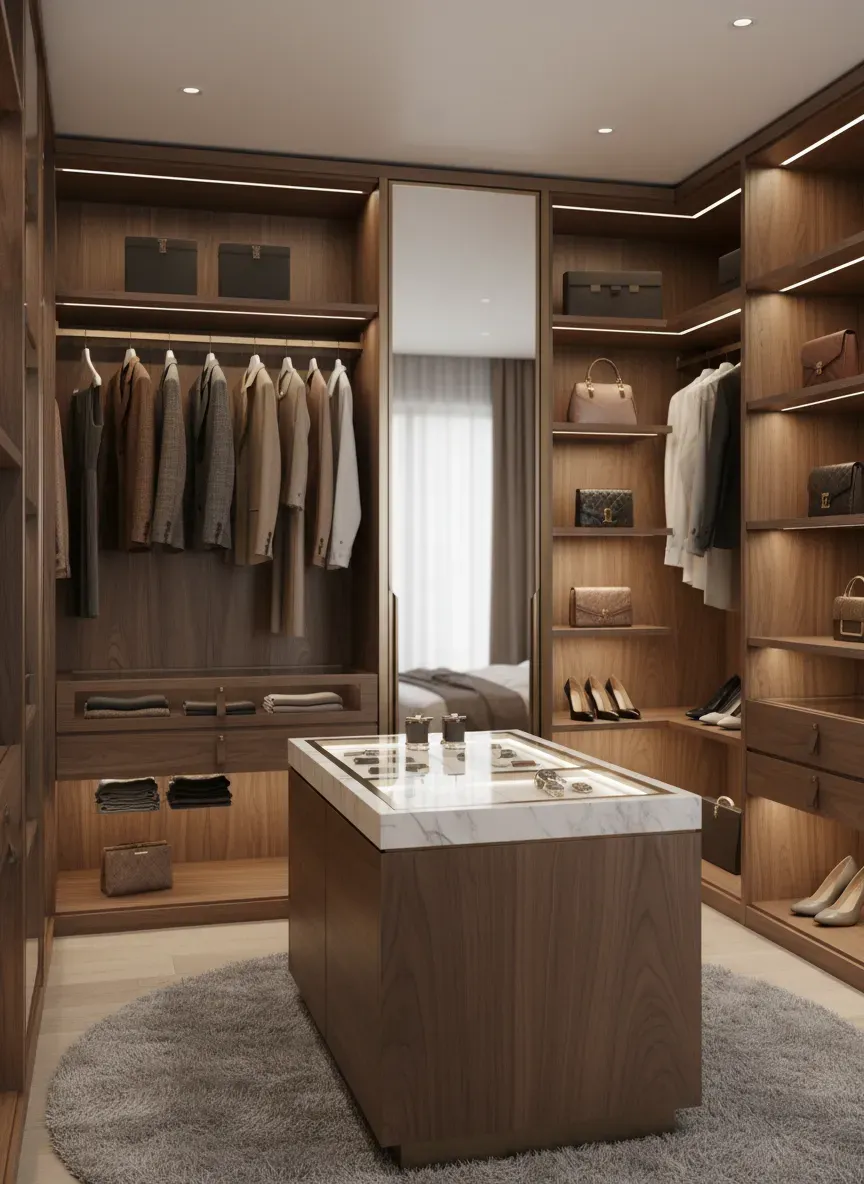
Purchasing at this level is a white-glove experience. A designer measures your space, inventories your clothing (literally counting your pairs of shoes and measuring your longest dresses), and produces a 3D CAD rendering.
You pay a premium for this frictionless experience. A system that might cost $1,500 in raw materials at IKEA can easily exceed $6,000 when designed, cut, delivered, and installed by a bespoke company. You are buying time, precision, and an extended warranty.
Key Takeaways for Tier 2:
- Best for: Homeowners looking to add resale value, oddly shaped rooms, and those who value their weekend time over their budget.
- The Catch: High markup on relatively standard materials. Long lead times for manufacturing.
- Expected Lifespan: 15 to 30 years.
Tier 3: The Robotic Frontier (Ori Systems)
Now we abandon static wood boxes entirely. Welcome to kinetic architecture.
Ori, born from MIT’s Media Lab, represents a fundamental paradigm shift. Instead of building storage into a room, Ori’s robotic furniture becomes the room, shifting on demand to reveal different functions.
Kinematic Furniture and Spatial Fluidity
Imagine a studio apartment. By day, you have a spacious living room with a media center and a home office. You press a button on the wall (or use a voice command via Alexa), and the entire media wall glides quietly across the floor along a discrete track. As it moves, it reveals a walk-in closet and a queen-sized bed hidden behind it.
This isn’t just a Murphy bed; it is an architectural transformer. The robotic track system handles thousands of pounds of payload with whisper-quiet electric motors. Built-in obstacle detection ensures it stops immediately if your dog or a stray shoe blocks the path.
The Mathematics of Expandable Apartments
To understand Ori, you have to look at the brutal math of urban real estate. If you live in a city where property costs $1,000 per square foot, a dedicated 10x10 bedroom is tying up $100,000 of capital just to house a mattress and a closet that you only use for 8 hours a day.
By utilizing Ori’s “Pocket Closet” or “Cloud Bed” systems, you essentially double your usable floor plan. You reclaim the dead space required for walking paths. I’ve toured installations in 400-square-foot micro-apartments that feel functionally identical to 800-square-foot one-bedrooms.
Pro Tip: Robotic furniture requires strict infrastructural prerequisites. Your floors must be mathematically level. If your floor has a dip exceeding a quarter-inch over ten feet, the track systems will bind, and the motors will fail. This is precision engineering, not rough carpentry.
Hardware Meets Software
The true novelty of Ori is that your closet now requires firmware updates. The ecosystem connects to your Wi-Fi network, allowing you to control spatial configurations from your smartphone while commuting home.
However, introducing motors, motherboards, and sensors into your wardrobe introduces new vectors for failure. If the power grid goes down, manual overrides exist, but they are cumbersome. You are trading the absolute reliability of a static shelf for the dynamic capability of a machine.
Key Takeaways for Tier 3:
- Best for: Luxury urban micro-apartments, tech enthusiasts, and high-end developers.
- The Catch: Exorbitant upfront costs. Relies on electricity. Requires perfectly level flooring.
- Expected Lifespan: 10+ years (assuming software support and motor maintenance).
Calculating Your Spatial Return on Investment (ROI)
How do you practically choose between a $500 weekend project and a $15,000 robotic wall? You conduct a brutal audit of your lifestyle, your lease, and your habits.
1. The Mobility Factor
Are you transient? If you move every two years, heavy built-ins are a sunk cost. You cannot easily take a California Closet with you, as it was cut for specific wall dimensions. An Elfa track system or an ELVARLI tension setup is vastly superior here because you can break it down, pack it into a sedan, and reconfigure it for your next space.
2. The Micro-Zone Assessment
You don’t need top-tier solutions for every corner of your house. Reserve the heavy architectural interventions for the primary bedroom. For high-traffic, utilitarian areas, functional simplicity wins. For instance, constructing a fundamental mudroom drop-zone requires durability over high-tech wizardry. You need solid wood that can take the abuse of wet boots and thrown backpacks, not a voice-activated app.
3. The Clutter Personality Test
Be brutally honest about your daily habits.
- The Curator: If your clothes are color-coded and you meticulously fold your jeans, you can pull off open-concept shelving.
- The Stuffer: If your organizational strategy involves throwing things onto a shelf and slamming the door before it falls out, you need robust hinges and solid doors. Do not buy a glass-fronted wardrobe if you are a stuffer; it will just frame your chaos like a museum exhibit.
Installation Realities: What the Brochures Omit
Regardless of the tier you choose, physical installation introduces variables that slick marketing materials conveniently ignore.
Baseboards and Crown Molding: Most homes have baseboards. If you want a built-in unit to sit flush against the wall, you must rip out the baseboards behind it. This requires scoring the caulk, prying off the wood without damaging the drywall, and later re-cutting the baseboard to butt perfectly against the new cabinet.
Out-of-Plumb Walls: I have never seen a perfectly straight wall in my life. Drywall bows. Studs twist. When you try to push a perfectly square cabinet against a wavy wall, you get gaps. High-end installers use scribing tools to custom-cut filler panels that match the exact contour of your wonky walls. If you are DIYing an IKEA system, you will have to learn how to scribe, or learn to live with ugly, dust-collecting gaps.
The Outlet Dilemma: Invariably, the perfect spot for your new shoe rack is directly over the only electrical outlet on that wall. Professional installers will cut access panels into the backing board or hire an electrician to relocate the receptacle. If you overlook this during planning, you’ll end up running an ugly extension cord around your beautiful new furniture.
The Bottom Line: Aligning Hardware with Habits
The Bottom Line: Your optimal storage solution is the one that removes friction from your daily routine without causing financial distress.
If you view home improvement as a hobby and have the patience to troubleshoot a jigsaw puzzle of particleboard, the flat-pack modular ecosystem offers unbeatable value. It forces you to learn spatial planning and rewards you with a highly customized interior.
If your time is your most valuable asset and you view your home as a long-term investment, bringing in a bespoke design team to utilize every millimeter of dead space will elevate your daily living experience immensely.
And if you are staring down the constraints of urban density, willing to embrace the future of domestic robotics, kinematic systems like Ori prove that our walls don’t have to be permanent boundaries.
Stop viewing your closet as an afterthought. Treat it as the logistical hub of your life. Whether that hub is built with wooden dowels or powered by electric motors, getting it right will fundamentally change how you interact with your home.