
Installing Soft-Close Drawers in Your DIY Entryway Organization Unit
Master the precise mechanics of installing soft-close drawer slides in your custom entryway unit. Say goodbye to slammed drawers with this expert, step-by-step guide.

Mar 10, 2026 - Written by: Linda Wise
Nothing shatters the serene vibe of a meticulously organized home quite like the jarring crack of a heavily loaded drawer slamming shut. If you are investing the sweat equity to build a custom entryway organization unit, upgrading to soft-close hardware isn’t just a luxury—it is an absolute necessity for the longevity of your joinery. Every time a standard drawer forcefully hits the cabinet frame, the kinetic energy transfers directly into your glue joints and fasteners. Over time, this repetitive stress fractures the structural integrity of your build.
I’ve personally found that the entryway demands more from furniture than any other space in the house. We toss heavy metal keys, drop dense winter boots, and cram thick woolen scarves into these compartments. The sheer mass of a fully loaded mudroom drawer requires industrial-grade control. Soft-close technology utilizes a specialized pneumatic or hydraulic dampener paired with a tension spring to catch the drawer box in the final two inches of its travel, gently pulling it flush with the carcass in total silence.
Transitioning from basic roller glides to high-end soft-close mechanisms intimidates plenty of novice woodworkers. The tolerance for error shrinks dramatically. A standard epoxy-coated roller slide will forgive a cabinet that is an eighth of an inch out of square. A premium soft-close slide will bind, stutter, and completely fail under the exact same conditions.
Before we rip into the precise mathematics of clearance and setback, review the hardware that actually makes this upgrade possible.
Quick Comparison: Top Picks
| Product | Rating | Check Price |
|---|---|---|
| Blum Tandem Plus Blumotion Undermount Slides | ⭐⭐⭐⭐⭐ | View on Amazon |
| Kreg Drawer Slide Mounting Jig | ⭐⭐⭐⭐½ | View on Amazon |
| Promark Heavy-Duty Soft-Close Side Mounts | ⭐⭐⭐⭐ | View on Amazon |
The Anatomy of a High-Performance Soft-Close Drawer
To properly install this hardware, you must first understand the physics driving it. Soft-close slides consist of three primary components: the cabinet member (which mounts to the inner wall of your unit), the drawer member (which attaches to the box), and the carriage assembly (the ball-bearing track that facilitates the movement).
The magic happens at the very back of the cabinet member. Here, a small, fluid-filled cylinder acts as a shock absorber. When the drawer pushes closed, a pin on the drawer member engages a latch connected to this cylinder. Simultaneously, a tension spring takes over, pulling the drawer inward while the hydraulic fluid regulates the speed, preventing the wood-on-wood collision.
Side-Mount vs. Undermount Glides
You have two distinct architectural paths when selecting your hardware, and your choice dictates how you will build your actual drawer boxes.
Side-mount slides are the utilitarian workhorses of the cabinetry world. They attach to the vertical sides of the drawer box. They are incredibly strong, relatively inexpensive, and intuitive to install. However, they require exactly 1/2-inch of clearance on each side of the drawer box. If your opening is 15 inches wide, your drawer box must be built to exactly 14 inches wide.
Undermount slides are the premium, hidden option. These mount beneath the drawer box, entirely out of sight, offering a pristine aesthetic when the drawer is open. They support heavier dynamic loads and usually offer superior, multi-directional micro-adjustment capabilities. The trade-off? Undermounts require incredibly specific drawer box construction. The bottom panel must be recessed (usually by 1/2 inch), and the back of the drawer box must be notched to accommodate the sliding mechanism.
Load Ratings and Entryway Physics
Here’s the real kicker about entryway storage: static load and dynamic load are entirely different beasts. A slide rated for 100 pounds might hold that weight perfectly still, but when you yank open a drawer filled with heavy winter gear, the sudden shifting of mass creates torque.
Always over-engineer your entryway unit. If you calculate the maximum weight of the drawer’s contents at 40 pounds, install 100-pound rated slides. If you are building deep, heavy-duty pull-outs for wet boots, step up to 150-pound heavy-duty slides. The dampening cylinder in a cheaper, low-weight slide will blow out within six months if repeatedly subjected to the high-velocity slam of a heavy drawer.

Pre-Planning Your DIY Entryway Unit for Optimal Fit
The success of your soft-close installation is determined long before you ever open the package of hardware. The single biggest reason DIYers fail with advanced drawer slides is an improperly constructed cabinet carcass.
Squaring the Carcass (The Crucial Step)
A soft-close mechanism demands parallel walls. If your cabinet is wider at the front than it is at the back, the ball bearings will bind as the drawer pushes inward, requiring excessive force to close and entirely defeating the purpose of the soft-close feature.
When assembling your entryway unit, you must check for square continuously. Measure diagonally from the top-left front corner to the bottom-right back corner, and compare it to the opposite diagonal measurement. These numbers must be identical down to a 1/16th of an inch. If they aren’t, you need to rack the cabinet into square before the glue dries or you drive your final structural screws.
When calculating your overall dimensions, especially if you’re pulling inspiration from clever layouts for confined foyers, remember that the internal clearance dictates your drawer capacity. Do not try to maximize space by skimping on the slide clearances. Wood moves. Plywood swells with seasonal humidity shifts. If you build your drawer box with 15/32” of side clearance instead of the required 1/2”, a humid July afternoon will lock that drawer solid.
Face-Frame vs. Frameless Considerations
Your installation method shifts depending on the style of your entryway unit. Frameless cabinetry (often called Euro-style) is straightforward because the inside wall of the cabinet is flush with the opening. You simply mount the slide directly to the cabinet wall.
Face-frame cabinets are trickier. Because the front frame extends past the inner cabinet wall, you cannot mount the slide directly to the side panel without it hitting the frame. You have two options here:
- Use rear mounting brackets: These attach the back of the slide to the rear wall of the cabinet. I strongly advise against these for heavy entryway drawers, as they introduce flex and reduce the weight capacity.
- Install wood blocking: This is the professional method. Rip down strips of scrap wood to match the exact depth of the face frame overhang, and glue/brad nail them to the inside walls of the cabinet. This creates a flush, solid mounting surface for the entire length of the slide.
Essential Tools and Jigs for Dead-Accurate Alignment
You shouldn’t wing it. Relying solely on a tape measure and a pencil to mark your mounting holes is a recipe for asymmetrical, binding drawers. The human eye struggles to maintain a perfectly level line while simultaneously holding a heavy steel slide and driving a screw.
The Arsenal
- Self-Centering Drill Bit (Vix Bit): This is non-negotiable. When you mark a hole through the metal bracket of the drawer slide, a standard drill bit will inevitably wander slightly due to the grain of the wood. A Vix bit features a spring-loaded housing that perfectly centers the drill bit inside the countersunk hole of the hardware, ensuring your screw drives exactly where it needs to.
- A Quality Jig: I heavily rely on the Kreg Drawer Slide Mounting Jig. It clamps directly to your cabinet face, providing a perfectly level, flush shelf to rest the cabinet member on while you drive your screws. It eliminates the need for three hands.
- Spacer Blocks: If you are installing multiple banks of drawers, cut spacer blocks from scrap MDF. Rest the slide on the spacer block to ensure uniform height across all your drawer bays without having to measure each one individually.
- Combination Square: Used to set the precise setback from the front edge of the cabinet.
Pro Tip: Never use the screws that come free in the package with cheap drawer slides. They are often made of soft metal that strips out instantly. Upgrade to #6 5/8-inch pan-head wood screws, or utilize specialized Euro screws if your cabinet features pre-drilled 5mm system holes.
Step-by-Step Installation Masterclass
We will focus this walkthrough on side-mount soft-close slides, as they are the most common choice for custom DIY entryway builds utilizing standard plywood drawer boxes.
Step 1: Mounting the Cabinet Member
First, separate the drawer member from the cabinet member. Fully extend the slide until you see a small plastic lever (usually black or blue) exposed in the track. Press this lever up (or down, depending on the side) and slide the inner track completely out.
Now, determine your vertical placement. If you are using a jig, clamp it so the mounting platform aligns with the bottom edge of where you want your drawer to sit. If you are using spacer blocks, place them on the floor of the cabinet.
Setting the Setback This is where precision is vital. The front edge of the cabinet member must be set back from the front edge of the cabinet by a specific distance. If you are using inset drawers (where the drawer face sits flush inside the cabinet frame), the setback must equal the thickness of your drawer front plus an additional 2mm (roughly 3/32”). This extra 2mm is critical; it gives the drawer face enough room to push inward slightly so the pneumatic catch can fully engage and lock the drawer.
If you are building overlay drawers (where the drawer face sits on top of the cabinet frame), set the front edge of the slide back exactly 2mm from the front edge of the cabinet.
Rest the slide on your jig or spacer, measure your setback with a combination square, and use your self-centering drill bit to pilot the front hole. Drive the first screw.
Check for level. Once the slide is perfectly horizontal, pilot and drive a screw into the rear horizontal slotted hole. Do not tighten these screws completely yet. The slotted holes allow for micro-adjustments up and down. Repeat this process for the opposite side.
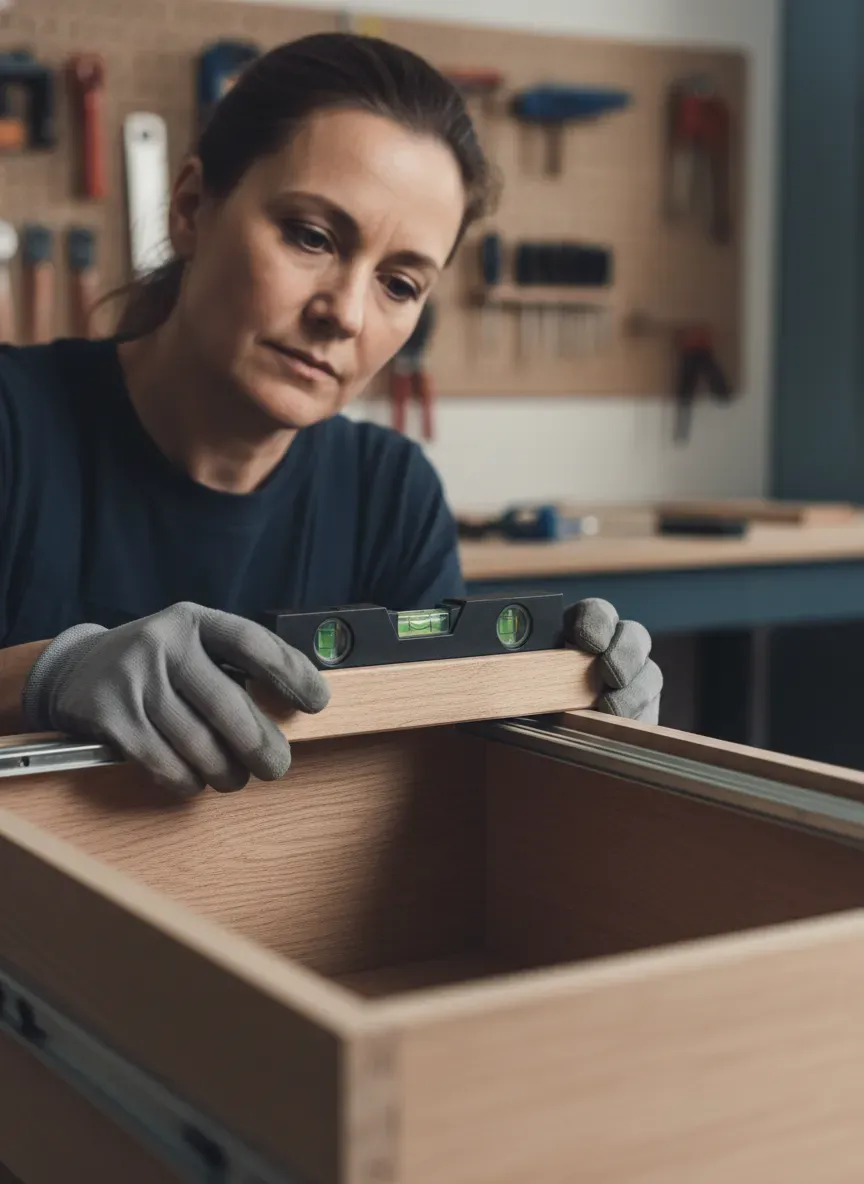
Step 2: Attaching the Drawer Member
With the cabinet members secure, turn your attention to the drawer box. Draw a perfectly straight line across the exact center of the drawer box side.
Align the drawer member of the slide directly over this center line. The front tip of the drawer member should be perfectly flush with the front face of the drawer box. Use your self-centering bit to pilot holes through the vertical slots on the slide, and drive your screws.
If your entryway unit incorporates a highly streamlined footwear compartment, precision is paramount because you lack the vertical space to adjust for sagging. The tighter the clearance, the more accurate your center line must be.
Step 3: The Mating Sequence and Micro-Adjustments
This is the moment of truth. Align the drawer members attached to your box with the carriage assembly protruding from the cabinet members. Keep the drawer perfectly straight and push inward evenly.
You will feel resistance. This is normal. The ball-bearing carriages are resetting themselves. Push firmly until you hear a distinct “click” on both sides. Pull the drawer all the way out, then push it closed again.
Does it glide smoothly? Does the soft-close catch engage and pull the drawer shut the rest of the way? If yes, congratulations. Carefully pull the drawer out, and drive additional screws into the round, non-slotted holes on both the cabinet and drawer members to lock them permanently into place.
If it feels tight, binds, or the soft-close doesn’t engage, do not force it. You need to troubleshoot.
Key Takeaways for Flawless Installation
- Measure diagonally to ensure your cabinet carcass is mathematically square.
- Maintain exact clearances. Side-mount slides require exactly 1/2” per side.
- Invest in a Vix bit. Off-center screws will twist the metal track and cause binding.
- Account for the setback. The slide needs 2mm of extra breathing room to trigger the pneumatic catch.
- Use spacer blocks instead of a tape measure to guarantee uniform height across parallel slides.
Troubleshooting Common Glitches
Even veteran cabinetmakers run into issues with soft-close mechanisms. Wood is an organic material that bows and twists. When dealing with steel tracks that demand perfection, conflicts arise.
The “Tug of War” (Drawer won’t close fully)
If the drawer glides smoothly but stops an inch before closing, refusing to be pulled in by the spring, your setback is wrong. The pin on the drawer member is not reaching the latch on the cabinet member’s cylinder.
You need to adjust the cabinet member forward slightly. Loosen the screws in the slotted holes, tap the slide forward by a millimeter or two, retighten, and test again.
Asymmetrical Reveal or Binding
If the drawer requires heavy physical force to push in, or if the gap (reveal) around your drawer face is uneven, your drawer box is likely racking.
I recall building out a compact entryway organization system in a tight 30-square-foot mudroom, and a slightly warped side panel completely derailed the glide track. If the cabinet is wider at the back than the front, the slides are pulling away from the drawer box as it pushes in.
To fix this, you must shim the slides. Cut thin strips of cardstock or use specialized plastic cabinet shims. Loosen the rear screws of the cabinet member, slide a shim behind the metal track to push it closer to the drawer box, and retighten.
The Bouncing Drawer
Sometimes you’ll push a soft-close drawer, and instead of catching and pulling shut, it hits the back and bounces open slightly. This happens when the hydraulic catch is misaligned or has been triggered prematurely.
Take a flashlight and look at the back of the cabinet member. The plastic latch should be pulled all the way to the front of its small track, waiting to catch the pin. If the latch is pushed to the back, it cannot catch the drawer. Take a flathead screwdriver and gently pull the plastic latch forward until it clicks into the “ready” position.

Upgrading Existing Entryway Furniture
What if you aren’t building from scratch? Retrofitting an existing, builder-grade entryway bench or console table with soft-close hardware is highly rewarding but requires a bit of forensic carpentry.
Retrofitting Old Carcasses
Older furniture often relies on wooden runners or single, center-mounted undermount wooden tracks. To upgrade these, you must completely remove the old hardware.
The biggest challenge in retrofitting is the drawer box width. Old drawers built for wooden runners rarely have the required 1/2-inch clearance on each side for modern side-mount metal slides. You have two choices:
- Rebuild the drawer boxes: This is the most labor-intensive but yields the best results. You keep the original drawer faces but build new plywood boxes sized correctly for the hardware.
- Use Undermount Slides: If the existing drawer boxes are structurally sound and have a recessed bottom panel, you can often transition to Blum Tandem Plus Blumotion Undermount Slides. These slides are far more forgiving of drawer width variations, as they mount underneath. However, you will still need to notch the back of the original drawer box to allow the track to pass through.
When retrofitting, always check the structural integrity of the cabinet walls. Modern soft-close slides exert significant pull-force when opening (you are pulling against the tension spring). If you screw these slides into flimsy, 1/4-inch particleboard sides, the screws will rip out within a week. You may need to glue and screw 1/2-inch plywood blocking to the inside of the cabinet to provide a secure anchor point for the new hardware.
Final Thoughts and Maintenance
Soft-close hardware is remarkably durable once properly aligned, but it still requires basic maintenance, especially in a high-traffic mudroom environment.
Dirt, dried mud, and pet hair are the enemies of ball-bearing tracks. Once a year, remove your entryway drawers completely. Use a can of compressed air to blow out any debris from the tracks and the hydraulic cylinder housing at the back. Never use WD-40 or heavy grease on the tracks, as these sticky substances attract and hold dust, eventually creating a gritty abrasive that destroys the bearings. If the slide begins to feel stiff, use a dry Teflon or graphite spray lubricant sparingly.
The Bottom Line: Precision is your greatest asset. Do not rush the layout phase. Invest in a self-centering drill bit, measure your diagonals obsessively, and respect the clearance requirements. A perfectly installed soft-close drawer elevates a simple DIY entryway unit from a weekend project into a piece of custom, high-end cabinetry that will silently handle your family’s daily chaos for decades.