
Portable & Powerful: The Best Knock-Down Workbench Plans for Easy Transport
Discover expert-level knock-down workbench plans, joinery secrets for maximum stability, and top portable workstands to revolutionize your mobile workspace.
Mar 24, 2026 - Written by: Linda Wise
I’ve lugged back-breaking, monolithic workbenches across uneven job sites more times than I care to admit. It ruins your joints, wastes precious time, and usually ends with a scuffed doorway. On the flip side, trying to hand-plane a piece of dense hardwood on a set of flimsy plastic sawhorses? That’s an absolute nightmare. The entire setup shimmies, shakes, and eventually collapses under lateral pressure.
You need a workspace that completely disassembles to fit into the back of a crossover SUV, yet locks together with the unyielding rigidity of a cast-iron anvil. That’s the magic of a properly engineered knock-down workbench.
Whether you are a traveling finish carpenter, a weekend warrior with a shared garage space, or a woodworker who simply loves taking their craft to the driveway on a sunny afternoon, mastering portable bench design will change your workflow entirely. We are diving deep into the structural mechanics, the specific joinery that makes temporary assembly indestructible, and the top commercial alternatives if you prefer to buy rather than build.
Quick Comparison: Top Picks
| Product | Rating | Check Price |
|---|---|---|
| Kreg Mobile Project Center | ⭐⭐⭐⭐⭐ | View on Amazon |
| Bora Centipede Workstand | ⭐⭐⭐⭐½ | View on Amazon |
| WORX Pegasus Folding Table | ⭐⭐⭐⭐½ | View on Amazon |
The Anatomy of a Brilliant Knock-Down Workbench
Here’s the real kicker: most people think a heavy bench is a sturdy bench. While mass absolutely helps absorb the shock of a mallet striking a chisel, mass isn’t the only way to achieve stability. Rigidity actually comes from fighting racking forces.
Racking is that annoying parallelogram effect. When you push forward on the top of the table, the legs want to fold backward. In a traditional shop bench, you combat this by sinking massive glued mortise and tenon joints into thick timber. Since we can’t use permanent glue in a knock-down setup, we have to rely on mechanical fasteners and specific geometric architecture to freeze the joints in place.
The Physics of Temporary Joinery
To build a portable bench that actually performs, you have to leverage tension. When you tighten a mechanical joint, you draw the shoulder of one board brutally tight against the face of another. This friction resists shear forces. I’ve personally found that relying strictly on gravity—like dropping a top onto a base without locking it down—is a rookie mistake. You need continuous, active tension holding the structural members together.
Foundational Joinery for Mobile Assembly
If you are drafting your own plans, your choice of hardware and joinery will dictate whether your bench takes three minutes or thirty minutes to assemble. Let’s look at the absolute best methods for securing a knock-down frame.
1. The Mighty Tusk Tenon
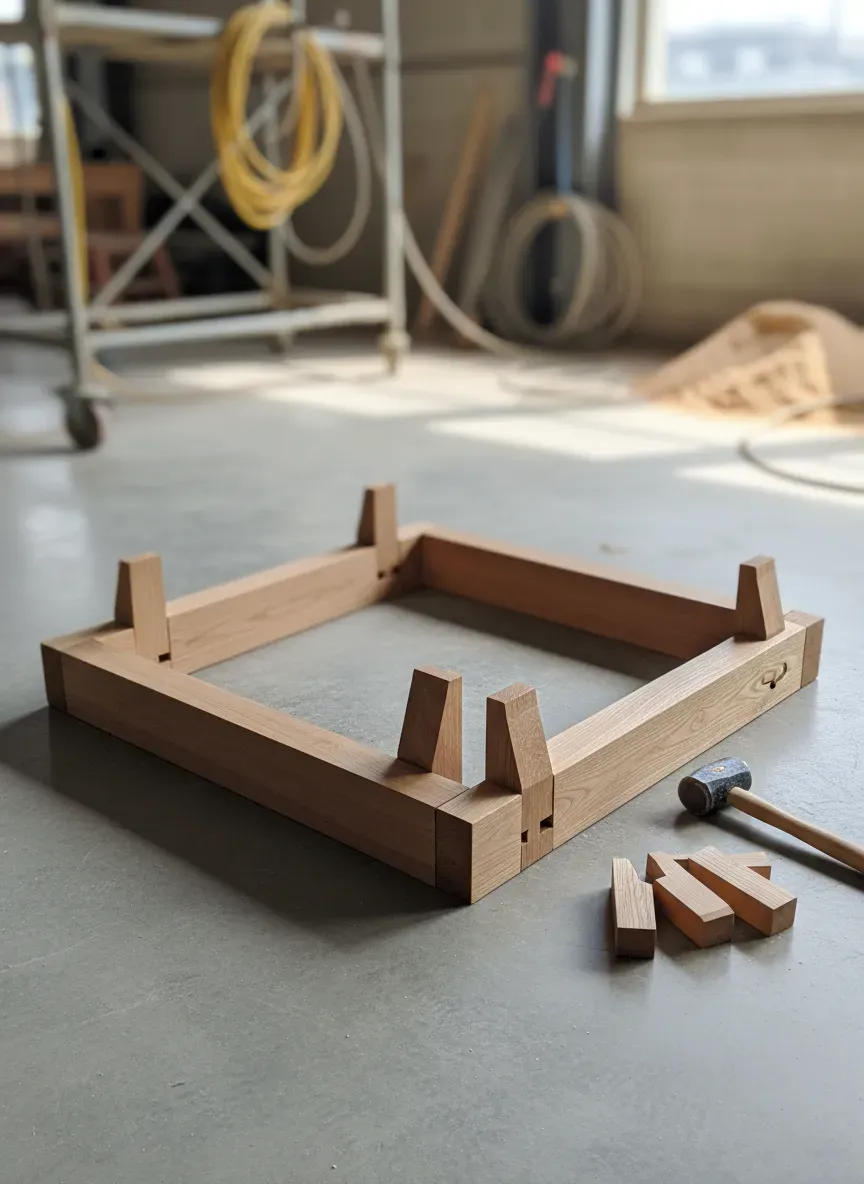
This is an ancient timber-framing technique, and it remains the undisputed king of portable workbenches. A tusk tenon involves a long tenon that passes entirely through a mortise. The protruding end of the tenon has a tapered hole chopped into it. You tap a wooden wedge (the tusk) into this hole.
As the wedge drives downward, it violently pulls the shoulder of the tenon against the mortised leg.
- Why it works: The harder you hit the wedge, the tighter the bench gets. As wood expands and contracts with humidity, you simply give the wedge a light tap with your mallet to retighten the entire structure.
- Best application: Connecting long stretchers to the leg assemblies.
2. Cross Dowels and Connector Bolts
For a more modern, hardware-based approach, cross dowels (also known as barrel nuts) are phenomenal. You drill a hole through the face of your leg and into the end grain of your stretcher. You drop a steel dowel into a perpendicular hole in the stretcher, then drive a heavy machine bolt through the leg and into the dowel.
This creates a terrifyingly strong mechanical joint that can be assembled and disassembled thousands of times without wearing out the surrounding wood. Unlike standard wood screws that strip out end grain after two uses, cross dowels rely entirely on the tensile strength of the steel bolt.
3. Threaded Inserts
Threaded inserts are brass or steel sleeves with coarse wood threads on the outside and fine machine threads on the inside. You drive them into the bottom of your workbench top. This allows you to bolt the heavy top directly to your leg base using hex bolts. When it’s time to pack up, you unbolt the top, leaving the steel inserts flush and undamaged in the wood.
Pro Tip: Always use a drop of epoxy on the outer threads of your threaded insert before driving it into the wood. It guarantees the insert will never back out when you are loosening the machine bolt.
Plywood vs. Solid Timber: Material Selection
Weight is the enemy of portability, but strength is the requirement for a workbench. Balancing these two demands requires intelligent material selection.
The Case for Baltic Birch Plywood
I am a huge advocate for using 3/4-inch Baltic birch plywood for knock-down systems. Unlike dimensional lumber from the big box store—which is often wet, warped, and prone to twisting—high-grade plywood is dead flat and dimensionally stable.
You can laminate two sheets together to create a rigid, heavy 1.5-inch top. For the base, cutting interlocking plywood ribs creates a honeycomb structure that weighs incredibly little but can support a massive amount of downward force. When designing these ribbed sub-structures, understanding load distribution is paramount. If you’re building a modular base, determining the ideal spacing to keep supports far apart without causing tabletop sag is a structural necessity you can’t ignore.
The Solid Timber Approach
If you prefer traditional woodworking, Ash and Soft Maple are excellent choices for a knock-down bench. They are incredibly tough but noticeably lighter than White Oak or Hard Maple. Softwoods like Douglas Fir or Southern Yellow Pine are also fantastic budget options. They are lightweight, cheap, and surprisingly stiff, though their surfaces will dent faster under heavy use.
Top 3 Commercial Knock-Down Systems Evaluated
Sometimes, you just don’t have the time to build a custom bench from scratch. The market has exploded with high-tech, ultra-portable solutions that fold flat in seconds. Let’s break down the mechanics of the three top contenders.
Kreg Mobile Project Center
Kreg revolutionized the portable bench market with this unit. It functions as both a sawhorse and a fully-fledged workbench. The heavy-gauge steel legs provide a surprisingly planted feel, but the real genius lies in the polypropylene top. It comes pre-drilled with 3/4-inch dog holes and integrated aluminum tracks. You can drop Kreg’s specialized bench clamps directly into the track, giving you instant hold-down pressure anywhere on the table. When you pull the release tabs, the two sides fold down, and the legs collapse inward, creating a slim package you can carry with one hand.
Bora Centipede Workstand
The Bora Centipede looks like a complex piece of camping gear, but its load-bearing capacity is staggering. It utilizes a matrix of steel struts that unfold outward in a single motion—much like a pop-up canopy tent. Depending on the size you buy, you can get a 2x4 foot or a massive 4x8 foot support base. You then drop a specialized dog-hole top onto the struts. The triangulation of the steel matrix means the weight is perfectly distributed. It easily supports thousands of pounds, making it ideal for breaking down full sheets of plywood on a job site.
WORX Pegasus Folding Table
For the sheer blend of value and utility, the WORX Pegasus is tough to beat. It’s slightly smaller than the Kreg, making it intensely maneuverable. The ABS plastic top is reinforced with an interlocking grid underneath to prevent deflection. What makes the Pegasus stand out is its integrated clamping system. It comes with two quick-clamps that slide perfectly into molded channels on the tabletop, effectively acting as an instant tail vise. It folds entirely flat and weighs a mere 30 pounds.
Designing Your Custom Portable Bench: The Blueprint Phase
If you’ve decided to build your own, drafting the plans requires a bit of foresight. A bench that lives in a corner of your shop can be massive, but a knock-down bench has to navigate doorways, stairwells, and the trunk of your car.
Ergonomics and Sizing
Your workbench height should be tailored to your primary tasks. If you do a lot of hand planing and heavy router work, a lower bench (around 32 to 34 inches) allows you to get your body weight over the tool. If you mostly do layout, sanding, and detail assembly, a taller bench (36 to 38 inches) will save your lower back from agony.
When it comes to the footprint, you have to balance surface area against transportability. Figuring out the drop-leaf dimensions or the main surface area often means analyzing 12-24 inches: finding the sweet spot for a secondary support shelf below the main deck. This shelf not only holds your active tools but acts as a critical structural diaphragm to prevent twisting.
Furthermore, you must consider the depth. Much like designing built-in storage where a precise mudroom locker depth guide prevents hallway obstruction, calibrating your bench’s depth ensures it fits through standard doorways when fully assembled. I recommend keeping the absolute maximum width of your top to 28 inches. Anything wider, and you’ll find yourself awkwardly shifting the bench sideways through residential door frames.
The Torsion Box Top
If you want a perfectly dead-flat surface that weighs next to nothing, you must employ torsion box construction.
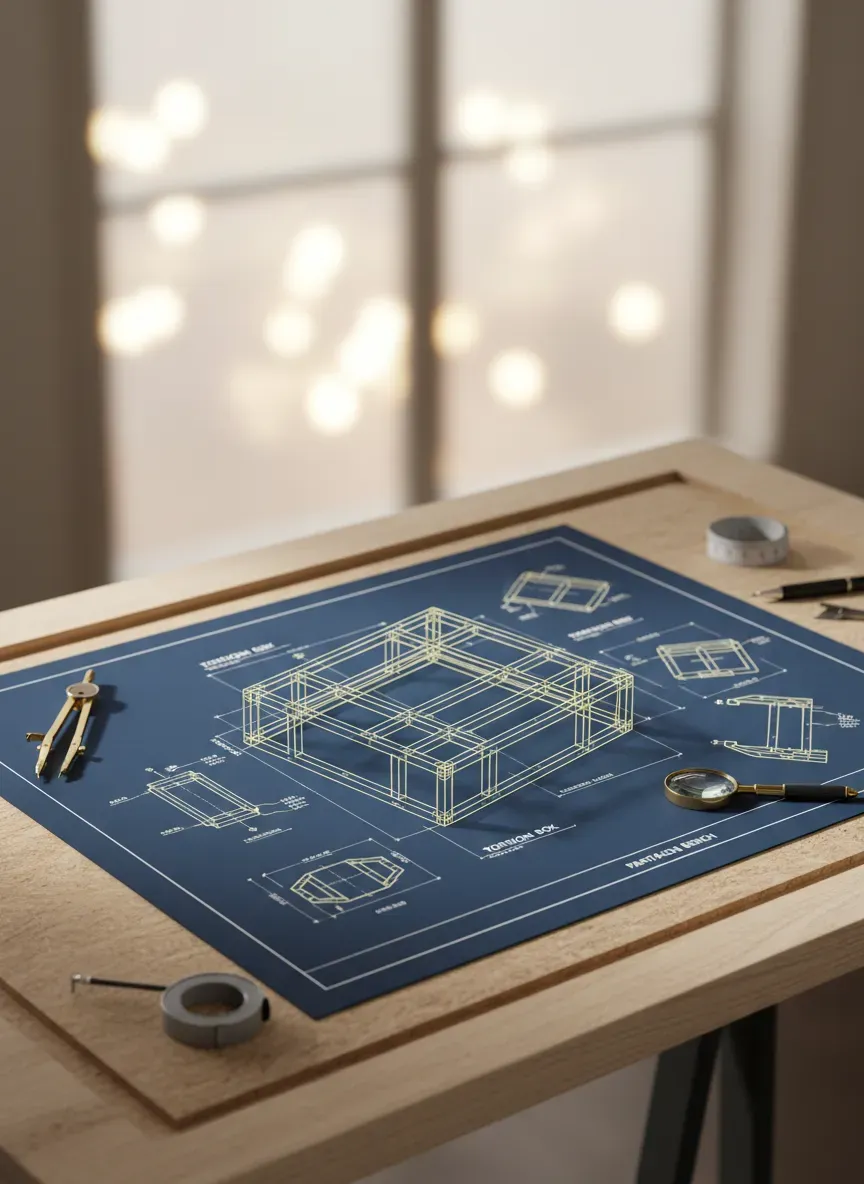
A torsion box consists of a grid of thin material (like 1/2-inch MDF strips) glued between two thin exterior skins (like 1/4-inch hardboard). The resulting structure is functionally similar to an airplane wing. It is highly resistant to sagging and twisting because the internal web prevents the top skin from compressing and the bottom skin from stretching.
A well-built torsion box top can be 3 inches thick, perfectly flat for glue-ups, and still light enough to tuck under your arm. The only downside? You can’t easily drill standard dog holes into it without hitting the internal web, so you must plan your hole locations during the internal grid construction, blocking out solid areas where the dog holes will pass through.
Workholding on the Go
A workbench is just a dumb table if it can’t hold your material securely. Traditional cast-iron vises are far too heavy for a portable setup. Instead, you need to rely on surface clamping.
Key Takeaways for Mobile Workholding:
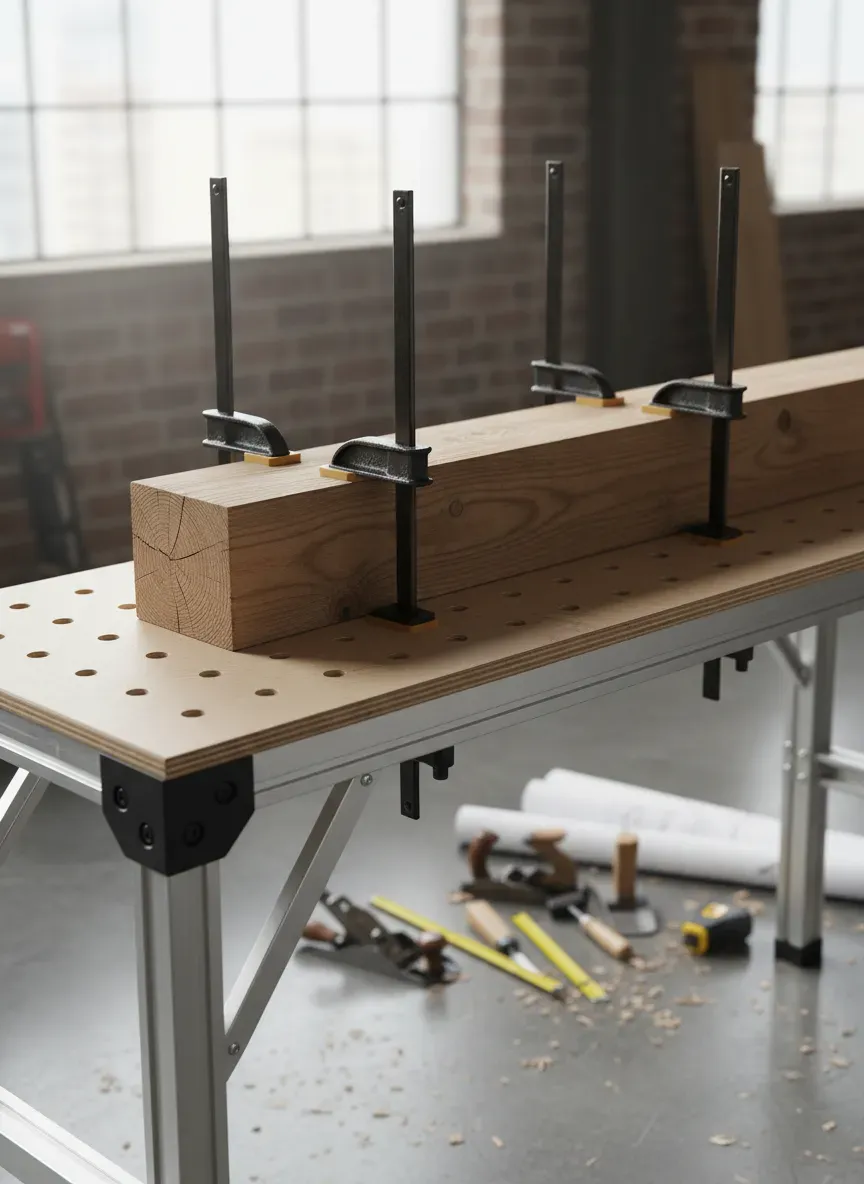
- The 20mm Dog Hole Grid: Drill a matrix of 20mm holes across your benchtop on 96mm centers. This matches the Festool MFT standard, allowing you to use a vast ecosystem of aftermarket track-saw dogs, cam clamps, and hold-downs.
- Inlaid T-Track: Rout grooves into your benchtop and epoxy/screw aluminum T-tracks flush with the surface. This allows you to slide toggle clamps anywhere on the board.
- The Pipe Clamp Vise: Use a standard 3/4-inch pipe clamp mounted beneath the table surface. Run the pipe through the front apron, attach a wooden jaw, and you have a high-pressure front vise that weighs a fraction of a traditional mechanism.
- Surface Holdfasts: If your top is solid wood and at least 1.5 inches thick, traditional forged iron holdfasts are brilliant. Drop them in a hole, whack them with a mallet, and they pinch the work tightly to the table. A tap on the back releases them instantly.
The Moravian Influence: A Historical Masterpiece
You can’t discuss knock-down benches without paying respect to the Moravian workbench. Originating in the Moravian settlements of North Carolina in the 18th century, this design is the holy grail of portable timber-framing.
The genius of the Moravian design is its splayed leg base. The legs sit at compound angles, naturally fighting both lateral and longitudinal racking. The stretchers are secured entirely with massive tusk tenons. The top is a thick slab of wood featuring a tool tray at the back to reduce overall weight.
You can assemble a full-scale, heavy-duty Moravian bench using nothing but a wooden mallet in under two minutes. No metal hardware, no tools required. It breaks down into five distinct pieces (the top, two leg assemblies, and two long stretchers) that can easily slide into the bed of a pickup truck. If you want the ultimate blend of traditional craftsmanship and rugged portability, researching Moravian blueprints is your next logical step.
Common Pitfalls in Portable Workbench Construction
Even seasoned builders make errors when designing for portability. Here are the traps you need to avoid.
1. The Top-Heavy Trap If you build a massive 3-inch thick laminated hardwood top but pair it with spindly 2x4 legs, you’ve created a pendulum. The moment you apply horizontal force, the top-heavy mass will cause the entire structure to sway violently. Your base must have a wide stance, and the lower stretchers should be situated as close to the floor as possible to lower the center of gravity.
2. Stripping Wood Threads Never drive metal bolts directly into tapped wood threads for a knock-down joint. Wood fibers break down quickly under the abrasive friction of steel threads. By the fourth time you assemble the bench, the bolts will spin loosely in the holes. Always use cross dowels or threaded metal inserts.
3. Ignoring Floor Leveling Job sites, driveways, and garage floors are rarely flat. A rigid four-legged bench will almost always wobble on an uneven surface. To counter this, design your bench with adjustable leveling feet. Heavy-duty threaded leveling glides on the bottom of your legs allow you to dial out the wobble in seconds. Alternatively, a three-legged design (a tripod base) will never rock on an uneven surface, though it sacrifices some corner stability.
4. Overcomplicating the Hardware If your bench requires two wrenches, a screwdriver, and a specialized hex key to assemble, you will eventually hate using it. Keep the hardware uniform. If you use connector bolts, ensure every single bolt on the bench uses the exact same size Allen wrench. Better yet, swap the hex bolts for star-knob bolts so you can tighten everything entirely by hand.
The Final Verdict on Mobile Workspaces
Creating a workspace that travels with you doesn’t mean sacrificing the rigidity required for precision craftsmanship. Whether you opt for the rapid deployment of the Bora Centipede, the integrated clamping of the WORX Pegasus, or the immense satisfaction of building a custom tusk-tenoned Moravian beast, the key is understanding the mechanics of tension and geometric stability.
Stop settling for wobbly sawhorses. Elevate your craft by investing in a foundation that actually fights back against the forces of your tools.
The Bottom Line: A well-engineered knock-down bench gives you shop-level accuracy wherever your work takes you.
Ready to Build Your Own Portable Masterpiece?
I get asked constantly for exact, step-by-step blueprints for the custom knock-down benches I’ve referenced here. Trying to figure out the exact compound angles of a Moravian leg base or the precise web spacing of a torsion box top can be a massive headache if you’re doing the math from scratch.
That’s exactly why I highly recommend checking out Ted’s Woodworking. It’s an absolute goldmine for builders. You get instant access to over 16,000 professional woodworking plans, including highly detailed, dimensioned blueprints for heavy-duty workbenches, portable folding tables, and modular shop stations.
The plans come with exact cut lists, material breakdowns, and step-by-step 3D schematics that completely eliminate the guesswork. Right now, you can grab the entire archive at a massive 75% discount.
Stop sketching on napkins and start building with proven engineering.
Click here to get instant access to Ted’s Woodworking and claim your 75% discount today!