
Small Shop Solutions: 8 Space-Saving Workbench Plans for Tight Spaces
Maximize your micro-shop with these 8 ingenious, space-saving workbench plans designed specifically for tight garages, basements, and sheds.
Mar 24, 2026 - Written by: Linda Wise
I distinctly remember staring at my first “woodshop”—a 10x12 foot section of a damp basement, already half-occupied by a water heater and my neighbor’s discarded exercise bike. Balancing a sheet of 3/4-inch plywood across two wobbly plastic sawhorses was my daily reality. Every time I ran a hand plane across a board, the entire makeshift rig threatened to collapse.
If you are working out of a single-car garage, a cramped shed, or a tiny basement corner, you know the frustration. You need a rock-solid surface for precision joinery, assembly, and finishing, but you simply don’t have the square footage for a massive 8-foot traditional Roubo bench.
The good news? You don’t need a sprawling commercial warehouse to build museum-quality furniture. You just need to outsmart your floor plan.
Below, I am breaking down eight highly functional, space-saving workbench plans designed specifically for tight quarters. These aren’t flimsy folding tables; they are legitimate, heavyweight workholding solutions that tuck away, fold flat, or serve multiple purposes.
Quick Comparison: Top Picks
| Product | Rating | Check Price |
|---|---|---|
| Heavy-Duty Retractable Casters | ⭐⭐⭐⭐⭐ | View on Amazon |
| Kreg T-Track Mini | ⭐⭐⭐⭐½ | View on Amazon |
| Bessey Inline Toggle Clamps | ⭐⭐⭐⭐⭐ | View on Amazon |
The Anatomy of a Micro-Shop Workbench
Before we dive into specific designs, we need to address the physics of small-space woodworking. A good bench must resist three forces: downward pressure (chopping mortises), lateral racking (planing), and upward lift (prying or heavy clamping).
When you scale down the footprint of a bench, you inherently lose the mass that traditionally counteracts these forces. Therefore, small-shop benches must rely on structural ingenuity rather than sheer weight. When you’re dealing with limited square footage, understanding the ideal spacing between shop fixtures becomes critical to your workflow. You can’t have a bench that traps you in a corner when you need to rip a long board.
Key Takeaways for Small Benches:
- Mobility is non-negotiable: Unless it’s bolted to a wall, your bench needs to move.
- Dual-purpose surfaces: Your assembly table should double as your outfeed table.
- Integrated workholding: Use dog holes and T-tracks instead of bulky, permanent face vises if space is at an absolute premium.
8 Ingenious Workbench Plans for the Space-Starved Woodworker
1. The Heavy-Duty Wall-Mounted Drop-Down Bench
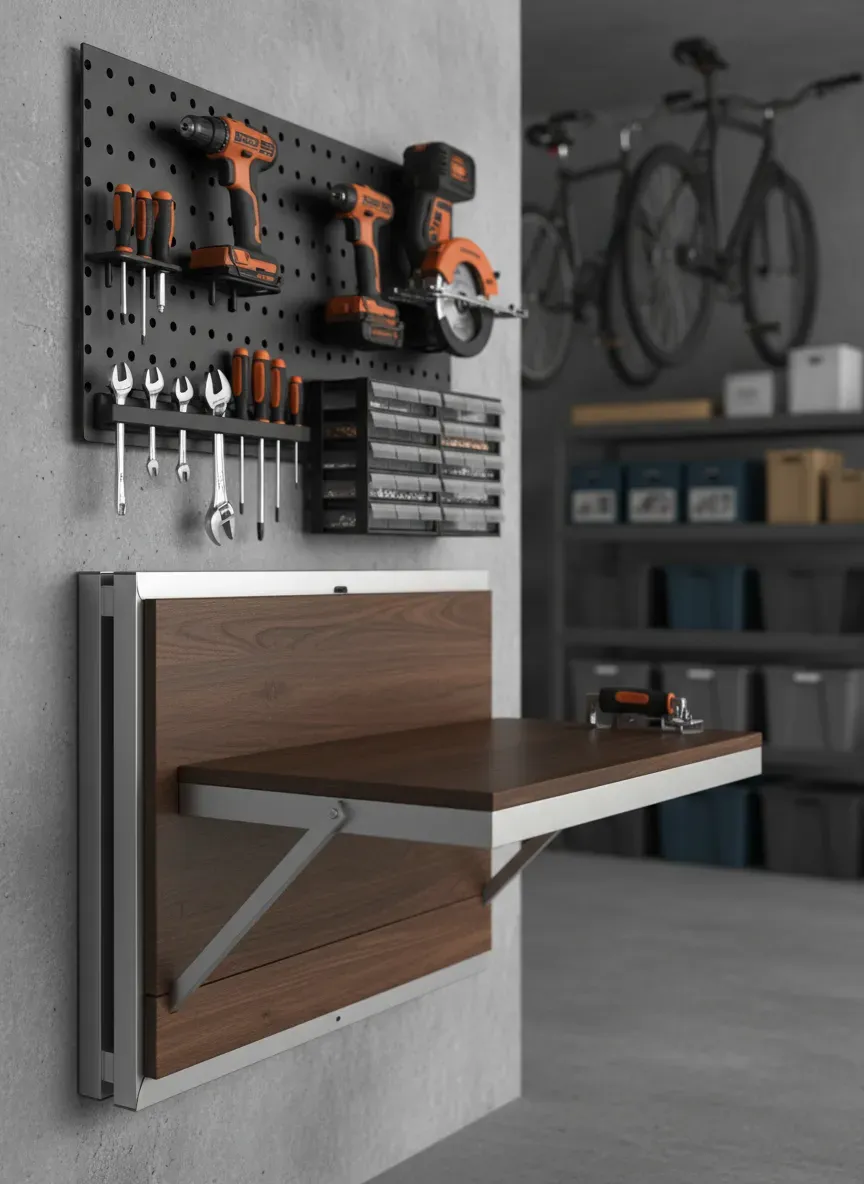
Forget those flimsy laundry-room folding tables. A proper woodworker’s drop-down bench needs to withstand the impact of a mallet and a chisel. The secret lies in a heavy-duty torsion box top and bombproof articulated legs.
How It Works: The rear ledger board of the bench is bolted directly into the wall studs using 3/8-inch lag screws. The top itself is constructed from two layers of 3/4-inch MDF, creating a dead-flat, heavy surface. Heavy-duty piano hinges attach the top to the ledger.
The Leg Mechanism: Instead of relying on locking shelf brackets (which will buckle under the vibration of a random orbital sander), this plan utilizes folding wooden legs that lock into the floor baseboard. When you fold the bench up against the wall, it projects a mere 3 inches into the room.
Pro Tip: Mount a French cleat tool wall directly above the folded bench. When the bench drops down, your hand tools are instantly within arm’s reach.
2. The Micro-Roubo: Traditional Mass in a Fraction of the Space
Hand tool purists often scoff at mobile benches because planing requires an immovable object. Enter the Micro-Roubo.
This plan takes the classic French workbench design—massive solid wood top, thick flush legs, sliding deadman—and condenses it into a 4-foot by 20-inch footprint. Because the bench is so short, you must build it out of incredibly dense wood like ash, hard maple, or white oak to retain the necessary mass.
Design Specifics: The top should be at least 3 inches thick, laminated from edge-grain hardwood. Drawbored mortise and tenon joints connect the stretchers to the massive 4x4 legs, ensuring absolutely zero lateral racking.
Whether you’re establishing the height or finding the perfect 12 to 24-inch depth ratio for your specific wingspan, ergonomics shouldn’t be sacrificed just because the bench is small. You can easily mount an end vise and a leg vise on a bench this size, giving you all the traditional workholding of a 9-foot behemoth.
3. The Flip-Top Tool Cart Hybrid
If your shop is dominated by benchtop tools—a miter saw, a thickness planer, a spindle sander—you are likely losing precious flat surface area to these machines. The flip-top bench solves this elegantly.
The Mechanics: The core of this plan is a central pivot mechanism. You construct a deep, rigid cabinet base on casters. The “top” is actually a two-sided platform that rotates 360 degrees on a 3/4-inch steel pipe running through the center.
You mount your thickness planer on side A. You leave side B completely flat. When you need to plane boards, you pull out the locking pins, flip the planer up, and lock it back in. When you’re done, flip it over, and you instantly have a perfectly flat 3x2 foot assembly bench.
This cuts your required footprint exactly in half.
4. The Ron Paulk-Inspired Mobile Torsion Box
Ron Paulk revolutionized the job-site woodworking scene with his brilliant torsion box designs, and small shop owners quickly adapted them for garage use.
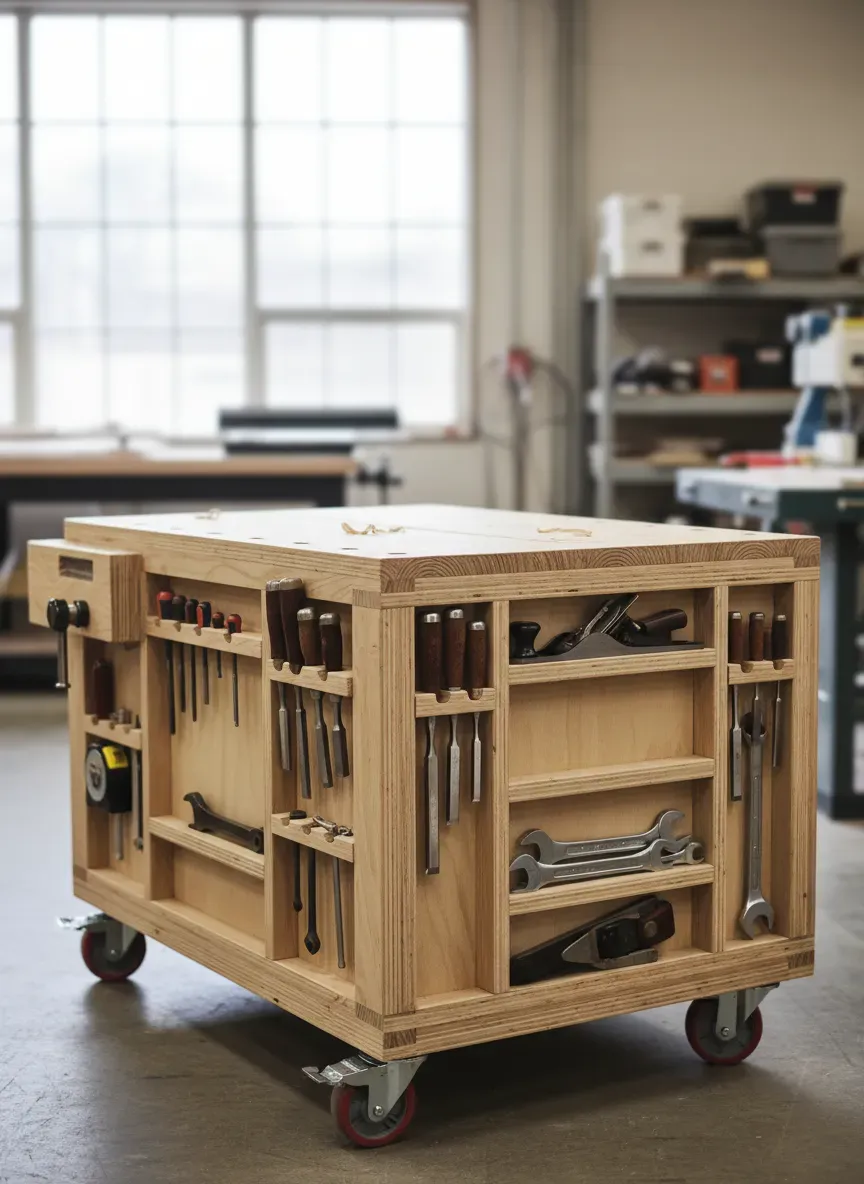
A torsion box is essentially a hollow core door on steroids. It utilizes a grid of interlocking plywood ribs sandwiched between a top and bottom skin. This creates a mathematically dead-flat surface that is incredibly rigid but surprisingly lightweight.
Why It Excels in Tight Spaces: You can build a 3x6 foot Paulk-style bench that rests entirely on collapsible sawhorses. The internal cavity of the torsion box provides instant, out-of-the-way storage for your tape measures, drills, and squares while you work. When the weekend is over and you need to park the car in the garage, you lift the top off the sawhorses and lean it against the wall.
5. The Drop-Leaf Expandable Assembly Station
Sometimes you just need a small station for routing edges, but occasionally you need a massive surface to glue up a dining room table. A drop-leaf workbench offers the best of both worlds.
The Construction: Start with a narrow, 24-inch deep primary bench. On both the left and right sides, install heavy-duty, hinged “wings” supported by swing-out gate legs (similar to an antique dining table).
When both wings are dropped, the bench sits tightly against the wall. When you raise the wings and swing the support legs out, you triple your working surface.
Pro Tip: Ensure the hinges you select are rated for at least 150 lbs. Standard door hinges will flex under the weight of heavy cabinetry, leading to a bowed assembly surface.
6. The Nested “Matryoshka” Workbench System
Think of Russian nesting dolls, but for power tools. This system involves building one primary, taller workbench, and a secondary, slightly shorter bench on casters that rolls entirely underneath the first one.
Strategic Execution: Your primary bench might be 38 inches tall—perfect for close-up detail work or routing. The secondary bench is built at 34 inches tall (the standard height of a table saw).
Just as you’d calculate a proper mudroom locker depth guide to ensure coats and boots fit without sticking out, you must measure your nesting benches down to the millimeter. When rolling the lower bench away, it serves as an outfeed table for your table saw or a dedicated sanding station. When you’re done, it slides seamlessly beneath the primary bench, reclaiming your floor space.
7. The Apartment Balcony “Mini-Bench”
For those who live in urban high-rises and do their woodworking on a balcony or inside a spare bedroom, standard plans won’t cut it. You need something that won’t ruin the floor and can be hidden in a closet.
The Hacksaw Approach: Take the base of a commercial folding work stand (like a Black & Decker Workmate). Discard the flimsy MDF top it comes with. Fabricate a custom, 2-inch thick hardwood top featuring a grid of 3/4-inch dog holes.
Mount this new top to the folding metal base. You now have a surface heavy enough to chisel on, with limitless clamping options via the dog holes, which folds down to the size of a folding chair. Use a rubber yoga mat underneath to dampen vibrations and protect your apartment floors.
8. The Ultimate Modular Grid Bench (MFT Style)
Popularized by Festool’s Multifunction Table (MFT), the grid bench relies entirely on precision rather than mass.
The Concept: The top is made of 3/4-inch MDF, CNC-machined (or carefully drilled using a jig) with a precise grid of 20mm holes spaced exactly 96mm apart.
Instead of traditional vises, you use specialized track clamps, bench dogs, and cam-locks that drop into these holes. You can secure a piece of wood of virtually any shape or size instantly.
Because the holding power comes from the mechanical advantage of the grid system rather than the crushing force of a steel vise, the bench itself can be incredibly lightweight and compact. You can easily integrate Kreg T-Track Mini rails along the perimeter for even more modular holding power without adding an inch to the bench’s footprint.
Crucial Hardware That Makes Micro-Benches Work
You can have the most brilliant architectural plan in the world, but if you use the wrong hardware, a small bench will fight you at every turn. Here is the gear I’ve personally found to be non-negotiable for tight-space setups.
Retractable Casters
Standard locking casters are a fatal flaw on a workbench. Even when locked, the polyurethane wheels introduce a micro-wobble that will drive you insane while hand planing.
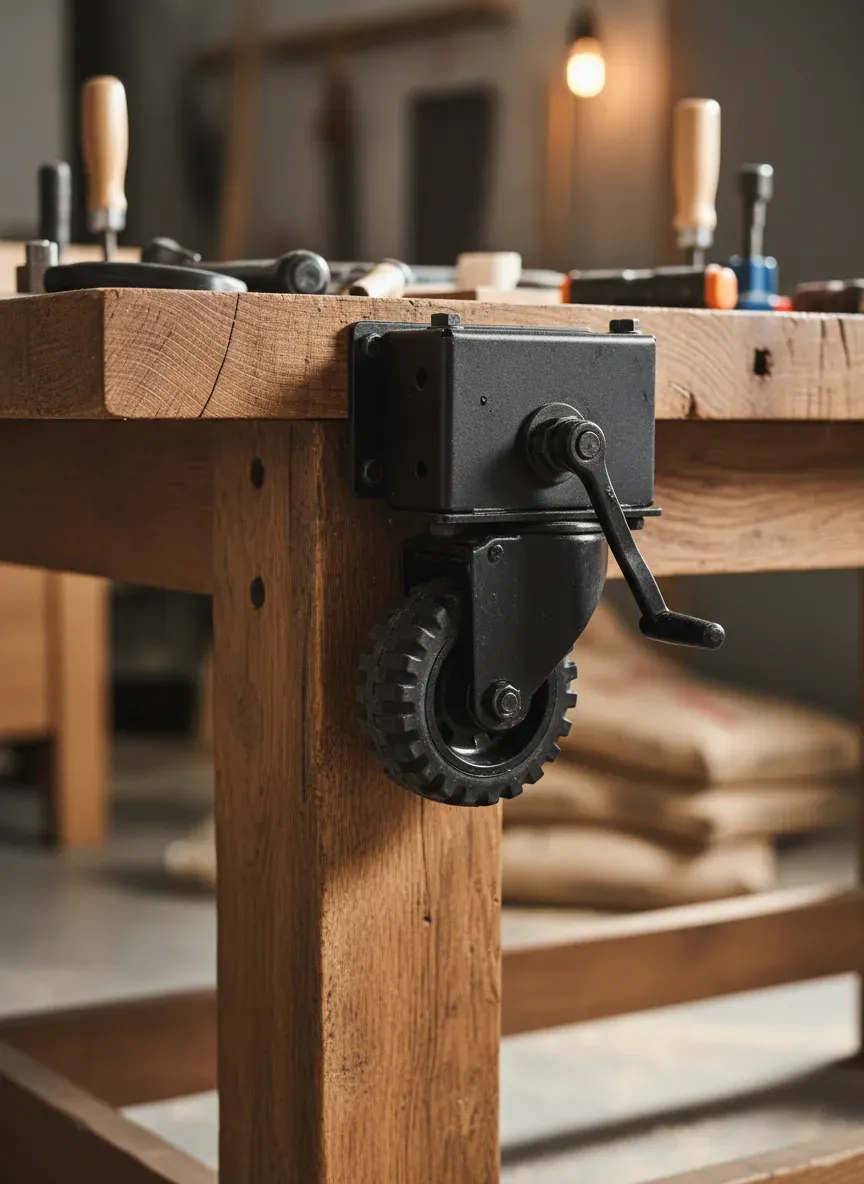
Instead, you must install Heavy-Duty Retractable Casters. These mount to the side of the bench legs. When disengaged, your wooden bench legs sit dead-flat on the concrete floor, providing absolute stability. When you need to move the bench, you step on the caster pedals, lifting the entire 300-lb bench half an inch off the ground, allowing it to glide effortlessly across the shop.
Inline Toggle Clamps
When your bench top is only 20 inches deep, a traditional 12-inch F-clamp hanging off the edge will snag your clothes, bump into walls, and disrupt your workflow.
By integrating Bessey Inline Toggle Clamps directly into a T-track system on your benchtop, you maintain a completely flush, low-profile clamping mechanism. They apply horizontal pressure, sandwiching your workpiece flat against the table without any vertical hardware getting in the way of your router or sander.
The Power of the Bench Dog
I cannot overstate how a grid of 3/4-inch or 20mm dog holes transforms a tiny surface. Combined with surface clamps and a simple wooden tail-vise, a perforated top allows you to secure wide panels, long boards, and irregularly shaped pieces that would typically require a massive traditional bench.
The Bottom Line on Small Shop Optimization
The Bottom Line: A small shop is not a death sentence for your woodworking ambitions; it is an invitation to work smarter.
By prioritizing mobility, dual-purpose surfaces, and leveraging modern workholding hardware, a 2x4 foot bench can easily outperform a poorly designed 8-foot behemoth. The trick is brutal honesty about the kind of work you actually do. If you build jewelry boxes and small cabinets, don’t build a massive Roubo. Build a modular torsion box or a drop-leaf station.
Stop letting a lack of space prevent you from making sawdust. Reclaim your garage, build a bench that respects your square footage, and get back to the craft.
Where Do We Go From Here?
I’ve personally found that the hardest part of building shop furniture isn’t the physical labor—it’s tracking down reliable, well-engineered blueprints that don’t leave you guessing on the dimensions. If you are ready to build one of these space-saving benches, you shouldn’t have to reinvent the wheel or sketch it out on a napkin.
Here’s the real kicker: you can get access to expertly drafted plans for almost every workbench style mentioned above, plus thousands of other projects. I highly recommend checking out Ted’s Woodworking. It is an absolute treasure trove featuring over 16,000 step-by-step woodworking plans, complete with cut lists, highly detailed schematics, and material requirements.
Whether you are building a micro-Roubo, a flip-top tool cart, or finally tackling that heirloom dining table, this collection takes the guesswork entirely out of the equation. Right now, they are offering a massive 75% discount on the entire archive.
Stop struggling with vague internet tutorials and start building with confidence. Grab your 16,000 woodworking plans and claim your 75% discount right here.