
Smart Closets & Tech Hubs: Why Hyper-Specific Zoning is the New Luxury
Discover why the modern definition of luxury interior design has shifted from massive square footage to hyper-specific, technology-integrated micro-zones.
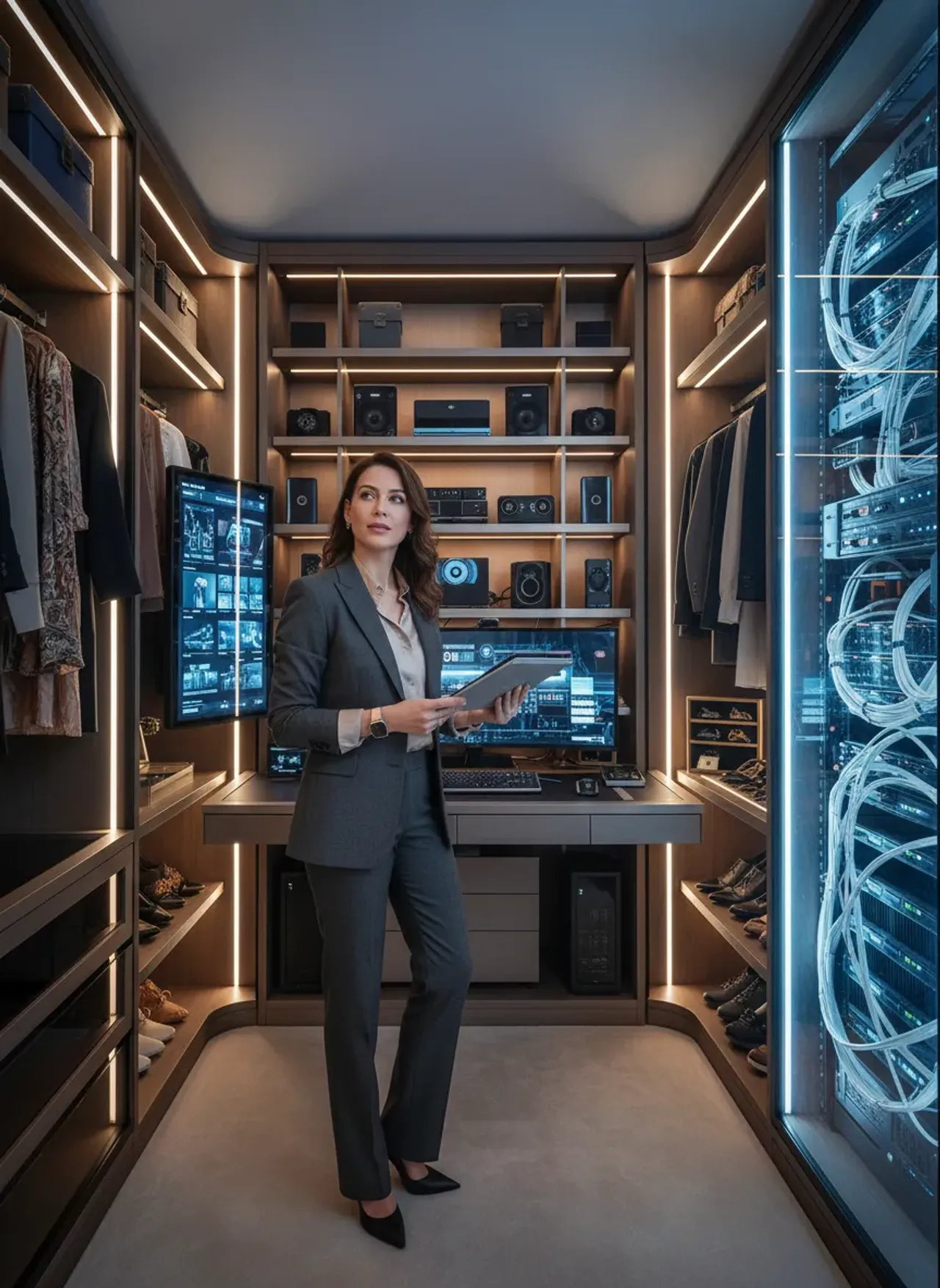
Mar 12, 2026 - Written by: Linda Wise
Walk into a multi-million-dollar custom build today, and you won’t hear the architect bragging about the sheer square footage of the master suite. The era of cavernous, empty rooms acting as proxies for wealth is entirely dead. Instead, the conversation immediately shifts to invisible utility. You’ll notice that true modern luxury is defined by the complete eradication of cognitive friction. It’s about spaces that anticipate your kinetic flow before you even realize what you need.
We call this hyper-specific zoning.
I’ve personally found that homeowners no longer just want a “walk-in closet” or a “home office.” They demand a climate-controlled wardrobe ecosystem with integrated dry-cleaning drop zones, alongside an acoustically treated, thermally managed network closet that hides the digital heartbeat of the property. When every object—from your fiber-optic modem to your titanium smart ring—has a dedicated, engineered micro-habitat, your daily life shifts from chaotic to completely seamless.
Before we dissect the topography of these advanced micro-zones, here is a quick look at the hardware making this level of architectural integration possible.
Quick Comparison: Top Picks
| Product | Rating | Check Price |
|---|---|---|
| Lutron Caseta Smart Lighting Starter Kit | ⭐⭐⭐⭐⭐ | View on Amazon |
| AC Infinity AIRPLATE T7 Quiet Cooling Fan System | ⭐⭐⭐⭐½ | View on Amazon |
| Rev-A-Shelf Pull-Out Valet Rod | ⭐⭐⭐⭐⭐ | View on Amazon |
The Evolution of Domestic Luxury: From Square Footage to Micro-Functionality
To understand why zoning is dominating high-end residential architecture, we have to look at how our relationship with our possessions has fractured. Twenty years ago, technology was a localized event. You had a desktop computer in a designated room. Today, technology is an ambient layer blanketing the entire house.
This creates an entirely new set of physical burdens. Where do the three iPads live? Where does the robotic vacuum empty its bin? How do we charge four different pairs of wireless earbuds without the kitchen island looking like a Best Buy clearance bin?
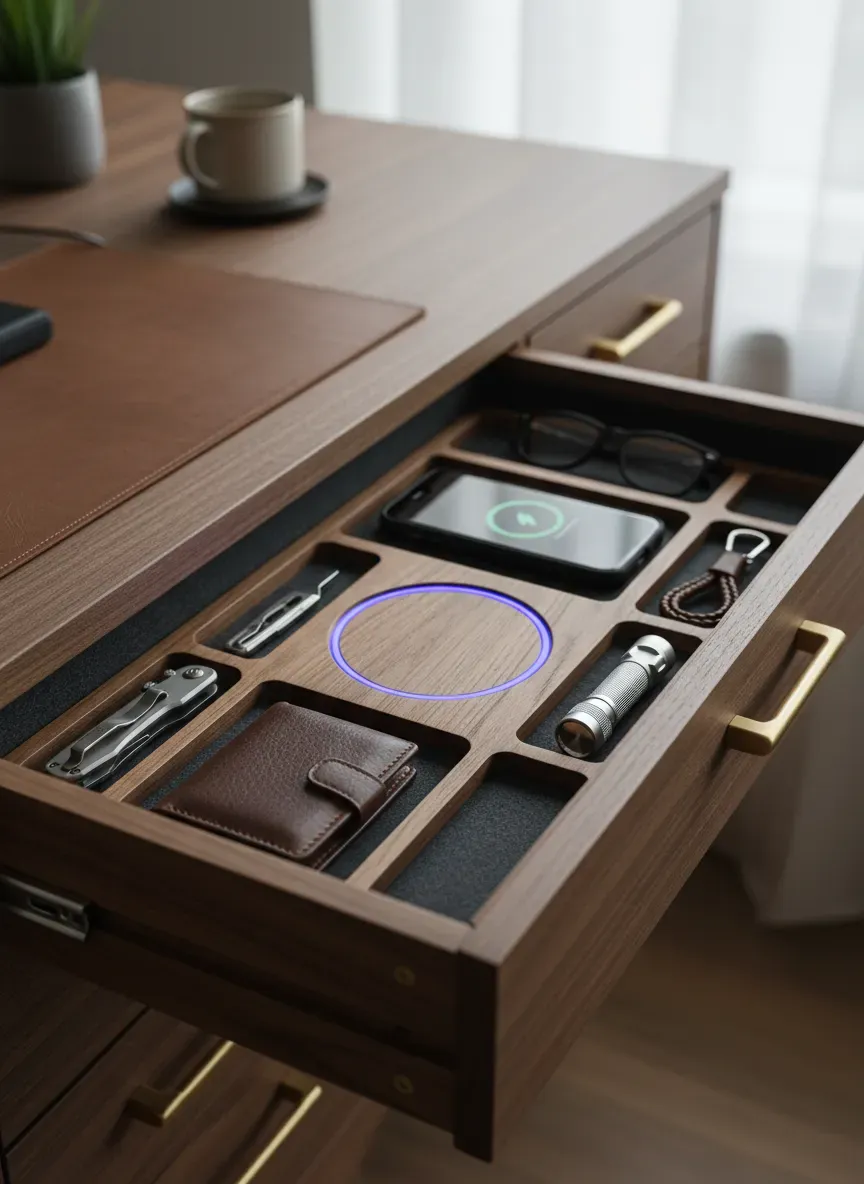
Hyper-specific zoning answers these questions by carving out dedicated, purpose-built niches within the broader floor plan. It replaces the ambiguous “catch-all” drawer with an engineered Everyday Carry (EDC) station outfitted with felt-lined, wireless-charging topography.
The Psychology of Visual Silence
Here’s the real kicker: visual clutter actively spikes cortisol levels. When you walk into your home and see a tangle of Ethernet cables spilling out of a router, or an ironing board leaning awkwardly against a wall, your brain registers unfinished tasks. Hyper-zoning creates visual silence. By allocating highly specific homes for notoriously awkward items, you strip away the low-level anxiety associated with maintaining a household.
It’s brilliant precisely because it operates entirely in the background.
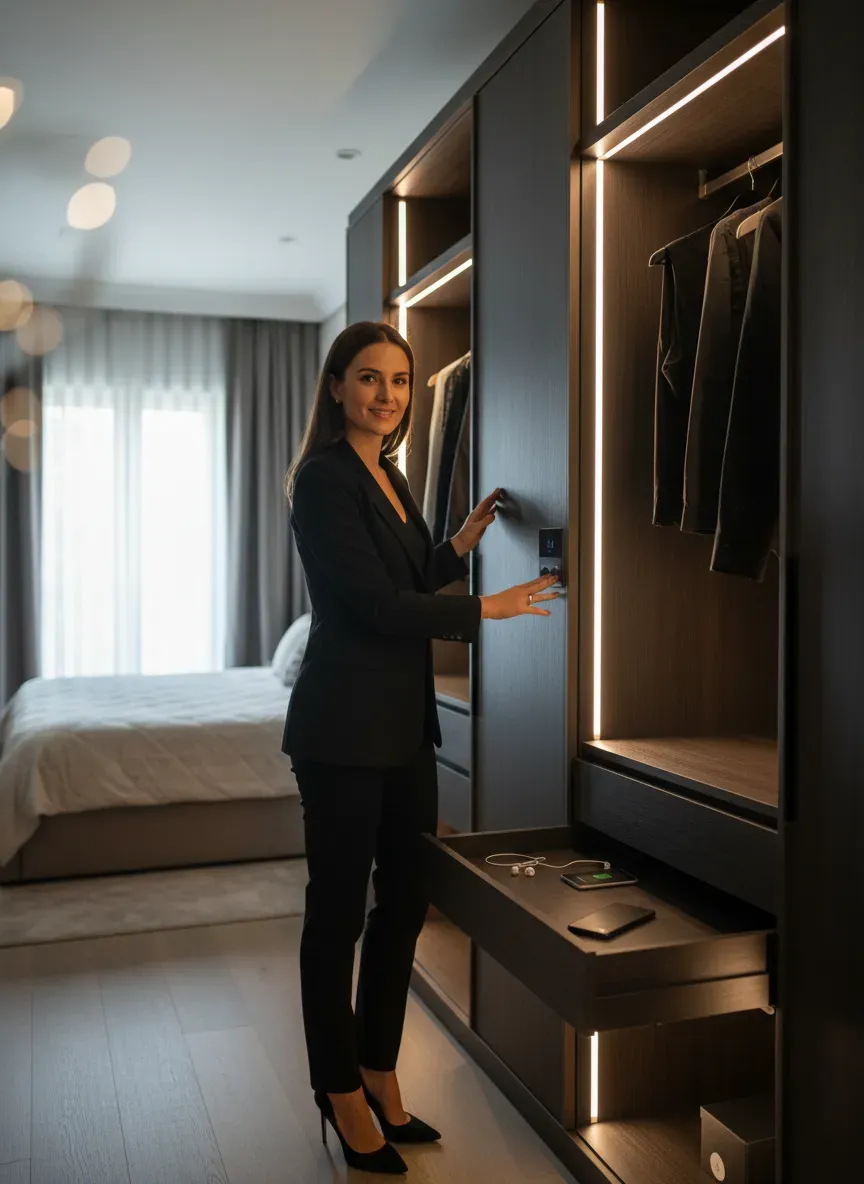
Anatomy of the Modern Smart Closet
The concept of the closet has undergone a radical transformation. It is no longer a static box with a rod; it is an active participant in your daily routine.
The Wardrobe Ecosystem
When I design a high-end dressing space, I stop thinking about clothes and start thinking about states of transition. Garments exist in different phases: clean and ready to wear, worn but not dirty enough to wash, needing dry cleaning, and ready for the laundry. A traditional closet only accounts for the first and last states.
A hyper-zoned smart closet integrates micro-stations for all four. We embed pull-out valet rods—like the exceptional mechanics found in a Rev-A-Shelf Pull-Out Valet Rod—to stage tomorrow’s outfit. We build hidden, ventilated hampers specifically dedicated to garments requiring specialized chemical cleaning, allowing a service to pick them up via a secondary access door.
Then comes the footwear. Deciding on the layout of your shoe collection is highly dependent on whether you view your shoes as investments to be displayed or tools to be organized. Understanding the nuances of open versus closed footwear displays is critical here. Open shelving requires constant dusting and meticulous aesthetic arrangement, whereas closed, climate-controlled cabinetry protects leather goods from UV degradation and ambient humidity while maintaining that coveted visual silence.
Integrating IoT and Climate Control
High-end clothing demands atmospheric regulation. Silk, wool, and exotic leathers degrade rapidly in fluctuating humidity. Modern luxury dictates that the master closet operates on its own HVAC zone, complete with a dedicated dehumidification system.
Automated Lighting and Scent Diffusion
Lighting within these spaces has transcended simple overhead illumination. We are now mapping LED strips into the routing of the shelving itself, angled at precisely 45 degrees to wash light down the garments without casting harsh, overhead shadows.
Pro Tip: Never use lighting above 3500K in a dressing space. You want high Color Rendering Index (CRI 95+) bulbs that mimic natural daylight, ensuring the navy blazer you pull out doesn’t turn out to be black when you step outside. Integrating a Lutron Caseta Smart Lighting Starter Kit allows you to automate this lighting to fade up gently based on your morning alarm.
Furthermore, HVAC integration allows for subtle, whole-room scent diffusion. Forget localized candles; these systems distribute micro-droplets of bespoke fragrance through the ductwork, ensuring the space constantly smells of fresh cedar or bergamot.
The Rise of the Hidden Tech Hub
If the smart closet manages your physical presentation, the hidden tech hub manages your digital existence. The days of leaving your Wi-Fi router on a random bookshelf are over.
Centralizing the Brains of the Home
Modern homes run on complex networks. You have the ISP modem, a gigabit switch, PoE (Power over Ethernet) injectors for security cameras, a smart home hub (like Control4 or Savant), an NAS (Network Attached Storage) drive for local backups, and heavy UPS (Uninterruptible Power Supply) battery backups.
This equipment is inherently ugly, noisy, and hot. It requires a dedicated, hyper-specific zone. Typically, this takes the form of an inconspicuous hallway closet or a customized niche beneath a staircase that has been retrofitted into a server room.
When designing this space, you cannot simply throw heavy server racks onto standard MDF shelving. The sheer density of network equipment, especially the lead-acid batteries inside UPS units, requires serious reinforcement. Getting the proper structural calculations for suspended loads is an absolute necessity before attempting to wall-mount a 12U server rack. A failure here doesn’t just damage the drywall; it takes down the entire digital infrastructure of the property.
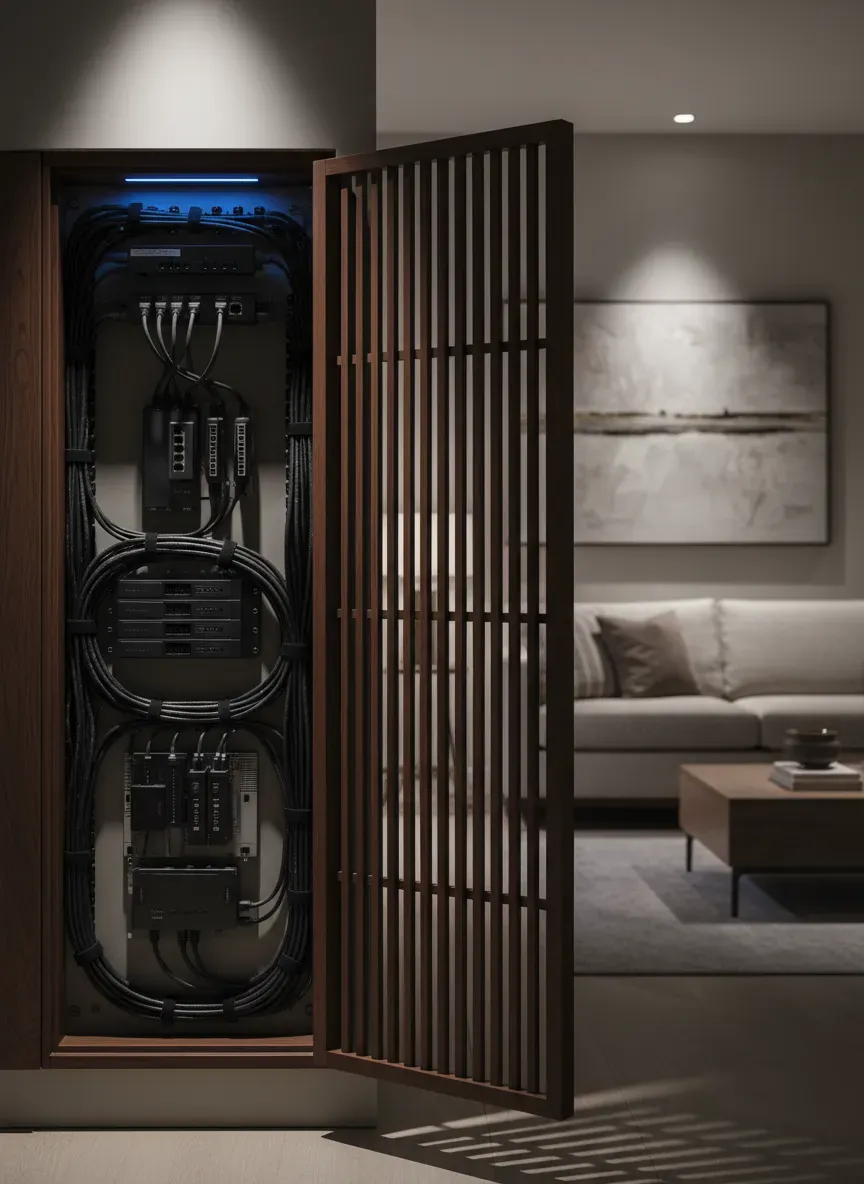
Thermal Management and Cable Architecture
Heat is the enemy of electronics. A sealed closet full of processors will easily reach 100 degrees Fahrenheit, throttling your network speeds and drastically shortening the lifespan of your hardware.
This is where active thermal management becomes non-negotiable. Designing a tech hub requires mapped airflow: cool air pulled from the floor, hot air exhausted out the top. Implementing an AC Infinity AIRPLATE T7 Quiet Cooling Fan System into the cabinetry door or adjacent wall allows the system to monitor ambient temperatures and dynamically adjust fan speeds. It operates silently while maintaining optimal thermal conditions.
Cable architecture is the other half of this equation. True luxury is opening the door to your network closet and seeing perfectly parallel, color-coded Ethernet runs secured with Velcro straps (never zip ties, which pinch the internal twisted pairs), terminating cleanly into a patch panel. It turns a chaotic nest of wires into an easily serviceable work of art.
Executing Hyper-Specific Zoning in Transition Spaces
While closets and tech hubs are prime examples of this trend, the philosophy truly shines in transitional zones—the spaces where you move from the public world to your private sanctuary.
The Next-Gen Mudroom
The mudroom acts as the home’s airlock. It is the boundary line where external chaos is stripped away. Hyper-zoning this space means going far beyond a few coat hooks.
We are now building distinct lockers for every family member, outfitted with integrated boot dryers on the floor and ventilated, mesh-fronted upper cabinets for damp athletic gear. The seating itself must be robust enough to handle the kinetic impact of daily life while hiding functional storage beneath. If you are considering engineering a robust drop-zone seating area, the focus must be on blending structural integrity with seamless aesthetic integration. Hidden hinges, soft-close hydraulic struts, and durable, easily cleanable textiles are mandatory.
Every-Day Carry (EDC) Integration
Within that mudroom—or sometimes just inside the secondary garage entrance—lies the EDC station. This is micro-zoning at its finest.
Instead of dumping your pockets onto the kitchen counter, you approach a localized alcove. There is a recessed, Qi-certified charging pad milled flush into the walnut countertop for your phone. Beside it, a soft, microfiber-lined dimple is carved out specifically for your watch or smart ring. A magnetized key catch securely grabs your key fob the moment you hold it near the wood. There is zero thought required. The architecture physically guides your belongings into their designated homes.
The Convergence of Power and Aesthetics
A major component driving the demand for hyper-specific zoning is the evolution of power delivery. We are living in a battery-powered renaissance. Handheld vacuums, portable speakers, power tools, laptops, and electric bikes all require juice.
In a poorly zoned house, charging blocks jut out of every wall receptacle like parasitic growths.
In a hyper-zoned house, power delivery is intentionally hidden inside cabinetry. We install outlets inside bathroom drawers specifically for hair dryers and electric toothbrushes, meaning the vanity counter remains completely empty. We specify deep pantry roll-outs with integrated power strips, so the toaster and blender are always plugged in, yet easily pushed out of sight.
The Hidden Infrastructure
Delivering power to moving parts requires specialized hardware. You cannot simply run a standard extension cord into a drawer; the repeated opening and closing will eventually fray the jacket, creating a massive fire hazard. High-end zoning utilizes articulated cable management arms—similar to the tracks found on industrial CNC machines—to protect the Romex wiring as the drawer extends and retracts.
It is this hidden infrastructure that separates a standard remodel from a genuinely luxurious, hyper-specific build. You are paying for the engineering you don’t see.
Common Pitfalls in Zoning Architecture
While the benefits are transformative, poorly executed zoning can quickly become an expensive nightmare. Because these systems are heavily integrated into the framing and drywall of the house, reversing a mistake is rarely cheap.
Over-engineering and “The Hyper-Specific Trap”
The most frequent mistake I encounter is a lack of physical adaptability. It is entirely possible to make a zone too specific.
For example, I once saw a custom build where the homeowner requested a routed depression in their bedside table exactly matching the dimensions of an iPhone 12. It looked incredibly sleek—until they upgraded their phone a year later, and the new device no longer fit in the custom-milled slot.
Hyper-zoning must account for the natural evolution of form factors. You design a charging drawer to accommodate any standard-sized tablet or phone, utilizing modular, adjustable dividers rather than fixed, unchangeable cutouts. You build the infrastructure for power and connectivity, but you leave the final millimeter-level layout flexible.
Ignoring Future Interoperability
Another massive pitfall is hard-wiring proprietary tech that will inevitably become obsolete.
When building a tech hub or a smart closet, never bury HDMI or proprietary data cables directly behind the drywall without a conduit. Technology cycles move far faster than architectural cycles. The “smart” mirror you install in your wardrobe today might have a dead operating system in five years.
To future-proof these zones, we run smooth, two-inch PVC conduit pipes from the tech hub to key locations in the house (like behind the TV, into the smart closet, and up to the ceiling for Wi-Fi access points). When a cable standard changes from Cat6 to fiber optic, you simply tie a string to the old cable, pull it out, and drag the new standard right through the wall without ever touching a drywall saw.
Acoustic Negligence
People drastically underestimate the noise generated by concentrated technology. A high-end PoE switch and a dedicated NAS drive sound like a small jet engine spooling up. If you hyper-zone your tech hub into a closet that shares a wall with the master bedroom or a home office, the persistent high-frequency whine of cooling fans will drive you slowly insane.
Acoustic mitigation must be engineered into the zone from day one. This means using solid-core doors equipped with perimeter weather-stripping to seal air gaps, installing staggered-stud framing to break sound transmission through the walls, and utilizing mass-loaded vinyl (MLV) behind the drywall to deaden the specific acoustic frequencies of hard drives and server fans.
Key Takeaways
- Shift in Luxury: Modern high-end design prioritizes seamless functionality and reduced cognitive load over empty, unused square footage.
- Active Spaces: Closets are no longer passive storage; they are climate-controlled ecosystems tailored to garment care and automated lighting.
- Centralized Tech: A dedicated, thermally managed tech hub is mandatory to protect expensive network infrastructure and eliminate visual wire clutter.
- Transitional Flow: Mudrooms and EDC stations act as the architectural “airlock,” absorbing the mess of daily life before it enters the main living spaces.
- Future-Proofing: Always design hyper-specific zones with flexibility in mind. Use conduits for wiring and avoid fixed cutouts for devices whose form factors will change.
The Bottom Line: Hyper-specific zoning is the ultimate expression of a home working for you. By engineering exact habitats for your technology, your wardrobe, and your daily carry items, you eliminate the daily friction of searching, organizing, and hiding clutter. It requires meticulous upfront planning and a deep understanding of your own routines, but the return on investment is a living space that feels effortlessly, perpetually pristine.