
Solutions for Seasonal Storage: Integrating Coat and Boot Management into Entryway Organization
Transform your chaotic foyer into a streamlined vestibule with our expert guide to solutions for seasonal storage. Master coat and boot management today.

Mar 11, 2026 - Written by: Linda Wise
If you live in a climate that experiences distinct seasons, your front door is likely a battlefield. Every November, a pristine, welcoming foyer suddenly devolves into a treacherous obstacle course of damp wool, salt-stained rubber, and rogue mittens. We try to fight the chaos by haphazardly throwing down an old towel for the wet boots or cramming just one more puffy down jacket onto an already groaning wall hook.
I’ve personally found that the fundamental flaw in most mudroom or foyer designs isn’t a lack of space. It is a lack of specialized, seasonal intention. We ask our entryways to function identically in July as they do in January, completely ignoring the drastic shift in our daily carrying load.
When you start analyzing solutions for seasonal storage: integrating coat and boot management into entryway organization, you are entirely rethinking the geometry and functionality of your home’s primary transition zone. You need systems that gracefully handle the bulky, the wet, and the dirty without sacrificing aesthetic cohesion.
Before diving into the architectural nuances of high-functioning vestibules, here are a few structural upgrades that will immediately elevate your space.
Quick Comparison: Top Picks
| Product | Rating | Check Price |
|---|---|---|
| Gorilla Grip Heavy Duty Boot Tray | ⭐⭐⭐⭐⭐ | View on Amazon |
| Prepac Wide Hall Tree and Storage Bench | ⭐⭐⭐⭐½ | View on Amazon |
| Umbra Sticks Wall-Mounted Coat Rack | ⭐⭐⭐⭐ | View on Amazon |
The Anatomy of a High-Functioning Entryway
A successful drop zone relies on strict behavioral psychology combined with strategic spatial geometry. Humans, especially exhausted ones returning from a long day at work or school, will inevitably take the path of least resistance. If putting a coat away requires opening a door, finding a hanger, and perfectly aligning it on a rod, that coat is ending up draped over a dining room chair.
Spatial Geometry and Human Flow
To integrate bulky seasonal gear, you first have to understand the anthropometrics of the space. How much room does a person actually need to sit down, remove a pair of tight, snow-caked boots, and stand back up? You’ll notice that tight, narrow hallways force the “one-foot hop,” causing people to lean against freshly painted walls, leaving scuff marks.
You need a minimum clearance of 36 to 42 inches in front of any seating area to allow for natural movement. When planning built-ins to accommodate winter gear, I always refer back to our comprehensive mudroom locker depth guide to ensure puffy winter jackets aren’t spilling out into the walking path, creating a claustrophobic bottleneck.
Zonal Separation: Wet vs. Dry
The secret to maintaining order during the slushy months lies in aggressive micro-zoning. You must establish a rigid border between the “Wet Zone” and the “Dry Zone.”
- The Wet Zone: This is the immediate landing pad right inside the door. Materials here must be aggressively hydrophobic. Think porcelain tile, sealed concrete, or heavy-duty rubberized mats. This area handles the primary shedding of precipitation.
- The Dry Zone: Located a few steps inward, this is where the permanent storage happens. Benches, cubbies, and baskets reside here.
If you allow these zones to bleed together, moisture tracks into your hardwood floors, warping the planks and creating a perpetual feeling of grime.
Conquering the Footwear Avalanche: Boot Management
Boots are the undisputed villains of entryway organization. They are tall, structurally unstable when empty, habitually covered in corrosive road salt, and notorious for holding onto moisture. Standard shoe racks, designed for the neat, low profile of a summer sneaker, fail miserably when confronted with knee-high Hunter wellies or insulated Sorel pac boots.
Drip Trays and Ventilation Systems
Here’s the real kicker: a flat mat is rarely enough. When snow melts off a heavily treaded sole, it pools. If the boot sits in that pool, it never truly dries, leading to a breakdown of the footwear’s materials and a distinctly unpleasant mildew odor that will permeate your foyer.
You need a localized drainage system. Deep-lipped polymer boot trays filled with river rocks or cedar planks are excellent DIY solutions. The rocks elevate the soles above the meltwater, allowing ambient air to circulate beneath the boot. Cedar, naturally antimicrobial and highly absorbent, actively neutralizes odors while wicking away ambient humidity.
Pro Tip: If you are undertaking a custom renovation, route a low-voltage heating mat directly beneath the tile in your mudroom’s wet zone. Radiant heat drastically accelerates the evaporation of snowmelt, turning a soggy puddle into dry tile in a matter of hours.
Vertical Boot Storage Dynamics
Tall boots present a unique structural challenge—the shafts collapse, causing them to take up double the horizontal footprint while looking incredibly messy.
Boot shapers are non-negotiable for an organized aesthetic, but true seasonal management requires architectural intervention.
Custom Built-ins vs. Freestanding Racks
If you lean toward custom cabinetry, request omitting the bottom shelf of a few designated lockers. Leaving a vertical clearance of 24 inches allows tall riding boots and rain boots to stand upright without their shafts bending.
Alternatively, inverted boot racks—where the boot is slid upside down over a wooden or metal peg—are highly effective. This method forces the boot shaft to remain straight while naturally directing moisture down and out of the toe box, preventing the damp, trapped air that degrades leather interiors.
Taming the Fabric Monster: Coat and Outerwear Optimization
While boots threaten the floor, coats threaten the airspace. A family of four can easily generate twelve distinct pieces of outerwear during a transitional season like autumn, where varying temperatures require windbreakers, fleece mid-layers, and heavy waterproof shells to all be accessible simultaneously.
Hooks vs. Hangers: The Eternal Debate
I strongly advocate for abandoning hangers in the primary entryway. Hangers require two hands and deliberate focus—a commodity rarely available when you are wrestling groceries or wrangling toddlers.
Hooks are the superior tactical choice, but their execution matters. A single, horizontal row of hooks is incredibly inefficient. Instead, utilize vertical staggering.
- Upper Tier (60-65 inches): Reserved for adult trench coats, long wool overcoats, and heavy parkas.
- Middle Tier (45-50 inches): Ideal for adult waist-length jackets, umbrellas, and tote bags.
- Lower Tier (30-36 inches): The autonomy zone for children. Empowering kids to manage their own gear requires placing the hardware at their natural reach level.
To prevent the dreaded “hook overload”—where pulling one jacket brings three others crashing to the floor—install double-pronged hooks and space them a minimum of 6 inches apart. Wet wool and synthetic downs need physical space to breathe; cramming them together guarantees they will still be damp the next morning.
Seasonal Rotation Strategies
You simply cannot keep your entire outerwear wardrobe at the front door year-round. An optimized entryway is ruthlessly curated.
When the frost thaws and spring arrives, the heavy parkas must be exiled. This requires a secondary storage system, typically located in a guest bedroom closet, a dry basement, or under-bed storage boxes. Vacuum-sealed bags are phenomenal for compressing the massive volume of down jackets, shrinking them by up to 80% to easily slide onto high, out-of-the-way shelves.
Hidden Compartments and Multi-Functional Furniture
If you live in an urban apartment or an older home without a dedicated mudroom, your foyer likely serves multiple architectural purposes. You cannot afford to sacrifice square footage to single-use furniture.
Just like you might try integrating a stealth home gym setup into a compact living space, hiding seasonal gear requires furniture that effortlessly works double duty. The aesthetic must remain clean, hiding the utilitarian mess behind beautiful facades.
Storage Benches with Secret Depths
A seating surface is mandatory for boot removal, but the void beneath that seat is prime real estate. Avoid benches with open cubbies facing outward. While they look charming in catalogs, in practice, they display a chaotic jumble of dirty soles and trailing shoelaces.
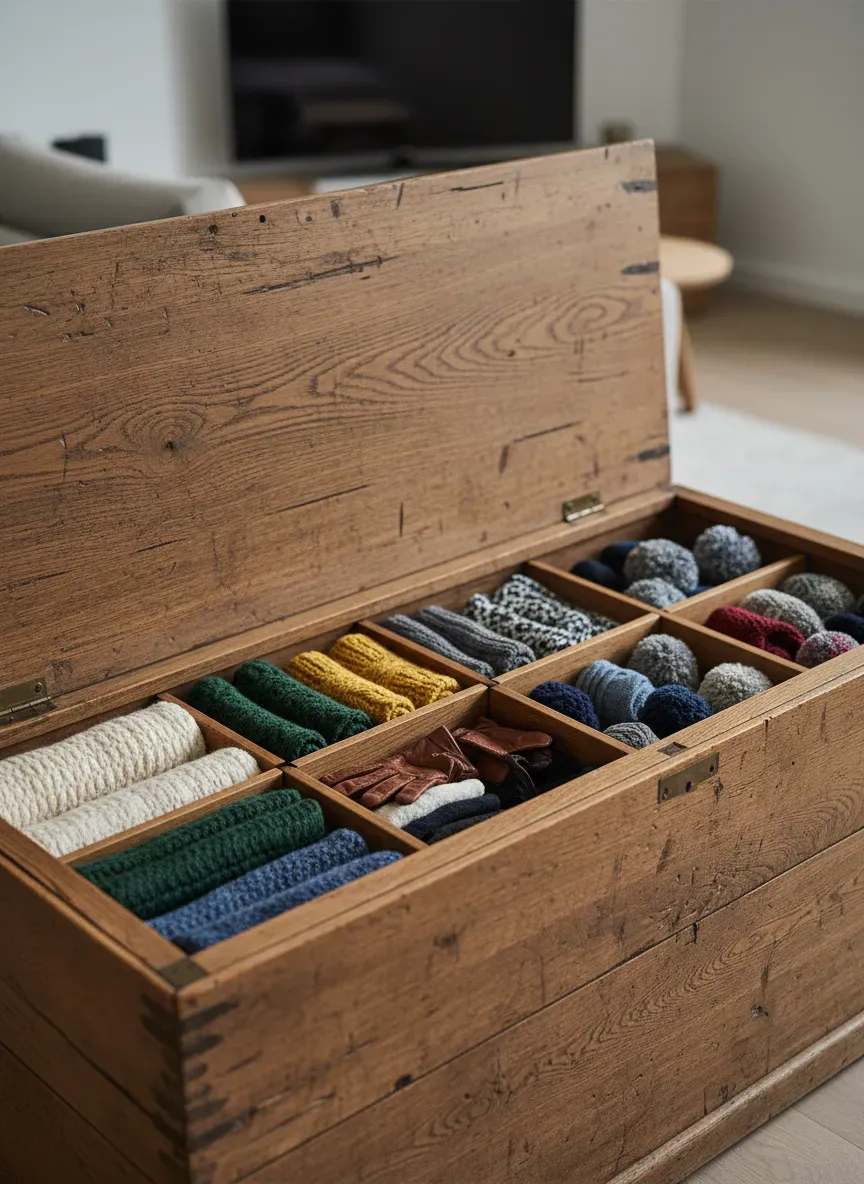
Opt for a bench with a hinged, lift-up top, or deep, soft-close drawers. The lift-top bench acts as a phenomenal “seasonal vault.” During the summer, it holds your winter scarves, heavy thermal gloves, and thick beanies. Come October, you execute a hard swap, filling the bench vault with sunscreen, baseball caps, and lightweight picnic blankets.
Overhead Bins for Off-Season Exiles
Look up. Most entryway designs completely ignore the vertical space between the top of the door frame and the ceiling. Installing a high, floating shelf equipped with matching, opaque woven baskets provides an incredible amount of cubic storage volume.
Because this zone requires a step stool to access, it is the perfect holding area for items you only need occasionally. The opaque nature of the baskets completely masks visual clutter, maintaining the serene, curated vibe of your home’s entry.
Key Takeaways for Furniture Selection:
- Demand Opaque Storage: Drawers and doors are vastly superior to open shelving for managing seasonal chaos.
- Maximize Verticality: Floor space is finite; wall space is abundant. Build up, not out.
- Prioritize Materials: Choose easily wipeable, moisture-resistant surfaces over delicate veneers that will warp under damp conditions.
Integrating Tech and Nuance into Entryway Storage
We often think of storage solely in terms of wood, metal, and plastic. But modernizing your approach to seasonal gear involves integrating discreet technology and hyper-specific organizational tools designed for the micro-items that accompany heavy weather gear.
Boot Dryers and Climate Control
A damp boot is a ruined boot. For households heavily involved in winter sports or outdoor labor, a forced-air boot dryer is a transformative investment. The challenge is keeping this distinctly utilitarian appliance from looking like a science experiment in your hallway.
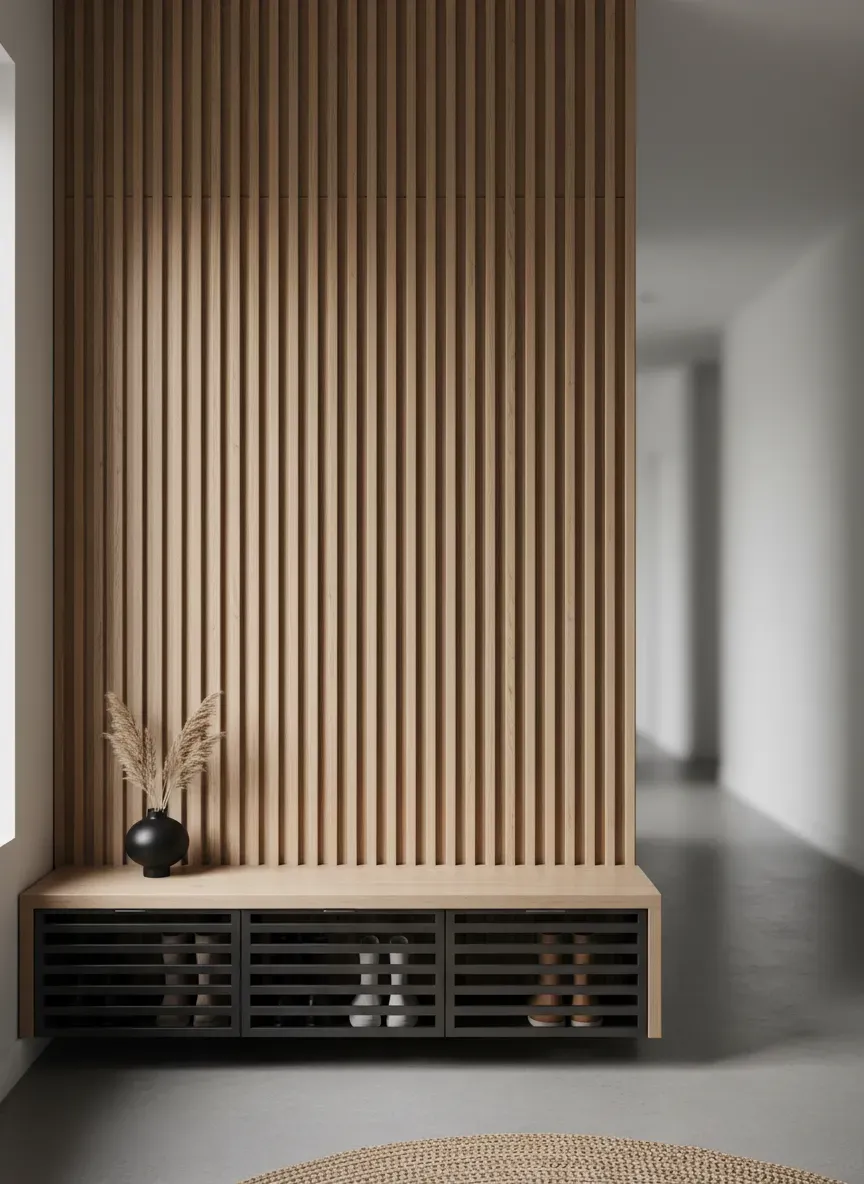
Custom cabinetry can solve this. Designing a lower, ventilated cabinet specifically to house a four-post boot dryer allows you to slide wet footwear over the drying pegs and close the door. Slatted cabinet fronts or subtle decorative mesh paneling ensure the damp air escapes while keeping the ugly mechanics hidden from view.
Maximizing Micro-Storage Real Estate
Heavy coats and boots are the macro problems. The micro problems are the keys, sunglasses, lip balms, and dog leashes that get buried under the avalanche of heavy fabric. Establishing a dedicated, uncompromised drop zone is critical; investing in the best wall-mounted key organizer keeps daily carry items completely isolated from the shifting tectonic plates of damp scarves and bulky sweaters.
Pro Tip: Assign a specific, small receptacle for each family member. A beautifully crafted ceramic bowl or a tailored leather valet tray for each person acts as a physical boundary. If your tray is full, you must empty it. It stops the slow accumulation of pocket trash that plagues flat foyer surfaces.
Common Pitfalls in Mudroom Architecture
Even with the best intentions, it is incredibly easy to design an entryway that looks beautiful empty but fails catastrophically upon contact with reality. Avoid these frequent structural and conceptual errors.
The Overcrowding Fallacy
There is a psychological temptation to fill every square inch of available wall space with hooks, cubbies, and shelves. This density creates a suffocating environment.
When outerwear is packed too tightly, it creates a damp microclimate. Wool requires excellent air circulation to release trapped moisture. If jackets are compressed against one another, they remain wet, harbor bacteria, and begin to smell. Always leave breathing room in your design. If you cannot fit all your coats with a few inches of clearance between them, you have too many coats in the rotation.
Neglecting the Lighting
Winter brings darkness. Rummaging through a deep, shadowy coat closet to find a specific pair of black gloves at 6:00 AM is a miserable experience.
High-functioning seasonal storage requires robust, layered lighting. Overhead ambient light is not enough. You need task lighting. Consider installing motion-activated LED strip lights inside the coat closets or directly underneath the upper cubbies. The moment the door opens or someone reaches for a jacket, the specific storage zone is flooded with crisp, illuminating light.
Ignoring the Reality of Dirt
White shiplap walls and pristine beige rugs are stunning in architectural digests. They are a nightmare in a functional winter entryway.
Baseboards and lower walls take a brutal beating from swinging backpacks, heavy boots, and wet umbrellas. If you want a light color palette, ensure you are utilizing high-gloss, easily scrubbable paints, or better yet, install a durable wainscoting made of beadboard or PVC composite that can withstand aggressive cleaning with heavy-duty detergents.
The Science of Transition: The Seasonal Swap Out
Your entryway should be a living, breathing space that adapts to the current climate. This requires a dedicated ritual twice a year.
A successful swap-out isn’t just about moving boxes; it’s an opportunity for a ruthless audit. As you pull out the winter gear, assess its condition. Are the gloves missing a partner? Is the zipper on the parka busted? Did the children outgrow their snow pants? Purge unmercifully. Storing items that no longer serve you is a massive waste of high-value residential real estate.
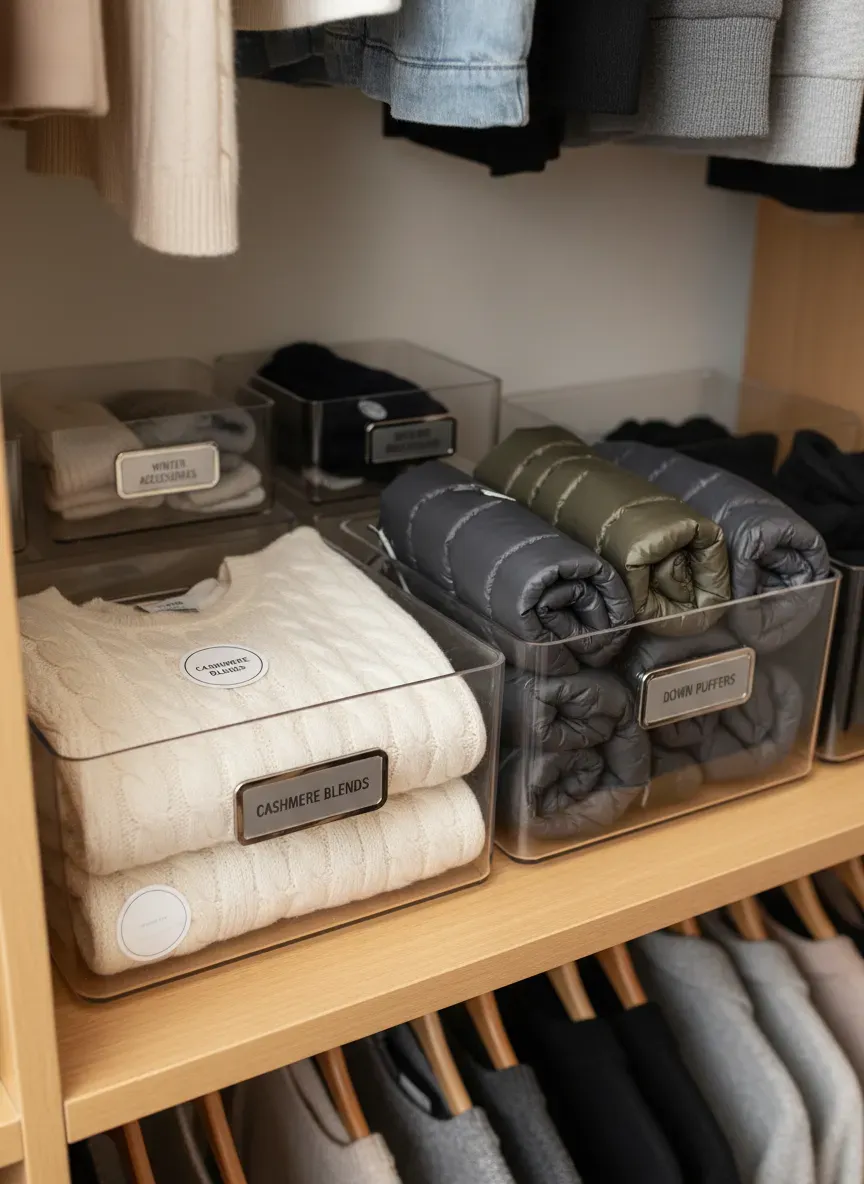
Categorize your accessories as you pack them away. Use clear, stackable acrylic bins for smaller items so you don’t have to guess what’s inside next year. Drop a few cedar blocks or lavender sachets into the storage containers to deter moths and keep the fabrics smelling fresh during their six-month hibernation.
The Bottom Line: Mastering solutions for seasonal storage and integrating coat and boot management into entryway organization isn’t about buying more bins. It is about acknowledging the harsh realities of weather, understanding the behavioral tendencies of your household, and designing a space that physically catches the chaos before it can penetrate the rest of your home. By utilizing strategic zoning, dedicated ventilation, and aggressive seasonal curation, you transform a chaotic bottleneck into a streamlined, highly efficient architectural machine.