
Solving the Shoe Pile Problem: Compact Entryway Storage Ideas for Serious Collectors
Discover sophisticated, space-saving strategies to organize and display footwear collections in small entryways without sacrificing style or square footage.
Feb 1, 2026 - Written by: linda wise

For the casual observer, shoes are merely utilitarian objects designed to protect feet. For the serious collector—whether your passion lies in limited-edition sneakers, bespoke leather brogues, or designer heels—footwear is an investment, a form of art, and a critical component of personal expression. However, the intersection of a growing collection and a compact living space often results in the dreaded “shoe pile.” This chaotic mountain of footwear at the front door is not only an eyesore; it is a direct threat to the condition of your prized possessions.
Navigating the logistics of entryway storage requires more than a plastic bin. It demands a strategic approach that balances accessibility, preservation, and interior design. When square footage is at a premium, every vertical inch counts. This guide explores high-level strategies for transforming a cluttered foyer into a curated gallery that respects both your architecture and your collection.
The Anatomy of the Shoe Pile
To solve the problem, one must first understand the mechanics of why the pile forms. It is rarely a result of laziness; rather, it is usually a symptom of inadequate infrastructure. The shoe pile is a friction problem. When the effort required to put a shoe away exceeds the effort required to kick it off near the door, the pile grows.
For collectors, the issue is compounded by volume. Standard shoe racks are designed for households with perhaps ten to twelve active pairs. A collector may have fifty pairs in rotation, with dozens more in archival storage. When the primary storage zone overflows, the overflow becomes the pile. This compression causes scuffs, deformed structures from crushing weight, and exposure to dust and sunlight.
Addressing this requires a shift in mindset: we are not just storing shoes; we are managing a rotation inventory.
Verticality: The Collector’s Best Friend
In compact entryways, floor space is the most expensive real estate. If you cannot build out, you must build up. Vertical storage solutions maximize density while maintaining a slim footprint, ensuring that the hallway remains navigable.
Floor-to-Ceiling Shelving Units
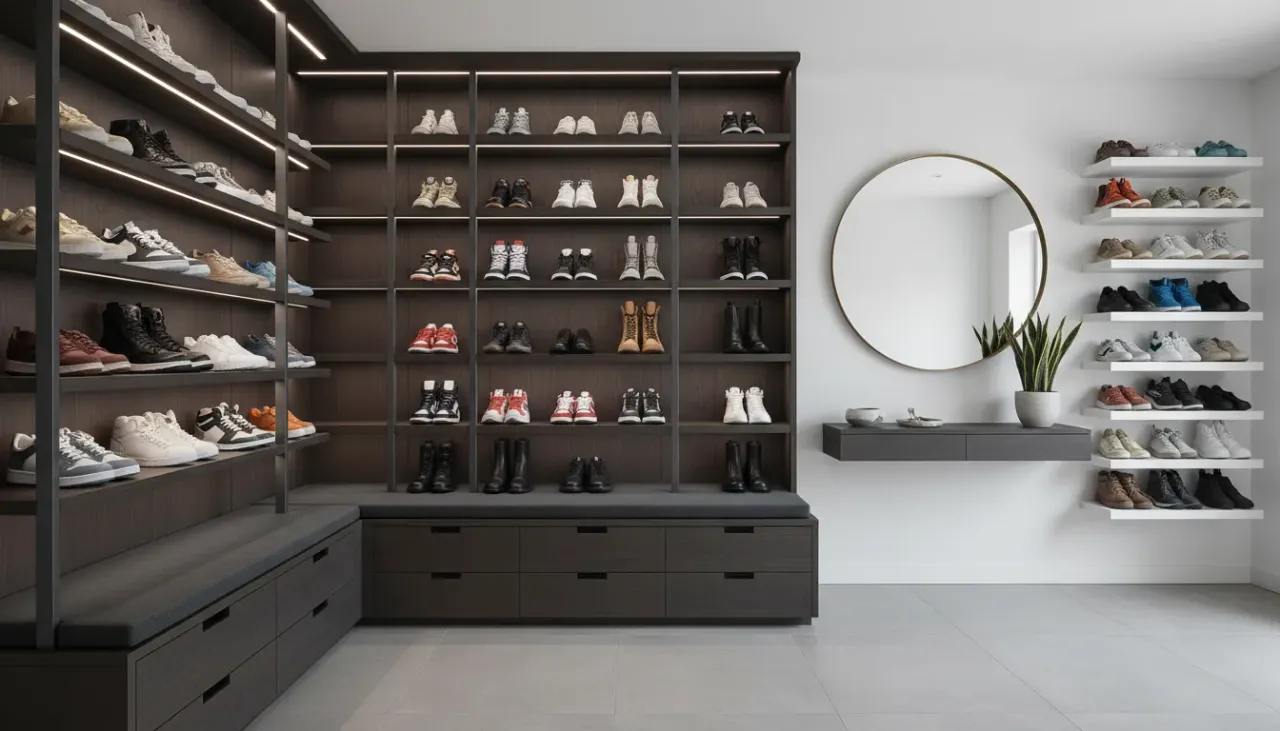
The most efficient way to store a large volume of footwear is to utilize the full height of the wall. Custom or modular shelving units that reach the ceiling can triple your storage capacity compared to waist-high consoles.
When selecting a unit, look for adjustable shelving. The height required for a high-top Jordan 1 is significantly different from a loafer or a thigh-high boot. Fixed shelves often result in “dead air”—wasted space between the top of the shoe and the shelf above it. By tightening these gaps, you can often fit an extra two or three rows of shelving in the same vertical span.
For those renting their space or unable to commit to built-ins, tall, narrow cabinets are the ideal compromise. These units often feature sleek facades that hide the visual clutter of the shoes, presenting a clean face to guests entering the home.
Check out this Tall Narrow Shoe Cabinet on Amazon
The Power of Tension Rods
For irregular alcoves or closets near the entryway, tension rods offer a surprisingly robust and non-invasive solution. By installing heavy-duty tension rods at varying depths—one slightly lower and closer to the wall for the heel, one higher and further out for the toe—you can create an angled display rack that holds shoes securely without any drilling. This method is particularly effective for high heels, as the heel can hook over the rear rod, keeping the shoe stable.
The Tilt-Out Cabinet: A Slim Profile Hero
One of the most significant innovations in compact entryway furniture is the tilt-out shoe cabinet. Unlike traditional cabinets that require roughly 12 to 15 inches of depth to accommodate the length of a shoe sitting flat, tilt-out mechanisms store footwear vertically or at a steep angle.
This engineering shift allows these cabinets to be incredibly shallow—often protruding only 6 to 9 inches from the wall. In a narrow hallway where a standard console table would block traffic, a tilt-out cabinet hugs the wall, leaving the walkway clear.
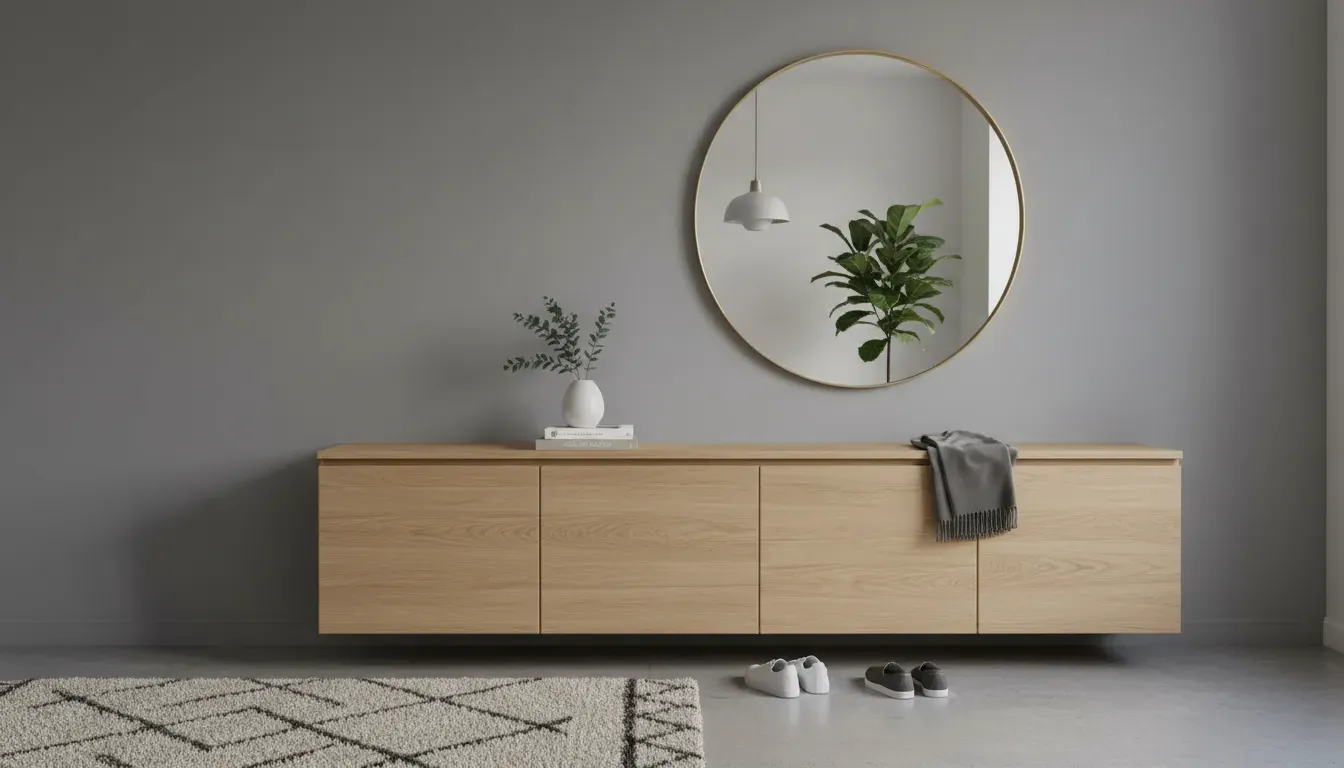
Despite their slim profile, these units are deceptive in their capacity. A three-tier unit can easily hold 18 to 24 pairs of standard shoes. For collectors, the top surface of the cabinet serves as a landing strip for keys, mail, or a singular “grail” shoe on display, blending utility with gallery-style aesthetics.
Display vs. Storage: The Acrylic Revolution
For the serious collector, hiding the collection is sometimes counterintuitive. If you have spent years acquiring rare colorways, you likely want to see them. However, open shelving exposes shoes to dust, humidity, and oxidization.
The solution lies in modular acrylic drop-front boxes. These have become the gold standard for sneaker collectors for several reasons:
- Protection: They provide a sealed environment that mitigates dust accumulation.
- Accessibility: The drop-front door allows you to grab a pair from the bottom of the stack without unstacking the boxes above it.
- Modularity: They stack securely, allowing you to build a wall of shoes that fits the exact dimensions of your available space.
These boxes transform storage into a feature wall. By lining a hallway with stacked acrylic boxes, you turn a passive corridor into an active display case. This approach works best for the “active rotation” or the “trophy” section of your collection.
View Premium Acrylic Drop-Front Shoe Boxes on Amazon
The “Current Rotation” System
No matter how efficient your storage is, a small entryway cannot hold 200 pairs of shoes. Attempting to do so ensures failure. The key to maintaining a clutter-free entrance is the implementation of a rigorous rotation system.
The Seasonal Shift
Divide your collection into active and archival categories. The entryway should only house the active category. This is generally dictated by weather and current fashion preferences. In the summer, heavy winter boots should be cleaned, stuffed with shapers, and moved to long-term storage (under the bed, in a climate-controlled closet, or a dedicated storage unit). This frees up prime real estate for loafers, slides, and canvas sneakers.
For advice on managing the archival process, you might find our guide on seasonal wardrobe transitions helpful.
The “On-Deck” Circle
Designate a specific zone for the shoes you wear daily. This is distinct from the shoes you wear weekly. A small, open tray or a designated low shelf serves as the “on-deck” circle. This prevents you from having to open cabinets or boxes every single time you run an errand, while still providing a designated “home” for the shoes so they do not end up in a pile.
Hidden in Plain Sight: Dual-Purpose Furniture
In compact spaces, single-purpose furniture is a luxury you cannot afford. Every item in the entryway must pull double duty.
The Storage Bench
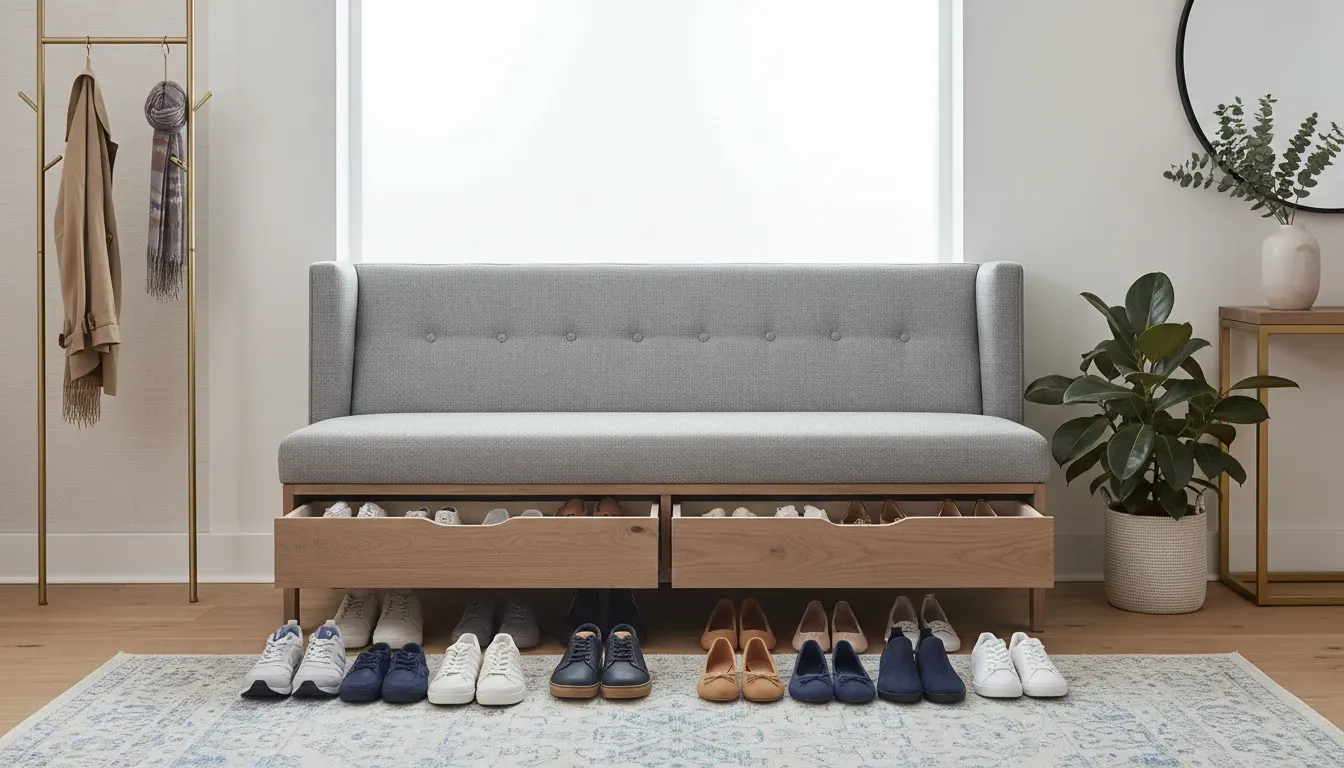
A bench provides a necessary place to sit while lacing up high-tops or putting on boots. However, the space beneath the seat is often wasted. Look for benches with a flip-top lid or cubbies underneath.
For collectors, a flip-top bench is ideal for “ugly” storage—items that are necessary but not aesthetically pleasing, such as shoe cleaning kits, waterproofing sprays, spare laces, and gym shoes that have seen better days. Keeping these items hidden but accessible maintains the visual purity of the entryway.
The Mirror with a Secret
Full-length mirrors are a staple of entryway decor, allowing for a final outfit check before leaving. Several manufacturers now produce mirrors that slide or swing open to reveal shallow shelving behind the glass. While these shelves are often too shallow for men’s boots, they are perfect for lower-profile shoes like flats, sandals, or even displaying specific collectibles sideways.
Utilizing Dead Space
When you believe you have exhausted all storage possibilities, look at the dead space. This is the negative space that exists in every room, often overlooked by conventional design.
Above the Door Frame
The 12 to 18 inches of space between the top of your door frame and the ceiling is frequently unutilized. Installing a high floating shelf here creates a perfect “purgatory” for shoes that are rarely worn but too beloved to box away. This is an excellent spot for display pieces—shoes that are art first and footwear second.
Corners and Nooks
Entryways often feature awkward corners where a door swing prevents standard furniture placement. Triangular corner shelves or rotating carousel racks can occupy these footprints efficiently. A rotating rack is particularly effective for density, as it allows access to shoes on all sides without requiring the user to reach deep into a dark closet.
Preservation: The Material Concern
Solving the pile problem is not just about organization; it is about preservation. Compacting shoes into a tight space can lead to humidity buildup and material degradation if not managed correctly.
Leather needs to breathe. If you are using sealed plastic containers, ensure they have ventilation holes. If you are using a wooden cabinet, ensure it is not placed directly against a heater or radiator, which can dry out the leather and cause cracking.
Furthermore, gravity is the enemy of shoe structure. Tall boots should always be stored with boot shapers or hung upside down using boot clips to prevent the shaft from creasing at the ankle. Sneakers and dress shoes should be stored with shoe trees whenever possible.
Find Cedar Shoe Trees and Care Kits on Amazon
Custom Solutions: When to Build
Sometimes, the architecture of a small entryway simply refuses to cooperate with ready-made furniture. In these instances, custom joinery is the most effective path.
Hiring a carpenter to build a recessed cabinet into the wall studs can reclaim space that didn’t exist previously. By utilizing the 4-inch depth of a standard wall cavity and extending out just a few inches, you can create a flush-mount storage system that feels like part of the architecture rather than a piece of furniture added later.
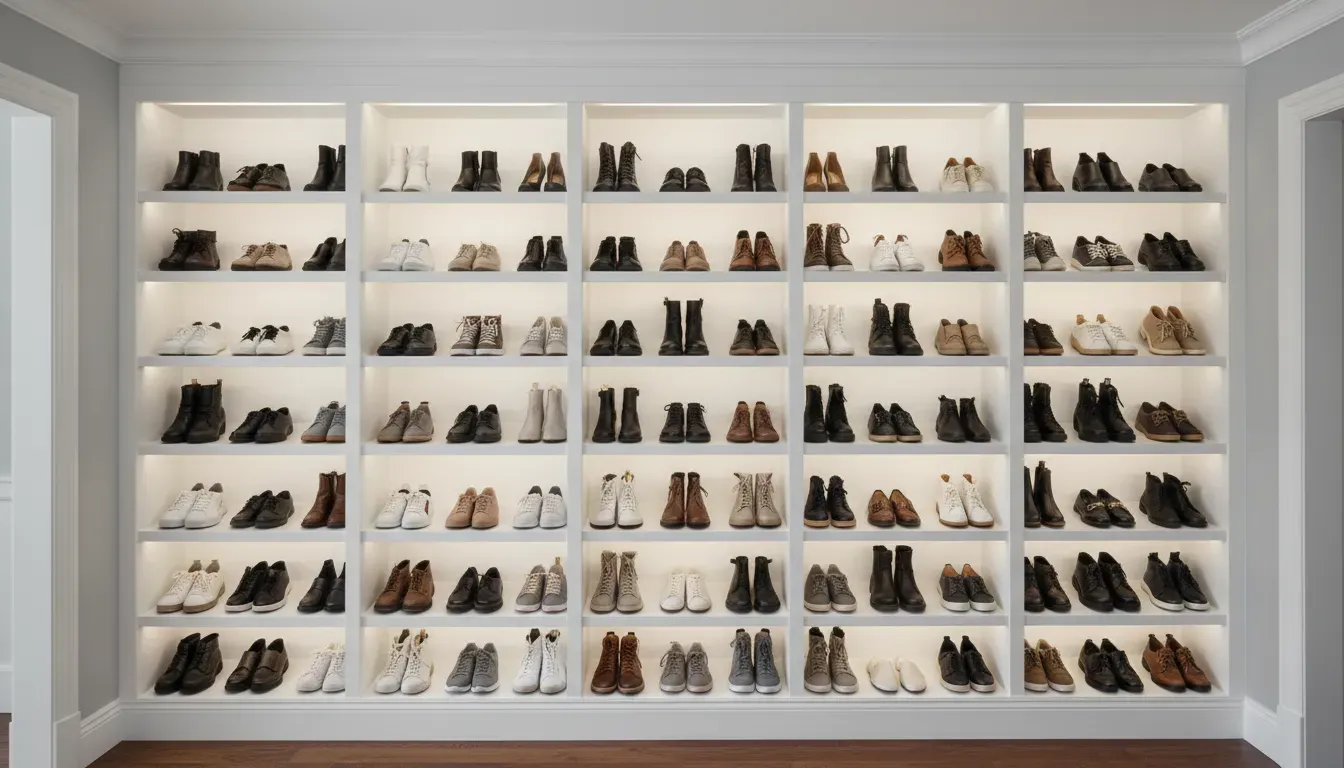
Custom solutions also allow for integrated lighting. LED strips routed into the shelves not only elevate the look of the collection but make it easier to find specific pairs in a dark hallway.
Curating the visual Flow
The ultimate goal of compact entryway storage is to reduce visual noise. A “busy” entryway creates subconscious stress the moment you walk through the door.
To maintain a sense of calm, consider color-coordinating your display. Grouping shoes by color—blacks with blacks, whites with whites—creates a cohesive visual block rather than a scattered pattern. If you are using open shelving, consider keeping the backdrop neutral to let the shoes stand out without clashing with the wallpaper or paint.
Additionally, use the concept of “negative space.” Do not fill every single shelf to capacity. Leaving a few empty spots or alternating shoes with decorative objects (a small plant, a sculpture, a book) breaks up the monotony of the retail-store look and makes the space feel like a home.
Conclusion
The shoe pile is a conquerable foe. For the serious collector living in a compact space, the solution lies in a combination of vertical exploitation, smart furniture choices, and rigorous inventory management. By treating your footwear storage as a design challenge rather than a chore, you can protect your investment and reclaim your entryway.
Your shoes carry you through the world; they deserve a better resting place than a heap on the floor. Whether you opt for sleek acrylic boxes, invisible tilt-out cabinets, or custom joinery, the right system elevates your collection from clutter to curation. Implementing these strategies ensures that the first thing you see when you come home is not a mess, but a reflection of your personal style and organizational discipline.
For more insights on maintaining a pristine home environment, read our deep dive on minimalist hallway design.