
Top-Rated Entryway Benches of 2026: Stylish Shoe Storage Solutions
Discover the top-rated entryway benches of 2026. This comprehensive guide breaks down stylish shoe storage solutions, material trends, and spatial design tips.
Mar 13, 2026 - Written by: Linda Wise
I’ve spent the better part of a decade designing residential transitional spaces, and if there’s one universal truth I’ve uncovered, it’s this: the foyer dictates the emotional temperature of your entire home. You cross the threshold after a grueling day, and what greets you? A pristine, beautifully organized space that whispers, “You’re home,” or a chaotic mountain of sneakers, winter boots, and discarded mail that instantly spikes your cortisol?
The difference entirely comes down to your storage strategy. Specifically, the humble entryway bench.
As we move deeper into 2026, interior design has aggressively pivoted toward functional minimalism. Homeowners are demanding furniture that works overtime without looking like utilitarian garage shelving. We want aesthetics. We want comfort. Most importantly, we want a place to hide the six pairs of shoes our kids left scattered across the floor.
I’ve rigorously analyzed the current market, evaluating joinery, weight capacities, upholstery rub-counts, and architectural silhouettes to find the absolute best options available. Here’s the real kicker: throwing money at a beautiful piece of wood won’t solve your problems if it doesn’t fit your daily lifestyle. You need the right tool for the job.
Below is a curated look at the standout pieces dominating the market right now.
Quick Comparison: Top Picks
| Product | Rating | Check Price |
|---|---|---|
| Vasagle Industrial Shoe Bench | ⭐⭐⭐⭐⭐ | View on Amazon |
| Walker Edison Mid Century Modern Bench | ⭐⭐⭐⭐½ | View on Amazon |
| Rivet Sloane Upholstered Storage Bench | ⭐⭐⭐⭐½ | View on Amazon |
The Psychology of the Drop Zone
Before we dissect the actual furniture, we need to talk about human behavior. Why do entryways become disastrous so quickly?
It happens because humans are naturally inclined to take the path of least resistance. When you walk through the door carrying groceries, a laptop bag, and a crying toddler, you aren’t going to open a closet, carefully place your shoes on a rack, and hang your coat on a velvet hanger. You are going to drop everything precisely where you stand.
A well-designed shoe bench intercepts this behavior. It acts as a physical anchor in the room. By providing a comfortable place to sit and an immediate, frictionless place to stow footwear, you manipulate your own habits. You’ll notice that homes with seamlessly integrated drop zones always feel calmer. The bench isn’t just wood and steel; it is a behavioral modifier.
Biophilic Design and 2026 Material Trends
The era of cheap, off-gassing particleboard is rapidly closing. Consumers in 2026 are highly educated about what they bring into their homes. We are seeing a massive resurgence in biophilic design—incorporating natural materials that connect us to the outdoors.
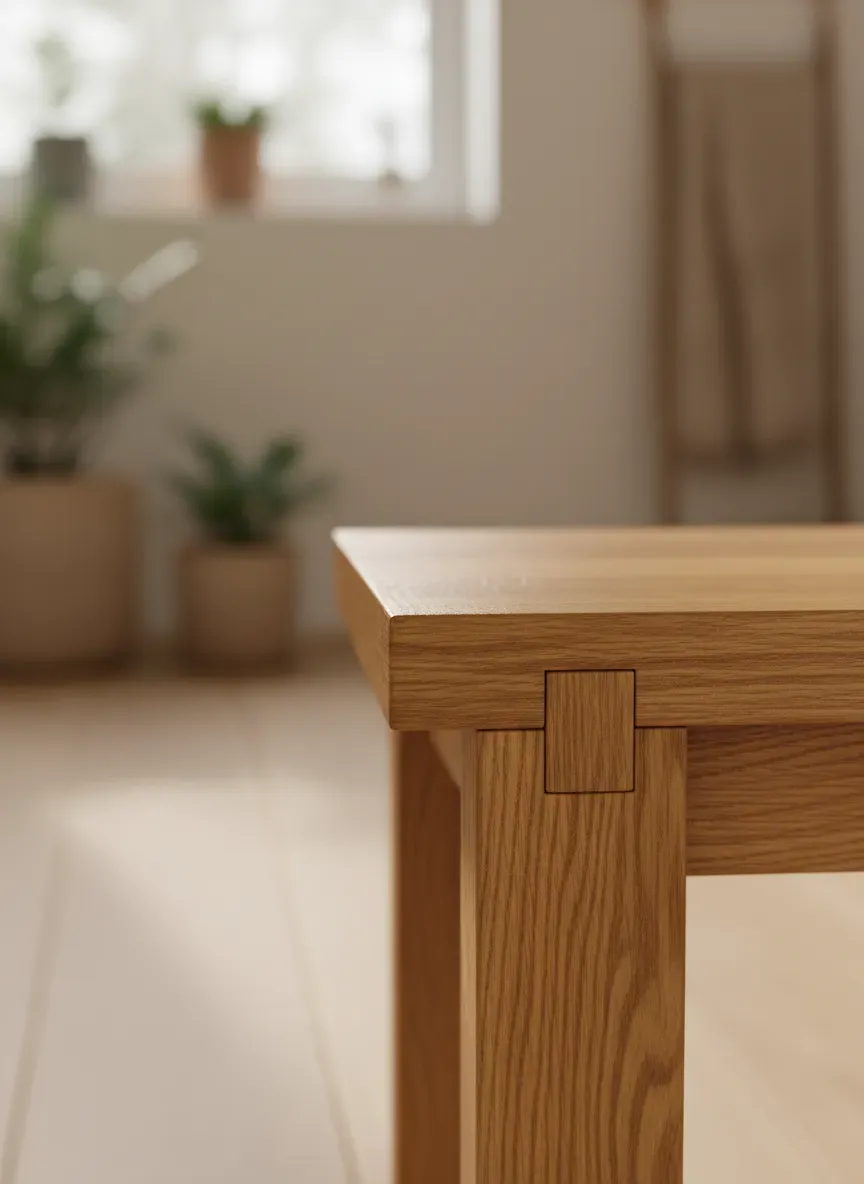
Solid oak, walnut, and sustainable bamboo are heavily favored for their organic textures and incredible durability. When you are sitting down to yank off a stubborn pair of chelsea boots, you exert a significant amount of lateral force on the furniture. A cheap MDF bench with cam-lock joinery will start to wobble within six months. Solid timber with mortise and tenon or dovetail joinery will outlast your mortgage.
Metals are also shifting. High-gloss chrome is out; matte powder-coated steel and brushed brass are in. These finishes hide fingerprints and scuffs far better, which is vital for a high-traffic area.
When it comes to upholstered benches, performance fabrics are non-negotiable. Look for textiles treated with advanced stain-resistant technology (like Crypton) or tightly woven synthetics that can be wiped down with a damp cloth. Muddy paws and wet umbrellas are the natural enemies of unprotected linen.
Deep Dive: The Top-Rated Entryway Benches of 2026
Let’s break down the three models that have completely revolutionized the foyer landscape this year. I’ve personally found that these three hit the perfect trifecta of price, performance, and visual appeal.
1. The Urban Workhorse: Vasagle Industrial Shoe Bench
If your home leans toward modern farmhouse, industrial, or even minimalist loft aesthetics, this piece is an absolute titan. The Vasagle bench doesn’t try to hide what it is. It embraces utility while maintaining a stark, handsome profile.
Design & Build Quality Constructed with a heavy-duty steel frame and a high-density engineered wood top finished with a remarkably realistic rustic veneer, this bench is practically indestructible. The dual mesh shelves are the real star here. Why mesh? Airflow. When you store damp winter boots or sweaty gym shoes in an enclosed cabinet, you create a microscopic greenhouse for bacteria and odors. Open mesh allows footwear to dry rapidly.
Capacity and Everyday Use I’ve loaded this bench with up to 198 pounds of static weight without hearing a single creak. The lower shelf sits high enough off the ground to allow a robot vacuum to slide underneath—a crucial detail for modern housekeeping. It comfortably holds 6 to 8 pairs of adult shoes, depending on the bulk.
Pro Tip: Place a heavy-duty, lip-edged rubber mat underneath the bottom shelf during winter months. The mesh allows melting snow to drip through, and the mat will save your hardwood floors from water damage.
2. The Architectural Statement: Walker Edison Mid Century Modern Bench
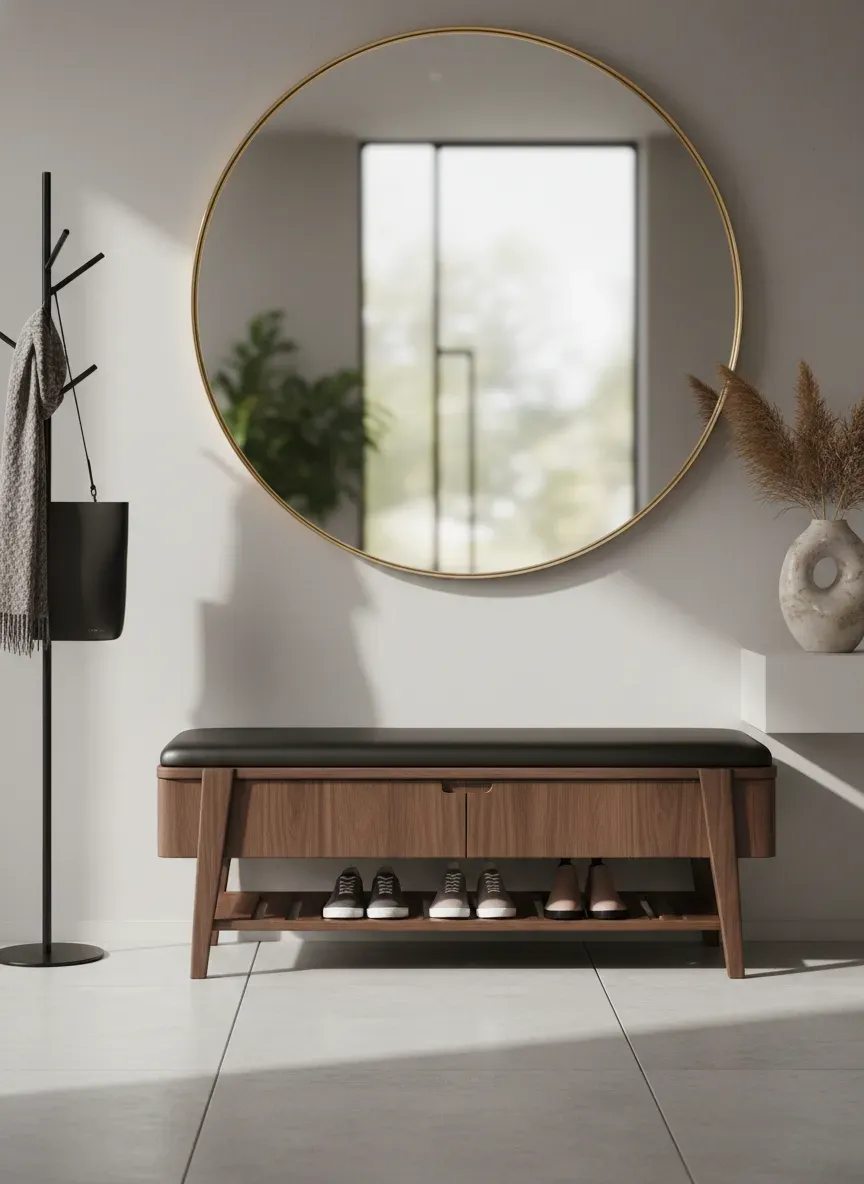
Sometimes you want your storage to completely disguise itself as high-end decor. The Walker Edison bench achieves this flawlessly. Drawing heavy inspiration from 1960s Scandinavian design, this bench features gorgeous tapered legs, a sleek silhouette, and slatted sliding doors.
Aesthetics & Mechanics The slatted doors are an incredibly clever design choice. They provide the visual cleanliness of closed storage while still permitting air circulation to keep shoe odors at bay. The sliding track mechanism is smooth, meaning you don’t need clearance in front of the bench to swing doors open—making it ideal for narrow hallways.
Who is this for? This is for the design-conscious homeowner. It’s perfect for storing ankle boots, loafers, and flats. However, be aware of its internal clearance. If your household is dominated by massive insulated snow boots or high-top basketball sneakers, you might find the internal shelving a bit restrictive. The included cushion is dense and wrapped in a durable poly-blend fabric that mimics the look of raw linen but cleans up infinitely better.
3. The Hidden Marvel: Rivet Sloane Upholstered Storage Bench
For those who detest visual clutter of any kind, the Rivet Sloane is the ultimate solution. This piece functions as a plush seating area first and a cavernous storage trunk second.
Form Factor & Comfort Unlike the previous two models, the Rivet Sloane is fully upholstered. The tufted top is generously padded with high-resiliency foam, making it by far the most comfortable option for sitting. The hinge mechanism utilizes dual gas struts, which means the heavy lid lifts with a single finger and stays open safely on its own. No slammed fingers.
Storage Strategy This bench is entirely open inside. It doesn’t have individual cubbies. This makes it incredibly versatile. You can toss in tall riding boots, bulky winter coats, or reusable grocery bags alongside your shoes.
I highly recommend buying a set of soft-sided fabric bins to place inside to keep pairs organized, otherwise, the interior can become a chaotic jumble. This piece leans heavily into a transitional or contemporary aesthetic and looks stunning positioned under a large, round entryway mirror.
Sizing Your Bench: Avoiding the “Goldilocks” Dilemma
Buying the wrong size bench is the most common mistake I see clients make. A bench that is too deep will choke a narrow hallway, forcing guests to awkwardly sidestep around it. A bench that is too shallow becomes a tipping hazard and is agonizingly uncomfortable to sit on.
The Golden Ratios of Entryway Furniture
Standard hallway clearance dictates that you must maintain an absolute minimum of 36 inches of walking space. If your foyer is exceptionally tight, you have to be meticulous with your measurements.
Bench depth usually ranges from 14 to 20 inches. If you are struggling with spatial planning, I highly suggest evaluating proper mudroom locker depth metrics to understand how different depths impact human traffic flow.
When it comes to height, the standard dining chair seat height is 18 inches. Your entryway bench should aim for exactly this mark. If it drops down to 15 inches, it becomes a literal pain in the knees for taller individuals or the elderly to stand up from. If it pushes past 20 inches, shorter individuals will find their feet dangling, reducing the leverage needed to pull off tight shoes.
Length is dictated entirely by your wall space, but visually, you want the bench to occupy about two-thirds of the wall it sits against. This leaves enough negative space on either side to prevent the room from feeling overstuffed, while still providing maximum storage. For a deeper understanding of these dimensional nuances, spend some time navigating the 12 to 24-inch depth requirements.
Organizing the Chaos: Cubbies vs. Cabinets vs. Open Shelves
Your organizational style should dictate the type of storage you buy. Be honest with yourself about your habits.
Open Shelving (The Grab-and-Go Approach)
- Pros: Instant access. Excellent ventilation. Forces you to keep your shoes relatively neat because they are always on display.
- Cons: Visually busy. If you have brightly colored running shoes mixed with formal leather oxfords, it can look messy no matter how neatly they are aligned.
Individual Cubbies (The Micro-Manager)
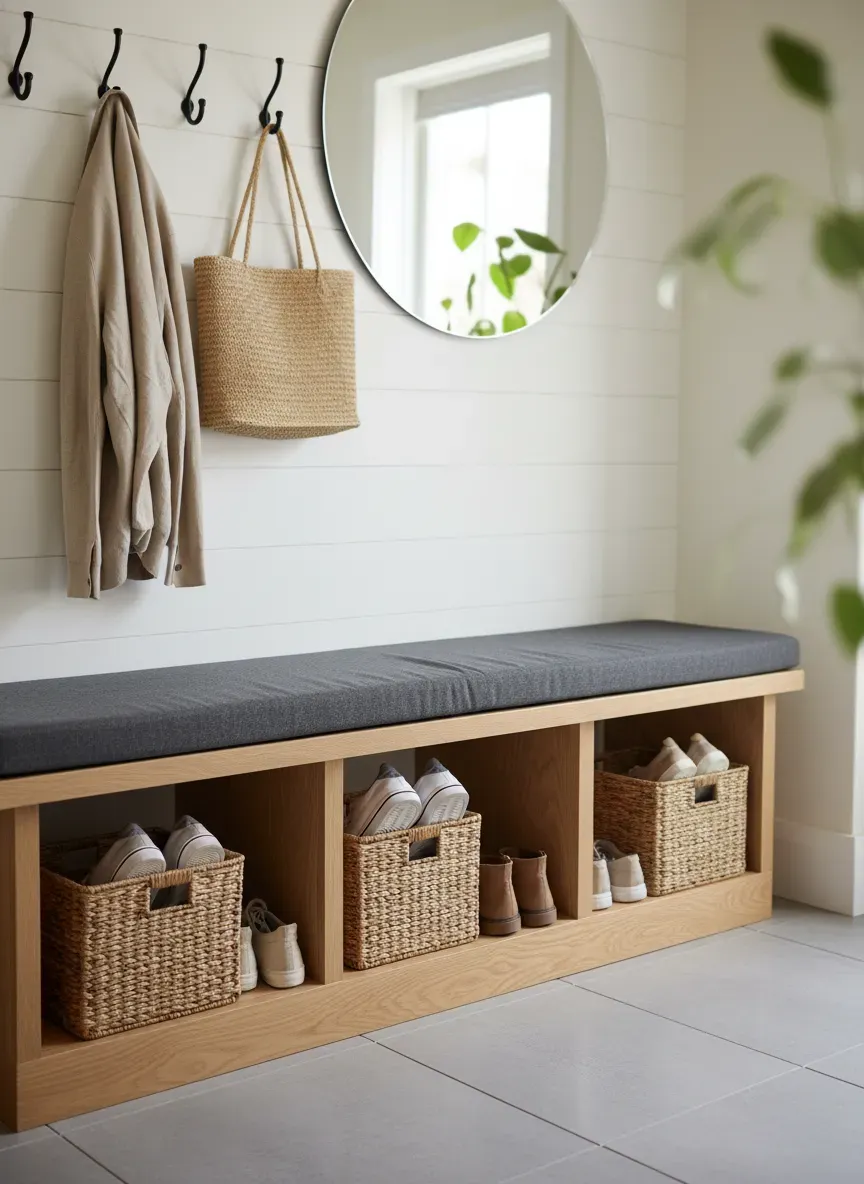
- Pros: Every shoe has an assigned home. Prevents the “shoe pile” phenomenon where pairs get separated. Fantastic for households with children.
- Cons: Rigid sizing. A cubby designed for a pair of Converse will absolutely not fit a pair of Sorrel winter boots.
Closed Cabinets/Drawers (The Minimalist)
- Pros: Ultimate visual serenity. You can hide absolute chaos behind a beautiful wooden door.
- Cons: Poor airflow without venting. Requires the extra step of opening a door, which is sometimes just enough friction to make a lazy family member leave their shoes on the rug instead.
Hardware and Joinery: The Hidden Indicators of Quality
When evaluating furniture, most people only look at the exterior finish. But as any experienced woodworker will tell you, the soul of a piece of furniture lives in its joints.
If you are buying a bench that requires assembly, pay close attention to the hardware pack. Does it rely solely on wooden dowels and a few dabs of glue? That bench will fail under repeated lateral stress. The best ready-to-assemble pieces utilize heavy-duty cam locks combined with deep-threaded steel screws.
If you are purchasing a pre-assembled piece, check the underside. Look for corner blocks—small triangular pieces of wood screwed into the corners of the frame. These blocks dramatically increase the torsional rigidity of the bench. If you have kids who tend to flop down onto furniture rather than sit gently, corner blocks are the difference between a bench lasting two years and twenty years.
The Seasonal Rotation Strategy
No bench in the world is large enough to hold an entire family’s four-season shoe collection. You need a rotation strategy.
Your entryway bench should only house the “active roster” of shoes. In July, this means sandals, running shoes, and light loafers. The heavy snow boots and insulated wellies need to be cleaned, stuffed with cedar inserts to maintain their shape, and relocated to a secondary storage area—like a master closet or basement bin.
When November hits, execute the swap. By limiting the volume of items in your primary drop zone, you reduce decision fatigue and keep the physical space uncluttered.
Styling Your Bench for Maximum Impact
A bench shouldn’t look like it was haphazardly dropped into a room. It needs to be integrated into the architecture.
Start from the ground up. Anchor the bench with a highly durable, washable runner rug. Ruggable and similar brands have perfected the aesthetic of vintage Persian rugs with the washability of a bath towel. This adds texture and catches the inevitable dirt tracked in from outside.
Above the bench, utilize vertical space. Install a row of architectural wall hooks for coats, hats, and dog leashes. Above the hooks, hang a large mirror. Mirrors bounce natural light around small foyers, instantly doubling the perceived footprint of the room. Finally, soften the hard edges of the bench with a structured lumbar pillow. Avoid scattering small, loose pillows, as they will inevitably end up on the floor when people sit down to tie their laces.
Common Pitfalls When Buying Entryway Furniture
Let’s bypass the expensive mistakes. Over the years, I’ve seen clients throw out perfectly good furniture simply because they failed to consider a few crucial variables before hitting the checkout button.
1. Ignoring Baseboards and Outlets You measure your wall, and you have exactly 48 inches of space. You buy a 48-inch flush-mount bench. The problem? Your home has thick, 5-inch historic baseboards. Now the bench sits two inches away from the wall, creating an ugly gap where mail and keys will inevitably fall. Always measure wall-to-wall space above the baseboard, and look for benches with inset legs or notched backs if you want a flush fit. Additionally, check if the bench will block a vital electrical outlet.
2. Overestimating Weight Capacities Do not trust vague claims of “sturdy construction.” Look for specific numerical weight capacities. A bench rated for 150 pounds is essentially a decorative item. If a 200-pound adult sits down abruptly while holding a heavy toddler, that frame will snap. Look for a minimum static load capacity of 250 pounds, with 350+ being ideal for peace of mind.
3. The Upholstery Trap Velvet looks spectacular in catalog photos. It catches the light beautifully and screams luxury. It is also an absolute nightmare for an entryway. Velvet acts as a magnet for pet hair, dust, and dried mud. If you want a soft surface, stick to top-grain leather, faux leather, or heavy-duty synthetic blends designed for commercial traffic.
Key Takeaways
- Prioritize Airflow: Damp shoes ruin closed cabinets. Opt for mesh shelves, slatted doors, or open cubbies unless you plan to dry your shoes before storing them.
- Measure Twice, Sit Once: Ensure your bench hits that sweet spot of 18 inches in height and leaves at least 36 inches of hallway clearance.
- Invest in Joinery: Solid wood with corner blocks and heavy steel hardware will survive the daily abuse of a busy household far better than standard particle board.
- Rotate Seasonally: Don’t treat your bench like a permanent archive. Keep only the current season’s footwear in the active drop zone.
The Bottom Line Your entryway is the prologue to your home’s story. Equipping it with a high-quality, thoughtfully designed bench isn’t just about hiding clutter; it’s about engineering a smoother, more peaceful transition from the outside world into your private sanctuary. Whether you lean toward the raw utility of industrial steel, the sleek lines of mid-century walnut, or the hidden depths of an upholstered trunk, the right choice will instantly elevate both the function and the feeling of your space.