
Best Hall Trees for Small Entryways
Discover the best hall trees for small entryways. Our expert-driven guide details dimensions, weight capacities, materials, and anti-tip installations.
Jul 29, 2026 · Linda Wise
5 min readSmall entryways present an architectural bottleneck. When you open your front door, you are instantly confronted by a physical transition zone where outdoor grit, wet coats, and daily footwear collide with your indoor living space. If your foyer is narrow, shallow, or tucked into a tight corner, a standard bulky wardrobe will choke the flow of foot traffic.
The solution is a highly optimized, small-footprint hall tree.
A well-engineered hall tree consolidates vertical coat hanging, bench seating, shoe storage, and accessory organization into a single, cohesive unit. Selecting the correct model requires balancing physical dimensions, load capacities, material durability, and visual mass.
This guide breaks down the engineering behind small-space entry storage. We analyze structural tolerances, depth thresholds, and mounting requirements to help you choose the ideal unit for your home’s unique layout.
Quick Comparison: Top Picks & Benchmarks
The following table benchmarks three high-performing, small-footprint hall trees designed specifically for confined zones. These products represent different structural styles: ultra-slim industrial, corner-optimized, and classic wood-framed.
| Product | Footprint Dimensions (W x D x H) | Weight Capacity (Bench / Hook) | Best For | Check Price |
|---|---|---|---|---|
| VASAGLE Slim Entryway Coat Rack | 28.3” x 11.8” x 72” | 176 lbs / 6.6 lbs | Ultra-narrow hallways and minimal depth clearances | Check Price on Amazon |
| Hoctieon Corner Hall Tree | 17.7” x 17.7” x 72” | 180 lbs / 11 lbs | Utilizing dead corners behind swinging doors | Check Price on Amazon |
| Walker Edison Furniture Modern Hall Tree | 30” x 16” x 68” | 250 lbs / 10 lbs | Heavy daily seating and classic styling requirements | Check Price on Amazon |
The Geometry of Tight Spaces: Critical Dimensions & Clearances
When dealing with a small entryway, every quarter-inch matters. Standard furniture design assumes a depth of 18 to 24 inches. In a tight hallway, an 18-inch deep unit will severely restrict your walking path, creating a safety hazard and a cramped aesthetic.
The Depth Threshold: 11 to 14 Inches
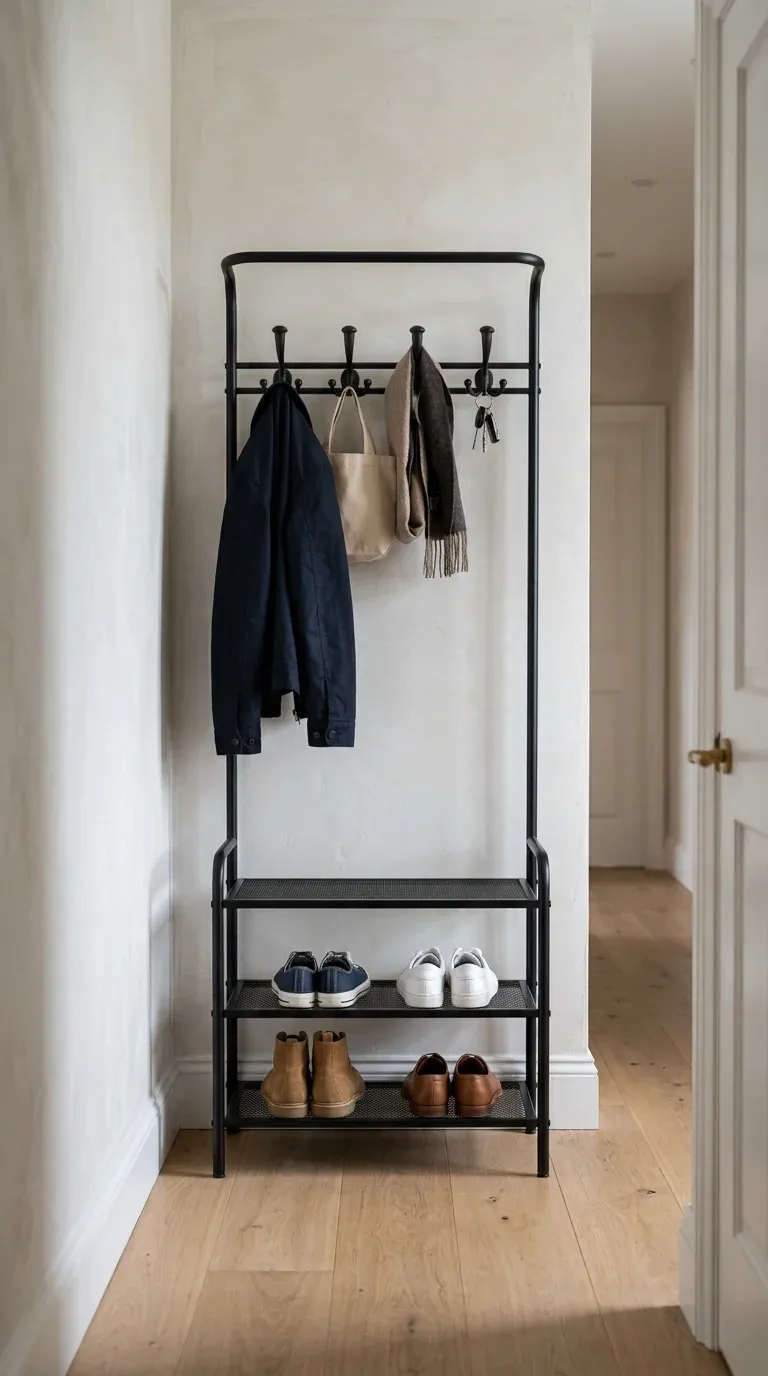
For narrow passageways, look for hall trees with a maximum depth of 11 to 14 inches. This range is deep enough to store standard shoes (which average 11 to 12 inches in length for adult sizes) while keeping the walking corridor clear.
If your unit has a built-in bench, a 12-inch depth is the absolute minimum required for a stable seat. Anything shallower compromises safety when you sit down to tie shoes, shifting the center of gravity too far forward.
The Swing Radius Calculation
Before purchasing any entryway unit, map out the swing radius of your front door.
- Door Clearance: Standard interior and exterior doors require a 36-inch clearance arc.
- Buffer Zone: Ensure the hall tree sits at least 3 to 4 inches outside the fully opened door’s path.
- Wall Stops: Install a heavy-duty wall stop to prevent the door handle from slamming into the hall tree’s metal frame or wooden panels.
Vertical Optimization: Utilizing the 72-Inch Line
When horizontal square footage is limited, you must look upward. The most efficient small-space hall trees stand between 68 and 74 inches tall.
This height places the primary coat hooks at approximately 60 to 65 inches above the floor, which is the ergonomic sweet spot for the average adult. It leaves enough vertical clearance below the hooks for long winter coats to hang without pooling on the shoe bench, while keeping top shelves accessible for hats, gloves, or storage baskets.
Field Note: If you have exceptionally low ceilings, measure your vertical clearance twice. A 72-inch hall tree requires at least 75 inches of ceiling clearance to assemble comfortably if you are building it flat on the floor and tilting it upward into place.
Material Science & Load Dynamics
The structural integrity of a small hall tree is critical because the unit must handle dynamic forces. Sitting down on the bench applies a sudden downward load, while pulling a heavy, snagged coat off a hook applies outward lateral force.
Solid Wood vs. Engineered Wood vs. Steel Frames
Each material offers distinct trade-offs in weight, cost, moisture resistance, and longevity:
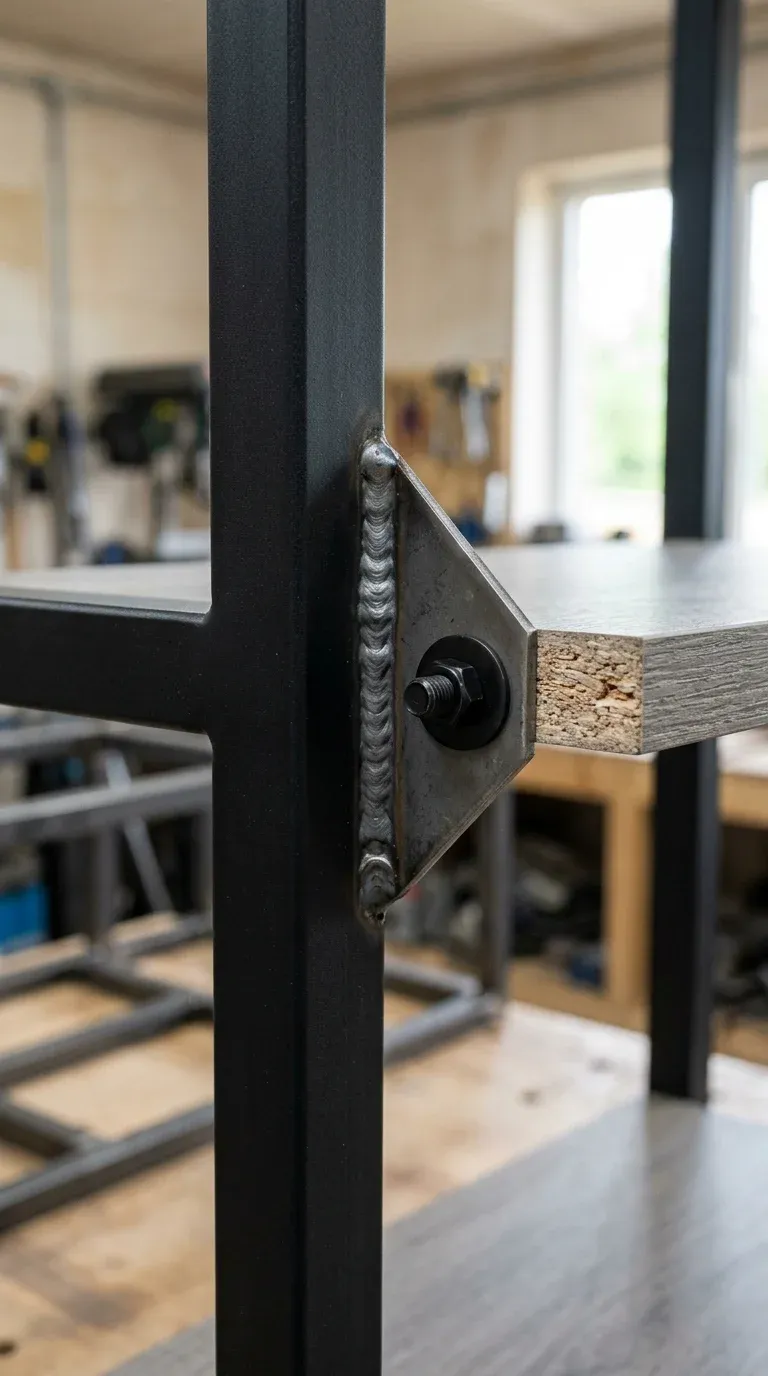
- Powder-Coated Steel Frames: These offer the highest strength-to-weight ratio. A frame constructed from 20mm x 20mm square steel tubing provides exceptional structural stiffness without visual bulk. This openness allows light to pass through, making your entryway feel larger. Steel is impervious to the moisture dripping from wet coats and umbrellas.
- Engineered Wood (MDF/Particle Board): Commonly used in budget-friendly units. While highly flat and uniform, standard MDF is heavy and prone to swelling if exposed to standing water from wet shoes. If choosing engineered wood, ensure it features a high-pressure laminate (HPL) or a thoroughly sealed melamine finish to block water ingress.
- Solid Hardwood: The gold standard for durability. Oak, maple, or birch can withstand decades of abuse. Solid wood can be sanded and refinished if scuffed by footwear, but it carries a premium price tag and increases the overall weight of the unit, requiring robust wall anchoring.
Load Capacity Benchmarks
Do not trust vague marketing claims. Look for certified weight limits:
- Seating Benches: Must support at least 175 lbs for ultra-slim units, and preferably 250 lbs for premium wood options.
- Coat Hooks: Must support a minimum of 6 lbs per hook. Heavy winter parkas, backpacks, and laptop bags can easily exceed this limit if multiple items are hung on a single prong.
- Shoe Shelves: Must support 15 to 25 lbs per tier without sagging. Metal mesh or slatted wood shelves prevent dirt accumulation and allow air to circulate around damp soles.
Top 3 Curated Hall Trees for Tight Footprints
Choosing the right storage solution depends on your specific layout constraints. Here, we analyze three top-performing options, focusing on material performance, actual assembly tolerances, and spatial efficiency. For a broader overview of various spatial configurations, you can read our guide on best hall trees for every entryway type.
1. VASAGLE Slim Entryway Coat Rack – Best for Ultra-Narrow Corridors
For hallways where every inch of walkway is precious, the VASAGLE Slim Entryway Coat Rack offers an exceptionally balanced layout.
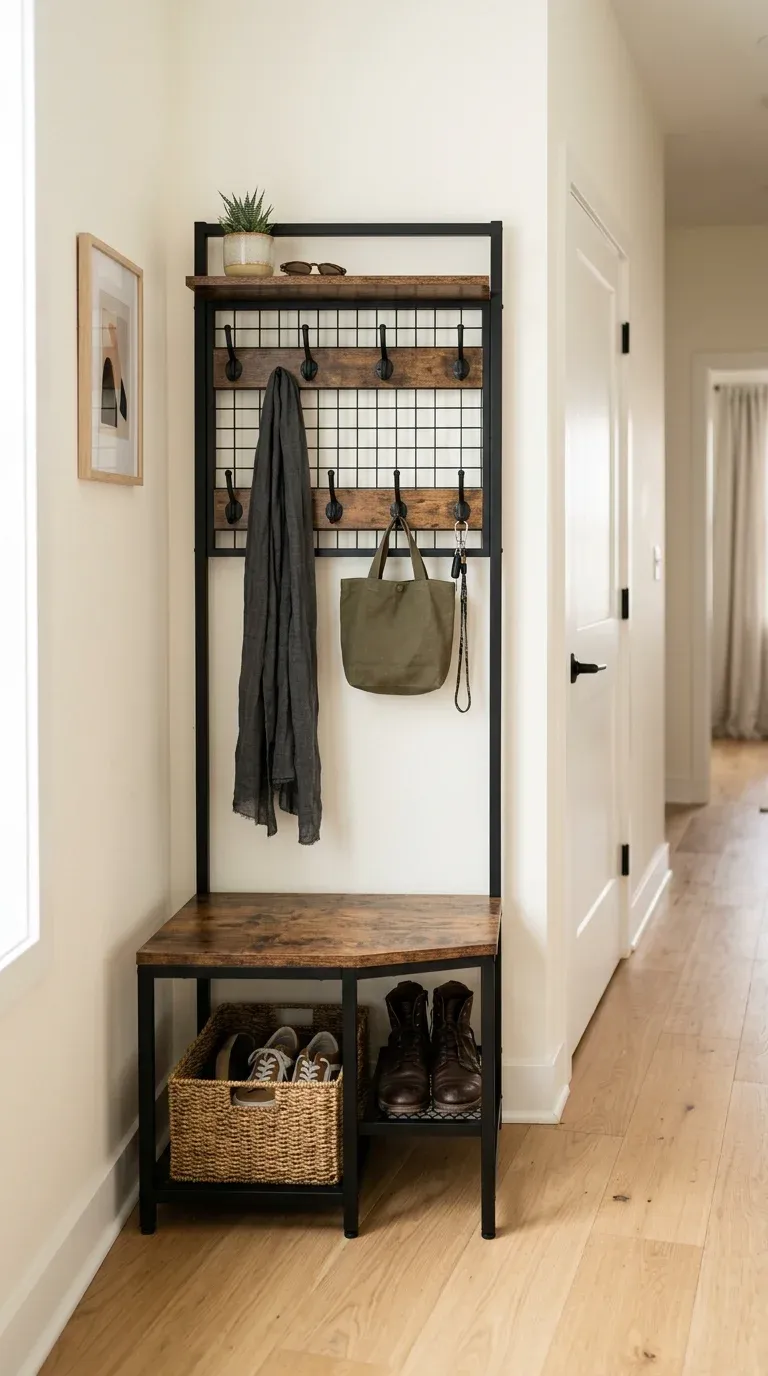
- Footprint: 28.3” Wide x 11.8” Deep x 72” High.
- Frame Construction: Matte black, powder-coated alloy steel.
- Storage Configuration: 9 adjustable hooks arranged across two levels, a dual-tier wire mesh shoe rack, and a high-density particle board bench.
- Key Advantage: The 11.8-inch depth is incredibly slim, making it one of the few functional hall trees that can sit comfortably in a standard 36-inch wide hallway without violating local building escape codes.
Performance Analysis
The steel tube frame provides excellent torsional rigidity. The adjustable leveling feet are a crucial feature for older homes with sloped or uneven entryway floors.
Because the hooks are repositionable along the wire grid backboard, you can customize the layout to prevent bulky jackets from overlapping and pushing the unit away from the wall.
- Pros:
- Extremely shallow depth preserves corridor space.
- Adjustable leveling feet compensate for uneven tiling or old wood floors.
- Nine heavy-duty hooks provide high hanging capacity.
- Cons:
- The particle board bench will degrade if subjected to prolonged standing water from snow boots. Use a plastic boot tray nearby for soaked footwear.
- The narrow depth makes the unit top-heavy when fully loaded with coats; wall anchoring is mandatory.
2. Hoctieon Corner Hall Tree – Best for Dead Corner Maximization
If your entryway is a tiny square foyer with doors on multiple walls, the only open real estate is often a 90-degree corner. The Hoctieon Corner Hall Tree is engineered specifically to convert this dead space into functional storage.
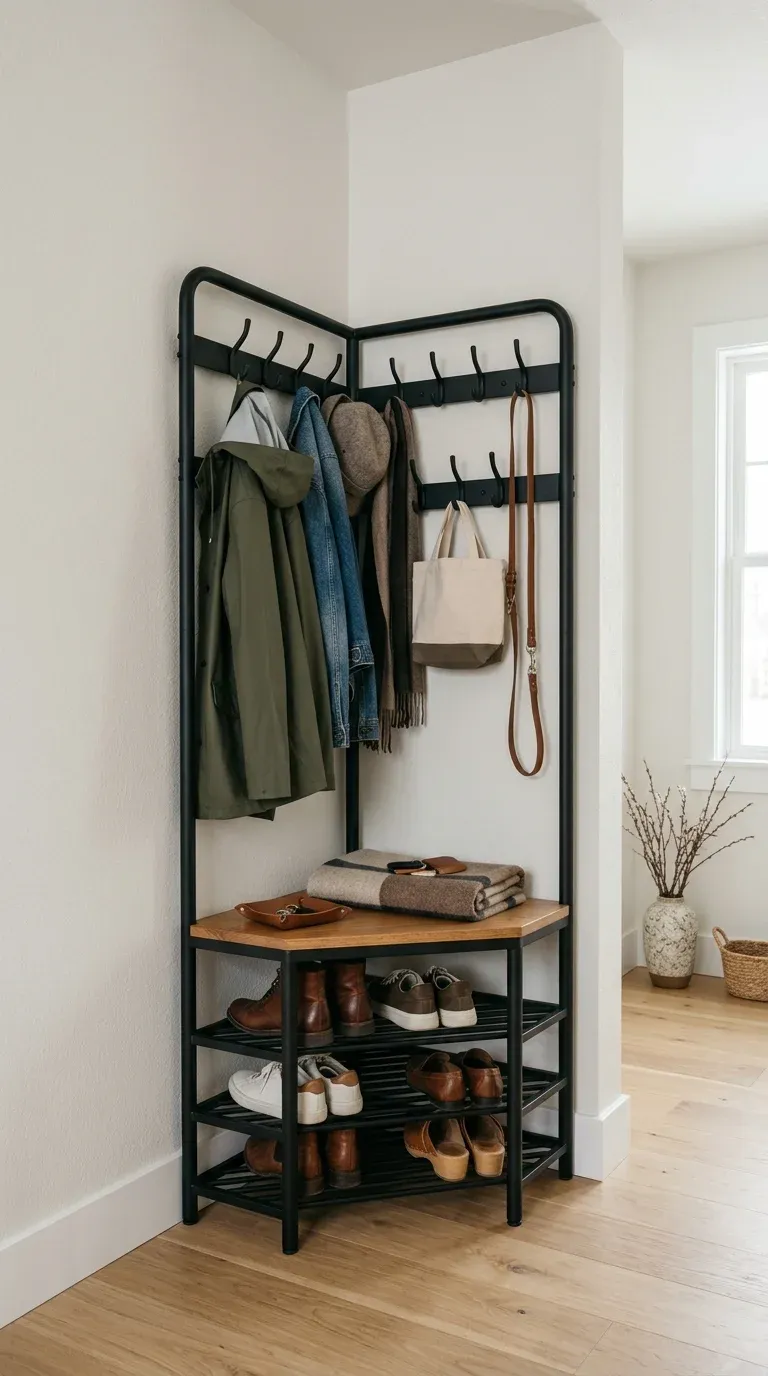
- Footprint: 17.7” Wide x 17.7” Deep x 72” High.
- Frame Construction: Round steel tubing with a rust-resistant finish.
- Storage Configuration: 6 fixed ball-end hooks, a small corner bench, and 3 tiers of wire shoe shelving below.
- Key Advantage: By utilizing a 90-degree corner, this unit leaves your main walkways completely unobstructed.
Performance Analysis
Corner designs are inherently more stable than flat-backed slim units because their geometry resists tipping in two directions. However, the seating bench on a corner unit is compact. It serves well as a perch to steady yourself while slipping on shoes, but it is not intended for lounging.
The three wire shelves below provide excellent ventilation for shoes, ensuring that damp soles dry quickly without trapping odors.
- Pros:
- Zero impact on linear hallway walls.
- Excellent structural stability due to 3D corner geometry.
- Triangular shelves maximize shoe storage within a small footprint.
- Cons:
- The seating area is small, which may be awkward for larger individuals.
- Hooks are clustered close together, limiting the bulkiness of coats you can hang simultaneously.
3. Walker Edison Furniture Modern Hall Tree – Best for Structural Seating & Classic Design
If your home demands a more substantial piece of furniture that blends seamlessly with traditional or modern transitional architecture, the Walker Edison Modern Hall Tree delivers a robust option without dominating a small space.
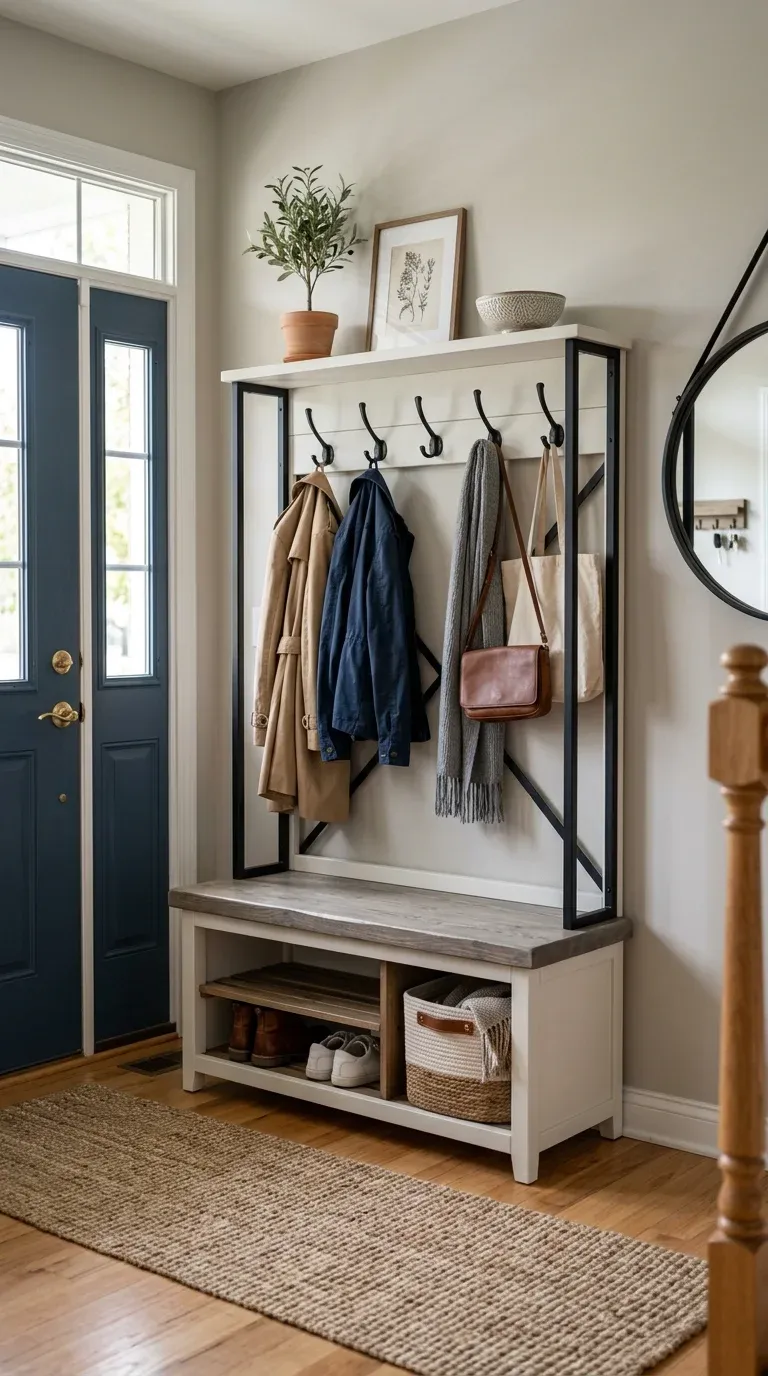
- Footprint: 30” Wide x 16” Deep x 68” High.
- Frame Construction: High-grade MDF finished with durable laminate, supported by steel structural brackets.
- Storage Configuration: 4 fixed double-pronged metal hooks, a spacious top shelf, and a large open lower storage compartment that can fit bins or shoes.
- Key Advantage: A highly stable, thick-profile bench rated for 250 lbs, offering a comfortable, solid seating experience.
Performance Analysis
This unit is deeper (16 inches) and wider (30 inches) than the previous models, making it ideal for slightly larger “small” entryways, such as dedicated alcoves or small mudrooms. The closed back panel protects your wall paint from being scuffed by wet coats or dirty bags.
The large open compartment below the bench can hold storage baskets to keep clutter entirely out of sight, which is essential for maintaining visual order in a small space.
- Pros:
- Highly stable, premium feel with a 250 lb bench weight capacity.
- Closed back panel prevents wall scuffs.
- Deep lower storage accommodates standard storage baskets.
- Cons:
- At 16 inches deep, it may feel too bulky in narrow, long hallways.
- MDF construction is heavy, requiring two people for safe assembly and installation.
Architectural Integration & Corner Strategy
In a small entryway, placement is everything. You cannot simply push a hall tree against the wall and call it a day. You must integrate it into the architecture of your room to maintain structural safety and visual flow.
If you are planning a complete entryway overhaul, consult our comprehensive hall tree buying guide for deep-dive technical insights into materials, spatial planning, and styling.
       TYPICAL NARROW HALLWAY LAYOUT (TOP-DOWN)

       +------------------- WALL -------------------+
       |                                            |
       |   +------------+                           |
       |   | HALL TREE  | <--- Depth: 11" - 14"      |
       |   | (Anchored) |      (Preserves Walkway)   |
       |   +------------+                           |
       |                                            |
=======[ DOOR OPENING                                |
  \    |                                            |
   \   | <----- Keep 36" Door Swing Clear -------> |
    \  |                                            |
     \ |                                            |
       +--------------------------------------------+
The Power of the Corner
Many homeowners overlook corners, leaving them empty or filling them with impractical decor. A corner hall tree utilizes space that is otherwise useless.
When positioning a corner unit, ensure it is on the hinge side of the door rather than the latch side. This positioning prevents the door from swinging into the path of hung coats, which can snag fabrics or knock down keys.
If your entryway aesthetic trends toward warm, rustic, or traditional styles, you can learn more about choosing farmhouse-style hall trees to create a cozy focal point.
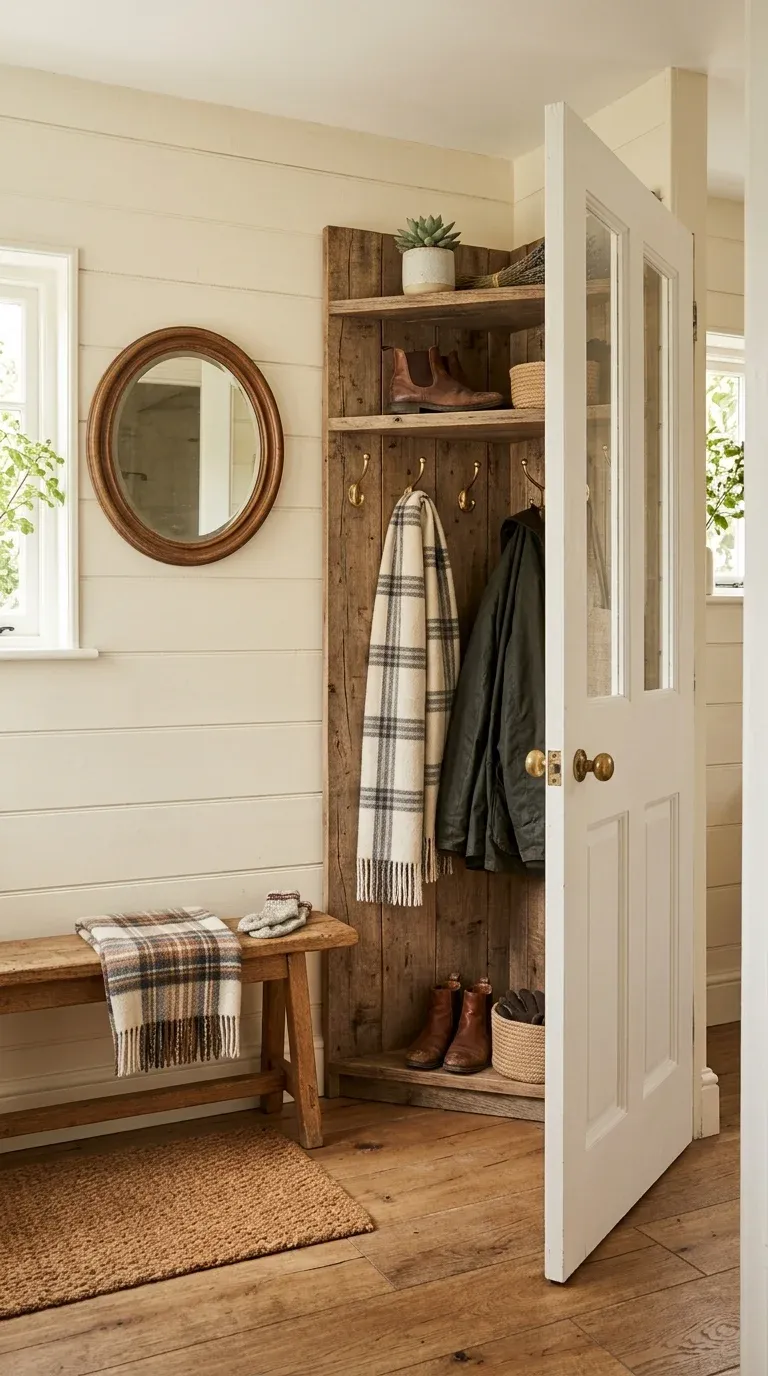
To dive deeper into design strategies for tight angles, read our dedicated article on maximizing style in small spaces with corner solutions.
Assembly, Installation, and Anti-Tip Engineering
Any tall, narrow piece of furniture is a tipping hazard, especially when loaded with heavy winter gear on the upper hooks. If you have children or pets, a tipping hall tree can cause severe injury. Securing the unit to your wall is a critical safety step.
Step-by-Step Wall Anchoring
Most manufacturers include basic plastic drywall wall plugs in the box. Throw these away. Standard plastic expansion anchors easily pull out of drywall under lateral shear stress. Instead, invest in high-quality hardware.
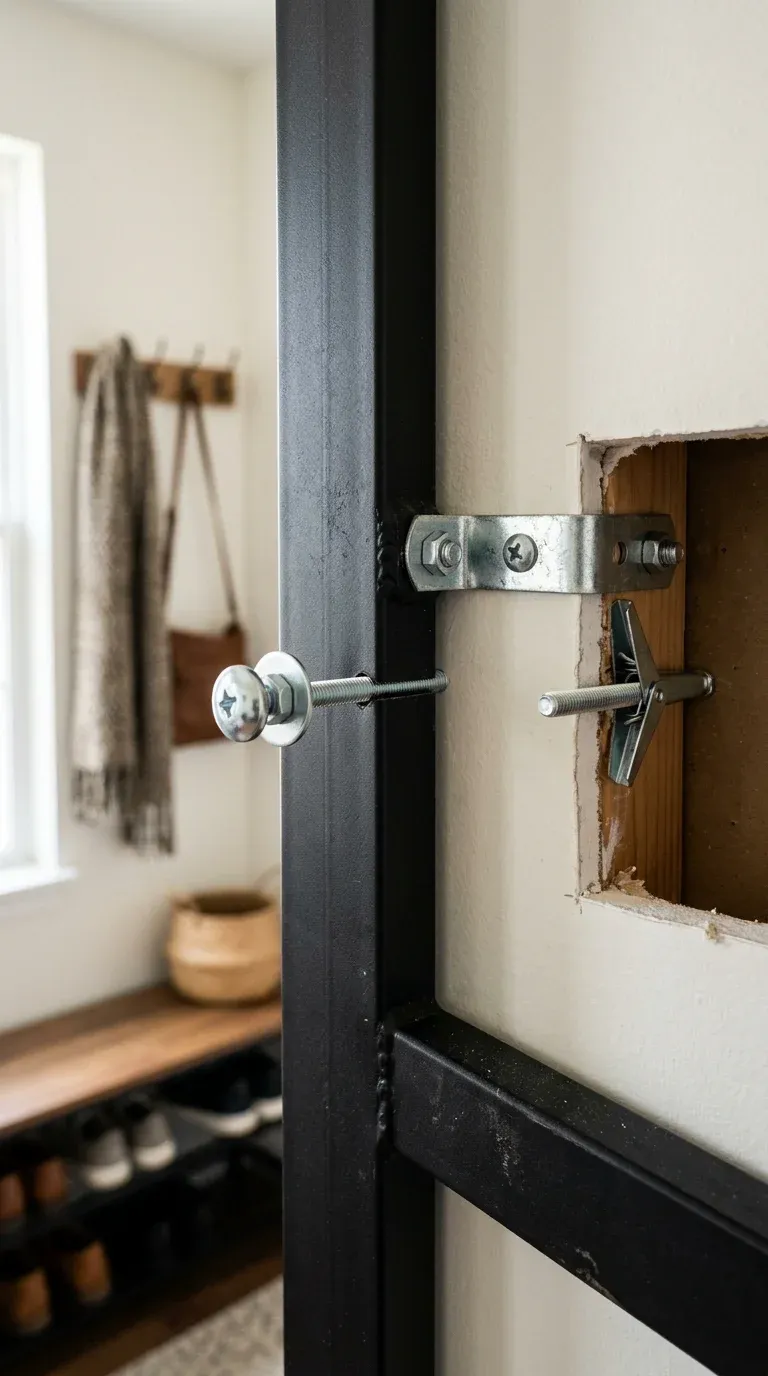
Required Hardware:
- A stud finder.
- Two 3/16-inch Toggle Bolts (if no stud is present) OR two 2.5-inch Wood Screws (if anchoring directly into wood studs).
- Heavy-duty nylon safety straps or steel L-brackets.
Installation Process:
- Assemble the unit completely on a flat surface, ensuring all frame bolts are tightened to 90% capacity.
- Move the hall tree to its final destination. Use the leveling feet to ensure the unit is perfectly plumb (vertical) and level (horizontal). If your floor slopes, adjust the feet until a bubble level shows the unit is true.
- Locate the wall studs behind the top rail of the hall tree using your stud finder.
- If a stud is present: Align the hall tree’s integrated mounting bracket (or your L-bracket) with the stud. Drill a pilot hole into the stud, then drive the 2.5-inch wood screw with a washer through the bracket and directly into the wood.
- If no stud is present: Mark the dry-wall location through the bracket. Slide the hall tree aside. Drill a hole matching the diameter of your toggle bolt (typically 1/2-inch for a 3/16-inch bolt). Compress the metal wings of the toggle bolt, insert it through the hall tree bracket, thread the wings onto the bolt, and push the assembly through the drywall until the wings spring open on the back side. Tighten the bolt until the bracket is flush and rigid against the wall.
- Verify Stability: Grasp the hall tree at chest height and apply outward pressure. There should be zero forward movement or wobble.
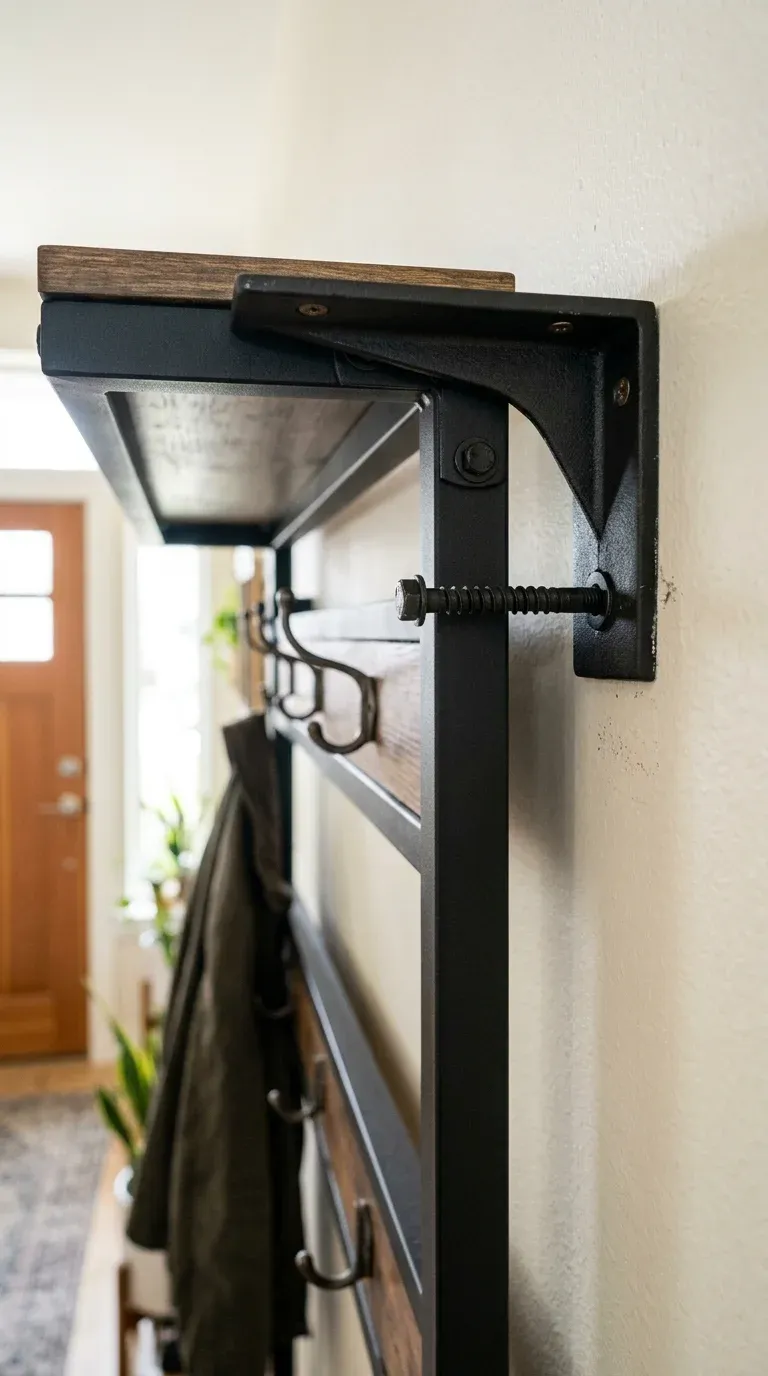
Pro Tip: If your baseboard moulding is exceptionally thick (over 1/2-inch), it will prevent the bottom of the hall tree from sitting flush against the wall. To fix this gap, use adjustable spacer brackets or mount a finished wood cleat to the wall studs first, then anchor the top of the hall tree to the cleat.
Design Aesthetics: Color, Light, and Visual Flow
A small entryway can easily feel dark and cluttered. The color, finish, and design style of your hall tree play a massive role in how spacious your foyer feels.
The Illusion of Open Space: Open vs. Closed Storage
- Open Frame (Industrial/Minimalist): Features thin steel legs and open wire shelves. This style allows the wall behind the unit to remain visible, which tricks the brain into perceiving a larger space. Open storage is perfect for modern, loft, or minimalist apartments.
- Closed Frame (Traditional Cabinetry): Features solid wood sides, a solid backboard, and sometimes closed drawers or shoe cubbies. While this style hides clutter exceptionally well, it creates a solid visual block that can make a tight hallway feel narrower.
Selecting the Right Finish
When choosing finishes, aim to either match your wall color for a seamless look or create high-contrast focal points. For a detailed breakdown of color theory in entryway design, read our guide on choosing the right color and finish for your furniture.
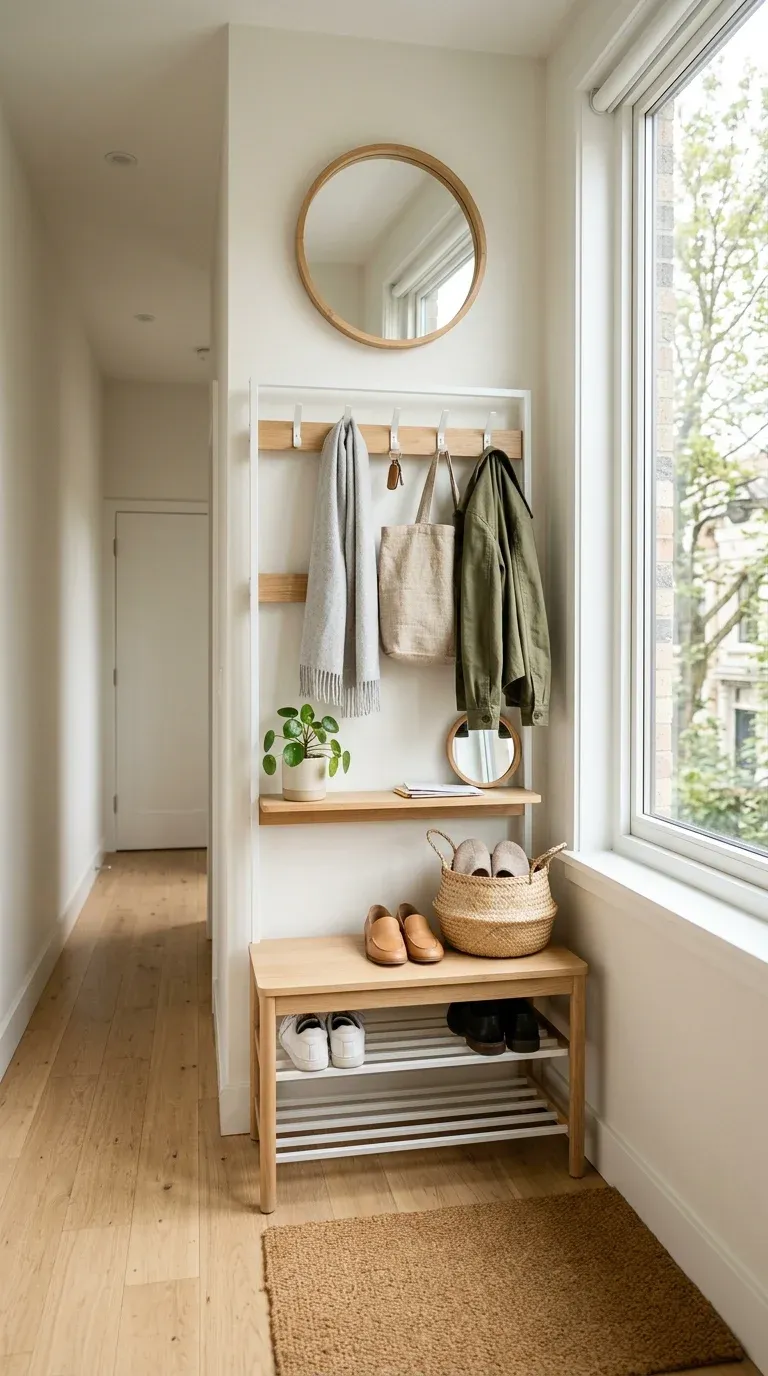
- Light Finishes (White, Oak, Light Grey): Reflect ambient light, making dark foyers feel brighter and more open.
- Dark Finishes (Matte Black, Walnut, Espresso): Create a sophisticated, grounded aesthetic, but they work best when contrasted against pale walls and paired with adequate lighting.
Maintenance, Wear-and-Tear, and Longevity
Entryway furniture takes a beating. Mud, road salt, water, and sand will inevitably contact your hall tree. Implementing a simple preventative maintenance routine will keep your unit looking pristine for years.
Protecting the Bench and Shelves
- Moisture Barriers: If your hall tree features an engineered wood bench, apply a coat of clear polyurethane or paste wax to the seat. This protective layer seals micro-gaps in the laminate, preventing water from seeping into the MDF core.
- Drip Trays: Place a slim plastic shoe tray directly on or beneath the bottom wire shelf. This catches salty winter slush and muddy drips before they pool on your flooring or corrode the lower frame of the hall tree.
Hardware Maintenance
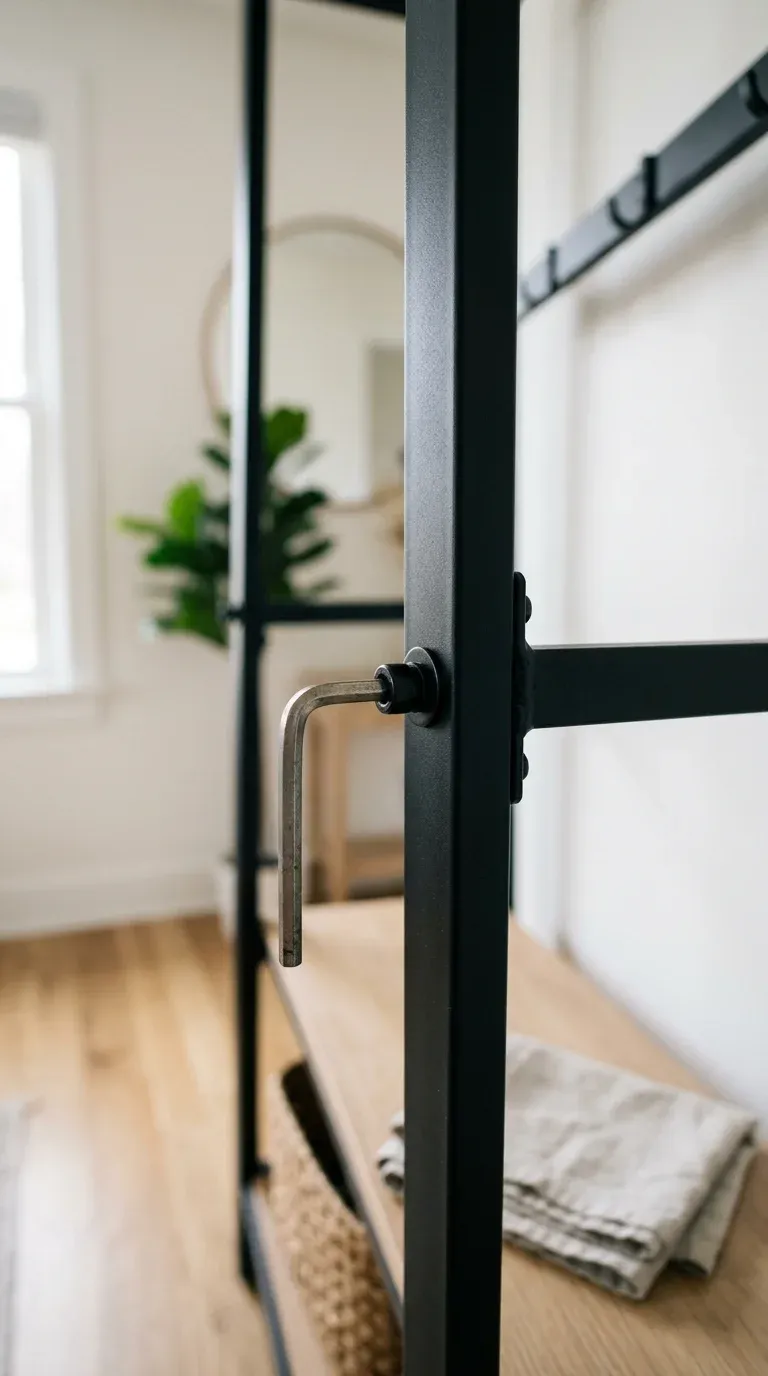
- Tighten Connection Bolts: The dynamic stress of sitting on the bench and hanging heavy items will naturally loosen fasteners over time. Check and tighten all hex screws and bracket bolts once every six months.
- Hook Inspections: If a hook begins to sag or wobble, remove it immediately. Stripped screw holes in wood backboards can be repaired by packing the hole with wood glue and toothpicks, letting it dry, cutting it flush, and re-drilling a fresh pilot hole.
Comprehensive FAQ
Is an 11-inch deep hall tree actually functional for adult shoes?
Yes, but with caveats. Standard adult men’s shoes (size 10-12) measure roughly 11.5 to 12.5 inches in length. On an 11-inch deep shelf, these shoes will overhang the front edge by a fraction of an inch, which is perfectly acceptable and does not compromise stability. If you wear larger sizes (size 13+), you will need to angle your shoes slightly on the shelves or opt for slatted shelves where the heels can hang off the back.
Can I install a hall tree if I have baseboard heating?
Never place a wood or MDF hall tree directly over or flush against a hydronic or electric baseboard heater. Doing so blocks airflow, creating a fire hazard and causing the wood frame to warp, dry out, and crack. If you must place a hall tree in front of a heater, select an open-back, all-metal frame unit with tall legs that clear the top of the heater by at least 6 inches, ensuring unrestricted air circulation.
How do I prevent my coats from making the hall tree look cluttered?
To avoid visual clutter in a small space, use the one-in, one-out rule. Only hang current, daily-use coats on the hall tree. Out-of-season jackets should be stored in a closet. Additionally, upgrade from mismatched plastic hangers to uniform, heavy-duty wooden or matte black metal S-hooks. This small change unifies the design and keeps your entryway looking polished.
Are corner hall trees harder to assemble than standard models?
Corner hall trees require more patience during assembly because of their non-standard 90-degree angles. If the frame is misaligned by even a single millimeter during assembly, the shelves will not sit flat, and the unit will wobble. Always assemble corner units on a flat surface, leave the bolts loose until the entire structure is put together, and then tighten them in an alternating pattern.
Can I use a hall tree in an apartment if I am not allowed to drill into the walls?
If your lease prohibits drilling holes for toggle bolts, do not buy a tall, ultra-slim hall tree. It is simply too dangerous to use without anchoring. Instead, look for a low-profile entryway bench with shoe cubbies underneath, and pair it with a lightweight, damage-free wall-mounted coat rack using heavy-duty adhesive strips (rated for 15+ lbs) or over-the-door hooks.
What is the average lifespan of a metal-frame hall tree versus an MDF-frame model?
A powder-coated steel frame hall tree can easily last 10 to 15+ years because steel does not degrade when exposed to moisture or temperature fluctuations. An MDF or particle-board unit typically lasts 3 to 7 years in high-traffic entryways, as moisture from shoes and wet garments eventually penetrates the seams, leading to swelling, bubbling, and structural softening. Ensure you dry any standing water immediately to prolong its lifespan.
Top Picks: Best Entryway Essentials
Editor's shortlist with verified ratings. Prices and availability below — clicking an Amazon link earns us a small commission at no extra cost to you.
| # | Product | Rating | Reviews | Tag | Check Price |
|---|---|---|---|---|---|
| 1 | Vasagle Industrial Entryway Bench | 8,420 | Top Pick | View on Amazon | |
| 2 | Crosley Furniture Seaside Hall Tree | 5,410 | — | View on Amazon | |
| 3 | Seville Classics 12-Pair Shoe Rack | 6,420 | Best Storage | View on Amazon | |
| 4 | Franklin Brass Wall Hooks (5-Pack) | 9,820 | — | View on Amazon | |
| 5 | Simplihome Artisan Solid Wood Bench | 3,127 | Editor's Pick | View on Amazon |
Affiliate disclosure: As an Amazon Associate we earn from qualifying purchases.
Tag: entreyway-20 — change in src/data/topPicks.ts.