
Corner Hall Tree: 7 Best Picks, Exact Sizes & How to Measure (2026)
Corner hall tree guide: L-shape vs half-moon vs wedge, exact dimensions, 7 best picks, and a 20-minute measuring routine so your unit sits flush.
Jan 28, 2026 · Linda Wise
13 min readA corner hall tree turns the most wasted square foot in your home into coat-and-shoe storage - if you measure the corner right.
I’ve measured a thousand corners in my twelve years of designing entryway storage, and the honest truth is this: most people buy their corner hall tree before they measure, then spend a weekend staring at the gap between the unit and the wall. This guide fixes that. You’ll get the three shapes a corner hall tree actually comes in, the exact measurements that decide which one fits, seven picks at real budget points, and the styling rules that make the corner look intentional instead of stuffed.
Quick Answer: The right corner hall tree is decided by three numbers: the narrowest reading on both adjacent walls, the depth of your baseboard, and the diagonal opening across the front of the corner. Measure those first, then pick your shape - true L-shape for clean 90-degree corners and maximum hanging, half-moon for old or leaning walls, right-angle wedge when depth is the enemy. Full dimension cheat sheet, 7 picks, and the measuring routine below.
Our Top 3 Corner Hall Tree Deals Today
| Our Pick | Why It Wins | Shape |
|---|---|---|
| Solid-Wood True L-Shape | Best overall corner hall tree: two walls of hanging + bench | True L-shape |
| Mid-Century Half-Moon | Best corner hall tree for apartments and imperfect walls | Half-moon |
| Farmhouse Right-Angle Wedge | Lightest footprint, easiest to swap out later | Wedge |
See current prices on corner hall trees with bench and shoe storage
One search, every shape: L-shape, half-moon, and wedge units with hooks, bench, and shoe tiers. Filter by width once you have your four measurements from the routine below.
Table of Contents
- What Is a Corner Hall Tree?
- Three Shapes: L-Shape, Half-Moon, Right-Angle Wedge
- How to Measure a Corner for a Corner Hall Tree
- Corner Hall Tree Dimensions Cheat Sheet
- 7 Best Corner Hall Trees in 2026
- Corner Hall Tree With Bench: When It Earns Its Footprint
- Half-Moon Corner Hall Trees (the elegant ones)
- How to Style a Corner Hall Tree
- 5 Corner Hall Tree Mistakes to Avoid
- Key Takeaways
What Is a Corner Hall Tree?
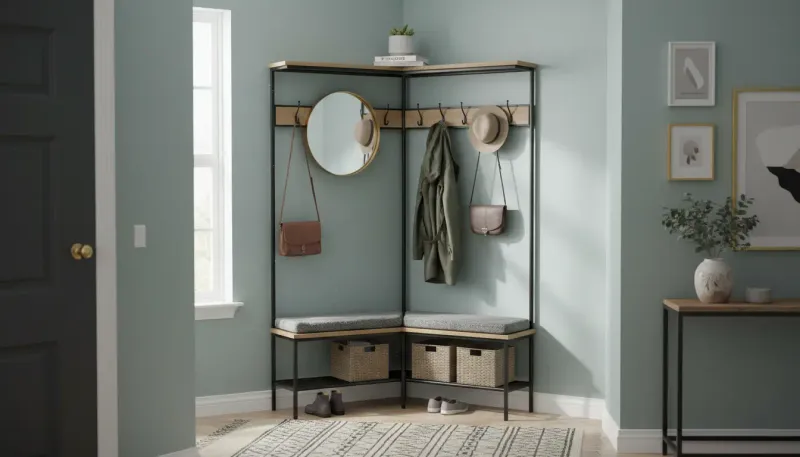
A corner hall tree is entryway furniture engineered for the one spot a normal hall tree can’t use: where two walls meet. Instead of needing a flat run of wall, it anchors to both adjacent walls (or sits diagonally across them) and stacks the full entryway program - coat hooks, a bench, shoe storage, sometimes a mirror - into a footprint that would otherwise hold a dust bunny.
The anatomy is the same as any hall tree, only rotated 45 degrees:
| Component | Standard height | What it does in a corner |
|---|---|---|
| Coat hooks | 60-65” | Adult reach on both faces of an L-shape, or one angled face |
| Bench seat | 17-19” | Lowers the center of gravity and gives you a place to sit |
| Shoe storage | 0-17” | Open shelf, cubbies, or closed cabinet under the bench |
| Top shelf | 60”+ | Display weight: plant, hat box, catch-all bowl |
Two things separate a corner hall tree from a straight one. First, it buys you a second wall of hanging, which is why a corner unit outperforms a 30-inch hall tree in the same amount of floor area. Second, it’s the only entryway furniture that uses the corner’s diagonal as its front face - which means the effective width you get in a 30-inch opening is closer to 40 inches of usable frontage.
If your corner is too tight for a full unit, our corner entryway storage solutions post covers shelves, towers, and hook rails for the same dead zone.
Three Shapes: L-Shape, Half-Moon, Right-Angle Wedge
Most units sold as a corner hall tree are one of three things. Knowing which you’re buying is the difference between a unit that hugs the walls and one that floats awkwardly in the middle of the room.
1. True L-shape corner hall tree. Two faces meeting at a right angle, each running along a wall. It captures the vertex where the walls meet and puts both adjacent walls to work for hanging. This is the highest-capacity shape and the one to buy when your corner is a clean, square 90 degrees.
2. Half-moon (diagonal) corner hall tree. One flat or curved front face angled across the corner, with the back cut to clear the walls. It reads as a single piece of furniture rather than two boxes glued together, and because it never has to match a perfect joint, it’s the shape that tolerates leaning plaster walls, out-of-square corners, and wallpaper seams.
3. Right-angle wedge corner hall tree. A triangular footprint - usually a bench with a small rack above - sized for corners that can’t take depth. It’s the lightest, cheapest, and easiest shape to swap out when your life changes.
The rule that governs all three: corners forgive width and punish depth. A corner absorbs a 30-inch-wide unit without complaint, but the deepest corner hall trees are the ones that stick out past the door swing, eat the walkway, and turn your entryway back into a coat pile. Width is cheap in a corner. Depth is expensive.
How to Measure a Corner for a Corner Hall Tree
Grab a tape measure and twenty minutes, because a hallway is no place for a tape-measure rounding error. This is the routine I run on every install, in order.
- Measure both adjacent walls, wall-to-wall, at 36” and 72” heights. Walls lean. In older homes, two points on the same wall can differ by an inch. You’re looking for the narrowest reading - that’s your limiting number, and your corner hall tree must sit within it on both sides.
- Note the baseboard depth. If your unit has no baseboard cutout (most don’t), it stands off the wall by the baseboard’s thickness. In a tight hallway that’s a real inch and a half of clearance you lose before the box is even open.
- Measure the diagonal opening - the corner’s “mouth.” From the corner, measure diagonally across to the far point where the unit’s front face will land. The width of a half-moon corner hall tree must fit inside that mouth. This single measurement eliminates 80% of returns.
- Check the door swing and ceiling height. Open every nearby door fully and confirm the footprint doesn’t collide. If you plan to top-load the unit, confirm you can reach the top shelf without a step stool in front of a walkway.
If your corner isn’t a true 90 degrees - common in older homes and in anything built after a settling foundation - note it now. A rigid L-shape will show the discrepancy as a visible gap, and that’s exactly the case where a half-moon is the correct answer. Full sizing context lives in our hall tree dimensions guide.
Corner Hall Tree Dimensions Cheat Sheet
| Shape | Fits corner opening | Width range | Depth | Best for |
|---|---|---|---|---|
| True L-shape | Both wall spans must be >= unit width | 30-48” total (15-24” per face) | 14-18” per face | Real 90-degree corners, family entries, max hanging |
| Half-moon / diagonal | One angled face fits the corner’s mouth | 22-30” wide | 15-19” at deepest point | Old homes, leaning walls, apartments |
| Right-angle wedge | Compact corners and doorside spots | 18-26” wide | 12-15” | Tight walkways, coat-rack-only corners, rentals |
Depth in this table is measured from the wall to the furthest point of the unit - not the box depth. Subtract 2-3 inches if your coats hang past the front rail, and keep 20-24 inches of walkway in front of the unit no matter which shape you pick.
7 Best Corner Hall Trees in 2026
These seven picks span all three shapes and honest price points. Prices are approximate and shift with sales, but the shape and the storage math don’t.
| # | Pick | Shape | Width | Budget (approx.) | Check price |
|---|---|---|---|---|---|
| 1 | Solid-Wood True L-Shape | L-shape | 30-48” | 650 | See price |
| 2 | Mid-Century Half-Moon | Half-moon | 22-30” | 400 | See price |
| 3 | Farmhouse Right-Angle Wedge | Wedge | 18-26” | 240 | See price |
| 4 | Industrial Pipe L-Shape | L-shape | 30-44” | 350 | See price |
| 5 | Bamboo Corner Stand | Wedge | 18-24” | 130 | See price |
| 6 | Mirror-Back Half-Moon | Half-moon | 24-30” | 520 | See price |
| 7 | Corner Hall Tree With Shoe Cabinet | L-shape | 32-46” | 400 | See price |
1. The Solid-Wood True L-Shape (650, approximate). A two-faced unit with a low bench under one face and double hooks up the other. The expert storage note: you get a full second wall of hanging that no straight hall tree can give you. This is the pick for family entries with genuine corner clearance and a real 90-degree corner.
2. The Mid-Century Half-Moon (400, approximate). Angled walnut-finish face, three top shelves, bench with an open shoe shelf underneath. My top pick for apartment corners - the single-face design tolerates imperfect walls like a champ and still looks like furniture.
3. The Farmhouse Right-Angle Wedge (240, approximate). White beadboard triangular bench with a corner coat rack above. The lightest-footprint option and the easiest one to swap out later if the room changes use.
4. The Industrial Pipe L-Shape (350, approximate). Black metal frame, two faces, open shelving that lets light pass through - which keeps a narrow hallway airy instead of boxy. Best where a solid panel would make the corner feel like a wall of furniture.
5. The Bamboo Corner Stand (130, approximate). Not strictly a hall tree, but a right-angle wedge with hooks and a shoe tray that fits even the tiniest door-side corner. This is the answer for houses that need corner entryway storage but have no room for a bench.
6. The Mirror-Back Half-Moon (520, approximate). Angled face with a built-in mirror and a slim 19-inch-deep footprint, plus a bench hiding a boot tray. The mirror does double duty as your last-looks station, which is why this shape wins in dark corners with no sconce room.
7. The Corner Hall Tree With Shoe Cabinet (400, approximate). A taller L-shape that trades open shelving for closed doors, so shoes disappear behind panels instead of sitting in the open. Pick this one when the corner is visible from the living room and you need the storage to read as furniture. If closed storage is your priority across the whole entryway, our hall trees with doors guide goes deeper.
Every link in the table above points to the same live corner hall tree search, so you can compare the shapes side by side instead of trusting a static price.
Corner Hall Tree With Bench: When It Earns Its Footprint
A bench doubles the depth of a corner hall tree with bench, so it has to justify itself. It earns the footprint in three situations:
- Kids or anyone who ties shoes daily. A 17-19 inch seat at 17-19 inches off the floor is the difference between a shoe-tying ritual and a one-legged hop.
- Wet or seasonal climates. An open bench shelf ventilates damp boots; a wedge with no bench leaves them in a pile on the floor.
- Heavy gear. A bench frame anchors the whole unit and drops the center of gravity, which is the mechanical fix for a corner unit that wants to walk forward.
Skip the bench when the corner sits inside a door swing, when the walkway is under 36 inches, or when the corner is purely a drop zone. In those cases, a wedge or a wall-mounted corner coat rack with a shelf underneath does the same job in half the depth. Compare the two furniture types in hall tree vs. coat rack before you commit.
Half-Moon Corner Hall Trees (the elegant ones)
If you’re decorating and organizing at the same time, the half-moon deserves its own section, because it’s the only corner hall tree shape I’ll recommend sight-unseen for old homes with plaster walls.
Because it presents one continuous face to the room, it reads as a piece of furniture rather than two cabinets glued into a corner. And because it never has to match a perfect 90-degree joint, it hides the wall’s sins instead of advertising them.
The trade-off is real: a half-moon leaves a small triangular void behind the unit. Counterintuitively, that’s a feature. The void is the perfect out-of-sight spot for tall boots, a boot tray, or the dog’s leash hooks mounted on the back board. Just buy storage baskets around the shape - triangular and trapezoidal baskets fit half-moon shelves, while a shoe drawer built for right angles won’t. Our half-moon entryway roundup covers the styling side in more detail.
How to Style a Corner Hall Tree
Once the unit is in, the corner is no longer dead - it’s your command center. Four rules make it look like you meant it:
- Anchor the hooks to real life. Middle hook row for daily coats, lower hooks for kid backpacks, top row for hats and totes. Assigning rows by person is what keeps a corner hall tree from becoming a single overloaded peg. Pair it with a DIY corner organizer plan if you have shelves left over.
- Use the top shelf for things you want to see. A trailing pothos, a hat box, a bowl for keys. Visual weight up top makes the whole corner feel styled rather than stored. For bins and tray systems, see our corner entryway storage solutions.
- Keep the floor plan honest. A shallow boot tray under the bench, holding only the shoes currently in rotation. Deeper shoe storage belongs in a closet - and if your corner is too narrow for even a wedge, our corner shoe storage solutions covers the alternatives before you give up.
- Add a mirror, subtract a sconce. Wall sconces fight corner furniture for space, so clip a battery light to the side frame instead and hang a mirror on the adjacent wall to bounce light into the darkest part of the room.
A corner hall tree changes the geometry of the room: it draws the eye to the perimeter so the center feels bigger, and everything you used to drape over the dining chair finally has a home.
5 Corner Hall Tree Mistakes to Avoid
- Buying before measuring the mouth. The diagonal opening kills more corner hall tree purchases than width or depth alone. Measure step 3 first.
- Ignoring baseboard standoff. A unit that doesn’t clear the baseboard sits 1-1.5 inches proud of the wall and shows the gap on every photo.
- Choosing an L-shape for an out-of-square corner. A rigid L-shape on a 87-degree corner shows a wedge of daylight down the joint. Half-moon, every time.
- Depth over walkway. Anything past 19 inches of depth in a tight hall steals the path. Corners forgive width and punish depth - this is where people lose the room.
- Skipping the anchor. A tall corner hall tree with shoes and coats in it is top-heavy. Bolt the top rail to a stud, or toggle-bolt it. Full steps in how to anchor safely.
Key Takeaways
- Measure the corner, not the room. Narrowest of both walls, baseboard depth, diagonal mouth, door swing - four numbers, twenty minutes.
- Match the shape to the walls. L-shape for square corners and maximum hanging, half-moon for old or leaning walls, wedge when depth is the enemy.
- Width is cheap, depth is expensive. A corner absorbs 30 inches of width happily; every inch past 19 of depth comes out of your walkway.
- Anchor on day one. It’s the fix for tip risk and wobble at the same time.
- Start with the shape that fits your tape measure, then style it. Check current corner hall tree prices ->
Verdict: The best corner hall tree is the one that fits the narrowest reading of your two walls, clears your baseboard, and stops inside the diagonal mouth - in that order of priority. Get the shape right and the corner works for a decade; get it wrong and you’ll spend that decade apologizing to the gap.
If you’re still staring at your corner wondering whether a full unit is too much, start with a right-angle wedge or a half-moon. Measure the mouth, pick the shape that matches your walls, and buy with your tape measure in hand.
Disclosure: this guide contains affiliate links to retailers such as Walmart USA. If you buy through them we may earn a commission at no extra cost to you - it helps keep our entryway guides free.

Stop Guessing Measurements. Build Your Dream Entryway with Confidence.
Transform awkward hallways, cramped foyers, and cluttered mudrooms into organized sanctuaries. Includes 20 CAD floor plans, facing real-home photo spreads, the 36-Inch Clearance Rule, the Shoe Pairs Formula, and 7 printable worksheets.
Core Edition ($17.99) · Flagship Photo Edition v5 ($39.99)
Frequently Asked Questions
What is a corner hall tree?
A corner hall tree is an entryway storage unit built specifically to sit in a 90-degree corner, combining coat hooks, often a bench, and shoe storage in one footprint that uses two walls instead of one. Corner hall trees come in three shapes: a true L-shape with two faces meeting at the corner, a half-moon with one angled face across the corner, and a right-angle wedge with a triangular footprint for the tightest spots.
How do you measure a corner for a corner hall tree?
Measure both adjacent walls wall-to-wall at 36 and 72 inches high and use the narrowest reading, note your baseboard depth, measure the diagonal opening across the front of the corner (the mouth) where the unit face will land, then check door swing and ceiling height. Those four numbers decide which corner hall tree shape fits before you spend a weekend discovering a gap.
What size corner hall tree fits in a small entryway?
A true L-shape corner hall tree runs 30-48 inches total across both faces at 14-18 inches of depth per face. A half-moon corner hall tree is 22-30 inches wide and 15-19 inches deep at its deepest point. A right-angle wedge is the smallest at 18-26 inches wide and 12-15 inches deep, which is the size to pick when a door swing or a tight walkway rules out the deeper shapes.
Is a corner hall tree better than a regular hall tree?
A corner hall tree beats a straight hall tree when your entryway has no usable flat wall: it captures the dead zone where the walls meet and gives you hanging on two walls instead of one. A straight hall tree wins when you have 30 inches of open wall and want the widest bench. Depth is the deciding factor in both cases, because corners forgive width and punish depth.
Do corner hall trees tip over?
Any tall corner hall tree is unstable until it is anchored, and a wedge shape makes it worse because the weight sits away from the wall. Bolt the top rail into a stud with a 2-inch wood screw, or use heavy-duty toggle bolts when there is no stud. Anchoring is the single step that removes both the tip risk and most of the wobble.
