
Custom Closet vs. DIY Shelving: Cost and Value Compared
Custom closet vs. DIY shelving compared on real cost, install time, and resale value, with a break-even rule for deciding which one your closet deserves.
Published · Linda Wise
7 min readLast updated: November 8, 2026 | Reviewed by: Linda Wise, managing editor
The closet decision is not really about taste. It is about three numbers: what you spend, how long it takes, and how long you stay.
DIY shelving for a standard 6-foot reach-in costs a few hundred dollars in materials and a weekend of your time. A custom system for the same closet runs into four figures and takes weeks to arrive. Both hold clothes. The gap is in fit, finish, and what happens when you sell.
Here is the comparison with the numbers attached, plus a break-even rule you can apply to your own closet in about five minutes.
Costs below are planning ranges for a typical 6-foot reach-in. Get itemized quotes before committing, and verify load ratings and dimensions on the product page.
The Cost Comparison, Side by Side
| Factor | DIY shelving | Custom built-in |
|---|---|---|
| Materials or system cost | $150-$600 | $900-$3,000 |
| Installation | $0 (your labor) | $300-$1,000 |
| Total for a 6-ft reach-in | $200-$750 | $1,200-$4,000 |
| Lead time | Same day | 4-10 weeks |
| Install time | 4-16 hours | 1-2 days on site |
| Tools required | Level, drill, stud finder, saw | None |
| Fit to out-of-square walls | Filler panels and shims | Built to measure |
| Reconfigurable later | Yes, easily | Difficult |
| Finish quality | Good to very good | Excellent |
| Resale impact | Neutral | Positive in a primary bedroom |
The DIY range is wide because the material choice is wide. Wire shelving sits at the bottom, melamine in the middle, and painted solid wood or plywood with a face frame at the top. The custom range is wide for the same reason: drawer count, finish, and whether the installer is a national franchise or a local shop.
What DIY Shelving Really Costs
Materials are the visible cost. Three others are easy to forget.
- Tools. If you do not own a level, a stud finder, a drill, and a saw, that is a real expense — and cheap tools produce crooked shelves.
- Mistakes. A miscut board or a missed stud means a second trip and a patched wall. Budget 10 to 15 percent over your material list.
- Time. A single wall is an afternoon. Three walls with drawers is a weekend, and it is a weekend you will not enjoy.
The upside is real: DIY shelving is the only option that lets you change your mind next year without writing off the investment. Shelves can move. A custom tower cannot.
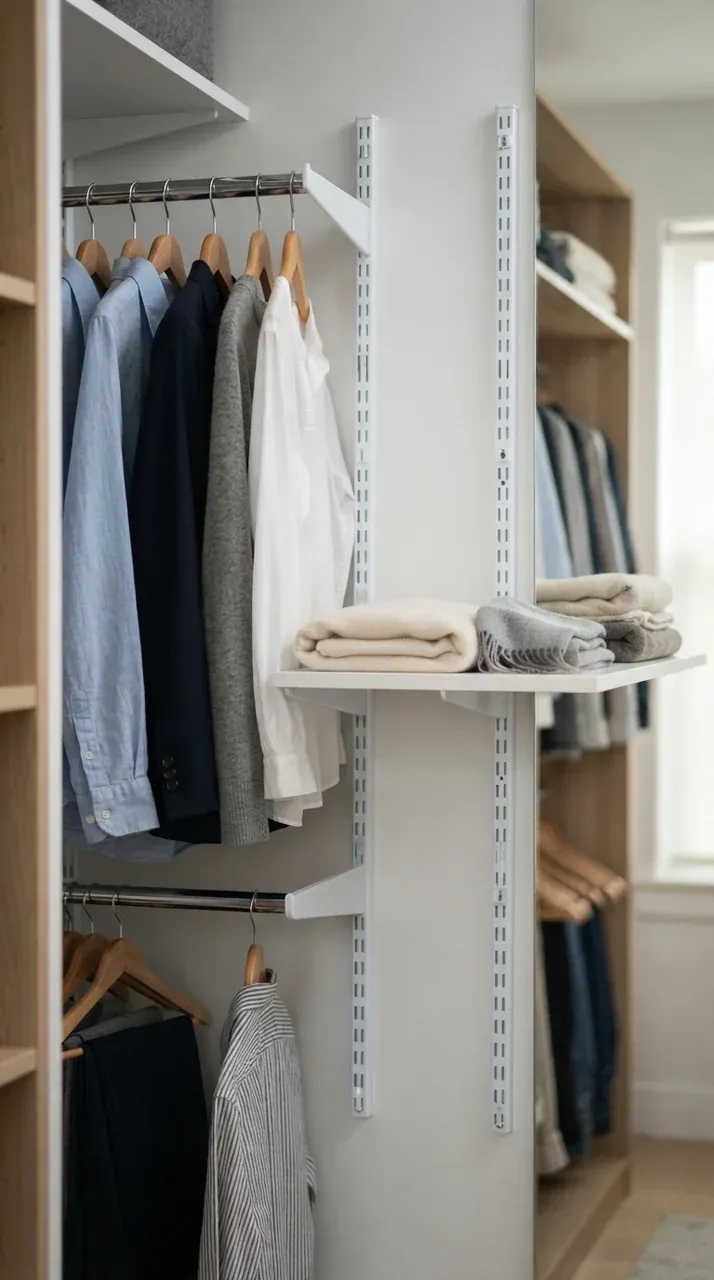
Image: a rail-and-bracket system is the fastest DIY route and the easiest to reconfigure when your needs change.
What Custom Really Buys You
Custom systems are not just nicer shelves. They buy four specific things:
- Fit. Panels are cut to your walls, including the out-of-square corners that force filler strips in a kit.
- Full height. Custom runs to 84 inches or higher, capturing the top two feet that most kits leave empty.
- Drawers and interior fittings. Pull-out trays, angled shoe shelves, and jewelry inserts are hard to build well by hand.
- A finished look. Concealed fasteners, matched edge banding, and consistent reveals are what make a closet read as cabinetry.
What custom does not buy you is flexibility. Once it is installed, changing the layout means new panels.
Installation Difficulty, Honestly Rated
| Task | DIY difficulty | Time | Common failure |
|---|---|---|---|
| Wire shelf on brackets | Easy | 2-4 hrs | Anchors pulled out of drywall |
| Melamine on a wall rail | Moderate | 4-6 hrs | Rail not level, shelves slope |
| Solid wood shelves with face frame | Hard | 8-12 hrs | Miters and gaps at the wall |
| Corner drawer tower | Hard | 6-10 hrs | Drawers rack because the box is out of square |
| Full custom install | Not DIY | 1-2 days | N/A — hire it |
The recurring failure in every DIY closet is anchoring. A loaded shelf is heavy, and drywall anchors are not enough. Find the studs, use them, and add a cleat where you cannot.
A second recurring failure is level. Check the rail with a level in both directions, and check it again after the first shelf goes on. A shelf that slopes a quarter inch over four feet will shed folded clothes onto the floor.
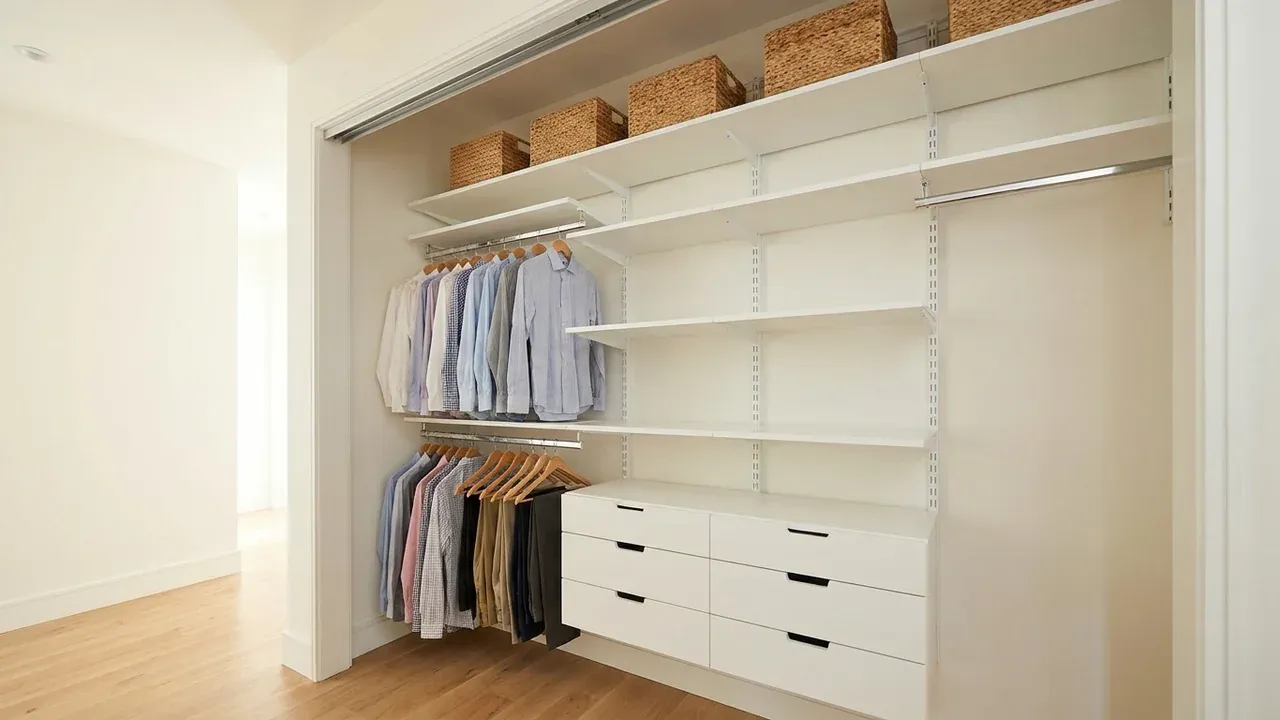
Image: drawers and angled shoe shelves are the fittings that are genuinely hard to build well by hand.
The Break-Even Rule
Apply this in order. Stop at the first “custom” answer.
- Are you renting, or moving within three years? DIY. You will not recover the cost.
- Is this a guest room, kids’ room, or secondary closet? DIY. Function is enough.
- Is this the only closet in the primary bedroom? Custom, or a hybrid.
- Are the walls badly out of square, or is the closet an odd shape? Custom. Kits will fight you.
- Do you plan to stay five years or more? Custom. The daily improvement compounds.
If you answered DIY to everything, spend the savings on lighting and a good rail system. Those two upgrades close most of the perceived gap between DIY and custom.
What the Money Actually Buys Per Linear Foot
Breaking the comparison down by linear foot makes the gap easier to judge.
| Item | DIY per linear ft | Custom per linear ft |
|---|---|---|
| Hanging section | $25-$60 | $120-$260 |
| Shelf section | $30-$70 | $100-$220 |
| Drawer bank (per drawer) | $40-$90 | $150-$350 |
| Top shelf | $20-$45 | $70-$140 |
| Lighting | $15-$30 | $25-$50 |
A 6-foot reach-in with two hanging sections, four shelves, and a top shelf lands around 12 to 14 linear feet of storage. At DIY rates that is a few hundred dollars; at custom rates it is comfortably four figures. The per-foot view also shows where custom costs the most: drawers. If your plan is mostly hanging and shelves, the custom premium buys less than you think.
Lead Time and Disruption
Cost gets the attention, but time is the constraint that actually derails projects.
- DIY: materials today, install this weekend, done. The closet is unusable for a few hours, not a few days.
- Custom: four to ten weeks from order to install in most markets, longer for painted finishes and busy seasons. Install itself is one to two days, but the closet is empty and unusable for that stretch.
If the closet is your only bedroom storage, plan the custom route around a temporary rack and a clear two-week window. If you are replacing DIY shelving, the swap can happen in an afternoon and you can live out of laundry baskets for one night.
Resale Value, Without the Hype
Closet systems are usually described as adding value. The honest version is narrower.
- Primary bedroom: a fitted closet removes an objection and photographs well. That is worth real money at sale, but it is a marketing advantage rather than a line-item return.
- Secondary bedrooms: buyers expect a rod and a shelf. Upgrading beyond that rarely changes an offer.
- Rentals: no return at all. Do the minimum, and do it well enough that you get the deposit back.
Remodeling cost data generally puts closet projects well below the recovery rates of kitchens and baths. Treat a custom closet as a quality-of-life purchase that happens to help at sale, not as an investment.
The Hybrid Option Most People Should Pick
The best value in closet storage is usually a mix:
- DIY rail-and-shelf on the long wall for hanging and folded stacks.
- A semi-custom or modular drawer tower in the corner where drawers matter.
- A full-width top shelf at 84 inches, cut to fit, with a filler panel at each end.
- LED strip lighting under the top shelf.
That combination typically lands between $500 and $1,200 for a reach-in — closer to DIY on cost, closer to custom on function. It also keeps the parts you are most likely to change (shelves) easy to change.
For kit options that fit this approach, see our affordable closet organization systems guide and the narrow closet organizer kits roundup. The IKEA PAX hack for a high-end look is the best-known version of the hybrid idea, and our IKEA versus custom comparison covers the middle of the market.
Where to Spend and Where to Save
Spend on: the rail or bracket system, solid shelf boards, and lighting. These are structural and hard to change.
Save on: bins, labels, and decorative accessories. They are easy to upgrade one at a time.
A budget-friendly supplement
Costway’s storage and organization range includes stackable bins, foldable baskets, and closet organizers at factory-direct prices. Affiliate link: we may earn a commission at no extra cost to you. Measure first, and buy one sample before committing to a matching set.
Bottom Line
DIY shelving wins on cost and speed, custom wins on fit and finish, and the honest answer for most closets is a hybrid: DIY structure, one good drawer tower, and lighting.
Use the break-even rule before you request a quote. If you are staying five years or more and the closet is the only storage in the primary bedroom, custom is worth it. Otherwise, put the difference into a better rail, solid shelves, and light — and keep the option to change your mind.
Shop Entryway Furniture & Storage Deals on Costway
Factory-direct pricing on entryway benches, shoe cabinets, hall trees, and organizers with fast, free US delivery.
* Affiliate disclosure: We may earn a commission if you shop through this link at no added cost to you.
Check Costway Entryway DealsFrequently Asked Questions
Is a custom closet worth the money over DIY shelving?
It depends on how long you stay and how bad the closet is. Custom pays back when the closet is the only storage in a primary bedroom, the walls are out of square, or you plan to stay five years or more. For a rental, a guest room, or a closet you will replace, DIY shelving delivers most of the function for a fraction of the cost.
How much does DIY closet shelving cost?
Materials for a 6-foot reach-in typically run $150-$600 depending on whether you use wire, melamine, or solid wood. Add $50-$150 for brackets, anchors, rods, and paint. Tools are the hidden cost if you do not already own a level, a stud finder, and a saw.
How long does it take to install DIY closet shelving?
A single-wall wire or melamine system takes four to six hours for a confident DIYer. A three-wall layout with drawers takes a full weekend. Custom installation is usually a one- or two-day job for a crew, plus four to ten weeks of lead time before that.
Does a custom closet add resale value?
It helps in a primary bedroom, where buyers expect functional storage, but it rarely returns its full cost. Think of it as a selling advantage rather than an investment. A clean, well-lit, fully fitted closet makes a bedroom photograph better and removes an objection, which is worth more than the line-item cost.
Can I mix custom and DIY in one closet?
Yes, and it is often the smartest option. Use a DIY rail-and-shelf system on the long wall and a custom or semi-custom drawer tower in the corner. You get the structural savings of DIY and the finished look where it shows, at roughly half the cost of a full custom build.