
7 Closet Systems Similar to IKEA PAX (Affordable to High-End)
Seven closet systems like IKEA PAX, from budget frames to custom installs. Compare depth, adjustability, and installation difficulty before you commit.
Published · Linda Wise
7 min readLast updated: November 8, 2026 | Reviewed by: Linda Wise, managing editor
IKEA PAX became the default closet answer for a simple reason: it is a framed box you can configure, it comes in several sizes, and it costs far less than a built-in. It is also not the only option, and for some closets it is the wrong one.
The real decision is not brand versus brand. It is framed box versus wall-hung rail. Those two families behave differently in a closet, fit differently, and fail differently. Everything else, including price, follows from that choice.
This guide compares seven systems that occupy the same territory as PAX, from flat-pack frames to custom installs, and explains which closet geometry suits each one.
Start With the Numbers PAX Actually Uses
Before comparing alternatives, know what you are comparing against. IKEA documents PAX frames at roughly these dimensions:
- Depths: about 13 3/4 inches and 22 7/8 inches
- Heights: about 79 1/4 inches, 90 1/8 inches, and 93 1/8 inches
- Widths: about 19 5/8 inches, 29 1/2 inches, and 39 3/8 inches
Those figures matter because they set the fit envelope. A 22 7/8-inch frame is deep enough for a full-depth hanging rod and folded storage behind it, but it eats a lot of a narrow reach-in closet. The 13 3/4-inch frame suits a shallow closet or the back wall of a walk-in.
Check the current product page for the exact combination you plan to buy, because IKEA revises its range periodically and the figures above are the documented ones at the time of writing.
The Two Families, and Why the Distinction Matters
Framed systems
A framed system is a box: two sides, a back, a top, and a bottom, with interior fittings hung inside it. PAX is a framed system. So are PLATSA and most flat-pack wardrobes.
Strengths: freestanding, so they do not depend on wall structure; they hide their own contents behind doors; they tolerate uneven walls because the frame squares itself.
Weaknesses: the frame consumes interior volume, the back panel limits depth, and you cannot easily change the outer dimensions later.
Wall-hung rail systems
A rail system screws a horizontal standard to the wall and hangs brackets, shelves, and rods from it. Elfa, ClosetMaid, and FreedomRail work this way.
Strengths: maximum usable depth, because there is no frame or back panel; shelves move in increments; you can reconfigure without buying new boxes.
Weaknesses: they depend entirely on wall structure and fixing quality; they show their contents; and they look unfinished without doors or a valance.
If your closet wall is plaster over lath, or masonry, the framed family is usually the safer call. If it is drywall with accessible studs, the rail family gives you more storage per cubic foot.
The Seven Systems Compared
| System | Family | Flexibility | Install difficulty | Best for |
|---|---|---|---|---|
| IKEA PLATSA | Framed, flat-pack | Medium | Low | Budget replacement for PAX in tight rooms |
| IKEA BOAXEL | Wall-hung rail | High | Low to medium | Open, adjustable storage on a budget |
| Elfa Classic | Wall-hung rail | Very high | Medium | Long-term reconfigurable closets |
| ClosetMaid SuiteSymphony | Hybrid, wall-hung | High | Medium | Reach-in closets with a mix of hang and shelf |
| FreedomRail | Wall-hung rail | Very high | Medium | Adjustability with a more finished look |
| EasyClosets | Cut-to-fit modular | High | Medium to high | Odd dimensions and full-height runs |
| Custom installer | Bespoke | Fixed | Professional | Awkward geometry, high-end finish |
1. IKEA PLATSA
The nearest thing to a PAX substitute in the same store. PLATSA uses smaller modules and a lighter frame, which makes it easier to fit into a bedroom or a hallway rather than a dedicated closet. Depth is shallower than the deep PAX frame, so it suits folded storage and short hanging better than full-length coats.
Choose it when you want PAX logic in a space too small for a PAX run, and accept the narrower module range.
2. IKEA BOAXEL
An open wall-hung system on a bracket-and-rail principle. It is cheap, adjustable, and completely visible, which is either the point or the dealbreaker depending on the closet.
Choose it for a walk-in where you want to see everything, or for a utility closet where doors are unnecessary. Skip it if the closet is in a bedroom and you want a clean wall.
3. Elfa Classic
The reference standard for wall-hung adjustability. The top rail carries the load, brackets clip on, and shelves and rods reposition without tools in most configurations. It costs more than flat-pack but survives reconfiguration, which is the argument for it.
Choose it if you plan to stay in the home and expect your storage needs to change.
4. ClosetMaid SuiteSymphony
A hybrid: wall-hung, but with enough trim and panel options to read as a built-in. It handles the standard reach-in closet well, mixing hanging sections with shelf towers.
Choose it for a primary bedroom reach-in where you want a finished look without a custom price.
5. FreedomRail
A rail system with a more furniture-like finish than most competitors, and components that move without dismantling the run. Our full FreedomRail closet system review covers the hardware in detail.
Choose it if you want rail adjustability and are willing to pay for the finish.
6. EasyClosets
A cut-to-fit modular line ordered by dimension rather than by fixed module. That makes it the best answer for a closet that is 3 inches too wide for a standard run.
Choose it when standard modules leave an awkward gap you cannot hide with filler panels.
7. Custom installer
Bespoke millwork, measured and built for the space. It is the only option that handles a sloped ceiling, an offset door, or a chimney breast cleanly.
Choose it when the geometry is genuinely difficult, or when the closet is a visible part of the room. Our modular versus bespoke comparison lays out the cost and timeline trade-off honestly.
What These Systems Cost, in Bands
Exact prices move too often to quote, and a figure from a blog post is usually wrong by the time you read it. What holds up is the shape of the market.
- Budget band: flat-pack frames and basic rail kits. This is where PAX and PLATSA sit, and where most of the house-brand rail systems compete.
- Mid band: branded rail systems with a wider component range and better hardware. You are paying for adjustability and finish, not for more storage.
- Premium band: cut-to-fit modular lines and rail systems with furniture-grade components.
- Custom band: measured, built, and installed. Expect a multiple of the mid band, and expect a lead time measured in weeks rather than a weekend.
The hidden cost in every band is the extras: doors, drawers, lighting, filler panels, and installation. A budget frame with doors and drawers can land close to a mid-band rail system, so price the full configuration rather than the frame.
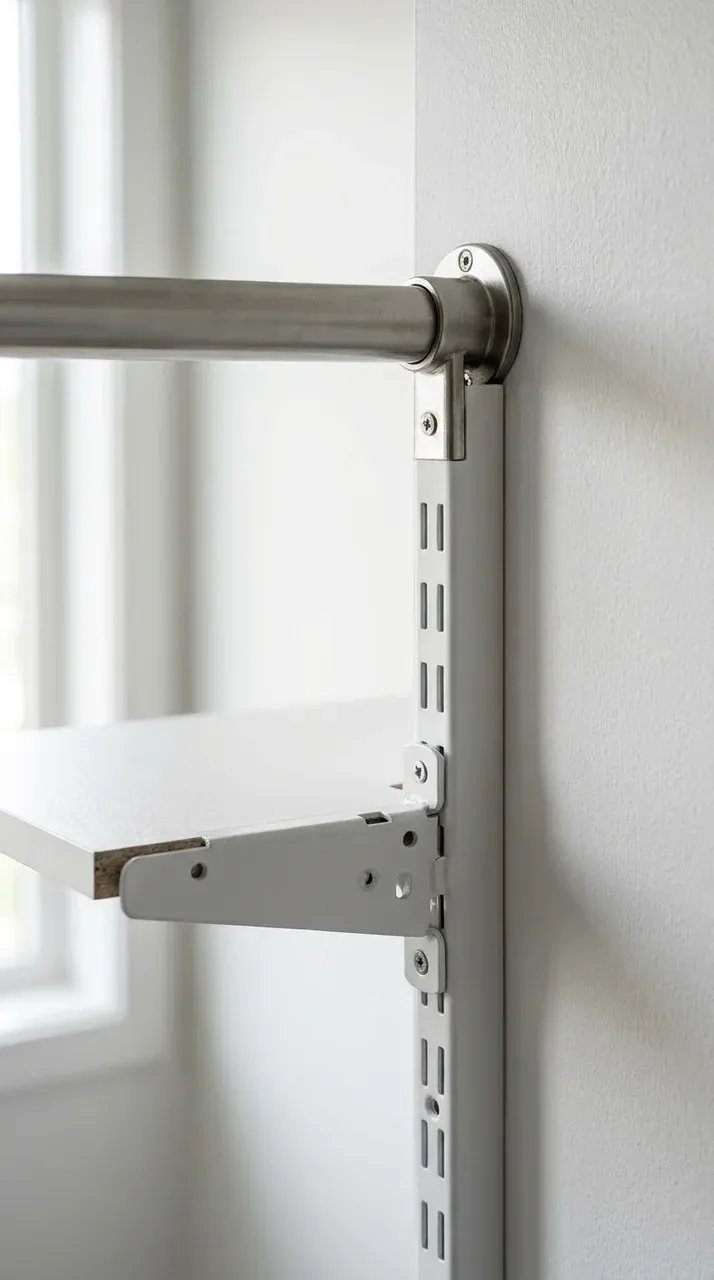
Image: a rail system gives more usable depth than a framed box because there is no back panel.
Match the System to Your Closet Geometry
Use this sequence to narrow the list quickly.
- Measure clear depth from the back wall to the inside face of the door. Under 20 inches, favor a shallow frame or a rail system.
- Measure clear width and divide by your preferred module width. A remainder under 4 inches is hard to hide without a filler panel.
- Check the wall structure. Drywall with studs suits rail systems. Plaster, masonry, or a shared wall may push you to a framed unit.
- Decide whether you want doors. Doors require a frame or a rail-mounted door track, and they add cost and depth.
- Decide your reconfiguration horizon. If you will rearrange in two years, pay for adjustability now.
Where PAX Still Wins, and Where It Does Not
PAX wins on price per cubic foot, on the breadth of interior fittings, and on the fact that you can see and touch it before buying. It also wins on doors, because the door range is unusually wide for the money.
PAX loses on awkward geometry. A deep frame in a narrow reach-in closet leaves you unable to open the door fully, and the fixed outer dimensions mean a 3-inch gap becomes a filler panel problem. It also loses on long-term adjustability, because moving a shelf inside a frame is a bigger job than moving a bracket on a rail.
If you want the PAX look with a more built-in feel, the tricks in our IKEA PAX hack guide cover trim, lighting, and filler panels. For a genuinely narrow closet, start with our narrow closet organizer kits instead.
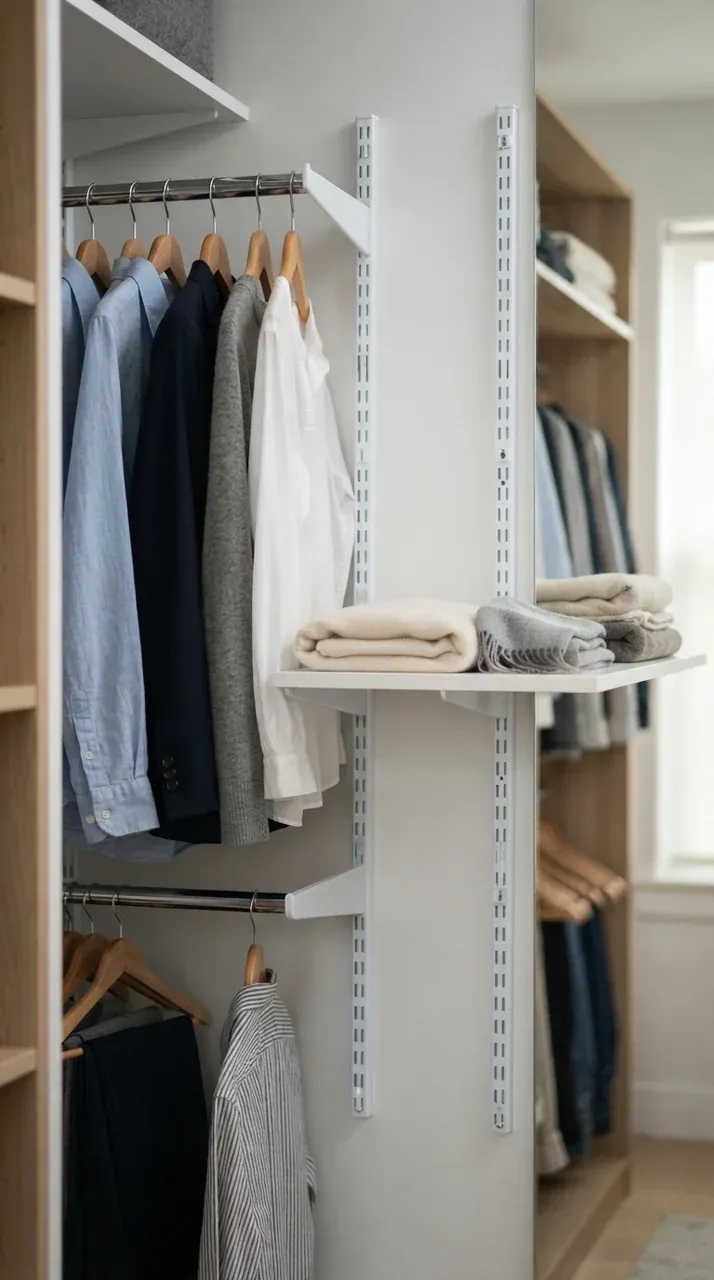
Image: filler panels and consistent shelf spacing hide the gap between standard modules and an odd wall.
A budget-friendly supplement
Costway’s storage and organization range includes stackable bins, foldable baskets, and closet organizers at factory-direct prices. Affiliate link: we may earn a commission at no extra cost to you. Measure first, and buy one sample before committing to a matching set.
Bottom Line
If your closet is a standard rectangle with drywall walls, a wall-hung rail system such as Elfa, ClosetMaid, or FreedomRail gives you more usable depth and more future flexibility than a framed box. If your closet is shallow, awkward, or you want doors, a framed system like PAX or PLATSA is the practical choice.
Measure clear depth and clear width before you compare prices. The system that fits without filler panels is almost always the cheaper one once you count the extras.
Shop Entryway Furniture & Storage Deals on Costway
Factory-direct pricing on entryway benches, shoe cabinets, hall trees, and organizers with fast, free US delivery.
* Affiliate disclosure: We may earn a commission if you shop through this link at no added cost to you.
Check Costway Entryway DealsFrequently Asked Questions
What is the closest alternative to IKEA PAX?
IKEA PLATSA is the closest match in construction and price, since it uses the same framed flat-pack logic with a smaller module range. If you want more adjustability, Elfa and ClosetMaid wall-hung systems let you move shelves and rods without rebuilding the frame.
Is PAX deeper than most closet systems?
PAX frames are documented at roughly 13 3/4 inches and 22 7/8 inches deep. Many wall-hung systems sit closer to 14 to 16 inches, so a deep PAX frame can crowd a narrow reach-in closet. Measure the clear depth from the back wall to the door before choosing.
Can I mix PAX with another closet system?
You can mix them in one closet if each system is independently supported, but the finishes and trim rarely match closely enough to look intentional. A cleaner approach is to use one framed system for the main run and a wall-hung rail system on a secondary wall.
Are custom closet systems worth the extra cost over PAX?
They are worth it when your closet has awkward geometry such as a sloped ceiling, an offset door, or a chimney breast. For a standard rectangular reach-in closet, a modular system delivers most of the function at a fraction of the price.
How much weight can a PAX frame hold?
IKEA publishes load information per shelf and per rod on the product page, and the figures differ by width and depth. Always check the current specification for the exact combination you are buying, and anchor tall frames to the wall as instructed.