
Big Box vs. Designer Closet Systems: Worth the Upgrade?
Big box store vs. designer closet systems: the real cost gap, the material and hardware differences, and when the luxury upgrade actually pays you back.
Published · Linda Wise
8 min readLast updated: November 8, 2026 | Reviewed by: Linda Wise, managing editor
A $600 closet kit from a home center and a $6,000 designer closet can hold the same number of shirts. That single fact makes the upgrade question harder than the showroom wants it to be.
The difference is rarely capacity. It is the thickness of the shelf, the way the drawers still glide in year eight, whether the panels were cut to your wall’s actual out-of-square measurements, and who answers the phone when a bracket pulls out of drywall.
Here is how to tell which of those differences you will actually feel every morning, and which ones you are paying for because the brochure was beautiful.
What “Designer” Actually Means
“Designer closet” is not a regulated term. In practice it describes one of three very different products:
- A dealer-installed custom system from a national brand, measured on site, cut to your walls, and installed by the company’s own crew.
- A local millwork built-in, fabricated from plywood or melamine in a shop and finished on site.
- A premium modular line sold through a showroom but assembled from standard components in standard widths.
Only the first two are truly custom. The third is a better-finished version of the same idea you can buy off a shelf, with a designer’s name attached to the layout. Ask which one you are being quoted. The price spread between them is large, and the installation difference is larger.
The Real Cost Gap
The figures below are planning bands for a standard 6-foot reach-in closet, as of 2026, in most US markets. Custom quotes vary widely by region, wall condition, and material, so treat these as ranges to budget against rather than quotes.
| Option | Typical installed cost | Who installs | Lead time |
|---|---|---|---|
| Big box kit, self-install | $300-$900 | You | Same day |
| Big box kit, pro install | $700-$1,600 | Handyman or retailer service | 1-3 weeks |
| Premium modular (showroom) | $1,800-$4,500 | Dealer crew | 3-6 weeks |
| Dealer custom built-in | $3,500-$8,000 | Dealer crew | 6-10 weeks |
| Local millwork custom | $4,000-$12,000+ | Carpenter or shop | 6-12 weeks |
Going from a $600 kit to a $6,000 built-in is roughly ten times the money for perhaps 30 percent more usable storage. The other 70 percent of that check buys fit, finish, and someone else holding the level.
Where Big Box Systems Win
A kit from ClosetMaid, Rubbermaid, IKEA, or a home center house brand is not a compromise you settle for. In several situations it is the correct answer.
- Rentals and short horizons. If you might move in three years, you will not recover a built-in’s cost in resale. A rail-and-standard kit comes down and goes with you.
- Guest rooms, kids’ rooms, and utility closets. Low daily use means the hardware never gets stressed. The premium buys durability you will not consume.
- Straight, plumb walls. Most kits fail on crooked walls, not on bad design. If your closet is square, a kit installs cleanly and looks intentional.
- Garages and laundry rooms. Dust, humidity, and utility storage do not reward furniture-grade finishes.
The trade-offs are real but predictable: thinner panel stock, plastic connectors instead of steel brackets, ventilated shelves that look utility-grade, and limited accessory lines. None of those break a closet. They just cap how good it can look.
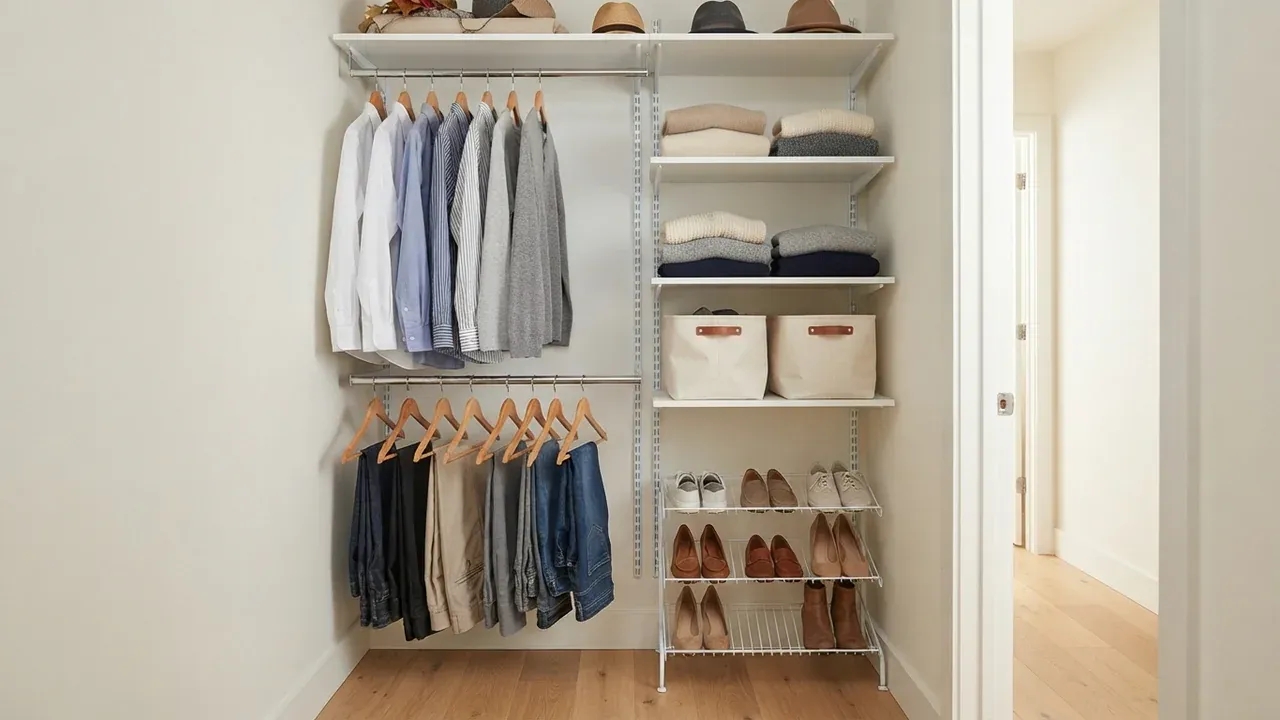 A well-planned kit layout captures most of the function of a custom closet at a fraction of the price.
Where Designer Systems Earn Their Price
The upgrade starts paying for itself in specific, checkable conditions.
- The walls are out of square. Old houses rarely have a true corner. Custom panels are scribed to the actual wall, which is why they look built-in and kits look applied.
- You want drawers, not shelves. Good drawer boxes with rated glides are the single most expensive component in any closet, and the one you touch most.
- The closet is a room. Walk-ins with islands, seating, and lighting are cabinetry projects. A kit will always read as a kit in a 10-foot walk-in.
- You are staying put. Over ten years, a $6,000 system costs about $600 a year. That is defensible for a closet you use twice a day.
- You want one throat to choke. A dealer crew that measures, installs, and warrants the result removes a category of risk.
If two or more of those apply, the upgrade is a rational purchase rather than an indulgence.
Materials and Hardware: The Quiet Difference
This is where the money actually goes, and where showroom conversations tend to stay vague.
| Component | Typical big box | Typical designer |
|---|---|---|
| Panel core | 5/8 in particleboard or MDF | 3/4 in furniture-grade board or plywood |
| Shelf span before sag | 30-36 in | 36-48 in with thicker stock |
| Drawer box | Staple-and-glue, thin sides | Dovetail or doweled, thicker sides |
| Glides | Basic roller, often unrated | Side-mount or undermount, rated for load |
| Edge banding | Thin melamine tape | Thicker banding, sometimes matching wood |
| Adjustability | Fixed shelf pin holes | System holes or fully adjustable |
Ask for the panel thickness and the glide rating in writing. A quote that will not name them is a quote you cannot compare to the next one. Verify any specific claim on the manufacturer’s product page before you rely on it, because specs change between production runs.
Installation Is Half the Product
Two closets with identical components can feel completely different based on who hung them.
- Anchoring. A kit rail screwed into drywall alone will eventually pull. Custom crews anchor to studs and add blocking where needed.
- Level and shim. Out-of-level rods make hangers slide to one end. It is a five-minute fix during install and a two-hour fix afterward.
- Wall repair. Custom installs usually include patching and paint touch-up. Kit installs leave you the holes from the old rod.
- Cleanup and haul-away. Worth roughly the cost of a dump run, and easy to forget when comparing bids.
If you hire out a kit install, ask specifically whether wall repair and haul-away are included. If you install it yourself, budget a full weekend for a reach-in and read our guide to the DIY vs. custom decision before you start cutting.
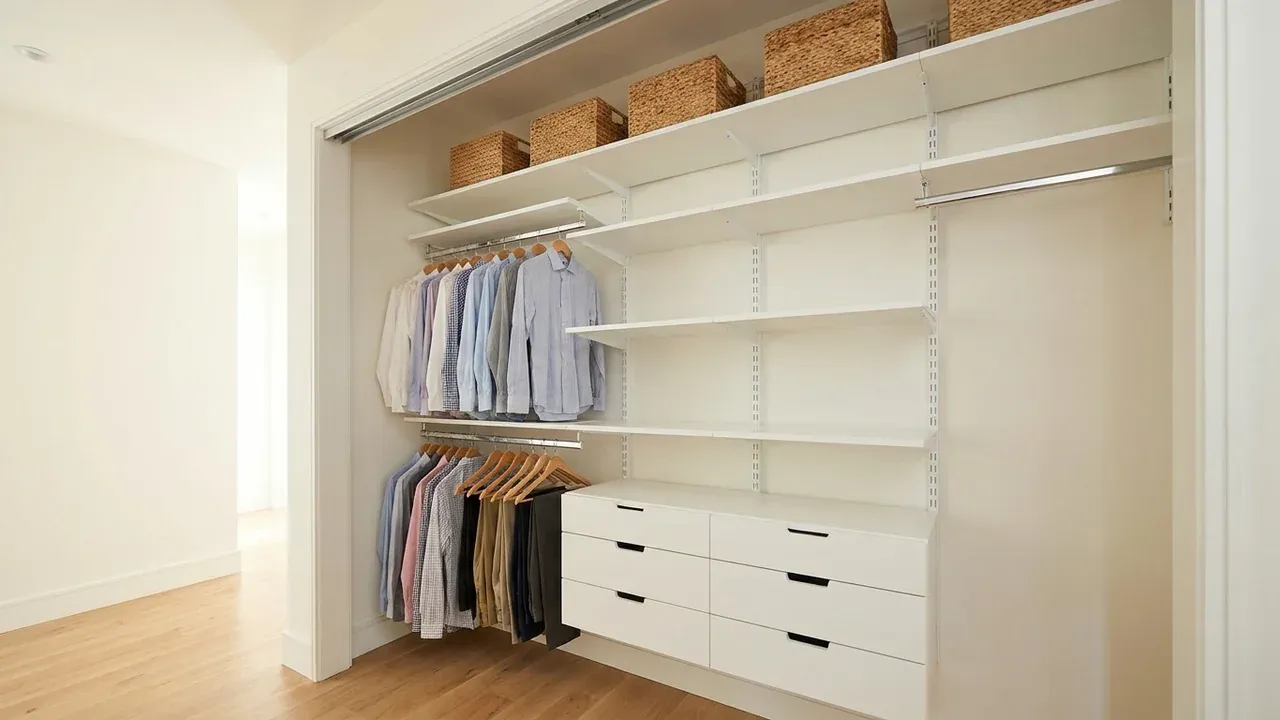 Custom panels scribed to out-of-square walls are the clearest visible difference between a built-in and a kit.
The Ten-Year Math
Run the numbers on cost per year of use rather than sticker price.
- Kit, self-installed at $600, replaced once in ten years: about $120 per year.
- Kit with pro install at $1,200, replaced once: about $240 per year.
- Dealer custom at $6,000, lasting the full ten years: about $600 per year.
The custom closet costs five times more per year. Whether that is worth it depends entirely on how many times a day you open the door and how much the fit bothers you. For a primary walk-in, many homeowners say yes. For a hall closet holding coats and vacuums, almost nobody does.
There is also a resale angle, and it is smaller than dealers imply. A well-organized closet photographs well and reads as cared-for, but buyers rarely pay a premium for a specific brand of shelving. Treat the upgrade as a daily-life purchase, not an investment.
If you want the middle path, a premium modular line like the ones in our FreedomRail review sits between the two extremes and can be reconfigured later. Our breakdown of modular vs. bespoke closets covers where that line falls for different room sizes.
The Middle Path Most People Should Take
The two-option framing is a sales device. In practice, the best value for a primary reach-in is usually a good kit installed properly, with two upgrades.
- Solid shelves instead of ventilated. They look built-in, hold small items, and cost a modest premium over wire.
- A professional install, or a careful DIY one. A level rail into studs is what separates a kit that looks intentional from one that looks improvised.
Add a filler panel at each end wall and the result reads as cabinetry from three feet away. You have spent perhaps $1,200 instead of $6,000 and captured most of the visual gain.
The remaining gap is drawers. If your wardrobe is drawer-heavy, the middle path stops working, because good drawer boxes are the one component kits do not replicate well. That is the honest crossover point between the two categories.
What to Ask Before You Sign
Bring this list to a showroom. The answers tell you more than any brochure.
- “What is the panel thickness and core?” If the answer is vague, the product is commodity board with a markup.
- “Who measures, and what happens if the wall is out of square?” A real custom shop scribes. A modular dealer shims.
- “What glide brand and load rating is included?” Get it in writing.
- “Is wall repair, patching, and haul-away included?” These are real line items, not courtesies.
- “What is the deposit and the lead time?” Typical deposits run 30-50 percent. Full payment upfront is a warning sign.
- “Can I see an installed job, not just a showroom?” Showrooms are staged with perfect walls.
Ask the same six questions of three dealers. The spread in answers, and in price, will be wider than you expect.
A budget-friendly supplement
Costway’s storage and organization range includes stackable bins, foldable baskets, and closet organizers at factory-direct prices. Affiliate link: we may earn a commission at no extra cost to you. Measure first, and buy one sample before committing to a matching set.
Bins and baskets are the right place to economize regardless of which system you choose. They are also the easiest thing to upgrade later, so spend the structural money on rails, shelves, and rods first. If you are still comparing kit options, our list of affordable closet organization systems covers the current field.
Bottom Line
Buy the kit when the walls are straight, the closet is secondary, or your horizon is short. Buy the custom system when the walls are crooked, the closet is a room you use daily, and you plan to stay long enough to amortize it.
What you should never do is pay designer prices for a standard modular line dressed up in a showroom, or expect a $600 kit to look like cabinetry on a wall that was never square. Get two or three local quotes, ask for panel thickness and glide ratings in writing, and let the answers decide.
Shop Entryway Furniture & Storage Deals on Costway
Factory-direct pricing on entryway benches, shoe cabinets, hall trees, and organizers with fast, free US delivery.
* Affiliate disclosure: We may earn a commission if you shop through this link at no added cost to you.
Check Costway Entryway DealsFrequently Asked Questions
Is a designer closet system worth the extra money?
It is worth it when you plan to stay in the home at least seven years and the closet is one you open every day. The premium buys tighter wall fit, better drawer hardware, and installation labor. In a rental, a guest room, or a closet you will renovate again, a well-installed kit delivers most of the function for a fraction of the cost.
How much more storage does a custom closet actually add?
Usually 20 to 35 percent more usable capacity in the same footprint, mostly from double-hang sections, full-height panels, and drawers that replace wasted shelf air space. The gain comes from layout planning, not from the brand. A good kit layout can capture most of it.
Can I install a big box closet system myself?
Yes, if your walls are reasonably straight and you own a stud finder, a level, and a drill. Budget a full weekend for a reach-in. The job goes wrong most often on out-of-square walls, which is exactly the problem a custom system is built to solve.
Why are designer closets so much more expensive?
Three reasons: on-site measurement and custom cutting, thicker panel stock and better hardware, and the labor of a two-person install crew. Dealer overhead and showroom costs add more. Material alone rarely explains a tenfold price gap.
What should I ask before signing a custom closet quote?
Ask what panel thickness and core material are specified, what drawer glide brand and rating is included, whether the price covers wall repair and patching, and what the lead time and deposit terms are. Get two or three local quotes, because the same scope can vary by thousands between dealers.