Hall Tree Vs Shoe Cabinet
Confused between a hall tree and a shoe cabinet? Our deep-dive comparison breaks down storage capacity, footprint, durability, and aesthetics to help you choose the ultimate entryway organizer.
Jul 29, 2026 · Linda Wise
5 min readEntryways are high-traffic battlegrounds. They demand smart design. When you step through the front door, the immediate visual and physical clutter—dripping coats, muddy boots, keys, school bags—requires instant containment. Choose poorly, and your foyer becomes a congested choke point.
The two primary contenders for entryway organization are the hall tree and the shoe cabinet. While both promise to tame the chaos, they approach the problem from completely opposite design philosophies.
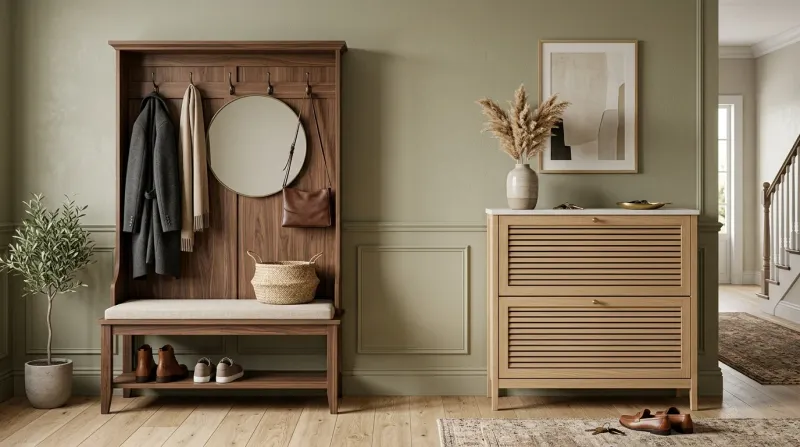
A hall tree is a vertical, multi-functional powerhouse. It combines seating, hanging storage, and open compartments. A shoe cabinet is a specialized, enclosed storage unit. It is engineered with a ultra-slim profile specifically to hide footwear from sight.
Choosing between them requires analyzing your home’s architectural constraints, your family’s daily habits, and the physical characteristics of your gear. This guide breaks down the engineering, spatial footprints, and real-world performance of both storage options so you can make an informed purchase.
Quick Comparison: Top Picks & Benchmarks
Before digging into the structural differences, here is a quick look at three top-rated entryway organizers representing different layout strategies.
| Product | Rating | Check Price |
|---|---|---|
| Vasagle Industrial Hall Tree with Bench | 4.7/5 | Check Price on Amazon |
| YITAHOME 3-Drawer Slim Tipping Shoe Cabinet | 4.5/5 | Check Price on Amazon |
| Tribesigns Large Enclosed Shoe Organizer Cabinet | 4.6/5 | Check Price on Amazon |
Understanding the Fundamentals: Anatomy & Design
To understand which unit fits your home, we must first analyze their structural anatomy. Each piece of furniture is engineered to solve a distinct spatial problem.

What is a Hall Tree?
Historically derived from the Victorian-era “hat stand,” the modern hall tree is an all-in-one storage hub. It relies on vertical integration to maximize utility over a singular footprint.
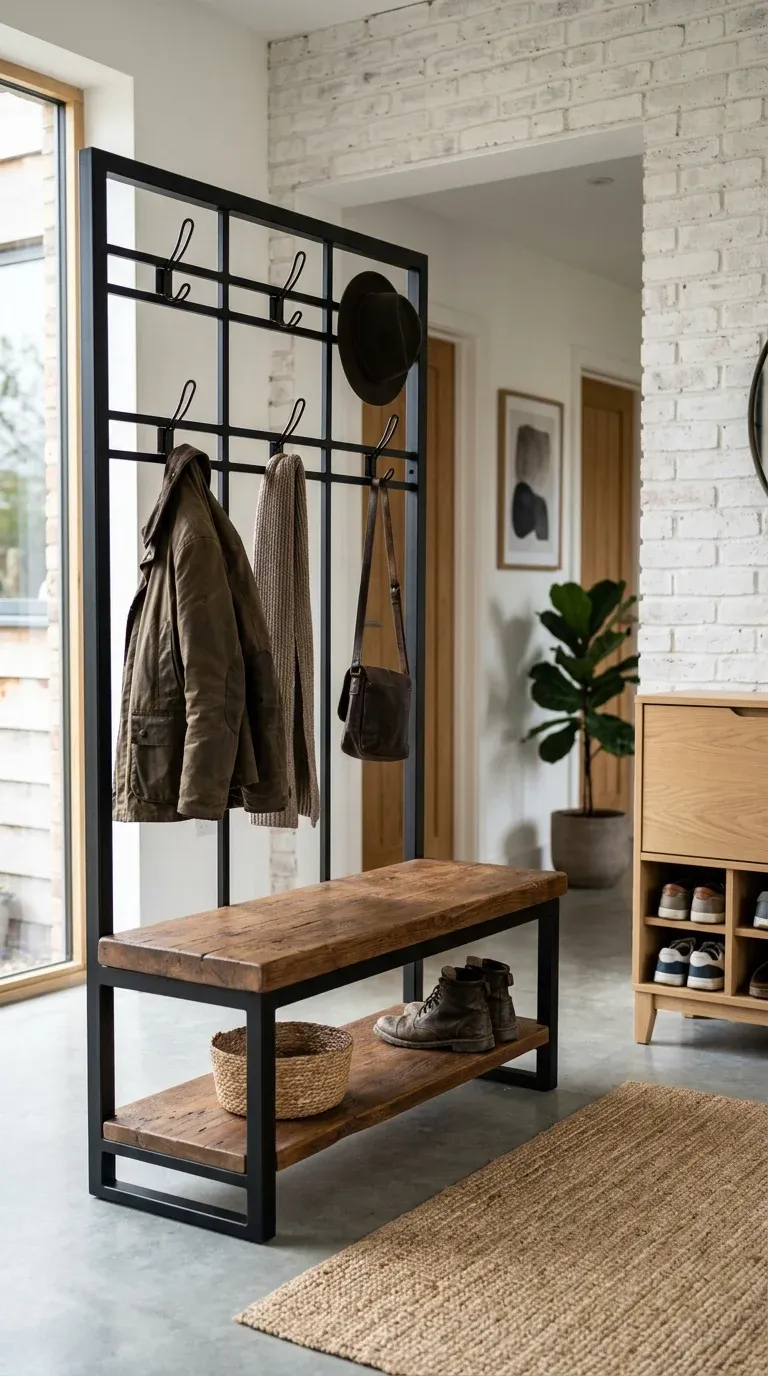
A standard hall tree features several distinct zones:
- The Upper Deck: Often consisting of a top shelf or open cubbies. This zone is designed for seasonal items, storage baskets, or decorative accents.
- The Mid-Section Hooks: Heavy-duty, double-pronged hooks mounted directly into the back panel or a metal rail. They support coats, pet leashes, scarves, and backpacks.
- The Bench Seat: A thick, horizontal platform designed to support human weight. It provides a dedicated spot to sit while putting on or removing shoes.
- The Base Storage: Located directly beneath the bench. This area features open metal wire racks, wooden cubbies, or pull-out drawers for footwear.
The primary design philosophy of a hall tree is accessibility and multifunctionality. Everything is visible and within arm’s reach.
What is a Shoe Cabinet?
The shoe cabinet is built for containment and visual minimalism. Unlike the open architecture of a hall tree, a shoe cabinet utilizes solid doors, drawers, or tipping bins to keep its contents hidden.
There are two primary types of shoe cabinets:
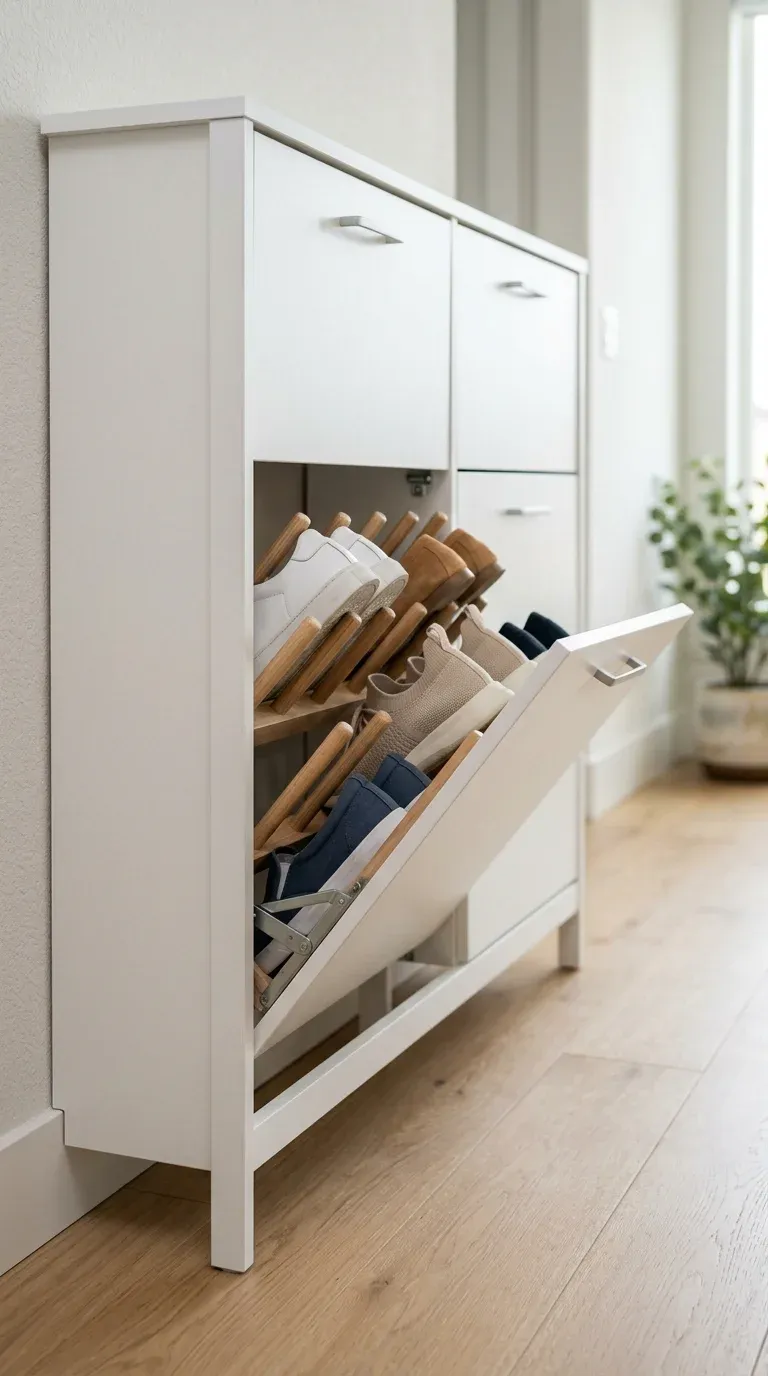
- Tipping Bucket (Drop-Down) Cabinets: These ultra-slim units feature drawers that pivot outward on plastic or metal gears. Shoes are stored vertically inside the door, sliding into pockets. When closed, the cabinet can be as slim as 5.5 to 9 inches deep.
- Standard Enclosed Shelving Cabinets: These resemble traditional sideboards or credenzas. They feature double doors that open to reveal adjustable horizontal or slanted shelves. They require a deeper footprint (typically 12 to 15 inches) but accommodate larger boot sizes and bulky footwear.
The design philosophy of a shoe cabinet is concealment and spatial efficiency. It treats footwear as utility items that should be hidden to maintain a clean aesthetic.

Head-to-Head Comparison Metrics
How do these two furniture pieces perform when subjected to real-world demands? Let’s compare them across five critical performance metrics: spatial footprint, storage capacity, visual clutter, ergonomics, and versatility.
1. Spatial Footprint & Clearance Envelopes
Space is the ultimate constraint in any entryway. You must consider not just the physical dimensions of the furniture, but the “clearance envelope”—the space required to use the unit.
+-----------------------------------------------------------------------+
| SPATIAL FOOTPRINT COMPARISON |
+-----------------------------------------------------------------------+
| |
| HALL TREE (Deep Footprint, Vertical Open Clearance) |
| +-----------------------------+ |
| | Base Depth: 16" - 22" | <--- Requires room for seating |
| | Height: 70" - 78" | |
| | Clearance: Open Front | <--- No swinging doors needed |
| +-----------------------------+ |
| |
| SLIM SHOE CABINET (Shallow Footprint, Frontal Swing Clearance) |
| +-----------------+ |
| | Depth: 6" - 10" | <--- Extremely narrow profile |
| | Height: 40" - 50"| |
| | Drawer Swing: +12" <--- Must account for tipping drawer |
| +-----------------+ |
+-----------------------------------------------------------------------+
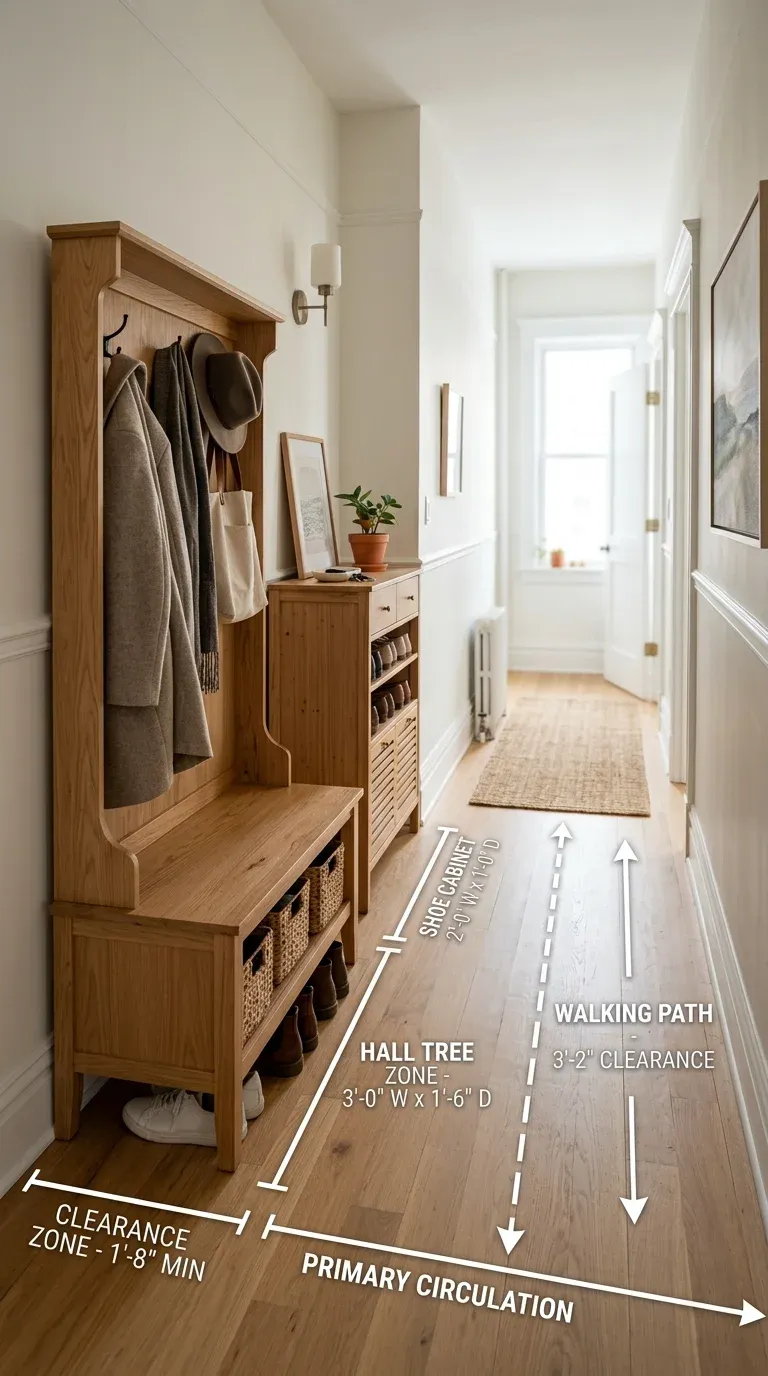
- Hall Trees: A standard hall tree requires a depth of 16 to 22 inches. This depth is structurally necessary to accommodate a human seated on the bench without tipping the unit forward. The height ranges from 70 to 78 inches. While it takes up more floor space, it requires zero door-swing clearance. The front profile remains static.
- Shoe Cabinets: A tipping shoe cabinet is a marvel of space-saving engineering. It can fit into narrow hallways with a depth of just 6 to 10 inches. However, you must factor in the drawer-swing clearance. When a tipping drawer is fully opened, it extends an additional 10 to 14 inches into the walkway. Standard swing-door shoe cabinets require even wider clearance arcs.
Winner for Tight Hallways: Shoe Cabinet
Winner for Wide Foyers/Mudrooms: Hall Tree
2. Storage Capacity & Diversity
What are you actually storing? This is where the difference in utility becomes apparent.
- Hall Trees: Excel at diverse storage. A single unit handles heavy winter coats, school bags, dog leashes, hats, and a moderate collection of shoes (usually 4 to 12 pairs on the bottom rack). If you have a family, the hall tree acts as a centralized drop zone for multiple categories of personal belongings.
- Shoe Cabinets: Excel at high-volume, single-category storage. A standard 3-drawer tipping shoe cabinet can hold anywhere from 12 to 24 pairs of shoes in a tiny footprint. Large enclosed cabinets can hold up to 40 pairs. However, they offer zero accommodation for coats, umbrellas, or bulky backpacks.
Winner for High-Volume Shoes: Shoe Cabinet
Winner for Everyday Gear Diversity: Hall Tree

3. Visual Clutter & Aesthetics
Your entryway sets the tone for your entire home. The visual impact of your storage solution is critical.
- Hall Trees: Use open storage. This is a double-edged sword. While it makes grab-and-go access simple, it puts your clutter on display. If your family hangs mismatched, bulky winter coats and tosses dirty sneakers haphazardly under the bench, the hall tree will look busy. It requires discipline to keep looking organized.
- Shoe Cabinets: Keep everything behind closed doors. Once the doors shut, the visual noise disappears. The top of a shoe cabinet serves as a clean console table. You can style it with a catch-all tray, a mirror, or a lamp.
Winner for Clean Minimalism: Shoe Cabinet
Winner for Casual Accessibility: Hall Tree
4. Ergonomics & Usability
How does the unit feel to use during the morning rush?
- Hall Trees: Offer superior ergonomics. The built-in bench is invaluable for children, elderly family members, or anyone trying to lace up boots. You sit down, pull your shoes from directly beneath you, put them on, grab your coat from the hook above, and walk out. It streamlines your morning routine into a single physical station.
- Shoe Cabinets: Require more bending. To retrieve shoes from a lower drawer, you must bend down. There is no built-in seating, meaning you either need to balance on one foot or place a separate stool nearby.
Winner for Comfort & Usability: Hall Tree
5. Architectural Versatility
Can the furniture adapt to different spaces?
- Hall Trees: Are physically imposing. They require a dedicated wall section with high vertical clearance. They cannot easily fit under low stairs, beneath windows, or in awkward alcoves.
- Shoe Cabinets: Are highly adaptable. Because of their low height (typically 35 to 48 inches), they can sit beneath low windows, slide into tight corners, or line a long, narrow apartment hallway without blocking traffic. For tight corners where square footage is extremely tight, maximizing style in small spaces with corner units can be your best tactical option.
Winner for Versatility: Shoe Cabinet
Architectural, Material & Engineering Breakdown
To ensure your entryway furniture survives years of daily use, you must look closely at its construction. High-traffic zones subject furniture to physical impact, moisture, dirt, and heavy loads.

Wood & Composite Performance
The base materials dictate the life expectancy of your organizer.
- Solid Wood (Oak, Pine, Birch): Offers exceptional durability and structural integrity. Solid wood handles the weight of multiple heavy winter coats and seated adults without bowing. However, it is susceptible to expansion and contraction when exposed to wet coats or muddy boots. Solid wood must be treated with a moisture-resistant polyurethane sealer.
- Medium-Density Fiberboard (MDF) & Particle Board: These materials dominate the budget segment. MDF is highly stable and does not warp like solid wood. However, if moisture penetrates the outer laminate or veneer layer, the underlying fibers will swell, crumble, and lose structural integrity. Look for high-density MDF with sealed edges to protect against wet footwear.
- Powder-Coated Steel Frames: Often paired with engineered wood elements in industrial-style hall trees. Steel provides incredible structural strength, preventing the tall frame from swaying or racking under uneven weight loads.
Field Note on Weight Capacities:
When purchasing a hall tree, check the rated capacity of the bench and hooks. A high-quality hall tree bench should support at least 250 to 300 lbs. Each hook should be rated for a minimum of 15 to 20 lbs to handle heavy winter coats or loaded school bags. If the manufacturer does not list these weight ratings, the unit likely uses cheap, low-density particle board with weak fastening points.
Hardware & Joint Integrity
The longevity of a shoe cabinet or hall tree often comes down to its moving parts.
- Tipping Drawer Pivot Gears: In slim shoe cabinets, the drawers rotate on pivot brackets. Cheap cabinets use thin plastic brackets that can crack under the weight of heavy work boots or high heels. Look for units that use heavy-duty nylon or cast-metal pivot hardware to ensure smooth, long-term operation.
- Hinges: If choosing a swing-door cabinet, prioritize 3-way adjustable soft-close European hinges. These hinges allow you to realign the doors if the cabinet settles on an uneven floor, and they prevent the doors from slamming shut.
- Joint Construction: Avoid units held together solely by standard wood screws driven directly into particle board. Instead, look for dowel-and-cam-lock assembly, reinforced corner blocks, or metal-to-metal barrel nut connections. These joints distribute weight more evenly and resist loosening over time.
Ventilation & Moisture Management
Footwear traps moisture and odors. How your furniture manages this environment is a critical health and sanitation concern.
- The Hall Tree Approach: Open air is the best natural deodorizer. Because shoes on a hall tree sit on open metal grates or slatted wooden shelves, they benefit from constant air circulation. Wet shoes dry quickly, reducing the risk of mold, mildew, and bacteria growth.
- The Shoe Cabinet Approach: Enclosing shoes in a dark, airtight space is a recipe for odor buildup and mold. High-quality shoe cabinets solve this by integrating slatted doors, mesh panels, or back-panel ventilation cutouts. If you choose an enclosed cabinet, make sure it has adequate venting to allow moisture to escape.

Detailed Product Spotlights
To help ground these technical specifications, let’s examine three top-performing products that represent different entryway design strategies.
1. The Industrial Heavyweight: Vasagle Industrial Hall Tree
This unit represents the pinnacle of modern open-concept entryway storage. It is built for busy households that need maximum utility and structural durability.
- Design & Materials: Constructed with a rigid, powder-coated steel frame and thick, rustic engineered wood panels. The combination of metal and wood gives it an industrial look that hides minor wear and tear well.
- Storage Features: It features 9 robust, adjustable metal hooks, a spacious bench, and two open mesh wire shoe shelves. The mesh shelves are ideal because they allow dirt, dried mud, and water to fall through to the floor for easy cleaning.
- Pros: High weight capacity (bench supports up to 176 lbs on older models, up to 220 lbs on upgraded versions); excellent air circulation; highly customizable hook placement.
- Cons: Open design means all clutter is fully visible; requires a larger depth footprint (approx. 12.6” x 27.5” x 68.9”).
- Best For: Active families, mudrooms, and open-plan foyers that need an all-in-one storage hub.
2. The Space-Saving Specialist: YITAHOME 3-Drawer Slim Shoe Cabinet
This tipping-drawer cabinet is engineered specifically for narrow corridors, small apartments, or minimalist entryways where floor space is at a premium.
- Design & Materials: Made of high-grade MDF with a durable melamine finish that resists light water damage and scratches. It features three tipping drawers with a sleek, hardware-free facade that uses integrated finger pulls.
- Storage Features: Three tipping compartments with adjustable internal dividers. By removing or adjusting the dividers, you can accommodate flats, sneakers, or high heels.
- Pros: Extremely slim profile (less than 10 inches deep); hides all footwear clutter; top surface acts as a functional console table for keys and decor.
- Cons: Cannot accommodate tall boots unless you remove structural dividers (which reduces overall capacity); no coat hooks or seating; must be anchored to the wall to prevent tipping.
- Best For: Urban apartments, narrow hallways, and minimalist homes with limited entryway floor space.
3. The Enclosed Hybrid: Tribesigns Large Enclosed Shoe Cabinet
For those who want the high capacity of a shoe cabinet but have the space for a more substantial piece of furniture, this large enclosed cabinet offers a premium solution.
- Design & Materials: Built with thick particle board panels and solid metal legs. It features a stylish geometric door design that elevates the look of any foyer.
- Storage Features: Behind the double doors lie multiple adjustable shelves capable of holding up to 24 pairs of shoes. The top surface is spacious enough for mail organizers, decorative lamps, or framed photos.
- Pros: Massive, enclosed storage capacity; accommodates taller boots and boxes thanks to adjustable shelving; high-end furniture aesthetic.
- Cons: Takes up a larger footprint (13.7” deep); no integrated seating or coat hooks; requires careful assembly to ensure door alignment.
- Best For: Dedicated shoe collectors, larger families, and formal entryways where clean, hidden storage is the top priority.
Installation, Assembly & Safety Protocols
Both furniture types require careful assembly and installation to ensure they remain safe and stable over years of use.

Anti-Tip Safety: A Non-Negotiable Step
Because of their height and narrow depth, both tall hall trees and slim shoe cabinets present serious tip-over hazards, especially in homes with children or pets.
- For Shoe Cabinets: When you open multiple tipping drawers loaded with heavy shoes, the center of gravity shifts forward. Without proper wall anchoring, the entire unit can tip over.
- For Hall Trees: Pulling a heavy winter coat from a top hook or sitting down on the bench can destabilize the frame.
Safety Standard:
Always install the included anti-tip kit. This kit typically consists of a nylon strap or metal L-bracket that anchors the furniture directly to a wall stud. If a stud is not available, use high-quality heavy-duty drywall toggles (such as Snaptoggles) rather than cheap plastic wall anchors.
Assembly Complexity & Common Pitfalls
Most flat-pack entryway furniture requires home assembly. Understanding what you are getting into can save hours of frustration.
- Cam-Lock Systems: Most budget and mid-tier units rely on cam-lock fasteners. The most common assembly error is over-tightening these fasteners, which can strip the pre-drilled holes in particle board. Tighten them by hand until snug; avoid using an impact driver.
- Door and Drawer Alignment: Cabinet doors and tipping drawers require precise alignment. If your floor is slightly uneven, the doors may look crooked or rub against the frame. Use the adjustment screws on the European hinges to adjust the door alignment along the X, Y, and Z axes.
- Squaring the Frame: During assembly, ensure the main frame is perfectly square before nailing or screwing on the thin back panel. A frame that is out-of-square by even a fraction of an inch will cause drawers to stick and doors to sag.
Buyer’s Evaluation Framework
To help you choose the right option for your home, ask yourself these five diagnostic questions:

1. What is the exact width and depth of your entryway?
Measure your space carefully. If your entryway is a narrow corridor less than 4 feet wide, a standard 18-inch deep hall tree will choke the walkway and block the flow of traffic.
Choose a slim tipping shoe cabinet instead. If you have a wide, open foyer or a dedicated mudroom, a large hall tree will fill the space beautifully and provide much-needed utility.
2. What are you storing?
Take an inventory of your daily gear. If you are struggling with a mountain of footwear and have a separate closet for coats, a shoe cabinet is the logical choice.
However, if your coats, dog leashes, work bags, and keys are currently scattered across dining chairs and kitchen counters, you need the multi-functional organization of a hall tree.
3. Who is using the space?
Consider the physical needs of your household. Families with young children or elderly relatives benefit immensely from a hall tree’s bench. It provides a safe, comfortable spot to sit and put on shoes, and low hooks allow kids to hang up their own backpacks.
If your household consists primarily of adults who don’t mind bending down or balancing to put on shoes, a shoe cabinet is a highly efficient choice.
4. What is your tolerance for visual clutter?
Be honest about your organizational habits. If you appreciate a clean, minimalist, showroom-like home, an open hall tree loaded with colorful coats and dirty shoes will likely stress you out.
An enclosed shoe cabinet keeps everything neatly hidden behind solid doors, preserving a clean, calm entry space.
5. What is your existing decor style?
Your choice should harmonize with your home’s architectural style.
- Industrial, Rustic, or Farmhouse: These styles pair naturally with the open metal frames and weathered wood finishes of modern hall trees. If you prefer rustic or cottage-inspired designs, checking out 7 stunning farmhouse hall trees can spark ideas on integrating weathered wood textures.
- Modern, Minimalist, or Mid-Century Modern: These styles are well-suited to the clean, handle-free facades and geometric lines of slim shoe cabinets. Matching your existing paint tones requires careful selection; we cover this in our manual on choosing the right color and finish for your entryway furniture.
Maintenance, Longevity & Lifecycle Care
To protect your investment and keep your entryway organizer looking pristine, establish a regular maintenance routine.

Moisture Mitigation
Moisture is the primary enemy of both wood and metal entryway furniture.
- For Hall Trees: Never hang soaking wet coats directly on hooks mounted to an MDF backboard. Let wet outerwear drip-dry in the shower or on a separate rack before placing them on the wood-backed hooks. Use a plastic boot tray under the shoe rack to catch melting snow and rainwater.
- For Shoe Cabinets: Never place damp, sweaty, or muddy shoes directly into a closed drawer. Let them dry and air out on a mat for at least a few hours first. This simple step prevents wood swelling, mold growth, and unpleasant odors inside the cabinet.
Regular Cleaning Routines
- Dusting and Wiping: Dust surfaces weekly with a soft, dry microfiber cloth. For deeper cleaning, use a damp cloth with a mild dish soap solution, then immediately dry the surface with a clean towel. Avoid harsh chemical cleaners, polishers, or abrasive pads, which can dull or scratch the finish.
- Caring for Wood Veneer: If your unit has a natural wood veneer, apply a high-quality furniture wax once or twice a year to maintain its luster and add an extra layer of protection against moisture.
- Cleaning Metal Frames: For hall trees with steel frames, wipe down the metal elements occasionally with a damp cloth to remove salt and dirt carried in from outdoors. Inspect the joints annually and tighten any loose bolts to ensure the frame remains rigid.

Summary of Key Differences
To help lock in your decision, here is a final summary of how the two styles compare across core attributes:
| Feature | Hall Tree | Shoe Cabinet |
|---|---|---|
| Primary Function | Multi-purpose storage (coats, bags, seating, shoes) | Dedicated, high-volume shoe storage |
| Footprint Depth | Deep (16” to 22”) | Ultra-slim (6” to 14”) |
| Aesthetic Style | Casual, open, industrial, or rustic | Clean, closed, minimalist, or modern |
| Seating | Yes (integrated heavy-duty bench) | No (requires separate seating) |
| Ventilation | High (open-air design prevents odors) | Low to Medium (requires ventilation slots) |
| Accessibility | Instant grab-and-go access | Delayed (requires opening doors/drawers) |
| Safety Concerns | High tip-over hazard; check hook/bench load | Extreme tip-over hazard; must be wall-anchored |
Final Recommendation: The Hybrid Solution
If you have the space and budget, you don’t necessarily have to choose one over the other. Many interior designers now recommend a hybrid entryway layout.

By pairing a slim shoe cabinet with a separate wall-mounted coat rack and a small stool, you get the best of both worlds:
- The Slim Cabinet hides your off-season or less-frequently worn footwear.
- The Wall-Mounted Rack holds your daily-wear coats and bags.
- The Stool provides a comfortable spot to sit, keeping your floor space clear of bulky, deep furniture.
For a deep dive into weight thresholds and hook capacities, our detailed hall tree buying guide offers an exhaustive checklist. If you prefer to stick with a singular, high-performance unit, exploring the best hall trees for every entry layout will help you find the perfect match for your home.
Exhaustive FAQ
Can I store tall boots in a tipping shoe cabinet?
Generally, no. Standard tipping drawers are designed for low-profile footwear like sneakers, flats, loafers, and heels. High-top sneakers and ankle boots may fit if you adjust or remove the drawer’s internal divider, but this reduces overall storage capacity.
For tall riding boots, work boots, or winter boots, a standard enclosed cabinet with adjustable shelves or the open under-bench rack of a hall tree is a much better choice.
How do I stop my shoe cabinet from smelling?
To keep an enclosed shoe cabinet smelling fresh:
- Never store damp or sweaty shoes.
- Choose a cabinet with slatted doors or back ventilation holes.
- Place charcoal air-purifying bags or cedar blocks on the shelves to naturally absorb moisture and odors.
- Wipe down the interior shelves monthly with a diluted vinegar-and-water solution to kill odor-causing bacteria.
Do hall trees always need to be anchored to the wall?
Yes, absolutely. Even heavy, solid-wood hall trees should be anchored to the wall using anti-tip hardware.
The tall, narrow frame of a hall tree makes it inherently susceptible to tipping if someone pulls down hard on a coat hook, if children attempt to climb the frame, or if uneven weight is applied to the seating bench. Wall anchoring is a quick, simple step that prevents serious accidents.
What is the ideal height for a hall tree bench?
The standard, ergonomically comfortable height for a hall tree bench is between 18 and 20 inches from the floor. This matches the standard seat height of dining chairs, making it easy and comfortable for most adults and children to sit down and stand up.
Can I put a shoe cabinet or hall tree in an unheated garage or porch?
It depends on the materials. If the unit is made of MDF, particle board, or has a thin laminate veneer, avoid placing it in unheated spaces like garages or damp porches. Extreme temperature swings and high humidity will cause these composite wood materials to swell, warp, and fall apart.
For unheated or semi-outdoor spaces, choose an organizer built from powder-coated steel, heavy-duty plastic, or weather-treated solid wood (like teak or cedar).
Top Picks: Best Entryway Essentials
Editor's shortlist with verified ratings. Prices and availability below — clicking an Amazon link earns us a small commission at no extra cost to you.
| # | Product | Rating | Reviews | Tag | Check Price |
|---|---|---|---|---|---|
| 1 | Vasagle Industrial Entryway Bench | 8,420 | Top Pick | View on Amazon | |
| 2 | Crosley Furniture Seaside Hall Tree | 5,410 | — | View on Amazon | |
| 3 | Seville Classics 12-Pair Shoe Rack | 6,420 | Best Storage | View on Amazon | |
| 4 | Franklin Brass Wall Hooks (5-Pack) | 9,820 | — | View on Amazon | |
| 5 | Simplihome Artisan Solid Wood Bench | 3,127 | Editor's Pick | View on Amazon |
Affiliate disclosure: As an Amazon Associate we earn from qualifying purchases.
Tag: entreyway-20 — change in src/data/topPicks.ts.