
Maximizing Entryway Storage in the Absence of a Coat Closet
How to store coats without a closet: entryway storage without a coat closet, plus how to hide coats in a hallway using racks, hooks, curtains, and armoires.
Feb 2, 2026 · Linda Wise
15 min readNo coat closet in the entryway? Then the entryway itself becomes the closet — with a plan, not a pile.
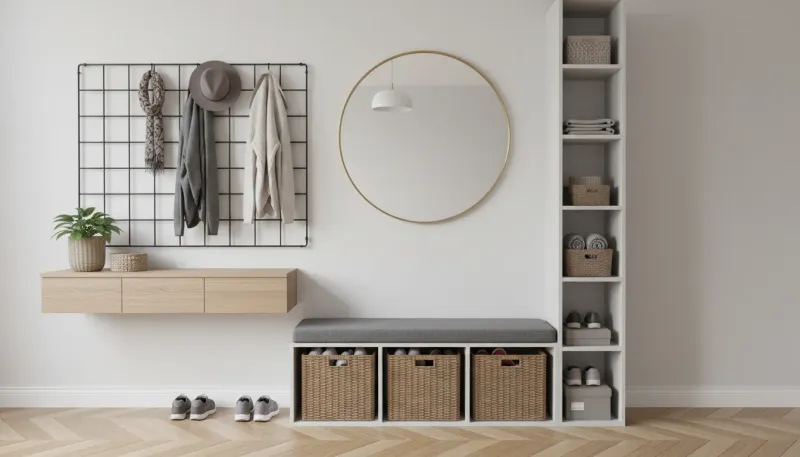
Your house doesn’t have a closet there. Fine. Most homes don’t. The best ones just made the wall work harder. Where there is no built-in closet, the storage system has to supply what the architecture didn’t: hanging space, a landing zone, and a place for everything that used to ride the coat tree. This is entryway storage without a coat closet, built the honest way — every hook earns its height, every piece of furniture earns its footprint, and the entryway itself quietly does the closet’s job.
Entryway Storage Without a Coat Closet: The Blueprint
Before buying anything, audit the wall like a contractor: height, width, and traffic. A closet-less entry is usually a narrow hallway or an open corner bleeding into the living room — and both reward the same blueprint.
- The wall is the closet. From floor to ceiling, the wall beside the door is your hanging volume. Plan storage zones from bottom to top: shoes and boots on the floor 12 inches, bench height at 18, bag and coat hooks at 55–65 inches, long-term storage above 70.
- Keep 36 inches of walkway. Subtract walking clearance from your hallway width first; every piece of furniture must fit the remainder.
- Add a landing surface. The door gets a bench and a tray, so the entryway stays a two-step transition instead of a storage locker.
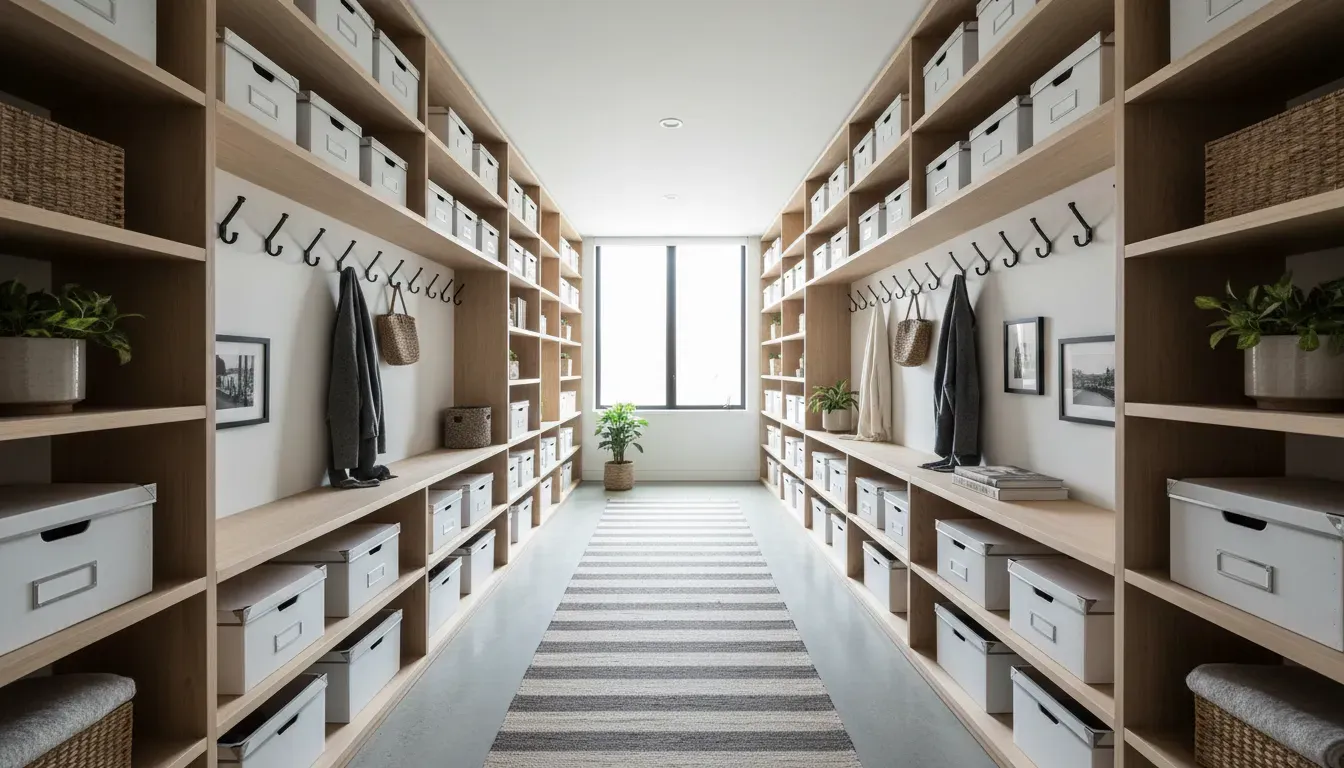
For a deep dive on rigging hanging space by itself — the coat-only half of this system — our hallway coat storage guide covers racks and rods in detail. This page is the full-storage version: coats, hats, shoes, umbrellas, and the bag drop, all planned as one system.
How to Store Coats Without a Closet (racks, hooks, curtains, armoires)
Four ways to store coats without a closet, from the immediate fix to the furniture solution:
Hooks. The fastest, cheapest, most flexible answer: a run of heavy-duty hooks at 55–65 inches holds the daily rotation of coats and bags. Stagger two lines — high for long coats, low for kids’ backpacks — and the wall stores twice what one row manages.
Freestanding racks. A coat rack or stand holds 6–10 garments in a square foot of floor. Good for the corner lease, weak for the family, and it must never become a leaner for things that belong on hooks.
Curtains. A tension rod or ceiling-track curtain across a recessed nook, an alcove, or a wall-mounted rail turns any 18-inch-deep space into a closet you can hide with a pull. Behind it: a tension shelf, bins, and hooks. This is the renter’s wardrobe, and it works everywhere.
Armoires and wardrobes. A freestanding wardrobe is a coat closet you can buy: double hanging rods inside, shelves for hats and scarves, doors that close the mess out of sight. Anchor it for safety, and it anchors the whole entryway visually.
How to Hide Coats in a Hallway (closed vs. deliberate-display)
How to hide coats in a hallway is really one decision: do you conceal them, or do you display them on purpose?
Closed storage is the armoire, the curtain, or the built-in-look wardrobe — coats disappear, and the hallway reads as furniture and art. This is the answer when the entryway doubles as the front-of-house impression or the hallway is short and a wall of coats would swallow it.
Deliberate display is the styled hook rail: a deliberate row of matching wooden or metal hangers, coats spaced a hook apart, and the rail treated as a design element. A chaotic wall of coats is a mess; a curated, evenly spaced hook run is a feature. The display method works when the hallway is wide enough that hanging coats add warmth instead of obstacle.
Either direction succeeds only with a discipline: one in, one out, and out-of-season coats migrated to the back of the wardrobe or a secondary closet. The hallway closet must never become the family’s permanent archive.
Storage Zones: Hats, Shoes, Umbrellas, Bag Drops
A closet-less entryway runs on zones — the four-way split of everything that lands within three steps of the door:
- Shoes: a slim closed cabinet (9–11 inches deep) or a bench cubby set, one shelf per person.
- Hats, gloves, scarves: one basket per person on the shelf above the bench or the armoire’s top shelf; a basket per family is a fight waiting to happen, a basket per person is peace.
- Umbrellas: a tall basket or a hook beside the door; wet umbrellas go feet-down in the basket, not folded into the coat pile.
- Bag drops: a tray, a bowl, or a small shelf at 36 inches for keys, mail, sunglasses — with a charging pad if you are feeling generous.
Zone labels matter more than zone bins: every item has exactly one place, and the whole entryway passes the “can I put it down without moving anything” test on the worst morning of the year. Where shoes need civilized containers, our best storage bins guide keeps every zone, wallet, and glove in uniform.
Small Entryway, No Closet: The Complete Setup Photos
Here is the whole system on a wall most people would call “no space at all”: a 6-foot section beside the front door.
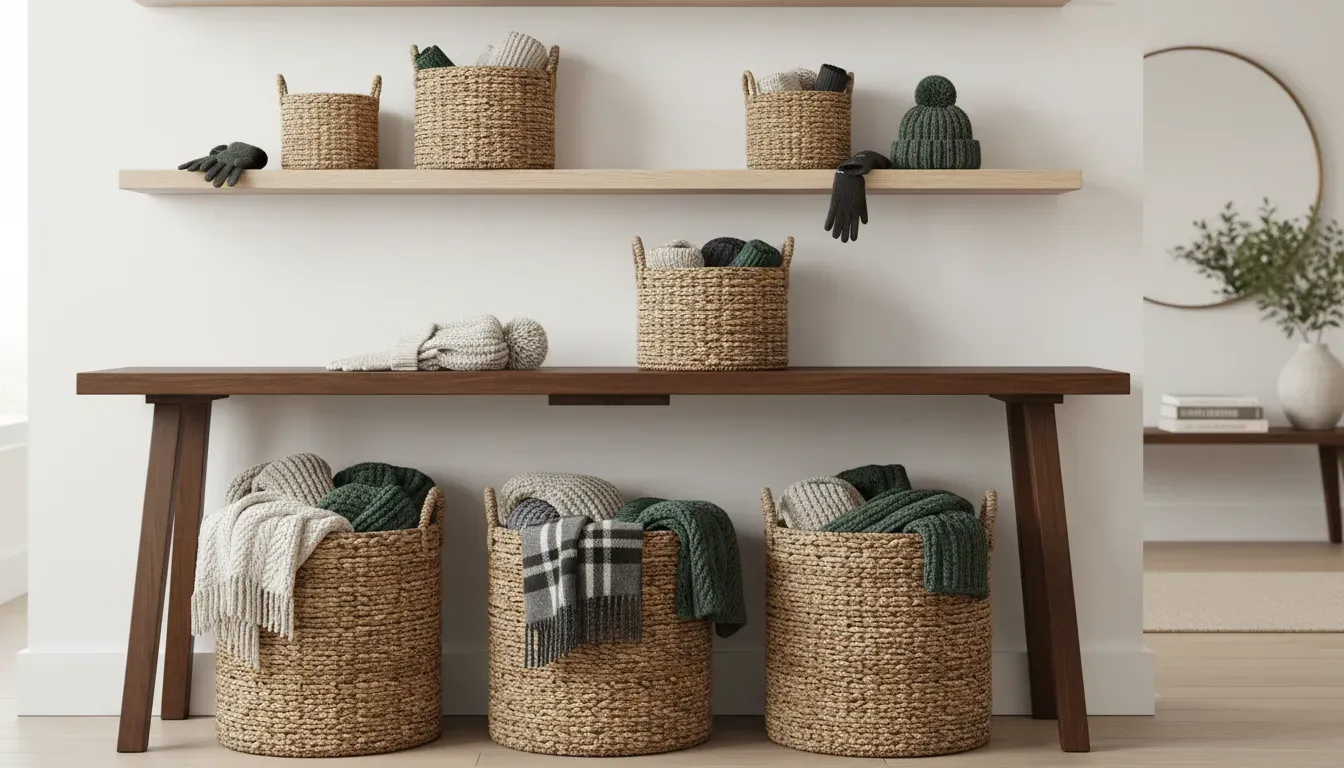
Baseline: a 40-inch bench at 18 inches for sitting and shoe-changing, a slim shoe cabinet beside it (16–30 pairs), and a run of hooks at 60 inches above the bench for coats. Above it, one shelf for the season’s out-prep: hats in two baskets, umbrellas tall in the corner basket, gloves in one tray.
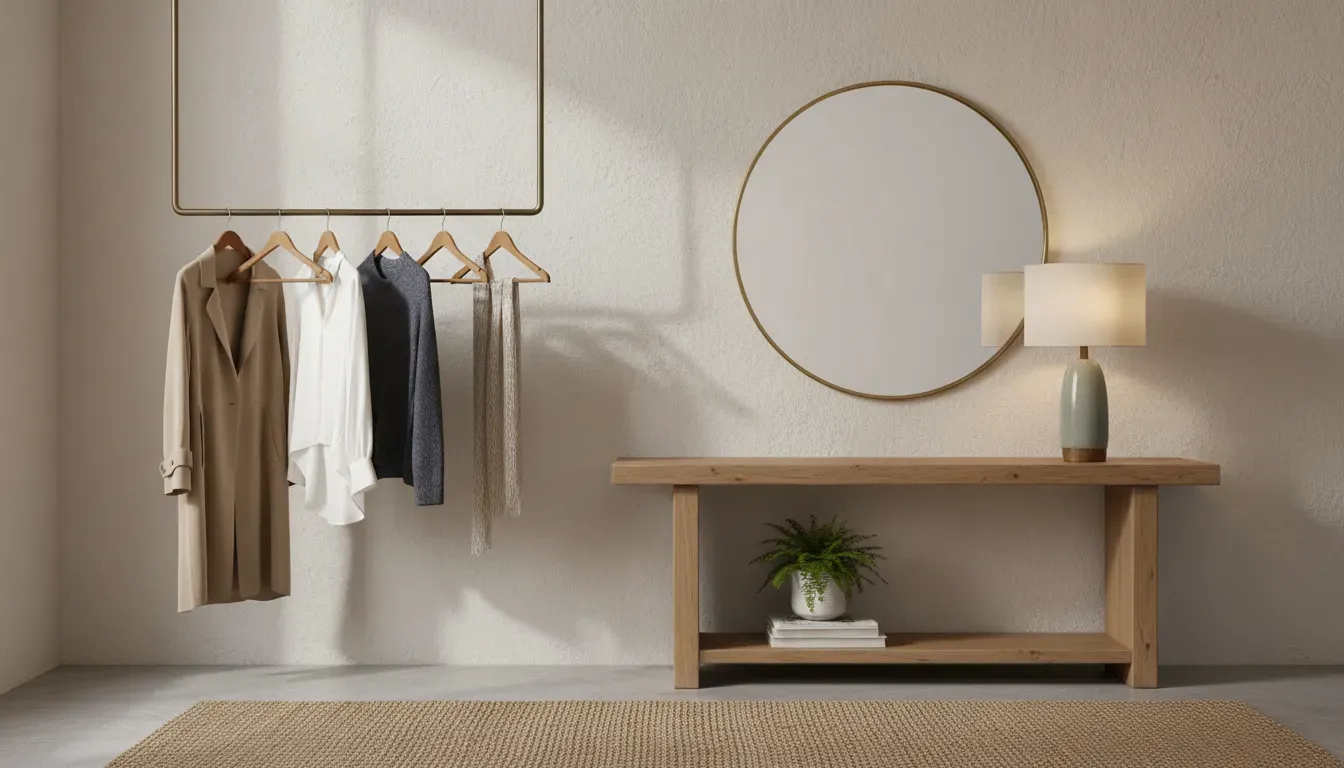
The finishing layer: a mirror behind the bench to double the light (and the apparent width), a table lamp or battery sconce so the corner never reads as a cave, and a runner that marks the change zone where boots come off. The system costs less than a built-in closet, undoes in an hour, and makes the wall the most working surface in the house.
Your house doesn’t have a closet there. Fine — neither did any of the homes these setups came from. The plan is the plan: hooks at the right height, a bench at the right depth, one basket per person, and a row of coats that looks like furniture. That is entryway storage without a coat closet, fully assembled — and it will hold your winter, your spring, and everything you carry through the door.

Stop Guessing Measurements. Build Your Dream Entryway with Confidence.
Transform awkward hallways, cramped foyers, and cluttered mudrooms into organized sanctuaries. Includes 20 CAD floor plans, facing real-home photo spreads, the 36-Inch Clearance Rule, the Shoe Pairs Formula, and 7 printable worksheets.
Core Edition ($17.99) · Flagship Photo Edition v5 ($39.99)
