
Mid-century Modern Entryway: Smart Shoe Storage With Mcm Soul
Design a mid-century modern entryway with smart shoe storage solutions: walnut benches, tilt-out cabinets, and floating shelves that fit small foyers.
Jan 30, 2026 · Linda Wise
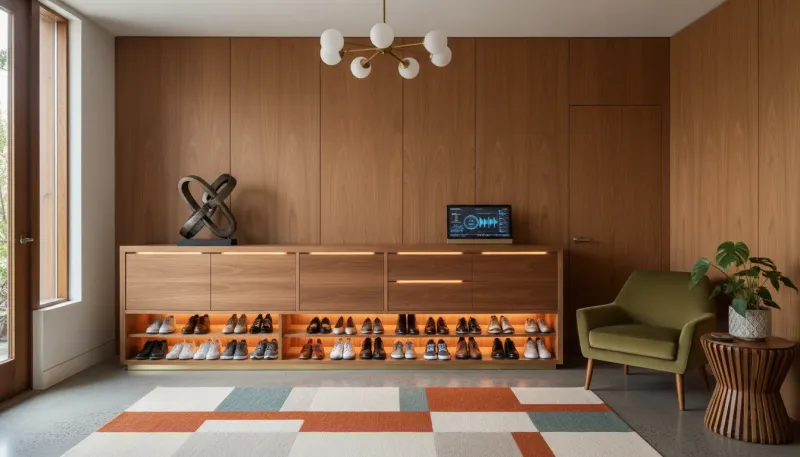
15 min readA mid-century modern entryway does two jobs: it welcomes, and it hides the shoe pile with style — walnut, tapered legs, and a shoe bench that multitasks.
MCM is the only style where ‘less furniture’ is the point — so the storage has to be invisible or beautiful. That’s the entire design brief in one sentence, and it’s why so many mid-century entryways fail: someone buys a perfect orange-and-walnut bench and then stacks three generations of sneakers beside it on a chrome rack. The fix isn’t a bigger mudroom. It’s storage that is the furniture.
I’ve designed entryway systems for over 200 homes, and the mid-century entryway is, ounce for ounce, the hardest to keep honest — because the era’s whole philosophy was that form serves function, and the storage simply has to rise to it. This guide walks through the MCM entryway formula, the best bench-with-storage picks, the cabinets and floating systems that fit the look, and the wood talk that keeps everything coherent.
The MCM Entryway Formula
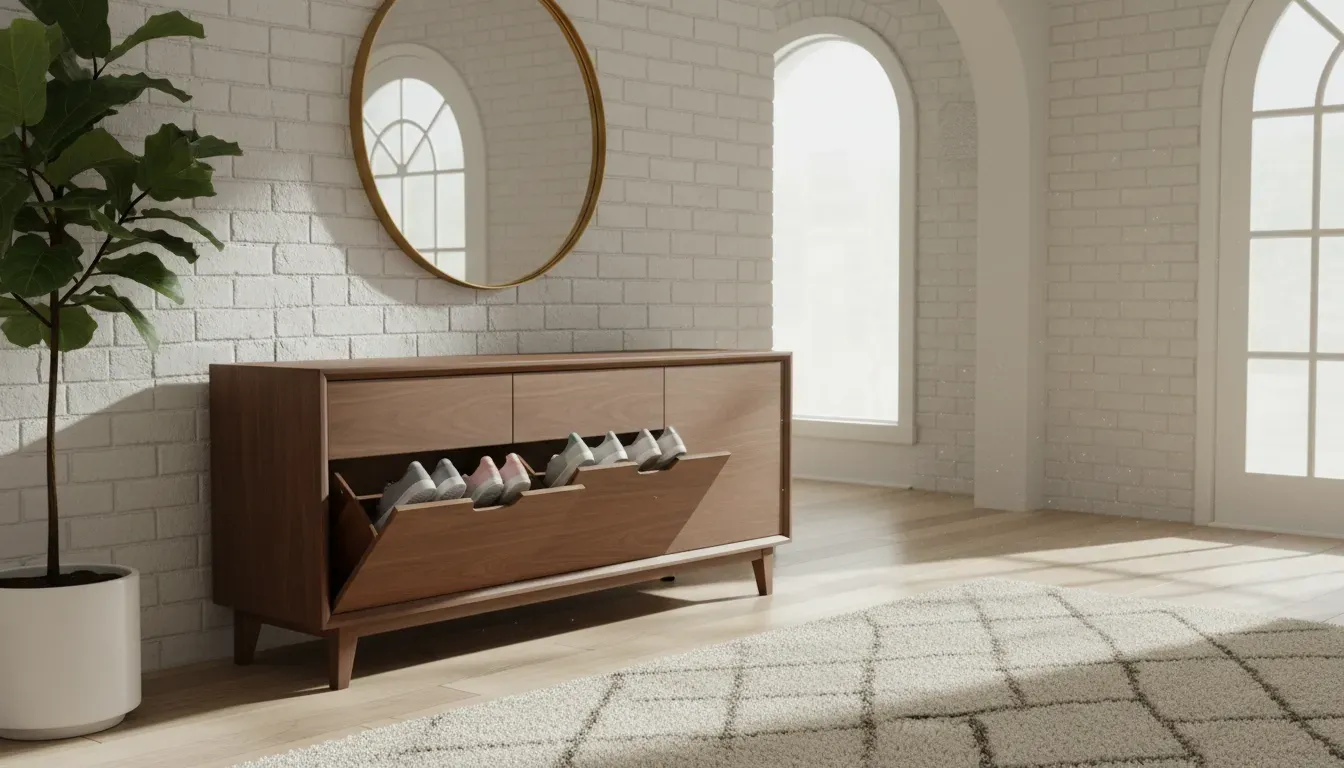
Every working MCM entryway I’ve designed follows the same four-part recipe:
- One anchor piece. One bench, cabinet, or shelf unit with a true storage job — not three accent pieces doing decorative nothing.
- Tapered legs or floating above the floor. The air gap under the furniture reads as space, which is worth ten inches of square footage in a small foyer — and it lets you sweep.
- Warm wood as the main material. Walnut, teak, or oak — never a full piece of glossy black lacquer and chrome unless you’re styling a 1960s time capsule.
- The surface stays curated. The top of whatever you bought holds exactly three things: a tray, a lamp or plant, and nothing else. Mid-century styling is negative space.
The formula exists because MCM entryways fail in one predictable way: storage gets added next to the furniture instead of inside it. Follow the formula and the shoe pile phase of your life ends quietly.
MCM Entryway Benches With Storage (the map of picks)
The bench is the heart of the mid-century modern entryway, and the mcm entryway bench with storage does the heaviest lifting. Here’s the map of what to look for:
- The lift-top box bench. Upholstered top (bouclé, tweed, or leather), tapered walnut legs, and a hinged lid over a deep interior. Perfect for a household that needs a black-hole storage volume for bags and seasonal gear. Must-have: slow-close hydraulic or spring hinges so the lid never slams on small fingers.
- The open-cubby bench. A slatted or solid seat over a row of open cubbies — the classic “one pair per slot” organizer. Add woven baskets or leather handles to the cubbies and it reads as decor. This is the pick for households where shoes live at the door all day.
- The low drawer bench. A bench with two or three shallow drawers under the seat. The front lip hides the drawer stacks completely — the piece looks like a solid wood slab that happens to open.
- The slatted shelf bench. A seat over one open slatted shelf. Least storage of the four, but the airy lightest look in a narrow hallway — and wet boots dry fast on slats.
Bench sizing in one line: seat height 18–20 inches for comfortable shoe-tying, depth 14–18 inches in a hallway, and width matched to your wall (a bench that floats between doorframe and corner looks intentional; one that crowds the door looks like a mistake).
Smart Shoe Storage Solutions That Fit MCM (benches, cabinets, floating shelves)
“Smart” in MCM-speak doesn’t mean internet-connected. It means the storage does more per square inch than its silhouette suggests — mechanisms that hide capacity inside what looks like a simple credenza.
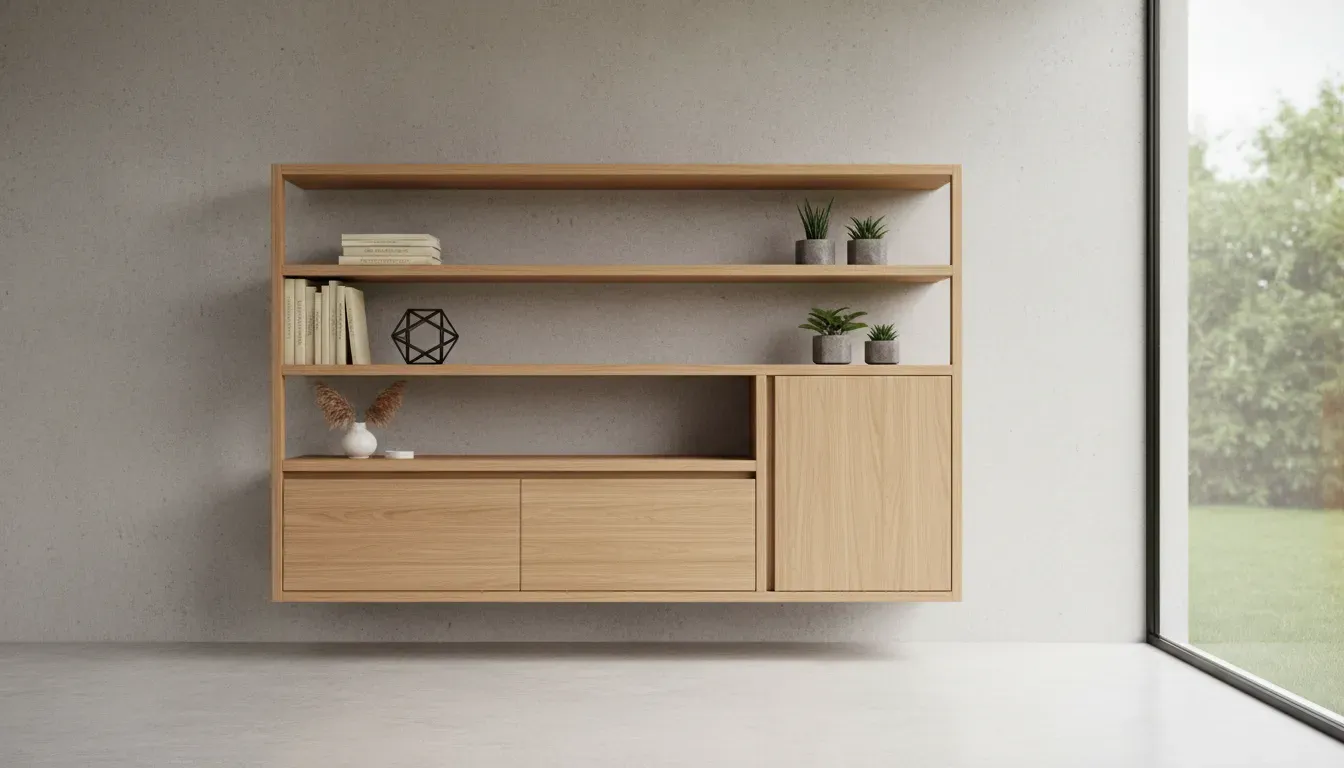
Tilt-out cabinets are the sleeper hero of the MCM entryway. A tilt-out drawer pivots forward to hold shoes standing upright, storing a dozen pairs in a cabinet barely ten inches deep — roughly half the depth of a standard sideboard. In walnut veneer with brass or matte-black pulls, a tilt-out reads as a piece of furniture from the era, not a shoe organizer wearing a costume.
Ventilated credenzas handle the odor problem the MCM way: cane webbing door fronts. Cane is naturally porous — air moves in and out all day, and the cabinet hides the shoes while they breathe. Solid-door units should have routed ventilation in the back panel, invisible against the wall.
Floating shelf systems are the most authentically mid-century of all. The era’s wall units (think the classic Danish rail systems) hung cabinets and shelves from vertical tracks, leaving the floor bare. Mount lower modules for shoes with drop-down doors, keep the middle shelf decorative, and the entryway gains both storage and the floating look MCM invented.
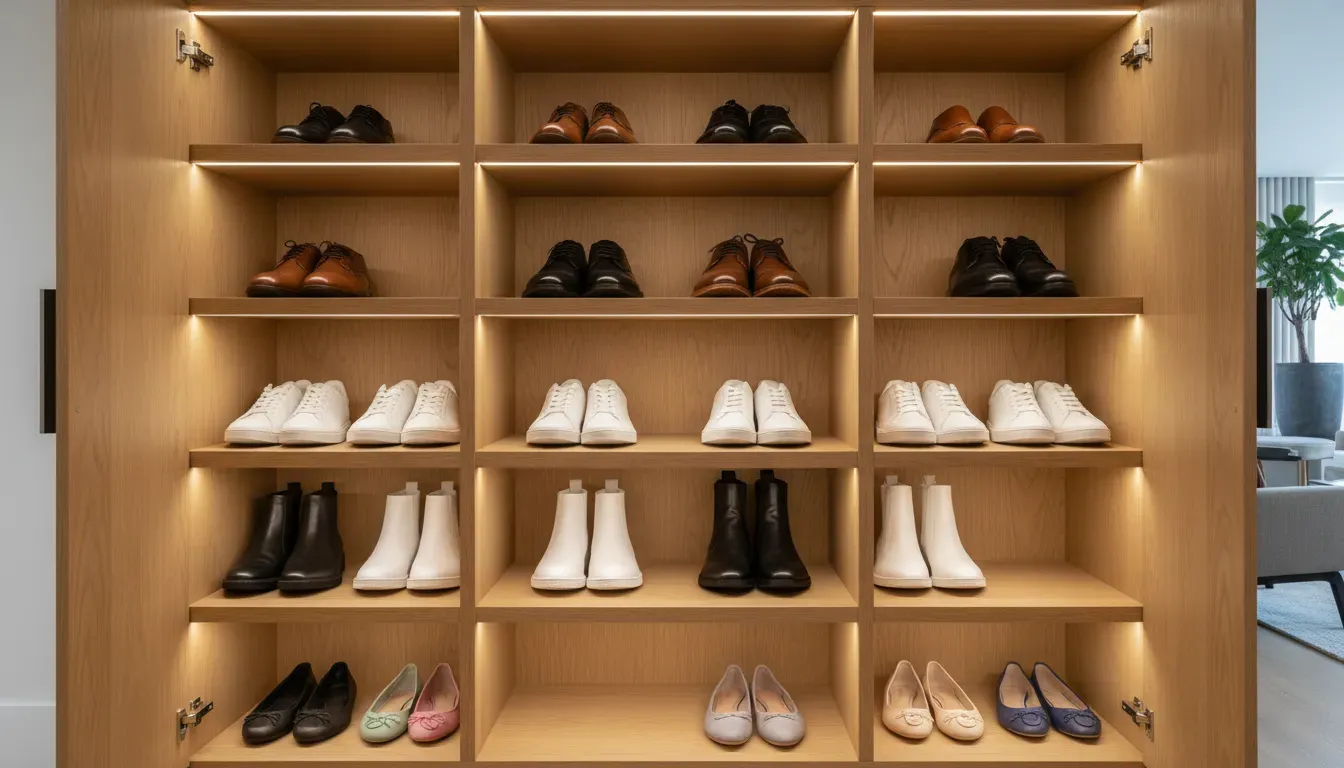
The interior organization matters as much as the cabinet: angled shelves that display shoes toe-out, adjustable dividers for boots and heels, and the heel-to-toe trick (one shoe forward, one back) that fits an extra pair or two per shelf. I sized 20-pair families into 14-pair cabinets with that single trick.
Walnut vs. Teak vs. Oak (MCM wood talk)
The wood is the style. If the wood is wrong, the entire palette collapses into “rustic.” Three woods carry MCM entryways, and they are not interchangeable:
- Walnut. The gold standard — rich, dark, chocolate-brown grain, and the only MCM wood that hides scuffs and scuff-adjacent chaos. Pairs with brass hardware and looks older and more learned than its price tag. If you buy one piece, buy walnut.
- Teak. Honey-gold, the favorite of the Danish branch of the movement, with a natural oiliness that shrugs off the moisture of wet winter coats. Warmer and lighter than walnut — the right call for a dim hallway that needs to glow.
- Oak. Blond, crisp, and cheaper than walnut or teak. Reads mid-century when the legs taper and the grain is plain-cut; reads farmhouse when it’s anything else. The budget pick that still talks the language.
The mixing rule: keep undertones warm-with-warm or cool-with-cool. A walnut bench on a honey oak floor works when they sit in the same warm family; stark contrast between them needs a rug as a buffer so the floor doesn’t argue with the furniture. In general, one wood per entryway — the second wood should be the floor, not another piece.
Styling Without Breaking the Aesthetic
The storage is set. Now the entryway has to look like a room, not a catalog page. Four styling rules that protect the MCM feel:
1. Mirror in an organic shape. A pond mirror, a sunburst, or a simple round frame above the bench. It reflects light down the hallway and finishes the inevitable “last look before leaving.”
2. One warm light source. A globe or sputnik fixture overhead, or a small table lamp on the credenza — never a single cold ceiling can. Warm light is the difference between a vintage-inspired foyer and a furniture showroom.
3. Greenery with an era story. A snake plant or monstera in a ceramic planter was literally in the 1958 design magazines. One plant beside the shoe bench reads as decoration and softens the wood’s straight lines. Don’t scatter three.
4. Baskets that match the period. Woven seagrass or cane baskets on the open shelves double as shoe and seasonal-gear storage in full view — the MCM answer to “where do the winter hats go.” For the wider basket strategy in other entryways, our guide to woven basket shoe storage covers sizing and placement in detail.
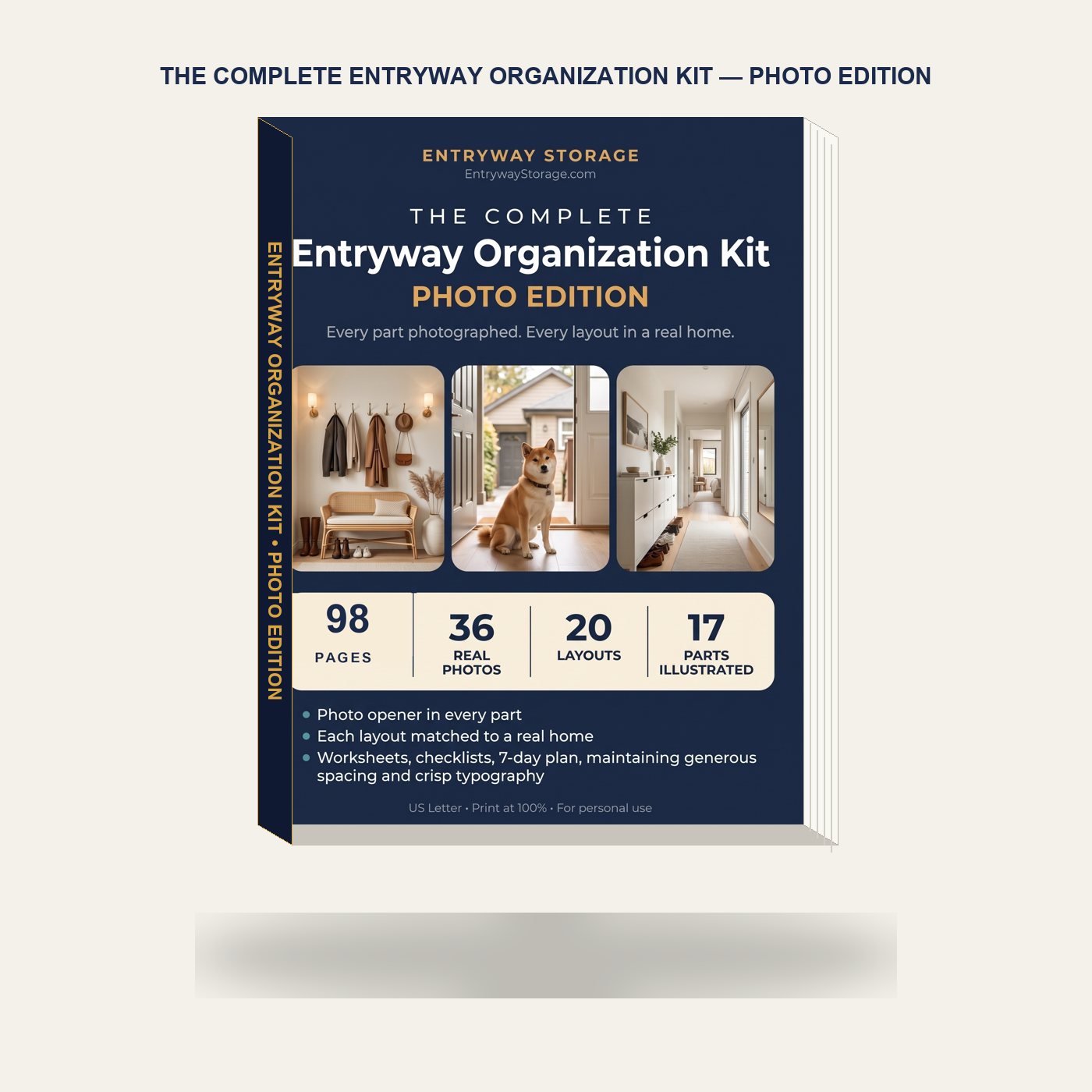
Stop Guessing Measurements. Build Your Dream Entryway with Confidence.
Transform awkward hallways, cramped foyers, and cluttered mudrooms into organized sanctuaries. Includes 20 CAD floor plans, facing real-home photo spreads, the 36-Inch Clearance Rule, the Shoe Pairs Formula, and 7 printable worksheets.
Core Edition ($17.99) · Flagship Photo Edition v5 ($39.99)
Frequently Asked Questions
How do I store shoes in a mid-century modern entryway without ruining the look?
Choose storage that is itself the furniture: a walnut bench with a lift-top interior, a tilt-out cabinet that hides shoes behind a credenza face, or cane-front doors that ventilate while concealing. Open-metal racks and plastic stackers are the two things that break the aesthetic.
What is the best wood for an MCM entryway bench?
Walnut is the gold standard for hiding scuffs and pairing with brass hardware. Teak resists moisture best for cold-climate entryways, and oak is the budget pick that still reads mid-century when the legs are tapered.
Can a mid-century modern entryway work in a narrow hallway?
Yes — use a floating shelf system or a slim tilt-out cabinet under 11 inches of depth, keep one anchor piece rather than several, and let the air gap under everything do the widening work.
Do tilt-out shoe cabinets hold boots?
Only if the internal buckets have adjustable dividers. Look for dividers that move or remove so tall boots stand upright without creasing; fixed small buckets are a flats-and-sneakers-only proposition.
