
Narrow Mudroom Solutions: How to Fit Lockers in a Tight Hallway
Transform your cramped hallway into a functional storage powerhouse. Discover expert structural tricks, slimline locker designs, and spatial optimization strategies.
Mar 9, 2026 - Written by: Linda Wise
You know the feeling. You walk through the front door—or perhaps the garage entry—and are immediately met with an impassable mountain of damp coats, stray soccer cleats, and overflowing backpacks. Space is a premium. You feel it every time you awkwardly sidestep a misplaced winter boot just to get into your kitchen. Transforming a cramped, narrow hallway into a highly functional mudroom feels like an impossible puzzle, but I’ve personally found that it only requires a shift in how you view architectural constraints.
When you’re dealing with a tight corridor, traditional bulky cabinetry is out of the question. You cannot afford to sacrifice necessary walking clearance—also known as egress—for the sake of storage. Instead, the secret lies in exploiting vertical planes, stealing structural voids within your drywall, and sourcing hyper-specific slimline millwork.
Before we tear into the architectural theory and structural hacks, here is a quick overview of the best ultra-narrow locker solutions currently on the market for those who want a plug-and-play fix.
Quick Comparison: Top Picks
The Anatomy of the Spatial Envelope
Hallways are primarily designed as arteries. They push foot traffic from one zone of the house to another. Building codes typically dictate a minimum residential hallway width of 36 inches. If your corridor is exactly 36 inches wide, surface-mounting a standard 18-inch deep mudroom locker will reduce your walking space to a claustrophobic 18 inches. That is a massive code violation and a logistical nightmare.
However, if your hallway stretches to 48 or 54 inches wide, you suddenly have an architectural playground. Squeezing lockers into this tight envelope means we need to meticulously calculate the friction points of human movement.
You’ll notice that standard cabinetry often feels visually oppressive. To combat this, you need a baseline understanding of what actually fits without looking like a barricade. I highly recommend cross-referencing your initial tape measure scribbles with standard depth and height measurements to ensure you aren’t violating basic spatial principles before purchasing a single piece of lumber.
Mastering Proportions: Dimensions That Save Your Sanity
When floor space is violently restricted, your only viable direction is up. The fundamental rule of narrow mudroom solutions revolves around maximizing vertical leverage while minimizing horizontal intrusion.
The Illusion of Depth
How shallow can a locker be while still remaining functional? A standard coat hanger requires about 20 inches of depth to sit completely flush behind a closed cabinet door. Obviously, in a narrow hallway, a 20-inch cabinet is an absolute non-starter.
This forces us to rethink the orientation of our storage. By transitioning from a traditional closet rod to a system of robust, wall-mounted hooks, you bypass the need for hanger depth entirely. Suddenly, a locker only needs to be deep enough to comfortably seat a human or hold a pair of shoes.
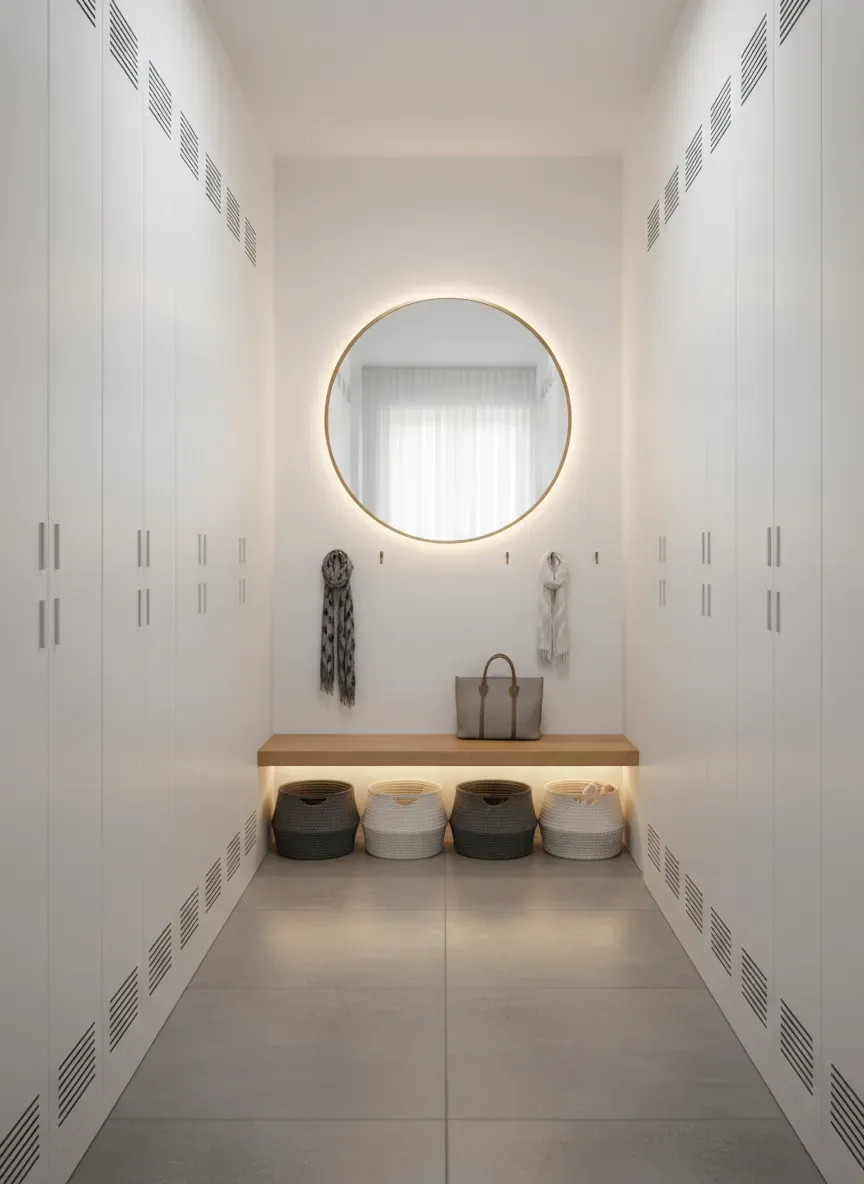
For seating, 12 to 15 inches of depth is the absolute minimum for temporary perching (i.e., sitting down to tie a shoelace). If you strictly need shoe storage and a place to hang bags, you can engineer custom lockers that protrude a mere 11 inches from the wall. Understanding the nuances of these micro-adjustments is critical, which is why reviewing our comprehensive mudroom locker depth guide will save you from building a beautifully useless unit.
Vertical Dominance
If you can only afford 12 inches of depth, you must capture every available inch from the baseboard to the crown molding. Floor-to-ceiling cabinetry draws the eye upward, accentuating the height of the hallway rather than its narrowness.
Utilize the uppermost cubbies for out-of-season storage—think winter scarves in July or beach towels in December. Keep the daily-driver items strictly within the “strike zone” (between waist and shoulder height).
Structural Tactics for Tight Quarters
If you are willing to get your hands dirty and cut into drywall, you can unlock storage space that essentially costs zero square footage.
Stealing the Stud Cavity
Here’s the real kicker: your interior walls are mostly hollow air. Standard residential framing utilizes 2x4 studs, leaving a 3.5-inch deep void between the drywall panels. By carefully mapping out your plumbing and electrical lines, you can cut away the drywall on your hallway side and recess your mudroom lockers directly into the wall framing.
If you build a locker that is 12 inches deep, but you recess it 3.5 inches into the wall cavity, the locker only protrudes 8.5 inches into your hallway. That 3.5-inch difference is monumental in a narrow corridor. It is the difference between brushing your shoulders against the woodwork and walking freely.
Pro Tip: When recessing cabinetry, always consult a structural engineer or a seasoned contractor if the wall is load-bearing. While you generally don’t need to alter studs for simple between-the-stud cubbies, building a wide, recessed bench requires a structural header to carry the overhead load, much like a window frame.
The Floating Locker Illusion
Visual weight and physical weight are two entirely different concepts in interior design. A massive, floor-to-ceiling cabinet built tightly against the floorboards feels heavy. It eats the room.
Conversely, a cantilevered or “floating” locker setup mounts the entire apparatus directly to the wall studs, leaving a 10-to-12-inch gap between the bottom of the cabinetry and the floor. By allowing the continuous flooring material to run unbroken beneath the unit, your brain perceives the hallway as wider and more expansive than it actually is.
This gap also serves a brilliant secondary purpose: it becomes a natural, out-of-the-way parking garage for wet, muddy boots that you don’t want touching your clean millwork.
Door Hardware and Millwork Selection
Open cubbies are the most space-efficient choice for a narrow hall because they require zero clearance for door swings. However, open storage demands meticulous tidiness. If your family treats the mudroom like a dumping ground, open lockers will immediately make your narrow hallway look like a chaotic thrift store aisle.
If you opt for closed storage to hide the mess, standard swing doors are hazardous. A door swinging outward into a 36-inch hallway blocks traffic completely and risks hitting anyone walking past.
Sliding and Tambour Alternatives
- Bypass Sliding Doors: Much like a traditional closet, these doors slide over one another on a hidden track. They require zero outward clearance, though they only ever allow access to half the locker at any given time.
- Tambour Doors: Reminiscent of roll-top desks, tambour doors roll upward into a hidden cassette at the top of the locker. They are incredibly sleek, highly durable, and completely eliminate the egress issue.
- Pocket Doors: If you have the wall space adjacent to the lockers, pocket doors slide directly into the drywall. This is a highly invasive retrofit but offers the cleanest possible aesthetic.
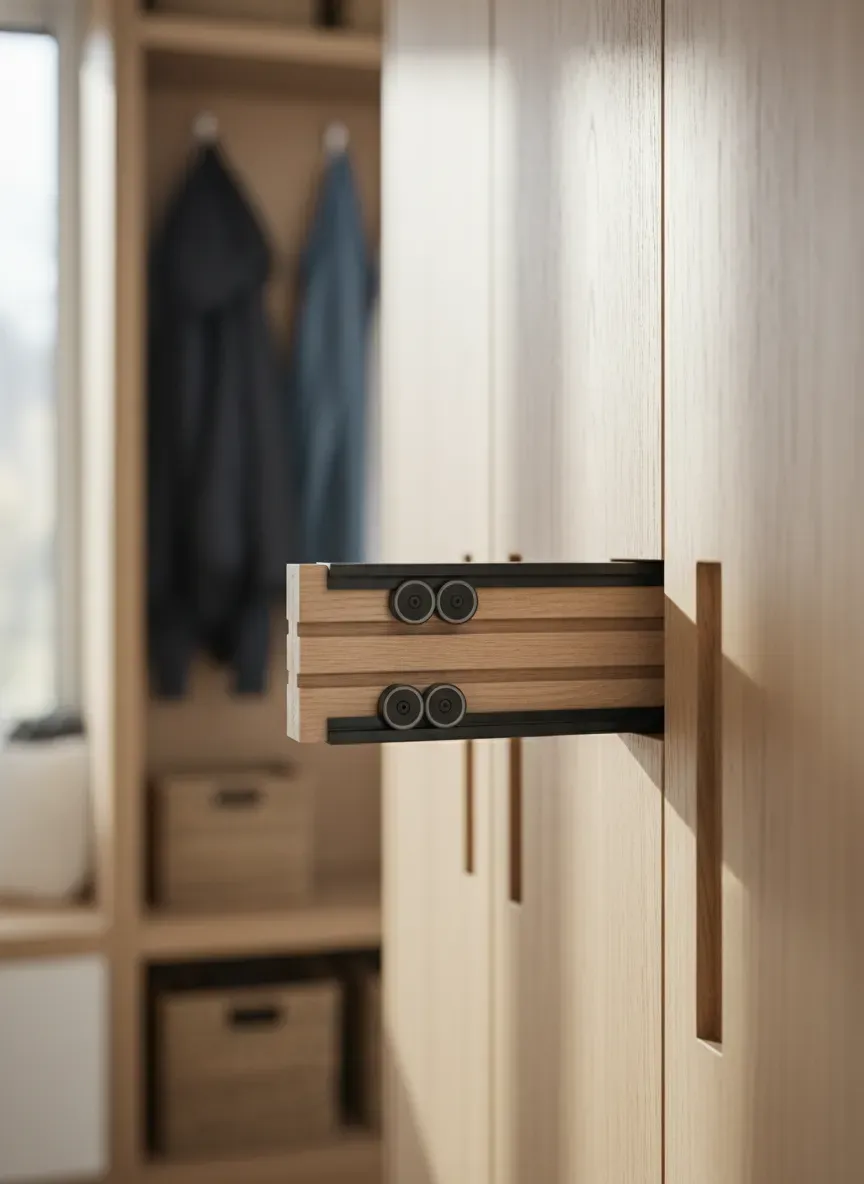
When dealing with the interior of the locker, your hook placement dictates how tightly you can pack the space. Overcrowding hooks will force bulky winter coats to billow outward, defeating the purpose of your slimline design. Referencing the ideal spacing between mudroom hooks and lockers is a non-negotiable step to prevent your jackets from turning into an impenetrable fabric wall.
Deep Dive: Top 3 Affiliate Product Solutions
Not everyone has the time, budget, or drywall-saw confidence to build a custom, recessed unit. Fortunately, the furniture market has caught onto the micro-mudroom trend. Let’s break down the three top-tier solutions that can ship directly to your door.
1. Prepac Slim Wall-Mounted Hall Tree
The Prepac Slim Wall-Mounted Hall Tree is an absolute lifesaver for micro-hallways. Because it relies on a wall-mounted French cleat system rather than resting on the floor, it perfectly executes the “floating illusion” we discussed earlier.
Why it works:
- Depth: At roughly 11.5 inches deep, it practically hugs the wall.
- Modularity: You can buy two or three of these distinct units and mount them side-by-side to mimic custom built-ins without the bespoke price tag.
- Floor Clearance: It keeps the floor completely clear, making vacuuming a breeze and giving you space to kick off oversized winter boots.
2. Bush Furniture Narrow Shoe Bench & Tall Rack
If you need a dedicated spot to sit and take off your shoes, the Bush Furniture Narrow Shoe Bench & Tall Rack strikes a brilliant compromise between comfort and spatial economy.
Why it works:
- Tiered Depth: The bench portion extends out just enough to sit comfortably (about 15 inches), while the towering backplate and upper shelf remain flush against the drywall. This tiered approach prevents the unit from feeling like a giant monolith.
- Durability: Bush Furniture uses high-density engineered wood with a thermally fused laminate finish, meaning it won’t instantly chip when an angry teenager hurls a backpack against it.
- Aesthetic Integration: It features clean, transitional lines that blend effortlessly into both modern farmhouse and contemporary urban apartments.
3. Walker Edison Transitional Slim Cubby Locker
For those who absolutely must hide their clutter behind closed doors, the Walker Edison Transitional Slim Cubby Locker provides an elegant barrier between your mess and your guests.
Why it works:
- Louvered Doors: The slatted door design allows for passive airflow. This is a critical feature when storing damp coats or sweaty gym shoes in an enclosed space, preventing mildew and musty odors.
- Slim Footprint: It maintains an incredibly tight profile, sacrificing just enough depth to hold angled shoe racks and side-mounted coat hooks.
- Versatility: The interior shelving is highly adjustable, allowing you to configure the internal cavity for tall rain boots or short sneakers on a whim.
The Psychology of Squeezed Spaces: Color and Light
You can build the slimmest, most efficient locker system on earth, but if you paint it charcoal gray in a hallway with poor lighting, the space will still feel like a subterranean tunnel. The visual environment dictates how the physical space is perceived.
Color Drenching Your Lockers
One of my favorite interior design tricks for tight spaces is “color drenching.” This involves painting your mudroom lockers, the baseboards, the surrounding drywall, and even the ceiling in the exact same color.
When a large piece of furniture strongly contrasts with the wall behind it, the eye immediately registers its edges, outlining its exact bulk. By painting the lockers the same color as the walls, the edges blur. The cabinetry visually recedes into the background architecture, making the hallway feel significantly less cluttered. For narrow corridors, stick to light, light-reflecting hues: warm whites, soft sages, or pale taupes.
Lighting the Tunnel
Hallways are notoriously starved of natural fenestration (windows). Relying on a single, centralized flush-mount ceiling light casts harsh, top-down shadows that emphasize the bulk of your lockers.
To counteract this, integrate localized lighting directly into the locker build.
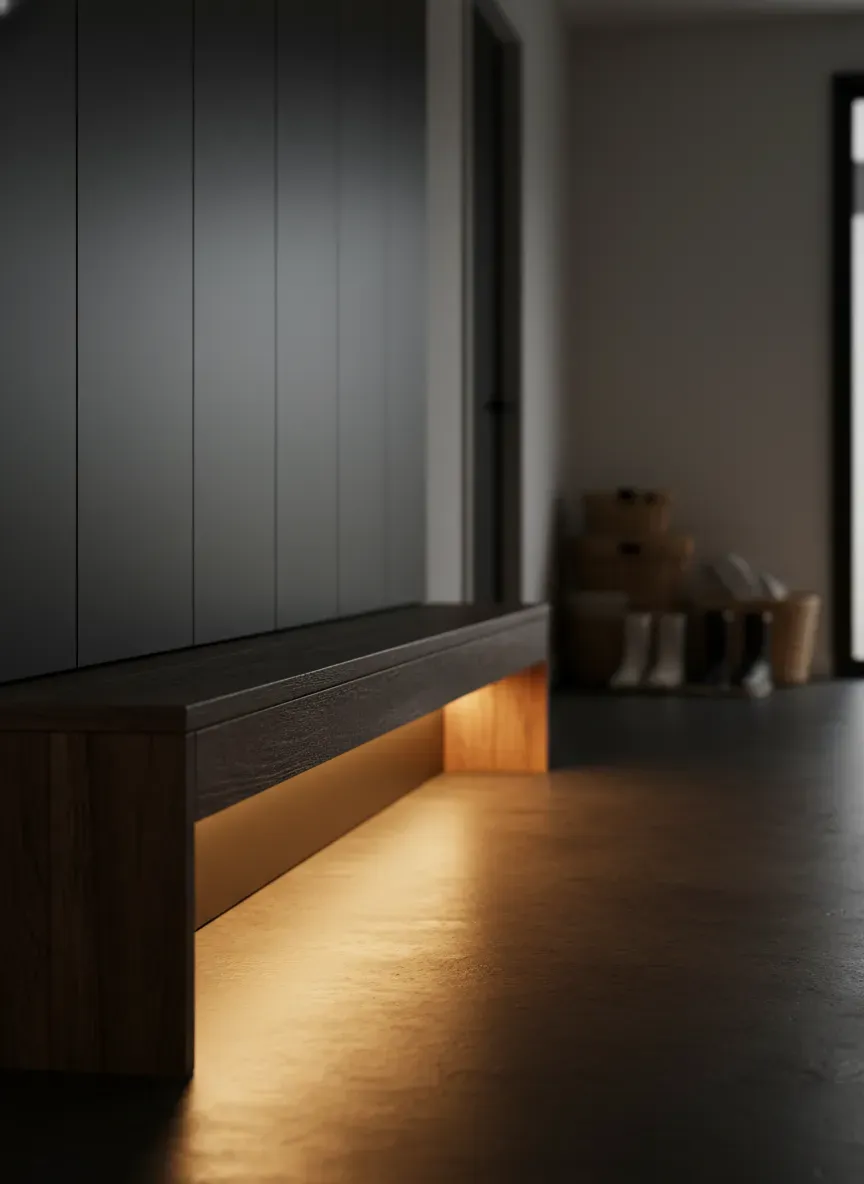
- Under-Bench Lighting: Run a low-voltage, warm LED strip along the underside of the floating bench. This washes the floor in soft light, enhancing the illusion of width.
- Sconces: If space permits, mount slim, low-profile wall sconces between the locker bays. Eye-level lighting pulls attention away from the narrow floorplan and creates an inviting, high-end atmosphere.
Common Pitfalls in Narrow Corridor Design
Even with careful planning, navigating the friction points of a tight entryway can trip up seasoned DIYers. Be hyper-aware of these common mistakes before you commit to an installation.
- Ignoring Baseboard Heaters and Vents: Blocking an HVAC return or a baseboard radiator with a solid wood locker will instantly throw your home’s climate control out of balance. If you must build over a vent, ensure your contractor integrates a toe-kick register to reroute the airflow seamlessly into the hallway.
- Overestimating Shoe Sizing: It sounds trivial until you try to shove a men’s size 12 hiking boot into an 11-inch deep cubby. If your household has large footwear, you must account for angled shoe shelves. Angling the shelves at 45 degrees allows you to store longer shoes in shallower depths.
- Blocking Essential Hardware: Map out your light switches, thermostat panels, and alarm keypads. There is nothing worse than building a gorgeous set of lockers only to realize you buried the hallway light switch behind a slab of medium-density fiberboard.
- Forgetting the “Drop Zone”: Coats and shoes are obvious, but where do the keys, mail, and sunglasses go? Always integrate a small, shallow tray or a designated micro-shelf into your design. Without it, the flat surface of your seating bench will immediately become a magnet for everyday pocket junk.
Key Takeaways for Your Micro-Mudroom
- Measure Thrice, Build Once: Hallway width is unforgiving. Maintain an absolute minimum of 36 inches of clear walking space to remain code-compliant and comfortable.
- Go Up, Not Out: Maximize vertical storage to offset shallow depth constraints.
- Recess When Possible: Stealing 3.5 inches from the stud cavity is the ultimate space-saving cheat code.
- Float the Bench: Exposing the floorboards underneath the lockers tricks the eye into perceiving a wider hallway.
- Mind Your Doors: Avoid outward-swinging cabinet doors. Stick to open cubbies, bypass sliders, or tambour rolling doors.
The Bottom Line: A narrow hallway does not sentence you to a lifetime of disorganized chaos. By viewing your limited square footage as a creative constraint rather than a curse, you can engineer a highly specific, hyper-efficient drop zone. Whether you choose to cut into the drywall to steal inches from the studs or opt for a sleek, pre-fabricated unit like the Prepac Slim Wall-Mounted Hall Tree, the goal remains the same. You are reclaiming your entryway, one carefully calculated inch at a time.