
The 12 Best Storage Solutions for Small Apartments to Declutter Every Room
12 best storage solutions for small apartments, ranked by square footage saved, renter-friendliness, and cost—plus room-by-room layouts that actually fit.
Published · Updated · Linda Wise
7 min readLast updated: November 6, 2026 | Reviewed by: Linda Wise, managing editor
Small apartments do not usually lack storage. They lack usable storage: the kind you can reach without moving a chair, the kind that does not block the bathroom door, and the kind that survives a lease.
The 12 solutions below are ranked by impact, not by how they look on Pinterest. Each one includes a fit rule so you can check it against your actual floor plan before spending money.
The 12 Solutions at a Glance
| Rank | Solution | Best room | Space gained | Renter risk |
|---|---|---|---|---|
| 1 | Floor-to-ceiling wall shelves | Living/bedroom | High | Low with anchor |
| 2 | Over-door racks | Entry/bedroom | Medium-high | None |
| 3 | Under-bed rolling bins | Bedroom | High | None |
| 4 | Stackable cube system | Living/entry | Medium-high | Low |
| 5 | Slim rolling cart | Kitchen/bath | Medium | None |
| 6 | Closet double-hang rod | Bedroom | High | Low |
| 7 | Storage ottoman | Living/bedroom | Medium | None |
| 8 | Bed risers | Bedroom | Medium-high | Low |
| 9 | Tension rod + hanging organizers | Closet/kitchen | Medium | None |
| 10 | Narrow console with baskets | Entry/living | Medium | Low |
| 11 | Wall hooks and peg rail | Entry/bath | Medium | Low |
| 12 | Back-of-door pocket organizer | Bath/bedroom | Low-medium | None |
1. Floor-to-Ceiling Wall Shelves
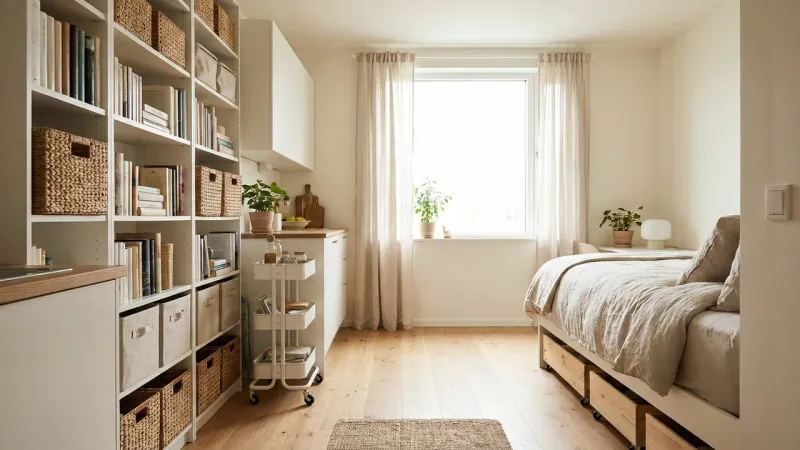
This is the highest-capacity solution that does not consume floor area. A single 12-inch-deep wall can hold more than a dresser, and it leaves the floor clear for walking.
Fit rule: keep shelves 8-12 inches deep in a living area and 12-16 inches in a closet. Deeper shelves become display surfaces for clutter. Anchor the top shelf to a stud and use a wall strap for tall units.
Best for: books, bins, baskets, display items, and a small home office. Use closed bins on the lowest and highest shelves, open baskets at eye level.
Renter note: a freestanding ladder shelf is easier to move than a drilled wall system. If you drill, use toggle bolts and patch on move-out.
2. Over-Door Racks
The back of a door is one of the few surfaces renters can use without drilling. A good over-door rack adds hooks for coats, towels, or bags without reducing floor space.
Fit rule: measure the door thickness and the gap above the door. Most racks fit doors 1.25-1.75 inches thick. Leave 1 inch of clearance so the door closes without rubbing.
Best for: coats, robes, towels, and lightweight bags. Do not hang a heavy backpack on a hollow-core door.
3. Under-Bed Rolling Bins
The space under a bed is often the largest unused volume in a small apartment. Low-profile bins on wheels turn it into a seasonal closet.
Fit rule: measure from the floor to the bed frame, not the mattress. Most bins need 6-8 inches. Leave 1 inch of clearance so the bin does not scrape.
Best for: off-season clothes, extra bedding, shoes, and luggage. Use breathable fabric for textiles and hard plastic for anything that could leak.
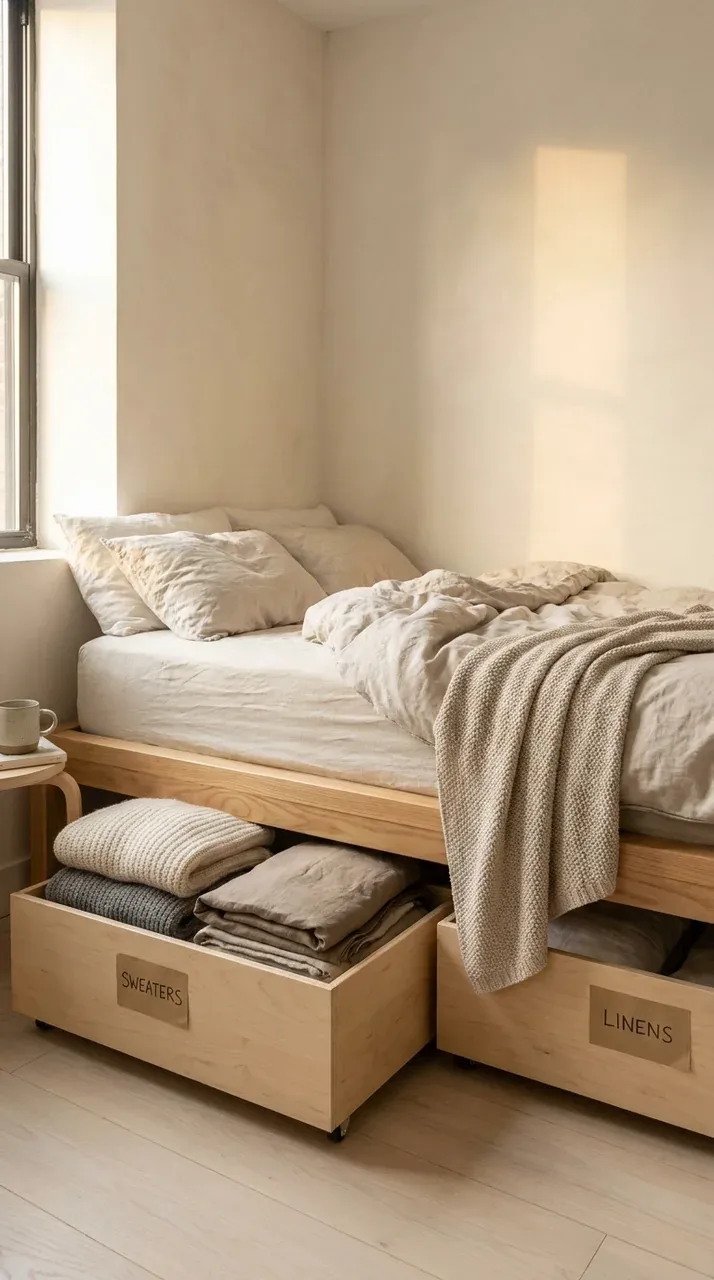
Image: measure the frame clearance before buying bins; a bin that does not roll is a bin you will not use.
4. Stackable Cube Systems
Cube systems work because they are modular: you can start with a 2 x 2 unit, add another row later, and use the top as a console. The weakness is the back panel, which is often thin and flimsy.
Fit rule: choose a cube opening of at least 11 x 11 inches if you want standard fabric bins. A 13 x 13 inch opening is more flexible but takes more floor space.
Best for: entryway catch-alls, toys, books, and craft supplies. Anchor tall units to the wall; a 4 x 4 cube loaded with books is tip-prone.
5. Slim Rolling Cart
A 5-7 inch cart is the best solution for the gap beside a refrigerator, washer, or bathroom vanity. It adds storage without taking a full cabinet’s footprint.
Fit rule: measure the gap at its narrowest point, including baseboards and door trim. Add 0.5 inch for the wheels. Check that the cart’s handle does not protrude into the walkway.
Best for: cleaning supplies, spices, snacks, and bathroom refills. Use locking casters so it stays put.
6. Closet Double-Hang Rod
Most apartment closets have one rod at 66-72 inches and a lot of wasted space below. A second rod at 40-42 inches doubles the hanging capacity for shirts, pants, and kids’ clothes.
Fit rule: allow 40 inches of vertical space per hang zone for adult shirts and 30 inches for kids. Long dresses and coats need a full-height zone, so keep one section uninterrupted.
Best for: shirts, skirts, pants, and short jackets. Use slim hangers to gain another 20-30% capacity.
7. Storage Ottoman
A storage ottoman replaces a coffee table or extra seat and hides blankets, remotes, or toys. The best ones have a lid that stays open, a rigid internal base, and a washable cover.
Fit rule: choose a lid that opens to at least 90 degrees; a lid that falls closed is a finger trap. Check the internal height against the items you plan to store.
Best for: living room blankets, kids’ toys, and guest bedding. Not for anything heavy or sharp.
8. Bed Risers
Bed risers add 3-8 inches under a bed frame, creating enough clearance for rolling bins or luggage. They are inexpensive and renter-friendly, but they change the bed’s stability.
Fit rule: use risers designed for your bed frame type. Do not stack risers. Check that the bed does not wobble after installation, and keep the risers centered under the legs.
Best for: platform beds and simple frames. Skip them if the frame already has drawers or if the bed is used by a young child.
9. Tension Rod + Hanging Organizers
A tension rod inside a closet or between cabinets creates a second hanging zone without drilling. Use it for lightweight items only.
Fit rule: choose a rod with a rubber foot and a load rating. Test it with a gentle pull before hanging anything. Do not use tension rods for heavy coats or shelving.
Best for: scarves, belts, cleaning sprays, and small bags. In a kitchen, a tension rod under the sink holds spray bottles.
10. Narrow Console with Baskets
A 10-12 inch deep console turns a blank hallway wall into a drop zone. The baskets below hide shoes and bags; the top holds keys and mail.
Fit rule: keep at least 24 inches of walkway. A 36-inch hallway can take a 10-inch console; a 42-inch hallway can take 12 inches. Anchor the console to the wall.
Best for: entryways, living room edges, and behind a sofa. See our narrow console depth guide for the full math.
11. Wall Hooks and Peg Rail
Hooks are the cheapest storage you can install. A row of five hooks at 60-66 inches holds coats, bags, and hats; a lower row at kids’ height keeps backpacks off the floor.
Fit rule: anchor heavy hooks into studs or use toggle bolts. Leave 6-8 inches between hooks for bulky coats and 3-4 inches for lightweight items.
Best for: entryways, bathrooms, and bedrooms. Use a peg rail with movable pegs for flexibility.
12. Back-of-Door Pocket Organizer
A fabric pocket organizer adds visible, accessible storage for small items without using floor space. It is best for bathrooms, craft rooms, and bedrooms.
Fit rule: check the door swing and the organizer’s thickness. A loaded organizer can add 3-4 inches to the door’s depth.
Best for: toiletries, hair tools, cleaning gloves, and craft supplies. Not for heavy bottles or anything that can leak.
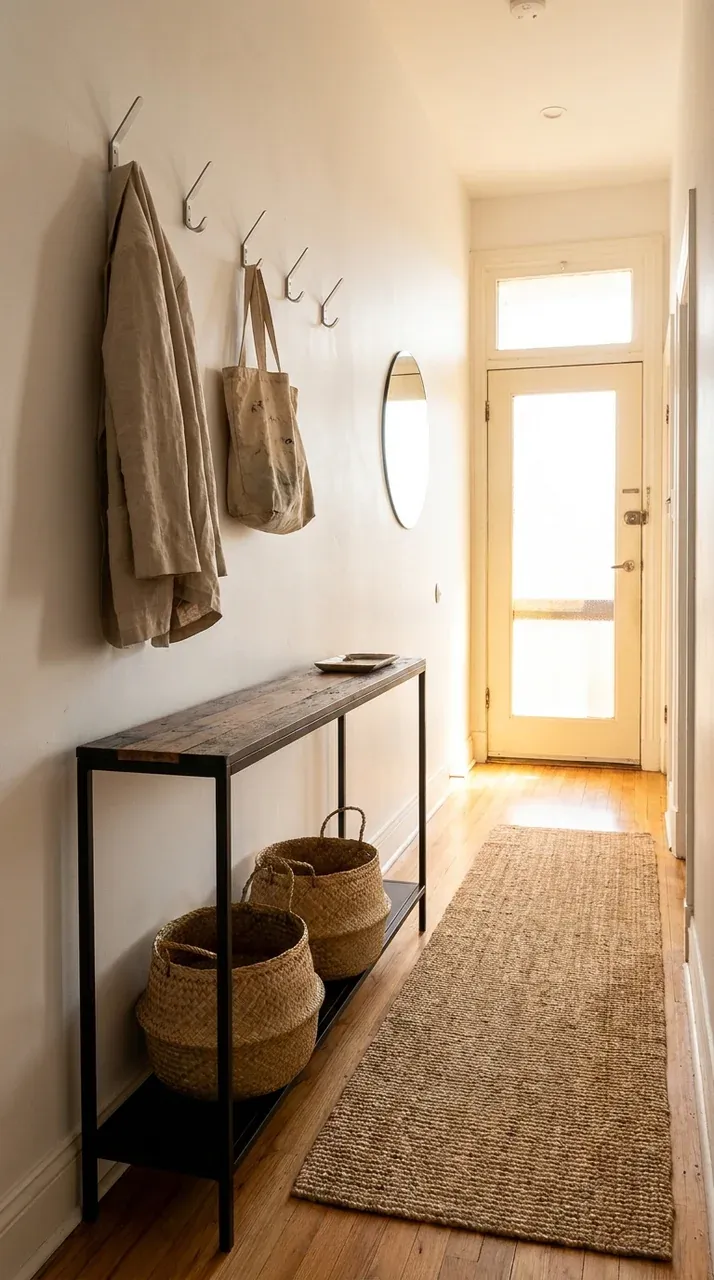
Image: a 10-12 inch console plus hooks and baskets can replace a bulky hall tree in a narrow apartment entry.
Room-by-Room Layouts
Studio apartment
Use one long wall for floor-to-ceiling storage, keep the bed on the opposite wall, and put a slim cart in the kitchen gap. The goal is a clear path from the door to the window. Measure the path before adding any furniture.
One-bedroom
Put the heaviest storage in the bedroom closet and the entryway, and keep the living room walls for shallow shelves. Under-bed bins handle off-season items so the closet can hold daily clothes.
Shared apartment
Label shared bins and keep personal storage in closed containers. A 2 x 4 cube unit with four bins per person is often enough for entryway and living room overflow. Avoid open shelves for shared small items; they become visual noise.
The 24-Inch Rule
The most useful number in small-apartment planning is 24 inches: the minimum clear walkway for one person. If a storage piece leaves less than that, it will feel wrong every day, even if it looks right in a photo.
Measure the narrowest point between:
- The door swing and the nearest wall.
- The kitchen counter and the refrigerator.
- The bed and the closet door.
- The sofa and the coffee table.
If a piece fails the 24-inch test, choose a shallower version or move it to another wall. Storage that blocks movement is not storage; it is an obstacle.
What to Buy First
Spend in this order:
- Under-bed bins if you have a bed frame with clearance.
- Over-door hooks if you have doors and no entryway closet.
- A slim rolling cart if you have a narrow gap in the kitchen or bathroom.
- A cube system if you need visible, flexible storage in the living room.
- Wall shelves last, because they require the most measuring and anchoring.
A budget-friendly place to start
Costway’s storage and organization range includes slim carts, stackable bins, shoe racks, and small-space furniture at factory-direct prices. Affiliate link: we may earn a commission at no extra cost to you. Measure your gap and walkway before ordering; the dimensions on the product page matter more than the lifestyle photo.
For entryway-specific layouts, see our small entryway storage guide and apartment hall tree picks. If you are organizing a narrow corridor, the narrow hallway storage guide has more depth math.
Bottom Line
The best small-apartment storage is vertical, shallow, and movable. Start with the pieces that use existing surfaces—doors, walls, under the bed, and narrow gaps—before buying another freestanding unit. Keep 24 inches clear, measure the internal dimensions, and anchor anything taller than your waist.
For a complete buying sequence that avoids duplicate purchases, read our simple tidying buying guide.
Shop Entryway Furniture & Storage Deals on Costway
Factory-direct pricing on entryway benches, shoe cabinets, hall trees, and organizers with fast, free US delivery.
* Affiliate disclosure: We may earn a commission if you shop through this link at no added cost to you.
Check Costway Entryway DealsFrequently Asked Questions
What is the best storage solution for a studio apartment?
A floor-to-ceiling wall system with closed and open storage, plus under-bed bins, is the best studio solution. It uses the one wall most studios have and keeps the center of the room open. Choose a shallow 12-15 inch depth so the room still feels passable.
How much walkway should I leave in a small apartment?
Keep at least 24 inches of clear walkway for one person and 36 inches for two people passing. In a studio, 30 inches is a comfortable compromise. Measure the narrowest point, not the average width of the room.
Are tension rods renter-friendly?
Yes, if the rod is rated for the load and the wall surface is sound. Tension rods work best inside closets, between cabinets, and under a desk. Do not use them for heavy coats, shelving, or anything that could fall on a person.
What should I do with the space above my door?
Use it for lightweight, seasonal, or rarely used items. A shallow shelf 6-8 inches deep above the door adds storage without reducing walkway. Keep the shelf at least 2 inches below the ceiling and secure it to studs.
Is it worth buying furniture with built-in storage?
Yes when the piece replaces furniture you already need, such as a bed, bench, or coffee table. It is not worth it when the storage cavity is small, hard to reach, or forces you to remove the piece from the room to access it. Measure the internal cavity before buying.