
15 Cute and Cheap Home Organizers That Maximize Small Spaces on a Budget
15 cute and cheap home organizers under $25 that actually maximize small spaces—entryway, closet, bathroom, desk, and kitchen picks with real dimensions.
Published · Updated · Linda Wise
8 min readLast updated: November 6, 2026 | Reviewed by: Linda Wise, managing editor
Small-space organizing fails for a predictable reason: people buy containers before they measure the space between the door and the wall. Then the cute bin arrives, does not fit, and becomes clutter with a lid.
The 15 picks below are chosen for a better ratio: usable space saved per dollar spent. Every one is inexpensive, easy to find, and small enough to fit an apartment. Prices are planning ranges, not quotes.
The 15 Picks at a Glance
| # | Organizer | Typical price | Best for | Space it saves |
|---|---|---|---|---|
| 1 | Collapsible fabric cube | $6-$12 | Entryway shelf | Hides loose items |
| 2 | Over-door hook rack | $8-$15 | Entryway, bedroom | Uses door width |
| 3 | Woven basket | $10-$20 | Entryway, living room | Corrals visual clutter |
| 4 | Shoe slot organizer | $10-$18 | Closet floor | Doubles shoe capacity |
| 5 | Hanging closet organizer | $15-$25 | Closet | Adds shelf tiers |
| 6 | Clear stackable drawer | $15-$25 | Bathroom, desk, vanity | Adds vertical layers |
| 7 | Acrylic cosmetic organizer | $10-$20 | Bathroom, vanity | Divides small items |
| 8 | Adhesive wall hooks | $6-$12 | Entryway, bathroom | Frees counter space |
| 9 | Lazy Susan turntable | $8-$15 | Kitchen, bathroom | Reaches back corners |
| 10 | Drawer divider set | $8-$15 | Clothing, utensils | Stops drawer sprawl |
| 11 | Shelf riser | $10-$18 | Kitchen, pantry | Creates a second level |
| 12 | Slim rolling cart | $20-$30 | Kitchen, entryway | Fits narrow gaps |
| 13 | Cable clips | $5-$10 | Desk, media area | Stops cord tangles |
| 14 | Under-bed storage bag | $10-$20 | Bedroom | Uses hidden volume |
| 15 | Label maker or label set | $10-$20 | Whole home | Keeps systems working |
Entryway and Living Room Organizers (1-3)
1. Collapsible fabric cube
A standard 11 x 11 x 11 inch cube fits most cube shelving and hall-tree cubbies. Collapsible models fold flat when you move, which makes them ideal for renters. Choose a bin with a reinforced bottom panel and a handle that is sewn through the fabric, not glued on.
Fit rule: the cube should be at least 0.5 inch narrower than the opening. If the bin scrapes both sides, it will tear at the corners.
Best for: hats, gloves, scarves, pet supplies, and kids’ toys. Avoid them for wet boots or heavy tools.
2. Over-door hook rack
This is the highest-value organizer in this list because it uses a surface you already have: the back of a door. A good rack has padded hooks, a narrow profile, and a width that clears the door frame.
Fit rule: leave at least 1 inch between the door and the frame so the rack does not rub. Do not hang more than the rated load; doors are not structural anchors.
Best for: coats, bags, towels, and robes. Keep heavy backpacks on a wall stud instead.
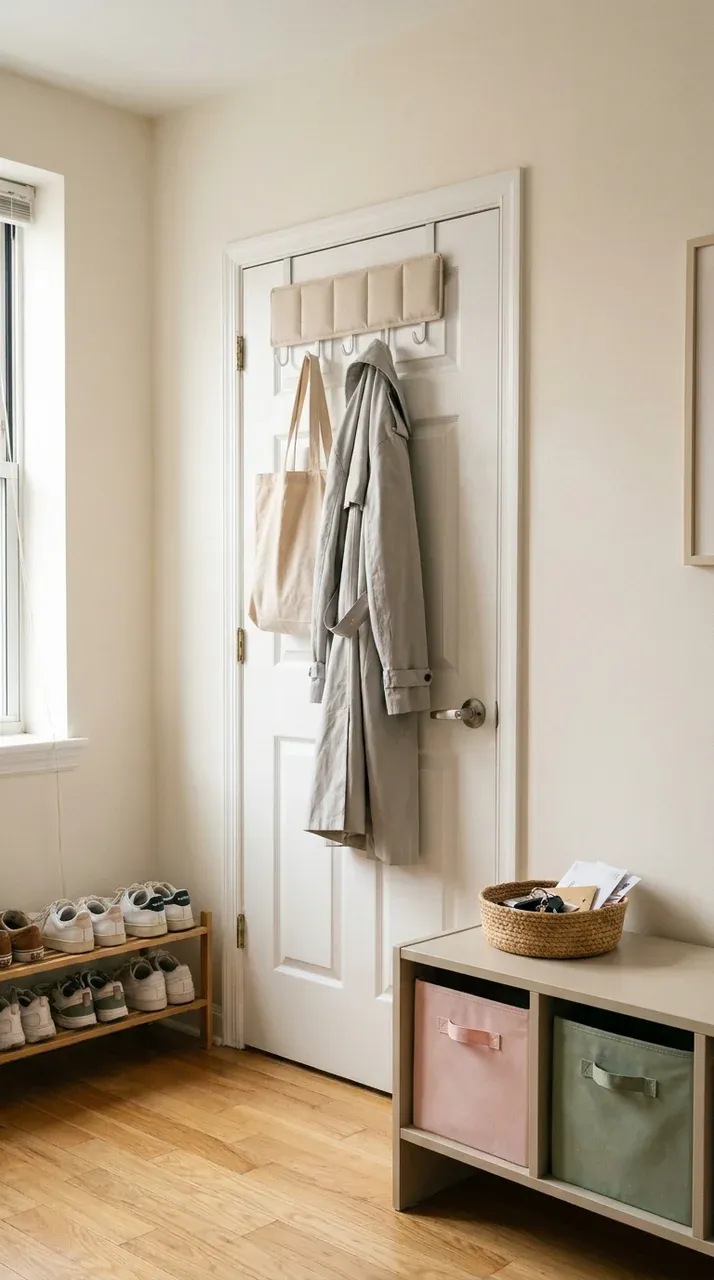
Image: use the door, the wall, and the vertical space above the floor before buying another piece of furniture.
3. Woven basket
A woven basket is the “pretty” version of a junk drawer. Use it for items that need to be contained but not perfectly folded: throws, dog toys, mail, or kids’ shoes. Look for a stiff rim and a flat bottom.
Fit rule: baskets without a firm base collapse when loaded. Choose one with a reinforced bottom or add a cut-to-fit cardboard insert.
Best for: living room throws, entryway odds and ends, and toy storage.
Closet Organizers (4-5)
4. Shoe slot organizer
A shoe slot is a simple plastic frame that lets one shoe sit on top of another. A set of 10 typically doubles the usable floor space of a small closet for less than the price of a single pair of sneakers.
Fit rule: check the slot height against your tallest boot. Most standard slots fit shoes up to 4.5 inches tall; boots need a different system.
Best for: sneakers, flats, sandals, and low heels. Not for tall boots or heavy work boots.
5. Hanging closet organizer
A hanging organizer with three to five shelves adds instant vertical storage without drilling. The weak point is the top bar: choose one with a wide, reinforced hanger loop rather than a thin wire hook.
Fit rule: leave 2 inches between the organizer and the closet wall so air can circulate and clothes do not bunch.
Best for: folded sweaters, bags, hats, and off-season accessories.
Bathroom and Vanity Organizers (6-8)
6. Clear stackable drawer
A two- or three-drawer acrylic or PP unit turns one shelf into three. Clear fronts make the contents visible, which is the whole point in a small space. Look for drawer stops and a reinforced frame; the cheapest units bow when full.
Fit rule: measure the drawer’s internal height. A 4-inch drawer will not hold a standard shampoo bottle standing up.
Best for: bathroom vanities, desk supplies, skincare, and small pantry items.
7. Acrylic cosmetic organizer
A modular acrylic organizer with drawers and dividers keeps small items visible and contained. Choose one with a closed back so items do not slide out, and avoid stacking heavy bottles on top.
Fit rule: measure the tallest bottle you own. A 6-inch organizer will not fit a family-size shampoo.
Best for: skincare, makeup, dental supplies, and hair accessories.
8. Adhesive wall hooks
Adhesive hooks are not all equal. The best hold 5-10 pounds on smooth tile or glass and remove cleanly with a pull-tab. They fail on textured walls, damp grout, and painted drywall.
Fit rule: clean the surface with rubbing alcohol and let it dry completely. Wait 24 hours before hanging anything.
Best for: loofahs, towels, squeegees, and small caddies.
Kitchen Organizers (9-12)
9. Lazy Susan turntable
A turntable earns its place in any deep cabinet. The best ones have a raised rim, a smooth-bearing base, and a diameter that leaves 1 inch of clearance from the cabinet wall.
Fit rule: measure the cabinet’s internal depth and subtract 2 inches. A turntable that touches the door will jam.
Best for: oils, spices, condiments, supplements, and cleaning supplies.
10. Drawer divider set
Drawer dividers stop the “everything slides forward” problem. Spring-loaded dividers are renter-friendly and adjustable; adhesive dividers are cheaper but permanent. Measure the internal drawer depth before ordering.
Fit rule: leave at least 2 inches between dividers so your hand can reach in.
Best for: utensils, socks, underwear, and craft supplies.
11. Shelf riser
A wire or acrylic riser creates a second tier inside a cabinet or pantry. It is the cheapest way to use the empty air above short items. Choose a riser with legs that do not wobble and a width that matches your shelf.
Fit rule: the top tier needs at least 6 inches of clearance to the shelf above. Otherwise you have created a display shelf, not storage.
Best for: cans, mugs, plates, and pantry boxes.
12. Slim rolling cart
A 5-7 inch wide rolling cart fits the gap beside a refrigerator, washer, or bathroom vanity. Look for locking casters and a steel frame; plastic carts flex when loaded with cans or cleaning bottles.
Fit rule: measure the gap at the narrowest point, including baseboards and door trim. Add 0.5 inch for the cart’s wheels.
Best for: cleaning supplies, spices, snack bars, and bathroom refills.
Desk Organizers (13)
13. Cable clips
Cable clips cost less than a coffee and solve one of the most visible kinds of clutter. Adhesive clips work on desks and baseboards; screw-mounted clips are better for permanent setups.
Fit rule: match the clip diameter to the cable. A 0.2-inch clip will not hold a thick monitor cable.
Best for: charging cables, lamp cords, and TV wires.
Bedroom and Whole-Home Organizers (14-15)
14. Under-bed storage bag
A low-profile bag turns the dead space under a bed into a seasonal closet. Choose one with handles on both ends, a zipper that runs around three sides, and a breathable fabric if you are storing textiles.
Fit rule: measure the bed frame’s clearance. Most bags need 6-8 inches; platform beds with drawers may have none.
Best for: off-season clothes, extra bedding, and shoes.
15. Label maker or label set
Labels are the difference between a system and a pile. A simple label maker or a set of removable labels helps everyone in the house put things back in the same place.
Fit rule: label the bin, not the lid. Lids get swapped; bins stay put.
Best for: pantry bins, toy storage, craft supplies, and linen closets.
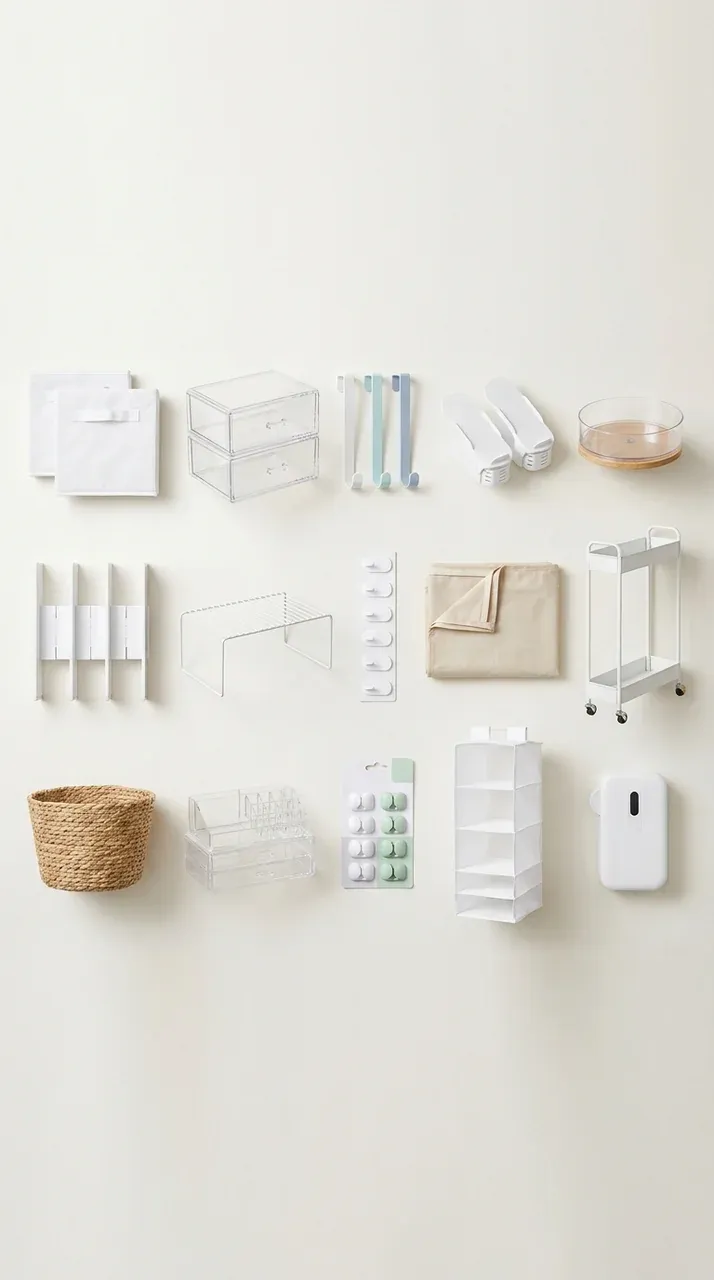
Image: buy one category at a time, label it, and live with it for a week before adding more.
How to Make Cheap Organizers Look Cute, Not Chaotic
- Pick one color family. Clear, white, natural woven, or a single pastel. Mixing all four is what makes budget storage look like a dorm room.
- Remove stickers and brand tags. A 30-second peel makes a $6 bin look like part of a set.
- Use matching labels. A simple label maker is the cheapest “design” upgrade in this guide.
- Leave breathing room. Fill bins to about 80% so they slide easily and do not bulge.
- Group by zone, not by product type. A bathroom bin should hold bathroom things, not a random mix of office and kitchen items.
- Hide the ugly stuff. Use opaque bins on open shelves and clear bins inside drawers or cabinets.
What Not to Buy
- Sets with non-standard sizes. If you cannot buy a replacement bin later, the set becomes disposable.
- Thin fabric bins with glued handles. They fail first and look tired fast.
- Deep drawer towers in narrow closets. They block the aisle and make the back unreachable.
- Adhesive shelves on painted drywall. They fall, usually at the worst time.
- Specialty gadgets for one item. A banana slicer has nothing on a good drawer divider.
A $50 Starter Plan
If you are starting from zero, spend it like this:
- $12 — two collapsible fabric cubes for the entryway shelf.
- $10 — one over-door hook rack for coats and bags.
- $12 — one lazy Susan for the kitchen cabinet.
- $8 — one set of drawer dividers.
- $8 — one pack of adhesive hooks and cable clips.
That covers the entryway, kitchen, and desk for about the price of one “organizer set” that may not fit your space.
Where to shop the budget picks
Costway’s home organization section carries folding storage bins, stackable baskets, shoe racks, and slim utility carts at factory-direct prices. Affiliate link: we may earn a commission at no extra cost to you. Check the external dimensions and load rating before ordering, especially for rolling carts and shoe racks.
For more sizing help, see our storage bin fit guide and our small apartment storage playbook.
Bottom Line
Cheap organizers work when they are measured, grouped, and labeled. The container is only the hardware; the system is what keeps the room tidy. Start with the five highest-impact pieces—cubes, over-door hooks, a turntable, drawer dividers, and a slim cart—then add more only after you know what actually accumulates.
If you want the full room-by-room approach, pair this list with our simple tidying buying guide.
Shop Entryway Furniture & Storage Deals on Costway
Factory-direct pricing on entryway benches, shoe cabinets, hall trees, and organizers with fast, free US delivery.
* Affiliate disclosure: We may earn a commission if you shop through this link at no added cost to you.
Check Costway Entryway DealsFrequently Asked Questions
What is the best cheap organizer for a small apartment?
A clear stackable drawer set or a slim three-tier rolling cart gives the most usable storage per dollar. Both add vertical capacity, fit in narrow gaps, and can move from room to room. Choose the drawer set for bathroom or desk items and the cart for kitchen or entryway supplies.
Are dollar-store storage bins worth buying?
Sometimes. Buy them for lightweight items such as socks, craft supplies, or seasonal decorations. Skip them for heavy tools, pantry staples, or anything that will be pulled daily. Check the bottom of the bin for a recycling code and avoid thin bins with glued-on handles.
How do I make cheap organizers look expensive?
Use one color family, remove manufacturer labels, group items by zone, and leave a little empty space between bins. Matching labels and a single style of basket do more for the look than expensive containers. Avoid mixing clear plastic, bright fabric, and wire in the same visual zone.
How many storage bins should I buy?
Buy one bin per category, not one per item. Start with three to five bins for a small room, label them, and live with the setup for a week before buying more. This prevents the common mistake of buying a matching set before you know the real volume of each category.
What organizer is best for a narrow entryway?
An over-door hook rack plus a slim shoe rack or a wall-mounted key shelf saves the most floor space. Keep the walkway at least 24 inches clear. If you have wall space, a shallow 6-8 inch shelf above the door line adds storage without reducing the walking lane.