15 Cube Storage Ideas That Actually Transform Any Room
Discover 15 cube storage ideas that work in every room — from living rooms and bedrooms to kids' rooms and home offices. Expert tips on styling, sizing, and selecting the best 6-cube organizer for your space.
Aug 11, 2026 · Linda Wise
5 min readLast Updated: August 11, 2026 | Reviewed by: Linda Wise, Senior Home Organization Editor Recommendations based on hands-on testing, verified manufacturer specs, and real-world room styling trials.
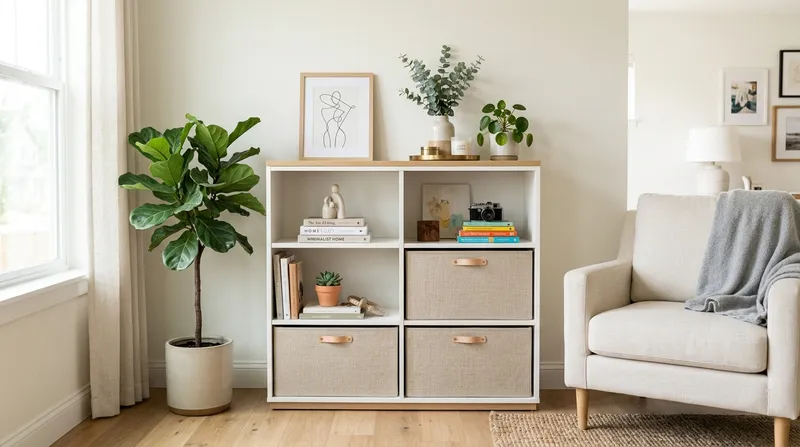
Walk into any well-organized home and you’ll almost always find a cube storage unit doing serious work in the background. It holds the living room together. It quietly replaces the dresser in the bedroom. It keeps the playroom from descending into chaos. It does all of this while looking like a deliberate design choice — not a last-minute fix.
The problem is that most people underuse them. They buy a 6-cube storage organizer, fill every slot with a matching bin, and wonder why the room still feels cluttered. The styling matters as much as the storage.
This guide covers 15 cube storage ideas across every room in the home, backed by real-world testing and practical design principles. By the end, you’ll know exactly which configuration works for your space, which bins to choose, and how to style the unit so it looks like it belongs there.
Our Top Pick: The 6-Cube Storage Organizer
Before diving into ideas, here’s the unit we recommend as the foundation for most of the setups in this guide.
⭐ Best Overall: 6-Cube Storage Organizer — Check Price on Amazon
A versatile 2×3 modular cube organizer that can be configured horizontally as a low console or vertically as a tall bookcase. Engineered wood construction with a clean finish that works in living rooms, bedrooms, offices, and kids’ rooms alike. Compatible with standard 11-inch fabric bins.
| Spec | Detail |
|---|---|
| Configuration | 2×3 grid (6 cubes total) |
| Orientation | Horizontal or vertical |
| Cube Opening | ~12” × 12” internal clearance |
| Best For | Living rooms, bedrooms, offices, kids’ rooms |
| Bin Compatibility | Standard 11” fabric or woven bins |
→ View the 6-Cube Storage Organizer on Amazon
Why Cube Storage Works (The Core Principle)
Every great cube storage idea is built on one insight: a grid of equal-sized compartments is the most psychologically satisfying organization format available. Unlike random shelving — where items compete for visual dominance — cube storage imposes a uniform, ordered frame around everything inside it.
This works for three structural reasons:
- Containment without effort. Each cube is its own bounded zone. Items can’t “spill” into adjacent categories the way they do on open shelves.
- Scalability. Stack another unit on top or beside it. The grid simply expands.
- Bin compatibility. Standard cube organizers accept universally sized fabric bins, which means you can swap, rearrange, and upgrade without buying a new unit.
With that foundation established, let’s get into the ideas.
Living Room Cube Storage Ideas

Idea 1: The Horizontal Media Console
Lay your 6-cube organizer on its side in a 3-wide × 2-tall configuration and place it beneath a wall-mounted TV. This creates a media console with six accessible compartments for remotes, gaming controllers, cables, and streaming device accessories.
The styling formula:
- Bottom row: Three closed linen bins for cable management, DVDs, and gaming accessories
- Top row: One open cube for a decorative tray, one for a small plant, one for a framed photo or small sculpture
This is one of the most effective cube storage living room setups because it serves a functional purpose (media storage) while simultaneously acting as an intentional design element.
Pro tip: Run cable management sleeves through the back panel access points to hide power strips and HDMI cables. The closed bins conceal everything unsightly; the open top row draws the eye upward toward the screen.
Idea 2: The Room Divider Configuration
Stack two 6-cube units in a 4-wide × 3-tall arrangement to create a half-height room divider between an open-plan living area and a home office or dining zone. This is one of the most underused cube shelving ideas in open-plan homes.
Configuration notes:
- Face the living room side with decorative open displays
- Face the home office side with practical closed-bin storage for supplies, files, and tech accessories
- Leave the very top row open on both sides for plants that soften the visual boundary
The divider creates visual separation without installing a wall. Light still flows through above the unit, keeping the space from feeling boxed in.
Idea 3: The Entryway Drop Zone
A single 6-cube organizer positioned in a wide entryway functions as a catch-all drop zone with built-in visual order. Use a horizontal layout to keep the silhouette low and welcoming.
Assign each cube deliberately:
- Cube 1: Keys, mail, and sunglasses (open or with a small tray insert)
- Cube 2: Dog leash, pet supplies bin
- Cube 3: Charging station bin with cable cutout
- Cube 4: Shoes (lower row, open access)
- Cube 5: Shoes (lower row, open access)
- Cube 6: Umbrella and seasonal items bin
For more structured entryway storage ideas, the principles in our storage room ideas guide apply directly to entryway cube setups.
Idea 4: The Styled Bookcase
A 6-cube unit oriented vertically (2-wide × 3-tall) becomes a streamlined bookcase that combines functional storage with curated display. This is the most aesthetically flexible of all the cube organizer ideas because the ratio of open to closed cubes can be adjusted easily.
The 60/40 display rule:
[Open: Books + Plant] [Closed: Linen Bin]
[Closed: Linen Bin] [Open: Art + Object]
[Open: Books + Tray] [Closed: Linen Bin]
Use a consistent color for all three bins (natural linen, charcoal felt, or black canvas) and vary the open-cube contents for visual rhythm. This prevents the finished result from looking either too sparse or too busy.
Bedroom Cube Storage Ideas

Idea 5: The Open Wardrobe System
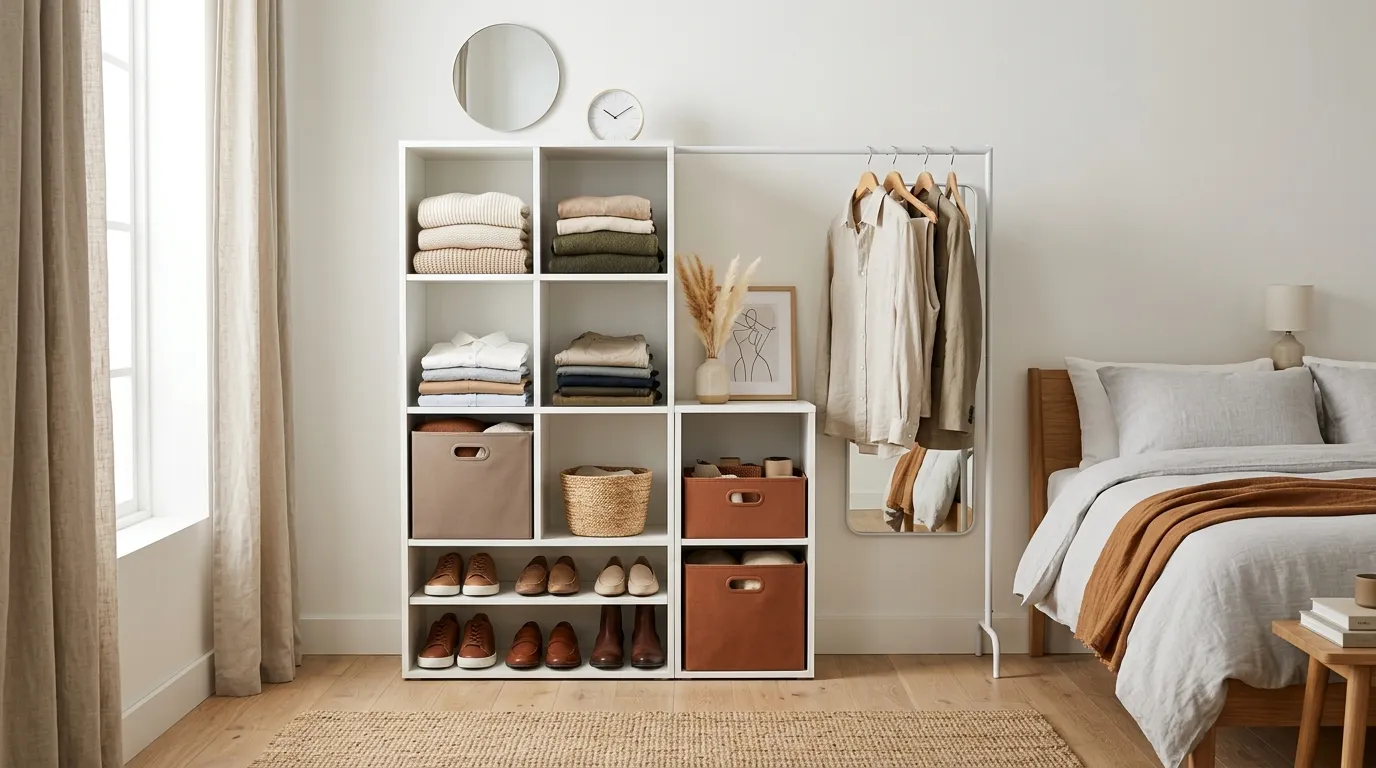
In smaller bedrooms without a built-in closet — or in rooms where the closet space is already maxed out — a 6-cube storage organizer oriented vertically makes an excellent open wardrobe system.
Load layout by weight (top to light, bottom to heavy):
| Row | Cube Left | Cube Right |
|---|---|---|
| Top (row 1) | Folded sweaters / light knits | Folded t-shirts |
| Middle (row 2) | Fabric bin: socks & underwear | Fabric bin: accessories |
| Bottom (row 3) | Shoes (direct, open access) | Shoes (direct, open access) |
This setup gives you an at-a-glance view of your entire folded wardrobe and eliminates the “I can’t find anything” frustration of overstuffed dresser drawers.
Weight note: Never overload the top cubes of a freestanding unit. Place heavier items at waist level or below to keep the unit’s center of gravity low and prevent tipping. If you’re loading it heavily, anchor it to the wall using a furniture safety strap.
Idea 6: The Nightstand Alternative
A 1×2 or 2×2 section of a cube unit — or a dedicated small cube organizer — works brilliantly as a nightstand alternative in rooms where standard bedside tables feel too bulky.
Cube nightstand setup:
- Top surface: Lamp, phone charger, water glass (use a cable cutout at the back)
- Upper cube: Books and Kindle
- Lower cube: Sleep essentials bin (sleep mask, earplugs, lip balm, hand cream)
This gives you double the storage of a traditional nightstand drawer while maintaining a clean, uncluttered top surface.
Idea 7: The Under-Bed Companion
Pair your vertical cube organizer with horizontal flat-profile bins that slide under the bed. While not cube storage in itself, this dual-system approach is one of the most efficient cube storage bedroom strategies for small rooms.
Use the cube organizer for daily-access items and the under-bed zone for seasonal clothing, extra bedding, and rarely used items. Together they eliminate the need for a bulky wardrobe, freeing up significant floor space.
Kids’ Room Cube Storage Ideas

Idea 8: The Color-Coded Toy System
This is arguably the most impactful of all cube storage kids room ideas because it leverages a behavioral insight: children are far more likely to put things away when the system is visually obvious and physically easy.
Color-coded category system:
- 🔴 Red bin: Building blocks and LEGO
- 🟡 Yellow bin: Dress-up and role-play accessories
- 🔵 Blue bin: Puzzles and board games
- 🟢 Green bin: Outdoor toys and sports equipment
- 🟠 Orange bin: Art supplies and craft materials
- Open cube: Books (spines facing outward)
Print simple icon labels (a LEGO brick, a paintbrush, a book) and attach them to the front of each bin. Children as young as three can follow this system independently, which means the room tidies itself — with minimal adult intervention.
Idea 9: The Reading Nook Integration
Add a 6-cube organizer beside a floor cushion or bean bag in a corner of the kids’ room to create a dedicated reading nook. The open cubes hold books with spines facing outward (far more visually engaging than stacked flat), while the closed bins hold quiet-time supplies (headphones, fidget tools, small puzzles).
Place a small LED string light along the top of the unit to define the reading corner visually. This creates a zone that children actually want to use — which is the best organizational outcome possible.
Idea 10: The Classroom-at-Home Setup
Homeschool families and parents who set up dedicated homework stations will find the cube organizer ideal as a desk companion. Orient it horizontally beside a child’s desk and assign each cube to a subject or type of supply.
Homework station cube layout:
[ Math + Workbooks ] [ Science + Kits ] [ Open: Plant + Art ]
[ Pencils + Rulers ] [ Art Supplies Bin] [ Spare Paper Stack ]
This makes daily setup and cleanup take under two minutes — the child can pull out the Math cube, do their work, and slide it back in. No hunting. No spreading everything across the floor.
Home Office Cube Storage Ideas
Idea 11: The Behind-the-Desk Storage Wall
A 6-cube organizer positioned directly behind a home office desk — within arm’s reach — creates an instantly accessible storage wall for the items you reach for constantly during the workday.
Office cube assignment:
- Cube 1: Inbox/outbox paper tray insert
- Cube 2: Tech bin (charging cables, adapters, spare earbuds)
- Cube 3: Reference books (upright, spines facing forward)
- Cube 4: Office supply bin (pens, highlighters, sticky notes)
- Cube 5: Archive bin for current project files
- Cube 6: Open display (plant, framed inspiration print, clock)
This system eliminates desk clutter by giving every office item a permanent home that is always within a two-second reach.
Idea 12: The Client-Ready Closet Upgrade
If your home office has a closet, replacing wire closet shelving with cube organizers creates a professional, immediately legible storage system. Use clear-lidded bins inside the cubes for supplies you need to inventory quickly, and label each cube with its category using a simple label maker.
Cube closet categories:
- Branding materials (business cards, presentation folders)
- Shipping supplies (bubble wrap, tape, labels)
- Product samples or client gifts
- Financial documents archive (clearly labeled by year)
- Technology (spare monitors, keyboards, backup drives)
Small Space Cube Storage Ideas
Idea 13: The Staircase Companion
Unused space beside a staircase — particularly in apartments or narrow townhomes — is ideal for a vertical 6-cube unit. The height of the staircase creates visual clearance above the unit, making it feel like a built-in architectural feature rather than furniture placed awkwardly.
Use closed bins for all cubes to maintain a clean, uncluttered silhouette against the wall. A vertical arrangement in a 2-wide × 3-tall format is the most space-efficient for a narrow staircase hallway.
Idea 14: The Bathroom Linen Tower
In bathrooms with no built-in linen closet, a 1×3 or 1×4 tall cube tower beside the toilet or in a corner provides linen storage that looks intentional.
Bathroom tower assignment (top to bottom):
- Top cube: Rolled hand towels and guest toiletries
- Middle cube: Spare toilet paper and cleaning supplies bin
- Bottom cube: Towels (folded, open display)
Use water-resistant bins with sealed seams in this environment. Avoid natural fibers (seagrass, water hyacinth) in high-humidity bathrooms — opt for polyester or treated canvas instead.
Idea 15: The Garage Wall Station
The utility garage is where most cube storage ideas don’t reach — but they should. A pair of 6-cube units in a powder-coated or weather-resistant finish creates a dedicated garage organization wall for tools, sporting equipment, and seasonal gear.
Garage cube assignment:
- Bottom row: Heavy items (toolboxes, car care kits) in metal or rigid plastic bins
- Middle row: Sports gear in clearly labeled canvas bins (one sport per bin)
- Top row: Seasonal items in clearly labeled clear-lidded plastic bins
Seal the back of the unit with a waterproof backing panel if your garage has moisture issues. Always leave a 2-inch air gap between the unit and the concrete wall to prevent moisture wicking.
For full garage and utility room organization, the vertical zoning principles covered in our how to organize a storage room guide apply directly to this setup.
How to Choose the Right Cube Storage Organizer
Not all cube organizers are equal. Before you buy, evaluate these four criteria:
1. Internal Cube Dimension
The internal opening dimension determines which bins you can use. The most common standard is 11 × 11 inches, which accepts the vast majority of fabric bins on the market. Some premium units offer a 13 × 13 inch opening, which accepts larger woven or rattan baskets.
Measure the opening, not the panel — the internal clear dimension is always smaller than the overall panel size.
2. Load Capacity Per Shelf
Engineered wood cube organizers typically support 25–50 lbs per shelf. If you plan to store heavy items (toolboxes, book collections, cast iron), look for units rated at 50 lbs or more per cube. Lightweight units with thin 5/8-inch panels will sag under sustained heavy loads.
3. Back Panel Presence
Units with a solid back panel are significantly more rigid and tip-resistant than open-back units. Open-back units flex under load and must be anchored to a wall to be safe. If you’re using the unit freestanding, always choose a solid-back model.
4. Assembly Hardware Quality
The weakest point in any flat-pack cube organizer is the cam-lock connector hardware. High-quality units use cam locks with a minimum 12mm diameter backed by wooden dowel alignment pins. Budget units use single-point pin connectors that allow panels to rack and wobble under load.
View Our Top-Rated 6-Cube Organizer on Amazon — This unit checks all four criteria: standard 12” openings, 50 lb per-shelf rating, solid back panel, and reinforced cam-lock assembly.
Choosing the Right Bins for Your Cube Storage Unit
The bins you choose change the entire character of a cube storage setup. Here’s a quick material comparison:
| Bin Material | Best For | Avoid If |
|---|---|---|
| Linen / Canvas Fabric | Living rooms, bedrooms, home offices | High humidity, wet gear |
| Woven Seagrass / Rattan | Styled living spaces, natural aesthetic | Wet items, garages |
| Polyester Felt | Kids’ rooms, painted furniture | Pet hair households |
| Rigid Plastic (PETG) | Wet boots, garages, bathrooms | Aesthetics-first spaces |
| Metal Wire | Tool storage, garages, airflow-critical | Delicate painted finishes |
For a deep-dive comparison of bin materials including load testing data and 10-year cost-per-year breakdowns, see our complete storage bins guide.
The 3 Styling Mistakes That Make Cube Storage Look Cluttered
Even a well-organized cube unit can look chaotic if you make these mistakes.
Mistake 1: Using Too Many Bin Colors
Three colors maximum. Most people buy bins in five or six different colors because they match the bins to the items inside — and end up with a rainbow that looks accidental, not intentional. Pick one dominant color and one accent color. Stick to them across every bin in the unit.
Mistake 2: Filling Every Single Cube
An empty cube is not wasted space — it’s visual breathing room. Leave at least one or two cubes in a 6-cube unit open for decor: a small plant, a sculptural object, a framed print. Fully loaded units feel oppressive. Partially open units feel curated.
Mistake 3: Mixing Bin Styles
Combining wicker baskets, fabric cubes, and plastic bins in the same unit creates a visual noise problem. Choose one bin material and use it consistently. If you want visual variety, vary the tone or texture within the same material family (light linen vs. dark linen, for example).
Assembly Tips for a Rock-Solid Cube Organizer
Even a high-quality unit assembled poorly will wobble and eventually fail. Follow these steps for a perfectly stable result:
- Pre-sort all hardware into labeled cups before you start. Mixing cam locks, dowels, and screws mid-build is the most common source of assembly errors.
- Hand-tighten all cam locks first, then go back and fully tighten. Never fully tighten as you go — panels must be perfectly aligned before locking.
- Use a rubber mallet, not a hammer, to seat wooden dowels. Metal hammers crack the engineered wood panel around the dowel hole.
- Lay the unit face-down on a carpeted surface to assemble the back panel. This keeps the face from getting scratched and keeps panels square while you work.
- Check for square by measuring diagonally from corner to corner before the cam locks are fully seated. Both measurements should match within 1/8 inch.
- Anchor to the wall using a furniture anti-tip strap, especially in homes with children. A fully loaded cube unit can exceed 150 lbs — sufficient to cause serious injury if it tips.
Key Cube Storage Tips for Long-Term Success
- Assign before you fill. Decide what category goes in each cube before placing a single item. Retroactively categorizing a full unit is twice the work.
- Label every bin. Even if you “know” what’s inside — label it. The label is for everyone else in the household who will inevitably put things in the wrong place.
- Run a quarterly purge. Every three months, pull every bin out and assess the contents. Remove anything that no longer belongs, discard anything damaged, and redistribute anything that’s in the wrong cube.
- Match the bin size to the cube opening exactly. A bin that’s too small slides around and allows items to fall behind it. A bin that’s too large jams in the opening and damages the panel finish over time. Aim for a 0.5-inch clearance on each side.
- Secure heavy units to the wall. A 6-cube organizer loaded with books, tools, or heavy bins can exceed 150 lbs. An anti-tip strap anchored to a wall stud costs under $10 and prevents a potentially dangerous tip-over.
Cube storage is one of the few organizational systems that gets better as your needs grow — you simply add another unit, and the grid expands. But the ideas above only work if you commit to the most important principle: assign every cube a fixed category, give every item inside that cube a fixed home, and enforce those assignments consistently.
Do that, and your cube storage unit will still look as intentional in five years as it does on day one.
Frequently Asked Questions
What is the best cube storage organizer for a living room?
The best cube storage organizer for a living room is a 6-cube unit in a neutral finish (white, natural wood, or black) that can be oriented horizontally as a media console or vertically as a shelving unit. Look for units with adjustable cube openings of at least 12x12 inches to accommodate standard fabric bins. Style half the cubes with closed bins for clutter concealment and leave the others open for decorative displays.
What size bins fit a cube storage organizer?
Most standard cube storage organizers have internal openings of 11x11 to 13x13 inches. The most common size for fabric or woven bins is 11 inches square. Always measure the internal opening of your specific unit before purchasing bins — target bins that are 0.5 to 1 inch smaller than the opening on each side for easy sliding.
How do you style a cube storage unit?
Style a cube storage unit using the 60/40 rule: fill 60% of cubes with closed storage bins for functional concealment, and leave 40% open for decorative items like books, plants, framed art, and sculptures. Use a consistent color palette of 2 to 3 tones across all bins and decor to create a cohesive, curated look rather than visual clutter.
Can you use cube storage in a bedroom?
Yes, cube storage works exceptionally well in bedrooms. A 6-cube organizer can replace a standard dresser, serve as an open closet system for folded clothes and shoes, or act as a nightstand alternative. Use fabric bins for soft goods like sweaters and store shoes directly in the open cubes of the lower row.
What is the difference between a 4-cube and 6-cube storage organizer?
A 4-cube organizer (2x2 grid) is compact and works best in tight spaces like small bedrooms, offices, or as a nightstand. A 6-cube organizer (2x3 or 3x2 grid) offers significantly more storage capacity and greater styling flexibility. It can be oriented horizontally as a low media console (3 wide x 2 tall) or vertically as a tall bookcase (2 wide x 3 tall), making it the more versatile choice.
How do you keep cube storage organized long-term?
To keep cube storage organized long-term: assign a fixed category to each cube and never mix contents, use closed fabric bins for items you don't want to see daily, label the front of each bin, do a 10-minute reset every week to return misplaced items, and apply the one-in-one-out rule — when a new item goes in, a same-category item must come out.
Is cube storage good for a kids room?
Cube storage is one of the best organization solutions for kids' rooms because it is at a child-accessible height, allows for color-coded categorization (one bin per toy category), and grows with the child. Use bold-colored labeled bins for different categories: toys, books, art supplies, and dress-up accessories. The modular format makes it easy to add additional units as their storage needs increase.
Top Picks: Best Entryway Essentials
Editor's shortlist with verified ratings. Prices and availability below — clicking an Amazon link earns us a small commission at no extra cost to you.
| # | Product | Rating | Reviews | Tag | Check Price |
|---|---|---|---|---|---|
| 1 | Vasagle Industrial Entryway Bench | 8,420 | Top Pick | View on Amazon | |
| 2 | Crosley Furniture Seaside Hall Tree | 5,410 | — | View on Amazon | |
| 3 | Seville Classics 12-Pair Shoe Rack | 6,420 | Best Storage | View on Amazon | |
| 4 | Franklin Brass Wall Hooks (5-Pack) | 9,820 | — | View on Amazon | |
| 5 | Simplihome Artisan Solid Wood Bench | 3,127 | Editor's Pick | View on Amazon |
Affiliate disclosure: As an Amazon Associate we earn from qualifying purchases.
Tag: entryway09-20 — change in src/data/topPicks.ts.