
Floating Shoe Shelves: Modern Shoe Storage That Doesn't Touch the Floor
Floating shoe shelves turn dead walls into open, modern shoe storage that uses zero floor space — with honest weight limits, mounting steps, and simple styling.
Jan 30, 2026 · Linda Wise
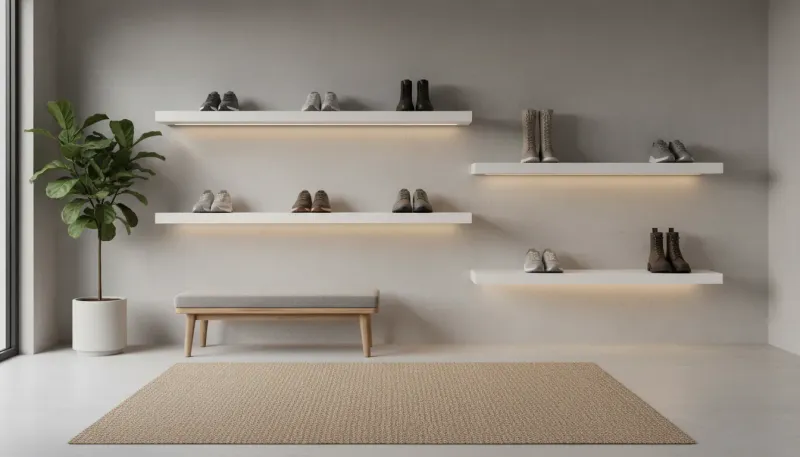
15 min readFloating shoe shelves turn a dead wall into a shoe rack you’ll actually see — which is the point: modern, open, and zero floor space used.
Most entryway clutter isn’t really a shoe problem; it’s a floor problem. Floor-standing racks claim the one strip of floor your door needs, and closed cabinets hide the rotation you actually reach for daily. Moving storage up the wall turns the entryway back into a walk-through space and makes your best pairs part of the design instead of an afterthought.
Are Floating Shoe Shelves a Good Idea? (honest pros & cons)
Yes — for most entryways, with a few honest caveats. The format solves a real problem, but it asks for better habits than a closed cabinet does.
The pro side:
- Zero floor space used. The entryway keeps its square footage for traffic, and narrow corridors feel twice as wide.
- The airy, modern look. A shelf with open floor beneath reads as floating architecture rather than furniture, which is why it suits minimalist and Scandinavian interiors so well.
- Visible rotation. Shoes you can see are shoes you actually wear. The pair you’d normally forget stops becoming a reason to buy duplicates.
- Easy under-shelf cleaning. No legs, no baseboards, no toe kicks — a broom passes straight underneath.
The con side:
- Honest weight limits. A pair of work boots can weigh 3–4 lb, and a shelf rated for display is not a boot rack. Mounting on studs is non-negotiable for heavy rotation.
- Open storage collects dust. Every pair is on display, smudges and all. You’ll dust more than you would behind doors.
- It’s a tripping and clambering hazard for small kids. A low row of shelves looks like a ladder, and shoes at ankle height are exactly where toddlers trip. Mount the bottom row out of reach.
- It demands commitment. Half a wall of floating shelves with three pairs on it looks unfinished, not minimal.
If you’re still weighing open versus closed systems, our look at open vs. closed shoe storage breaks down the dust-and-display trade-offs pair by pair, and vertical shoe storage solutions covers the compromise setups in between.
Floating Shelves for Shoes: DIY vs. Buy
Both routes work; the honest difference is finish quality versus control over sizing.
Buying gets you a tested bracket system and a finished surface. Acrylic “levitating” shelves disappear against the wall for sneaker display, while powder-coated steel gives a clean graphic line. Expect to pay for good hardware — the $20 kits with plastic anchors are where floating shelves get their bad reputation.
Building is where you get exact sizing for awkward spaces. A DIY build is dead simple: a routered solid wood slab, two steel blind-shelf supports driven into studs, and the shelf slides on like a sleeve. It’s also cheaper per linear foot, and you can match your trim or wall tone exactly.
The Single Floating Shoe Shelf
If you’re unsure about committing a whole wall, start with one floating shoe shelf above a bench or beside the door — it’s a 30-minute install, it holds today’s rotation, and it proves the concept before anything gets permanent. A well-done single shelf holds two to three pairs and reads as intentional design rather than a partial project.
For sizing and materials guidance, our ultimate guide to slim shoe storage compares profiles and depths so your shelves don’t stick out into the walkway.
How Many Shoes Per Shelf? (the stacking math)
Let’s do the actual math, because it’s more forgiving than most people assume.
A standard sneaker is roughly 10–12 inches long and 4–5 inches wide. Side by side, two pairs fill a 24-inch shelf in one layer; three pairs fit a 36-inch shelf. Double-stack by turning the inner pair heel-to-heel and you roughly double that — four pairs on a 24-inch shelf, five or six on a 36-inch, without changing the footprint.
Weight follows the same arithmetic. The average pair runs about 1.5–2 lb — most sneakers land at the low end, leather boots at 3–4 lb each pair. That means a 24-inch shelf rated for 25–30 lb on studs has load headroom for 12–15 pairs, far more than the four it physically fits. The load limit is basically never the binding constraint when you mount on studs; it becomes the constraint only on drywall anchors, which is exactly why the mounting section matters.
Vertical spacing matters more than horizontal math. Leave 8–10 inches between shelves for sneakers and flats, and 14–16 inches if boots are in the rotation, or retrieval turns into an annoying shuffle. If shoes still pile on the floor even with shelves on the wall, our practical guide to solving the shoe pile problem covers the rotation habit that actually fixes it.
Weight & Mounting (studs, drywall, heavy boots)
This is the section where setups succeed or fail. A floating shelf is a lever: every inch it projects from the wall multiplies the force on its fasteners, so the bracket — not the wood — is what you’re really buying.
Mounting Guide: Studs First, Anchors Second
| Shelf Length | Max Load (well-mounted on studs) | Max Load (anchor-only drywall) | Best For |
|---|---|---|---|
| 24” | 25–30 lb | 15–20 lb | 2–4 pairs of sneakers or flats, light rotation |
| 30” | 30–35 lb | 18–25 lb | 3–5 everyday pairs, above a bench |
| 36” | 35–40 lb | 20–25 lb | Mixed pairs including light boots |
| 48” | 50–60 lb | 25–30 lb | Heavy rows, double-stacked pairs, boot storage |
Read the load the way the table intends: those stud numbers are conservative, and anchor-only numbers are deliberately modest. At roughly 1.5–2 lb per shoe pair, a 48-inch shelf on studs handles 25–30 pairs of typical sneakers in raw load terms — but it physically fits only about eight, so in practice you’re far from overloading. The anchor-only column is where you earn the caution: heavy boots at the end of a 48-inch span can pull a drywall anchor through the board within months. If you can’t hit a stud, keep the 20+ lb rows on 24-inch shelves, or upgrade to toggle bolts rated at 50 lb or higher.
A few practical rules from installation work:
- Find the studs first. Stud finder or a magnet trick over the drywall screws. Standard studs run 16 inches on center, so a 24- or 30-inch shelf spans at least one; a 48-inch shelf should be anchored to two.
- Span, don’t float. The shelf must sit across at least one stud — a shelf mounted to the wall between two studs is never “well-mounted,” regardless of anchor quality.
- Boots get their own row. Keep boots and platforms on stud-mounted shelves at 36 inches or longer; never on anchor-only shelves.
- Level before you load. Use a level on the mounting bar, then place shoes heel-out so nothing rolls.
Sneakerheads: this is your display case. Parents: this is your tripping hazard — mount high.
Styled Examples for Modern Entryways
The easiest way to make floating shoe shelves look intentional is to treat the wall as a composition, not a rack.
The Scandinavian run. A single 36-inch black steel shelf at ankle height beside a slim bench and mirror, holding four pairs of neutral sneakers heel-out. One shelf, four pairs, zero styling effort — the restraint is the design.
The color-blocked grid. In a walk-in closet, three 30-inch white shelves in a tight grid with pairs arranged by color — white to gray at the bottom, saturated tones above. This is the showcase treatment, and it’s worth the dusting.
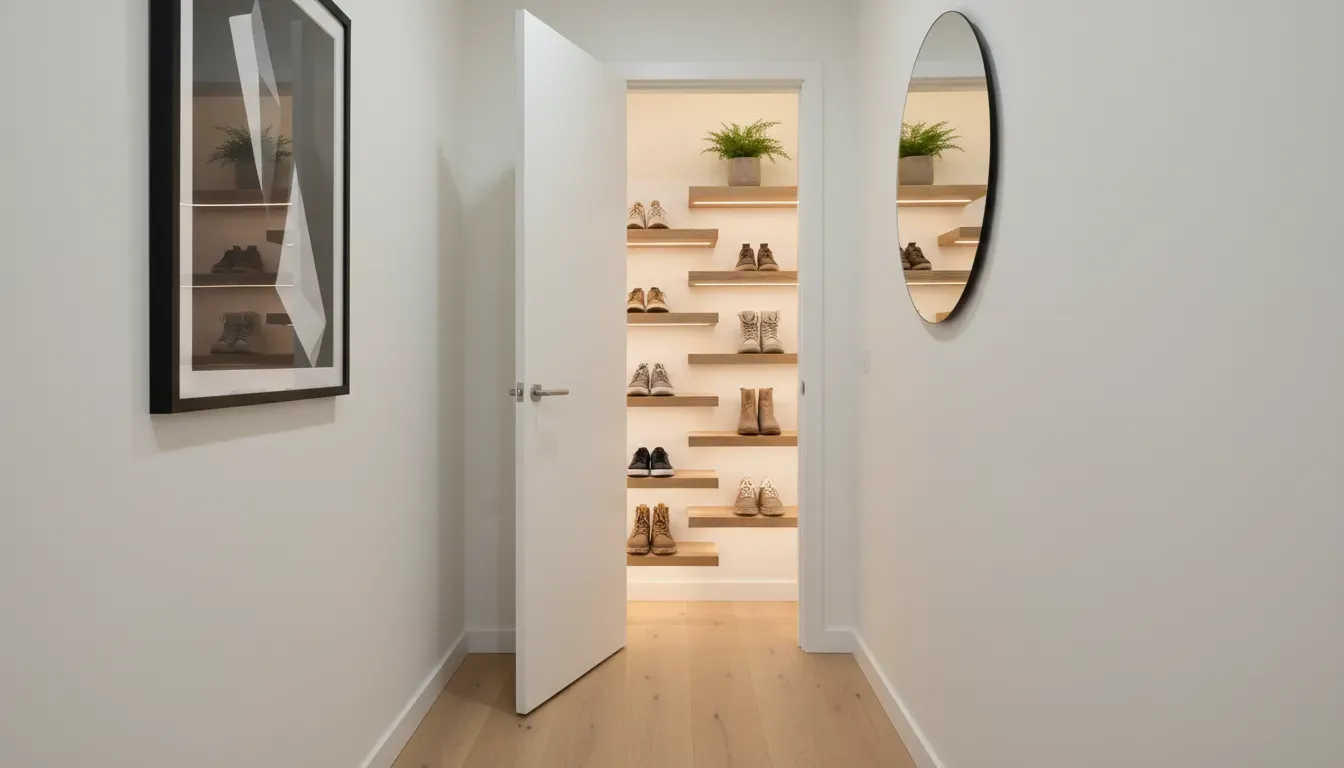
The staggered hallway wall. Three 24-inch oak shelves stepped up a narrow hallway, one pair per shelf, with the tallest shoes on the top step. The stagger draws the eye up and keeps the walkway shoulder-clear even in tight corridors.
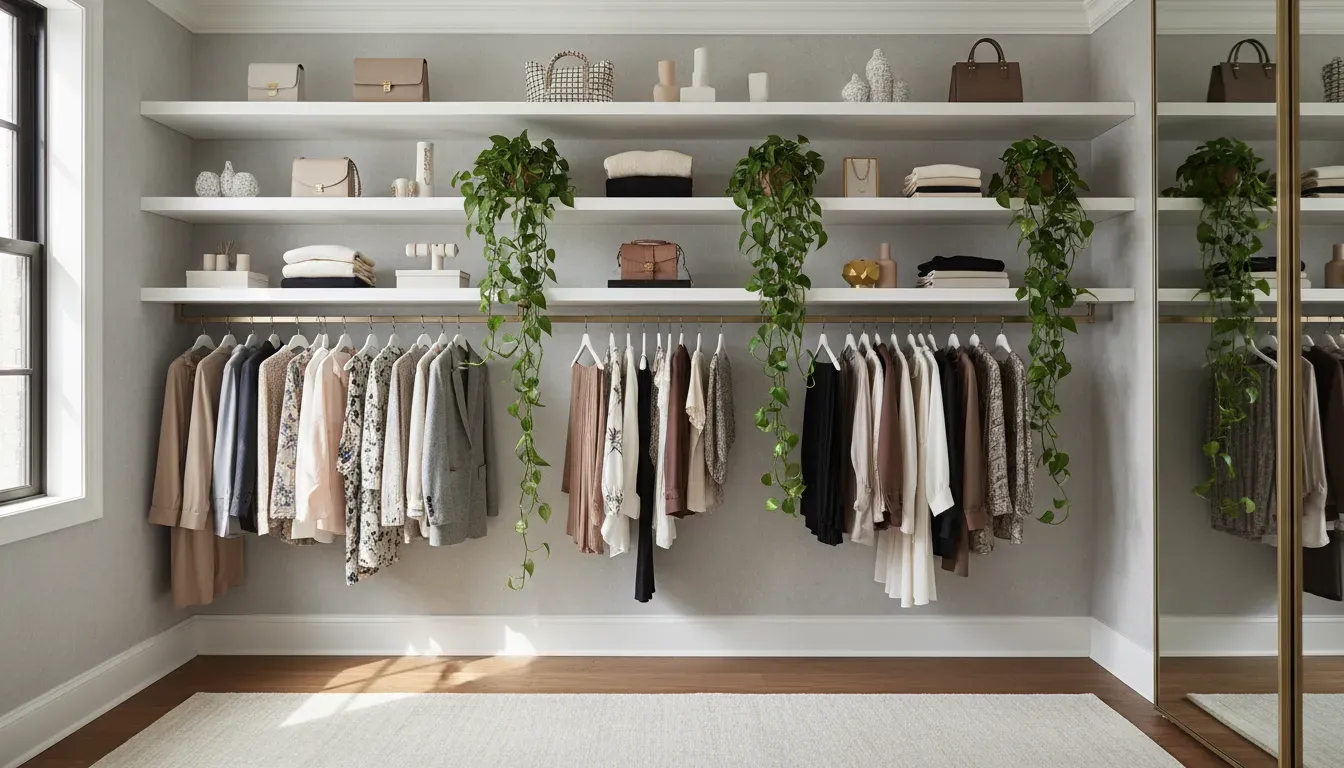
Finish by mixing in one non-shoe object per wall — a small plant, a framed photo — so the arrangement reads as decor instead of stockroom. Keep the bottom row above a toddler’s reach, rotate seasonally with the stack-math above, and the wall will earn its place in the room. Between the honest load numbers and the display factor, floating shoe shelves are one of the rare storage upgrades that recommend themselves once they’re up.
Stop Guessing Measurements. Build Your Dream Entryway with Confidence.
Transform awkward hallways, cramped foyers, and cluttered mudrooms into organized sanctuaries. Includes 20 CAD floor plans, facing real-home photo spreads, the 36-Inch Clearance Rule, the Shoe Pairs Formula, and 7 printable worksheets.
Core Edition ($17.99) · Flagship Photo Edition v5 ($39.99)
