
Narrow Hallway Storage Ideas: 10 Solutions That Keep the Walkway
Narrow hallway storage ideas with a 4-to-10-inch depth budget: bench-free storage solutions for narrow hallways, wall rails, and rental-friendly fixes.
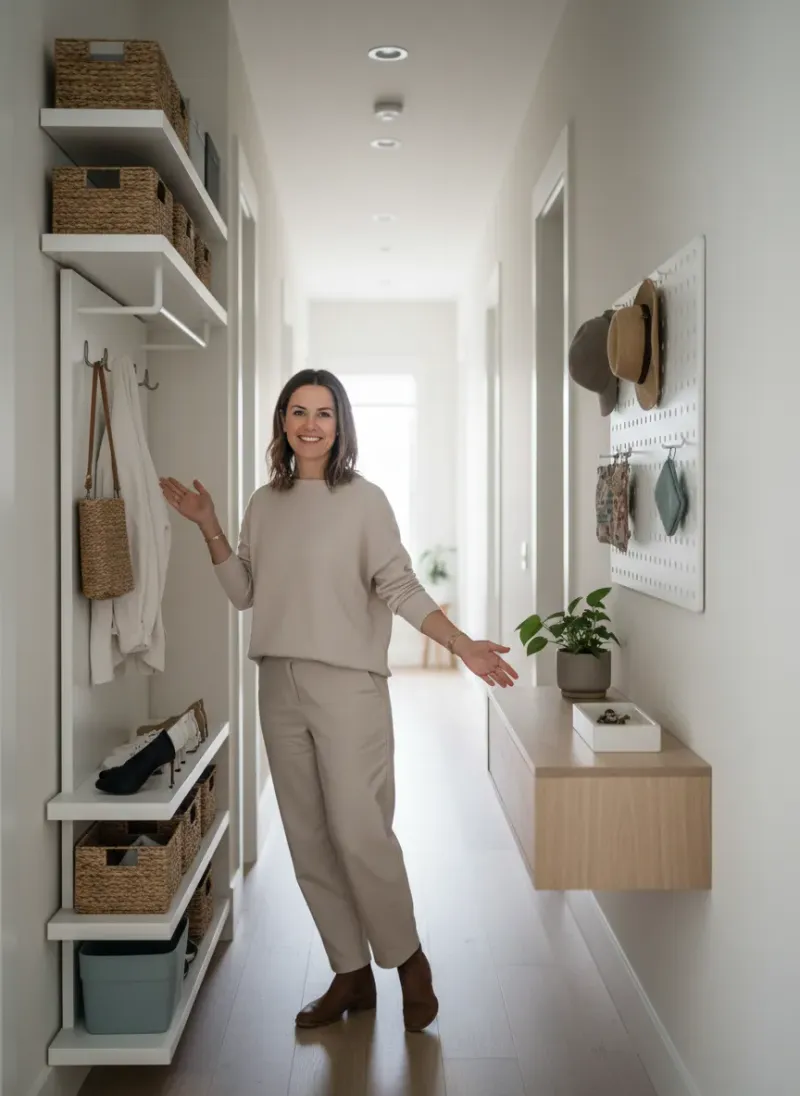
Feb 18, 2026 · Linda Wise
15 min readStorage solutions for a narrow hallway all share one rule: the depth of everything you add can’t exceed the width you’re willing to give up.
Say it once and you’ve said most of the topic: a narrow hallway is not a room you furnish — it’s a corridor you equip. Standard furniture arrives at standard depths — 16, 18, 24 inches — and standard depths are what a corridor can’t afford. A 36-inch hallway loses a third of its walkway to one console. So the whole art is that 4–10 inch zone against the walls: deep enough to hold gear, shallow enough to still feel like a hallway.
Narrow Hallway Storage Ideas (10 that keep walkway)
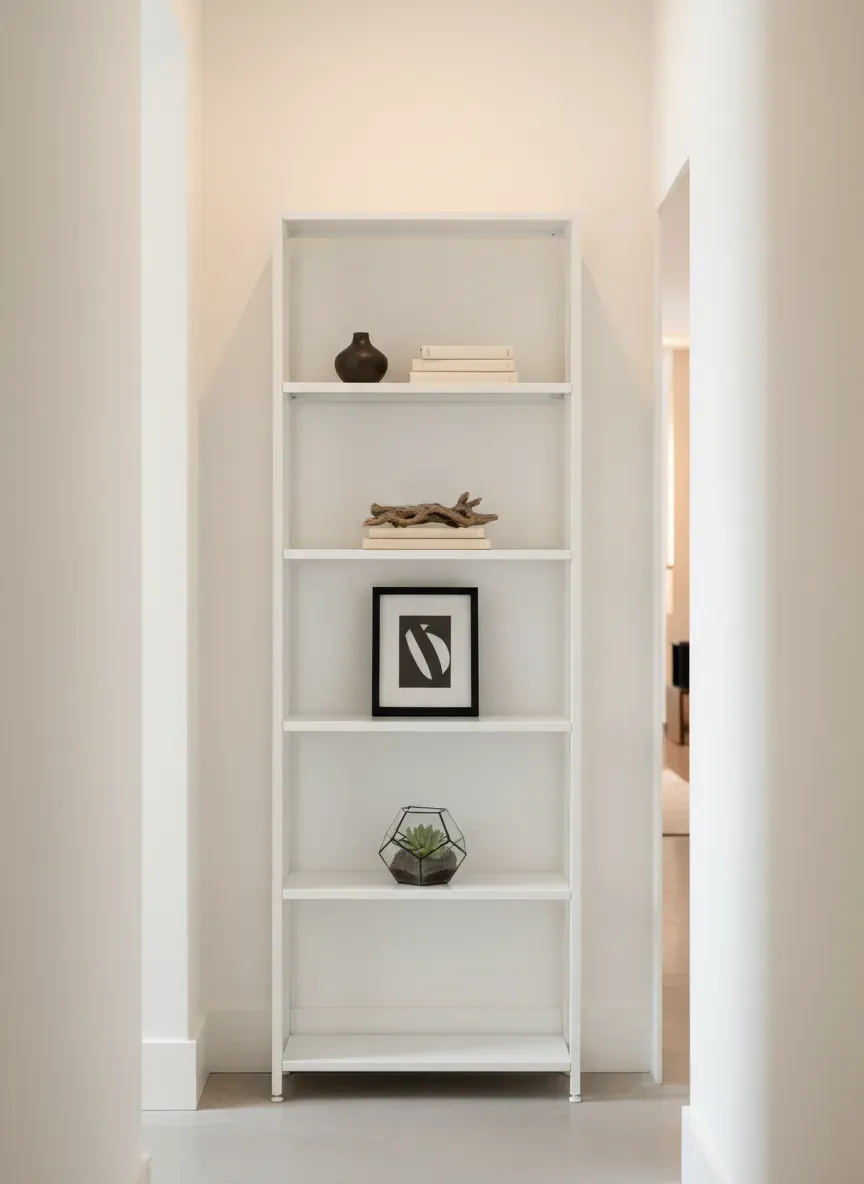
1. The 4-inch floating shelf. A slim shelf mounted at waist height for keys, mail, and one plant pot. Depth: 4”. Why it works: the eye skips past anything shallower than a stride, so it reads as trim, not furniture — and the floor underneath stays open for cleaning and light.
2. The wall rail with hooks. One continuous rail with sliding hooks, run the length of the wall. Depth: 2”. Why it works: coats, bags, and leashes park anywhere along the run, so daily traffic never forms a pile.
3. The tilt-out shoe cabinet. Shoes stored at an angle instead of flat. Depth: 6–7”. Why it works: it’s the only shoe storage that fights the depth war and wins — a dozen pairs in less than half a standard rack’s footprint.
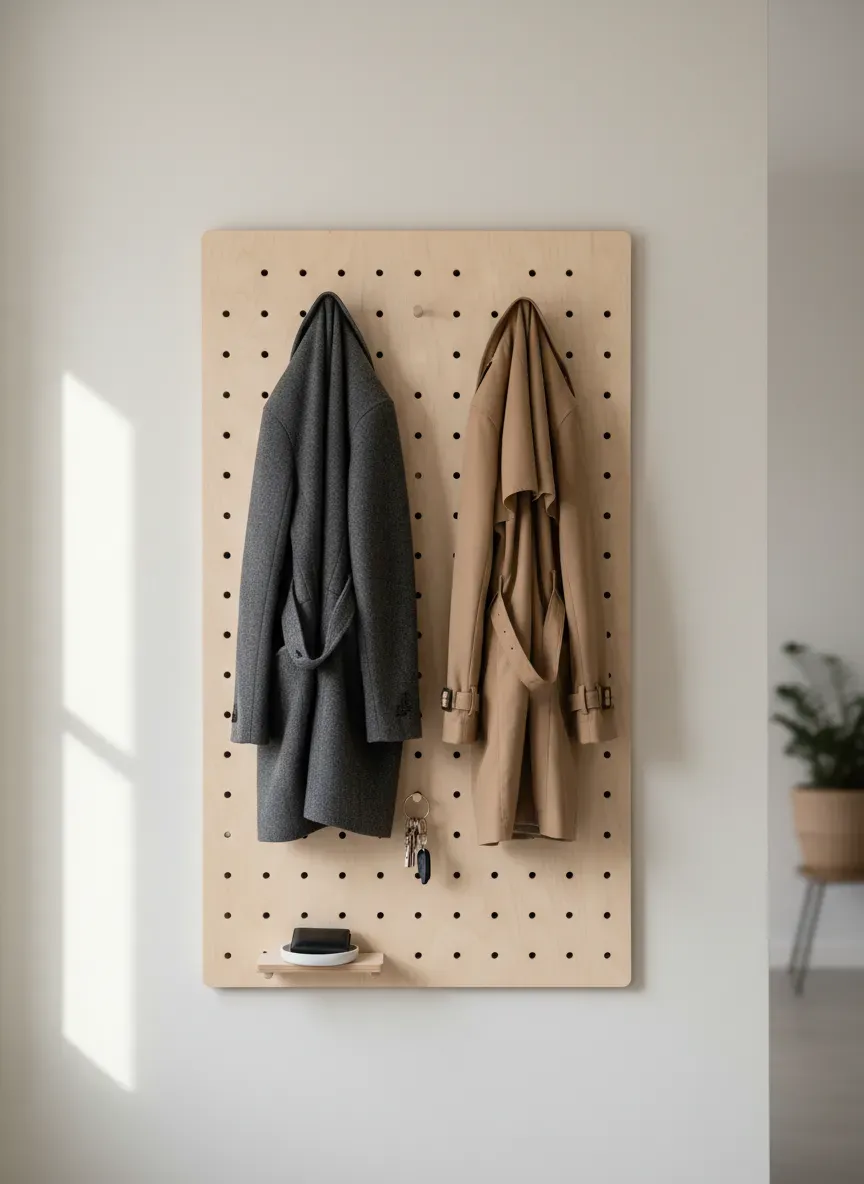
4. Pegboard or slatwall, trimmed to the wall. A wooden pegboard with moveable hooks and tiny shelves. Depth: 1–3”. Why it works: the configuration changes with the seasons — heavy hooks in winter, small shelves in summer — with zero new hardware.
5. The mail ledge trio. Three picture ledges, three feet apart, for mail, sunglasses, and the dog’s leash. Depth: 3–4”. Why it works: ledges are invisible to feet and read as art to eyes, and mail now has a home inside arm’s reach of the door.
6. The between-the-studs niche. A recessed shelf framed into the drywall cavity between two studs. Depth: 3.5” (inside the wall, 0” protrusion). Why it works: it adds storage that never enters the walkway — the purest form of the depth rule.
7. The over-door organizer. Pockets on the back of the hallway door or closet door. Floor depth: 0”. Why it works: doors are the most underused real estate in every hallway — a canvas pocket system swallows shoes or scarves and steals nothing from the corridor.
8. The radiator cover with a top. A heat-safe cover with a vented front and sealed top over the hallway radiator. Depth: 7–10” total. Why it works: dead heat becomes a console surface, and the flanks gain cubbies for umbrellas — space you were already heating.
9. The under-stair drawers. Full-extension drawers cut into the stair-side wall void. Floor depth: 0” when closed. Why it works: the triangle under the stairs is the only “room” a narrow hallway has — drawers make it reachable and hide everything.
10. The mirror ledge. A full-length mirror with a shallow shelf lip or hidden cabinet behind. Depth: 5”. Why it works: it doubles the perceived width — the cheapest widening a hallway will ever get — and gives sunglasses a home.

Maximizing Narrow Corridor Storage
The one strategy that maximizes narrow corridor storage: the four-step audit I run on every corridor I’m hired to fix:
- Measure the width, honestly. Wall to wall at the narrowest point, baseboards included.
- Set your depth budget. Hallway width minus 36 inches of clear walkway equals your storage depth ceiling. A 40-inch hall gets 4 inches; a 46-inch hall gets 10 — your 4–10 inch zone, computed for your house.
- Zone vertically. High (above 6 feet) for seldom-used gear; mid (shoulders to waist) for daily coats and bags; low for shoes and kid-access storage.
- Equip the walls, not the floor. Rail, pegboard, ledges, and niches do the work; the floor stays clear. Corridors are walked, not furnished.
Run the four steps and the hallway redesigns itself in one Saturday — every idea below is one of those moves applied to a problem.
Depth Budgeting: The 4–10 Inch Zone (shelves, rails, shallow consoles)
The 4–10 inch zone is where narrow hallway storage actually lives, and it has tiers:
| Depth | What fits | Good for |
|---|---|---|
| 1–3” | Hooks, rails, pegboards, slatwalls | Coats, bags, leashes, keys |
| 3–4” | Ledges, floating shelves | Mail, sunglasses, small decor |
| 4–5” | Mirror ledges, slim shelves | Daily carry, one shelf of gear |
| 5–7” | Tilt-out shoe storage, niche boxes | Shoes — the big win |
| 7–10” | Shallow consoles, radiator covers | Baskets, boots, umbrella stands |
Two rules keep the zone honest. First, anything that wants to be deeper than 10 inches has to go into the wall — niches, under-stair voids, over-door pockets — or it’s out. Second, depth is forgiven when it’s seasonal: a 7-inch console that holds winter gear six months of the year is different from a permanent 18-inch monolith. The walkway rule is about what’s there every day.
And if you ever feel the pull of “just one standard piece,” re-read the opening line. The furniture aisle wasn’t designed for your 38-inch hallway; a few brackets and a 2-inch rail will out-storage any console that fits.
Storage Solutions for Narrow Hallway (bench-free options)
The bench is the piece I get asked about most, and the answer is usually no — in a hallway under 42 inches, a standard bench costs more walkway than it returns. The bench-free storage solutions for a narrow hallway use the same shallowness playbook, in three sizes:
- The wall-mounted entryway system. A rail, hooks, a shelf, and a mirror in one coordinated wall kit — the closest thing to a mudroom a corridor can get. A full wall-mounted entryway setup stores everything a bench holds at 2–7 inches of depth instead of 16.
- The pegboard wall. Endless reconfiguration, nearly zero depth, and it never bumps anyone’s hip. The full treatment — peg types and hook spacing — is in the pegboard entryway storage systems guide.
- The fold-down perch. A wall-mounted seat on a hinge: 2 inches when closed, a solid perch when laced on. All the sitting, none of the footprint.
The one bench exception: if your hallway is 42 inches or wider, a slim bench under 12 inches deep earns its floor space — but that’s the 42-inch rule, and most corridors asking this question aren’t there yet.
Corridors: Storage Along the Wall, Not Across It
The layout principle behind all of it: in a corridor, storage runs along the wall, never across it. A single side-mounted run of rail and shelf carries the whole hallway, and it beats a standalone piece three ways:
- The whole wall becomes the drop zone. Coats spread along the rail instead of piling into one 6-inch-deep cluster — ten inches of hanging space per person, evenly spaced.
- Vertical zoning works at hallway scale. High zone for off-season gear, mid for daily coats, low for shoes — one continuous wall treatment that reads as architecture, not furniture.
- Traffic flows past it, not around it. Nothing protrudes past the depth budget, so the corridor never funnels into a pinch point.
When you trade “furniture against the wall” for “wall equipped as furniture,” the walkway regains every inch the old piece ate, and the corridor stops reading as cramped — because the visual mass is gone even though the storage is bigger.
Rental Narrow-Hallway Fixes
Renting doesn’t waive the depth rule — it adds a second one: nothing that makes the landlord mad. The good news: the shallowest systems are also the most renter-friendly, because they ask the least of your walls:
- Tension rods, not rails. A spring-loaded rod between floor and ceiling carries hooks and small shelves with zero drilling — keep the load under 20 pounds and it’s fully removable.
- Over-door pockets. The classic no-drill win: rigid pocket organizers hang from the top of any door and come down clean.
- Adhesive hooks, for light things only. Keys, leashes, and hats — never coats, which are too heavy for adhesive on most walls.
- Renters’ removable rails. Damage-free rail kits exist — verify the weight rating against your heaviest coat and patch-test a corner first.
- Floor-standing but corridor-slim. A 5-inch-deep tilt-out cabinet or slim cart works without touching the walls — the most landlord-proof option of the five.
The rental-zone formula is the same as everywhere else: light items high and shallow, shoes in anything angled or over-the-door, and never let a “temporary” solution exceed your depth budget, because the walkway doesn’t know your lease. When you own the walls instead, the full wall-mounted route — hardware, weights, and hook plans — is in the wall-mounted entryway guide.
Equip the corridor, keep everything in the 4–10 inch zone, and the hallway stops being the house’s bottleneck and starts being its hardest-working foot of wall. Measure the width, compute the budget, zone it vertically, and walk the walls — that’s the whole method, and it’s cheaper than a single trip to the furniture store.

Stop Guessing Measurements. Build Your Dream Entryway with Confidence.
Transform awkward hallways, cramped foyers, and cluttered mudrooms into organized sanctuaries. Includes 20 CAD floor plans, facing real-home photo spreads, the 36-Inch Clearance Rule, the Shoe Pairs Formula, and 7 printable worksheets.
Core Edition ($17.99) · Flagship Photo Edition v5 ($39.99)
