
Best Corner Hall Trees: Smart Space-savers for Small Entryways
Max out your small foyer with our expert, field-tested guide to the best corner hall trees. Discover precise architectural tips, material reviews, and structural secrets.
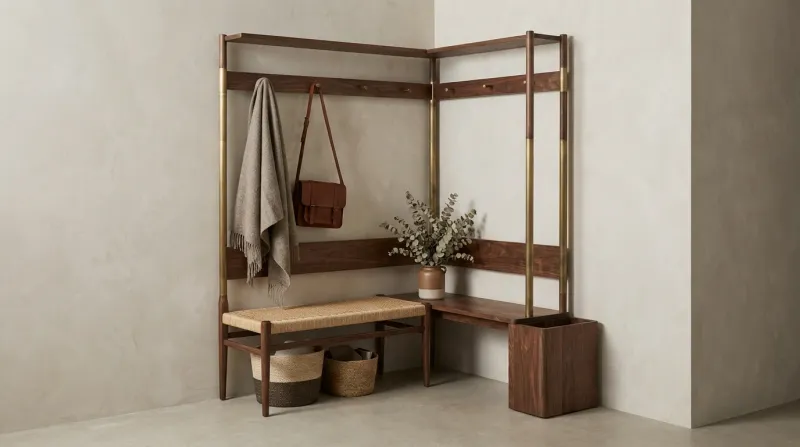
Aug 5, 2026 · Linda Wise
5 min readThe dead corner is a notorious waste of residential square footage. In tight entryways, foyers, and mudrooms, every square inch of floor space must earn its keep. Standard linear furniture pieces choke narrow hallways, leaving corners completely empty while walkways become cluttered.
A corner hall tree solves this spatial puzzle. By wrapping directly into the 90-degree intersection of your walls, it transforms neglected vertical space into an organized storage hub for coats, boots, keys, and bags.
Choosing the wrong model can lead to wobbly frames, doors that hit adjacent walls, or units that sit crooked due to uneven baseboards. This comprehensive guide breaks down the engineering, material choices, and installation methods you need to select a high-performance corner hall tree that fits perfectly.
Quick Comparison: Top Picks & Benchmarks
The following three models represent the best-performing configurations based on structural stability, spatial efficiency, and real-world durability.
| Product | Rating | Check Price |
|---|---|---|
| Vasagle Industrial Corner Hall Tree | 4.8 / 5.0 | Check Price on Amazon |
| Bush Furniture Salinas Corner Hall Tree | 4.7 / 5.0 | Check Price on Amazon |
| Linon Home Decor Corner Hall Tree | 4.6 / 5.0 | Check Price on Amazon |
The Geometry of Corner Entryway Storage
When you place flat furniture against a wall, you only need to worry about length and depth. Corner furniture introduces a third dimension: the diagonal projection.
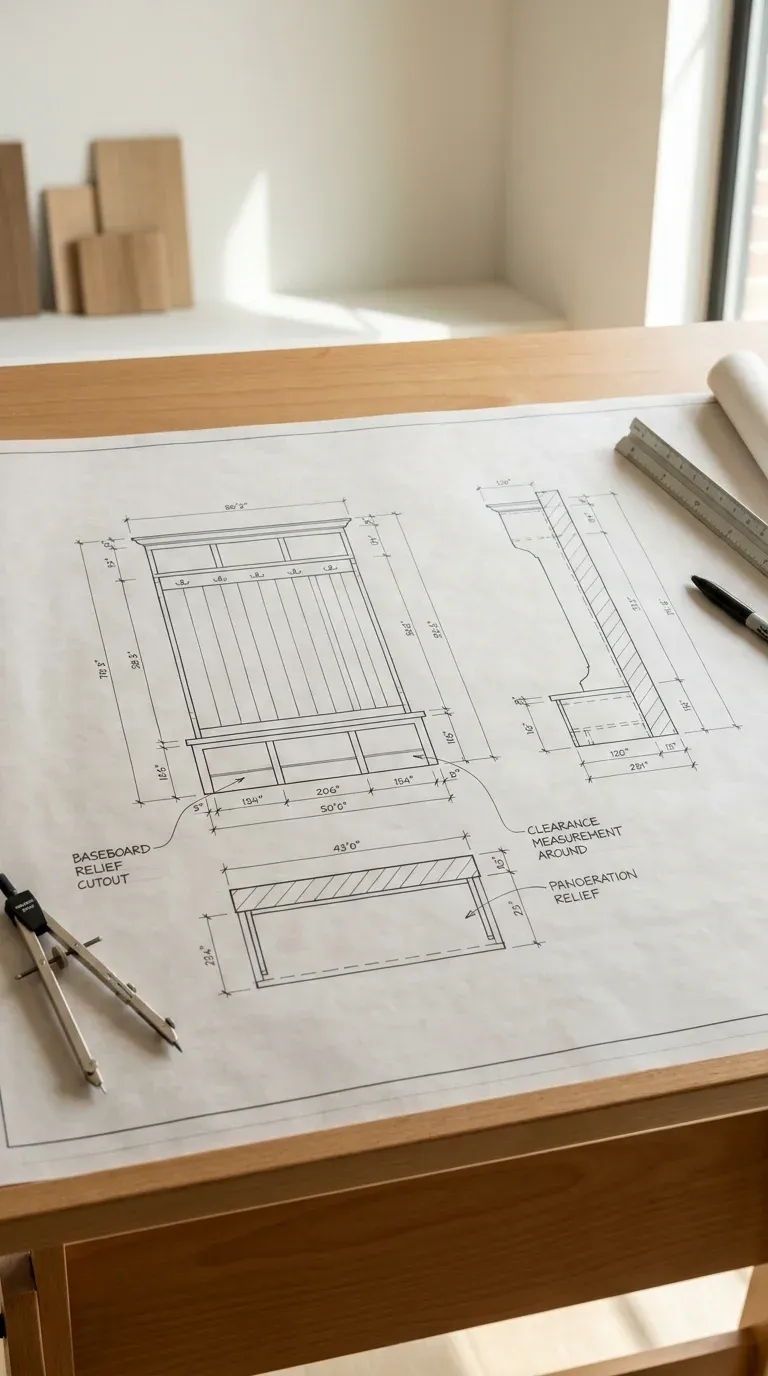
Understanding the Footprint
A corner hall tree features a right-angle back designed to sit flush against your drywall. The front profile can be flat (creating a triangular footprint) or curved/faceted (creating a pentagonal footprint).
- The Triangular Footprint: This is the most space-efficient layout. The front edge runs diagonally from one wall to the other. While it minimizes protrusion into the room, it reduces the depth of the seating bench and the volume of lower shoe storage.
- The Pentagonal Footprint: This design features a flat front face with two small side panels running parallel to your walls before angling back to the corner. This configuration yields a deeper bench and significantly more shoe storage capacity, but it extends further into your walking path.
Baseboard and Crown Molding Interference
Houses are rarely perfectly square. More importantly, baseboards and shoe moldings prevent flat-backed furniture from contacting the drywall.
If a corner hall tree lacks a built-in baseboard cutout, it will be pushed away from the wall at the bottom. This creates a top-heavy gap, making the unit tilt forward and rendering wall anchors difficult to secure.
Field Note: Look for corner hall trees with a recessed rear leg design or a built-in cutout that accommodates baseboards up to 6 inches high. If the unit lacks this, you will need to install custom spacers behind your wall anchors to bridge the gap safely.
Deep Dive Reviews of the Top 3 Corner Hall Trees
Our team analyzed the structural designs of the market’s leading corner hall trees. Here is how the top three options perform under real-world conditions.
1. Vasagle Industrial Corner Hall Tree
Engineered for raw stability, this unit features a powder-coated steel frame paired with dense particle board shelving. It is a prime example of high-strength industrial hall trees designed for active, high-traffic households.
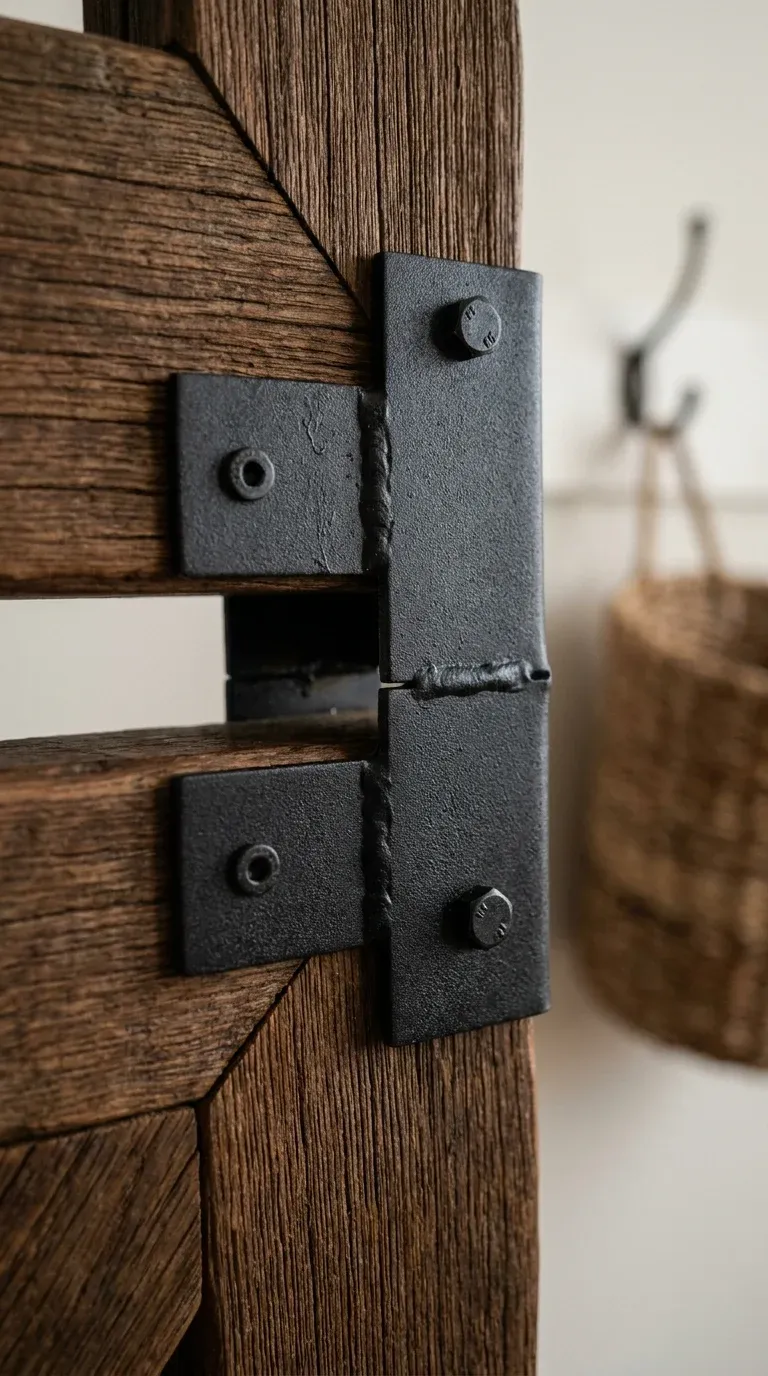
- Design & Aesthetics: This piece blends dark steel tubing with rustic brown finishes. It is an ideal option for anyone seeking striking black hall trees to anchor a modern, high-contrast entryway.
- Structural Tolerances: The frame is built from 20mm x 20mm square steel tubing. The bench easily supports up to 198 lbs (90 kg), while each of the six dual-hooks holds up to 6.6 lbs.
- Storage Configuration: Features a tri-level lower shoe rack made of durable steel mesh. This open design allows dirt and water from wet boots to fall through to the floor, where it can be easily cleaned.
- Pros:
- Unmatched structural rigidity due to the welded steel side frames.
- Adjustable feet compensate for uneven tile or hardwood floors.
- Extremely open visual profile that prevents small entryways from feeling cramped.
- Cons:
- Steel mesh shoe shelves do not catch fine dirt, meaning debris can accumulate on the floor underneath.
- The industrial look may conflict with traditional, formal home designs.
2. Bush Furniture Salinas Corner Hall Tree
This unit offers a classic, built-in look with a solid back panel, decorative beadboard detailing, and a comfortable, integrated seating surface.
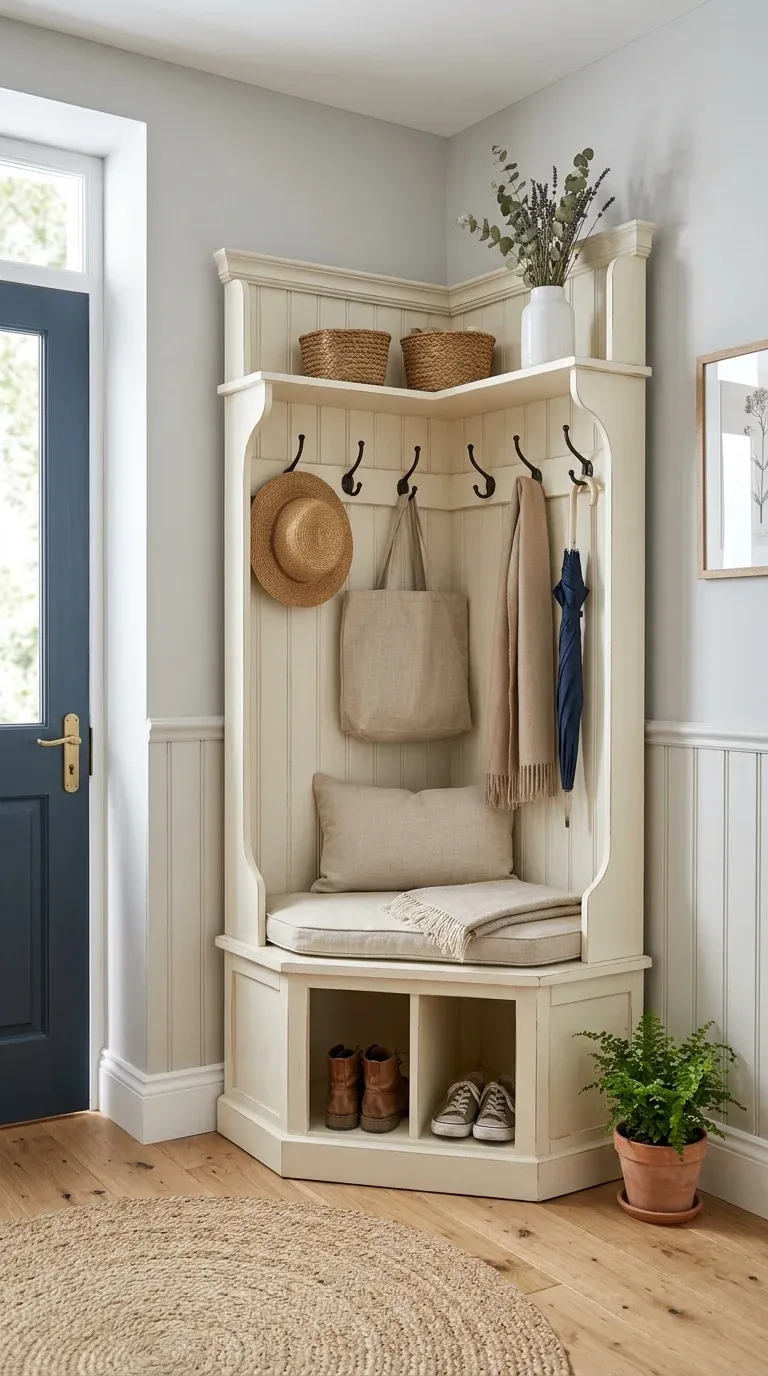
- Design & Aesthetics: With its soft, painted finishes, this model is an excellent fit for those wanting classic white hall trees or cozy farmhouse hall trees that match traditional trim work.
- Structural Tolerances: Built from high-density engineered wood and laminate. The bench supports a static weight load of 250 lbs, making it one of the sturdiest seating platforms in its category.
- Storage Configuration: Features a closed lower cabinet door that conceals an adjustable shelf, keeping shoes completely out of sight. The upper section includes three double-prong coat hooks.
- Pros:
- Concealed storage hides messy footwear.
- Elegant beadboard backing adds immediate architectural character to plain drywall.
- Flush-to-wall design sits snug in 90-degree corners.
- Cons:
- Requires a longer assembly time due to the cabinet door hinges and back panels.
- Closed cabinets can trap moisture from damp shoes if they are not dried before storage.
3. Linon Home Decor Corner Hall Tree
A hybrid design that bridges the gap between classic woodworking and modern simplicity. It offers a solid wood frame with a rich, stained finish.
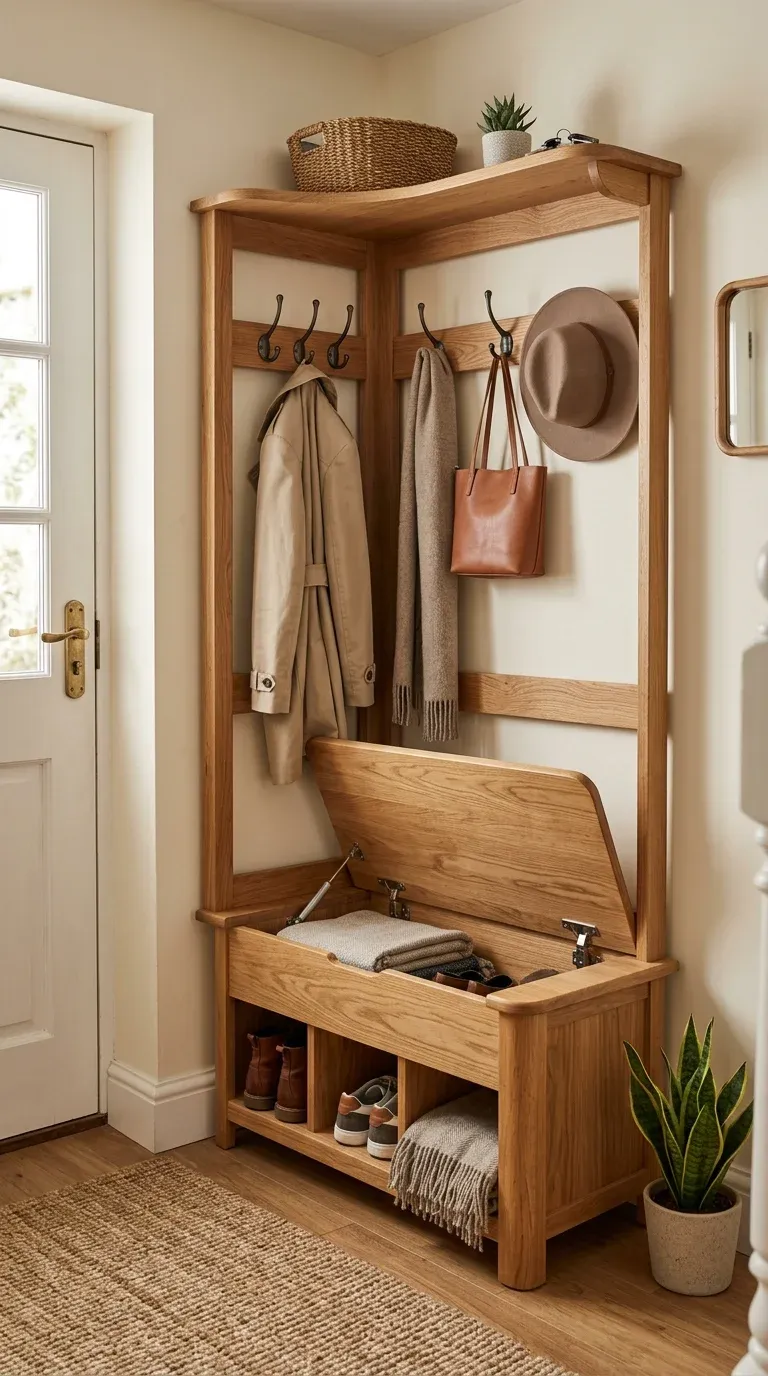
- Design & Aesthetics: This unit features warm, natural wood grains. It is a fantastic option for homeowners looking for rugged rustic hall trees or sleek, minimal modern hall trees that highlight natural organic textures.
- Structural Tolerances: Constructed using solid pine and birch veneers. The flip-top bench seat opens to reveal a deep storage chest, supporting up to 220 lbs on its lid.
- Storage Configuration: The top lid lifts on a soft-close safety hinge, offering a hidden compartment for winter gear, dog leashes, or sporting equipment. It also features four heavy brass double hooks.
- Pros:
- Authentic wood construction provides long-term durability and a premium tactile feel.
- Flip-top bench chest maximizes storage volume in a small footprint.
- Soft-close safety hinge prevents fingers from getting pinched.
- Cons:
- You must clear items off the bench seat to access the storage chest inside.
- Lacks open under-bench shoe slats, meaning dirty shoes must be placed elsewhere.
Anatomy of an Elite Corner Hall Tree
Understanding the key components of a corner hall tree helps you evaluate its quality before making a purchase.
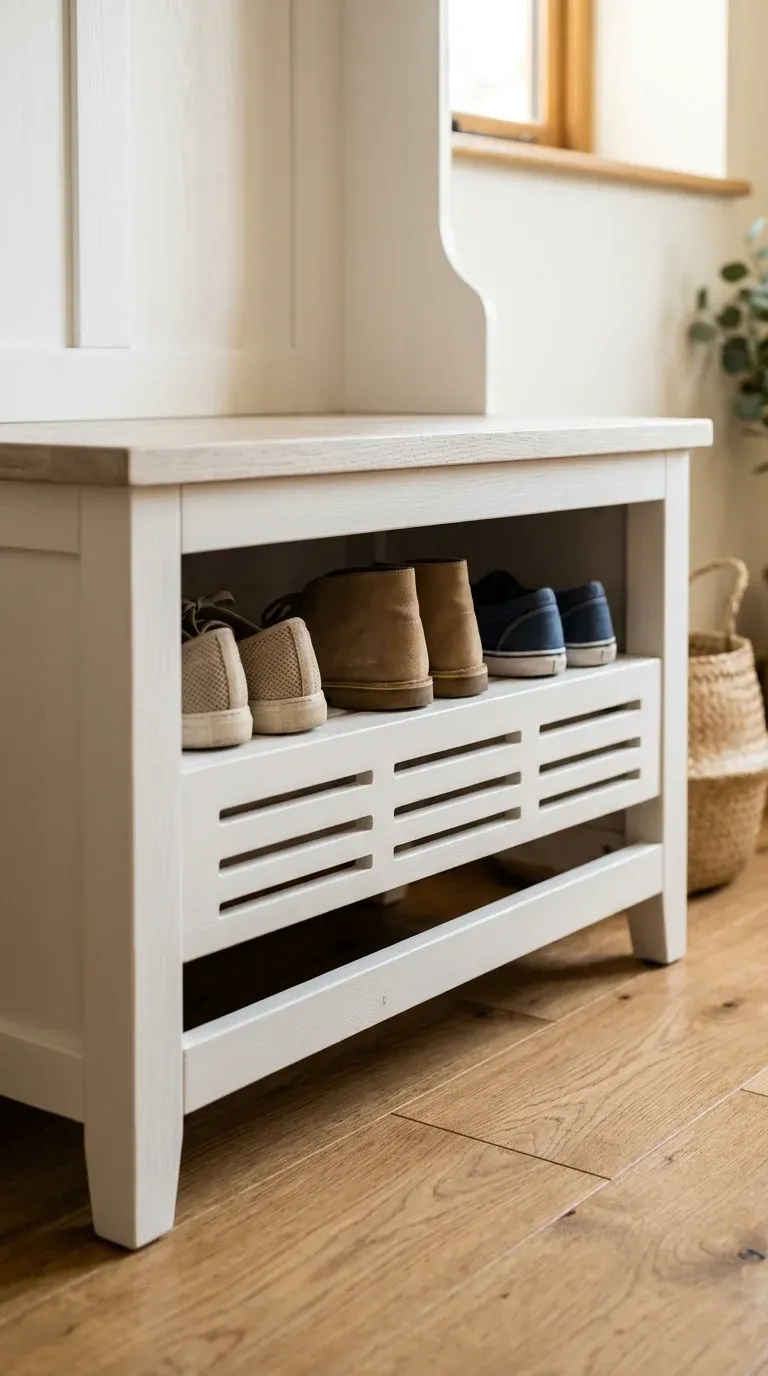
1. Benches and Seating Load Capacity
The bench is the structural anchor of the entire unit. It lowers the center of gravity, which helps prevent tipping. When shopping, prioritize integrated hall trees with benches that have a static load capacity of at least 200 lbs.
Lower-quality units use thin 12mm particle boards that will bow and crack over time. High-performance benches feature a minimum of 15mm engineered wood with under-seat steel support bars, or 18mm solid wood.
2. Shoe Storage Mechanics
Shoe storage generally comes in three configurations: open metal wire shelves, solid wooden shelves, or drop-down cabinets. If your family deals with wet weather, opt for hall trees with shoe storage that feature raised, slatted, or mesh shelves. These allow air to circulate around damp footwear, preventing mold and unpleasant odors.
+--------------------------------------------------------------+
|                   Shoe Storage Comparison                    |
+----------------------+-----------------------+---------------+
| Style                | Airflow / Drainage    | Aesthetics    |
+----------------------+-----------------------+---------------+
| Open Metal Mesh      | Excellent (Dries Wet) | Industrial    |
| Solid Wood Slats     | Good (Breathable)     | Rustic/Warm   |
| Closed Cabinet Wood  | Poor (Traps Moisture) | Clean/Hidden  |
+----------------------+-----------------------+---------------+
3. Hooks and Hanging Hardware
Coat hooks endure significant daily stress. Cheap plastic or thin alloy hooks will snap under the weight of heavy winter coats or loaded backpacks.
- Material: Look for zinc alloy, cast iron, or heavy-gauge steel hooks.
- Mounting: Hooks should be secured through the front of the back panel with dual screws, or bolted directly into a steel frame. Avoid hooks that rely on thin wood screws driven into low-density fiberboard.
- Configuration: Double-prong hooks are superior. They allow you to hang a hat on the upper prong and a heavy coat on the lower prong without overcrowding the unit.
Architectural and Material Comparison
To find the right corner hall tree for your home, you must understand the trade-offs between different materials.
+-----------------------------------------------------------------------------+
|                            Material Comparison                              |
+-------------------+----------------------+----------------------------------+
| Material          | Pros                 | Cons                             |
+-------------------+----------------------+----------------------------------+
| Solid Wood        | Durable, repairable, | Expensive, prone to seasonal     |
|                   | premium look/feel.   | warping in humid entries.        |
+-------------------+----------------------+----------------------------------+
| Powder-Coated     | Structural strength, | Industrial look is not for       |
| Steel             | waterproof, light.   | everyone.                        |
+-------------------+----------------------+----------------------------------+
| High-Density MDF  | Perfectly flat,      | Heavy, susceptible to swelling  |
|                   | budget-friendly.     | if water penetrates the seams.   |
+-------------------+----------------------+----------------------------------+
Frame Materials and Structural Rigidity
Solid wood offers a beautiful, organic look, but steel-framed units provide incredible strength-to-weight ratios. If you have children who might climb on the unit, a steel-reinforced frame is the safest option.
If you choose an engineered wood (MDF or particle board) model, ensure all edges are sealed with PVC edge banding. This prevents moisture from wet raincoats or snowy boots from seeping into the core material, which can cause swelling and ruin the finish.
Safety Engineering: Anti-Tipping Systems
Because corner hall trees are tall, narrow, and designed to hold weight high up, they present a tipping hazard. An anti-tip kit is not optional; it is a critical safety requirement.
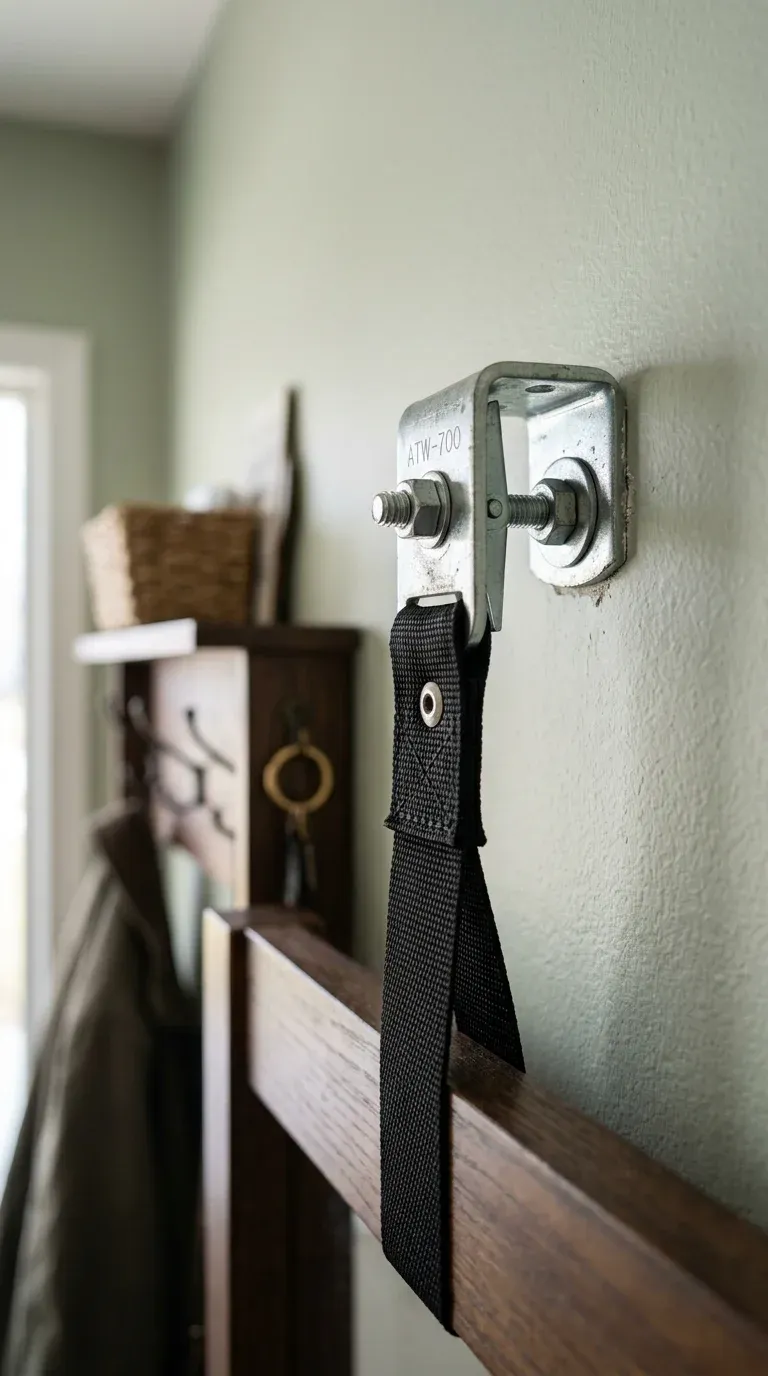
Standard nylon zip-tie straps degrade over time. The gold standard for safety is a steel cable or solid metal bracket secured directly into a wall stud with a 2-inch wood screw, or into drywall using heavy-duty toggle bolts.
Because corner units sit at a 45-degree angle to both walls, you must anchor them to the wall at two points to ensure complete stability.
Installation, Leveling, and Assembly Realities
Installing a corner hall tree requires precision. Walls are rarely set at a perfect 90-degree angle, and floors often slope near exterior doors.
The “Out of Square” Corner Test
Before unboxing your new hall tree, check your corner with a framing square or a simple 3-4-5 triangle test:
- Measure 3 feet out from the corner along one wall and make a pencil mark.
- Measure 4 feet out along the adjacent wall and make a mark.
- Measure the distance between the two marks.
- If the distance is exactly 5 feet, your corner is a perfect 90 degrees.
If the measurement is more than 5 feet 1 inch or less than 4 feet 11 inches, your corner is out of square. A solid wooden corner unit will not sit flush against both walls.
In this scenario, a steel-frame unit with open backing is your best choice, as it offers more flexibility to accommodate slight wall angles.
Dealing with Baseboards and Trim
If your corner hall tree does not clear your baseboards, you have three options:
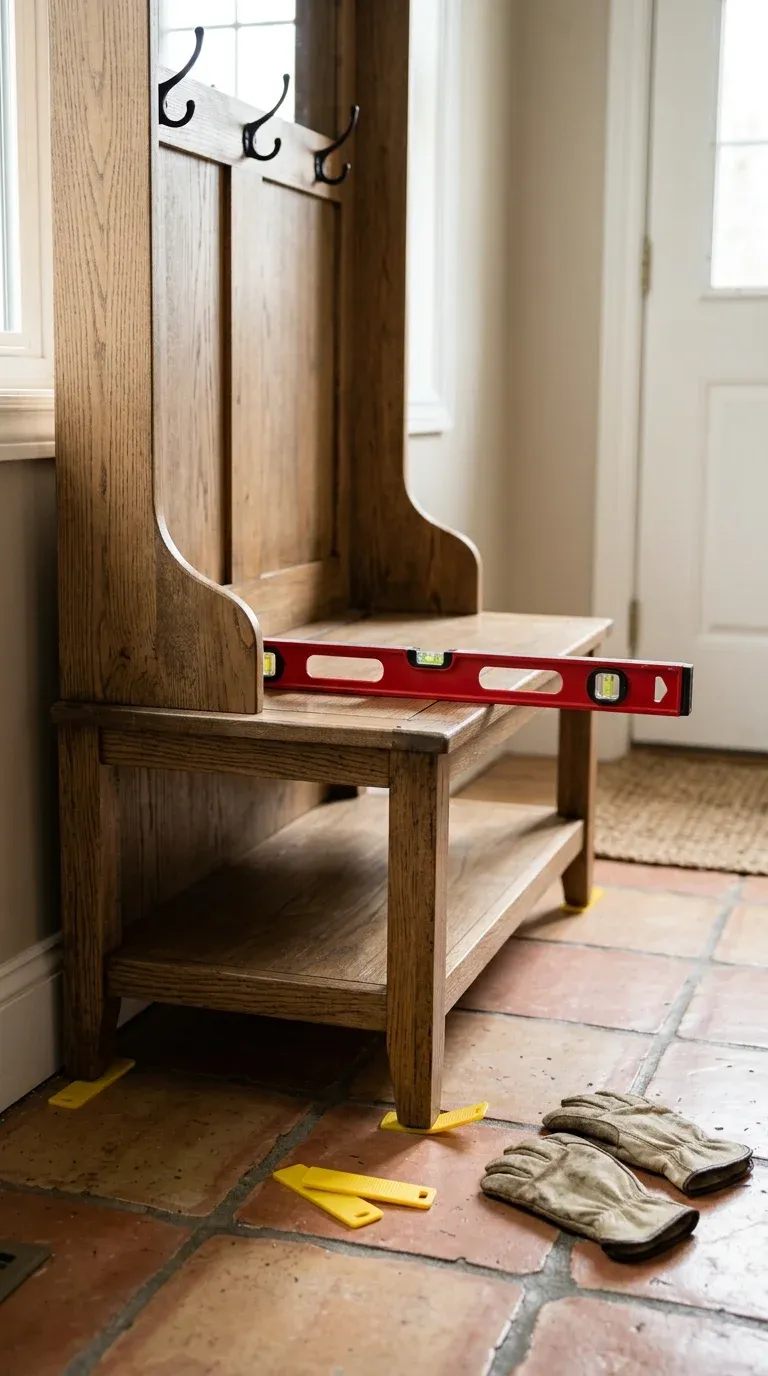
- Shim the Base: Place plastic furniture shims under the front feet of the unit to tilt it back toward the wall. (Only do this for minor gaps of less than 1/4 inch).
- Install Wall Spacers: Cut small blocks of wood matching the thickness of your baseboard. Place these behind the unit’s wall-anchor brackets so you can secure them tightly without distorting the frame.
- Modify the Unit: Use a coping saw or jigsaw to cut custom notches into the bottom rear legs of wooden units, allowing them to slide over your baseboard.
Step-by-Step Installation Guide
- Clear and Clean: Empty the corner completely. Vacuum up any grit that could scratch your flooring during installation.
- Pre-Assemble the Frame: Assemble the unit on a soft blanket to protect the finish. Leave all frame bolts slightly loose (about 90% tight) to allow for adjustments later.
- Position and Level: Slide the hall tree into the corner. Place a spirit level on the bench seat, checking both front-to-back and side-to-side leveling.
- Adjust the Feet: Adjust the leveling feet until the bench is perfectly level. If the unit has static legs, slide plastic shims underneath as needed.
- Tighten Frame Bolts: Once the unit is level and stable, tighten all frame bolts securely.
- Install Wall Anchors: Mark the anchor points on your drywall. Slide the unit out, drill holes, insert heavy-duty wall anchors (preferably toggle bolts), slide the unit back, and secure the brackets tightly.
Buyer’s Evaluation Framework
With so many options available, use this target framework to find the perfect fit for your home’s layout. We have designed this framework to accommodate hall trees for every entryway type, whether you have a narrow hallway or a spacious mudroom.
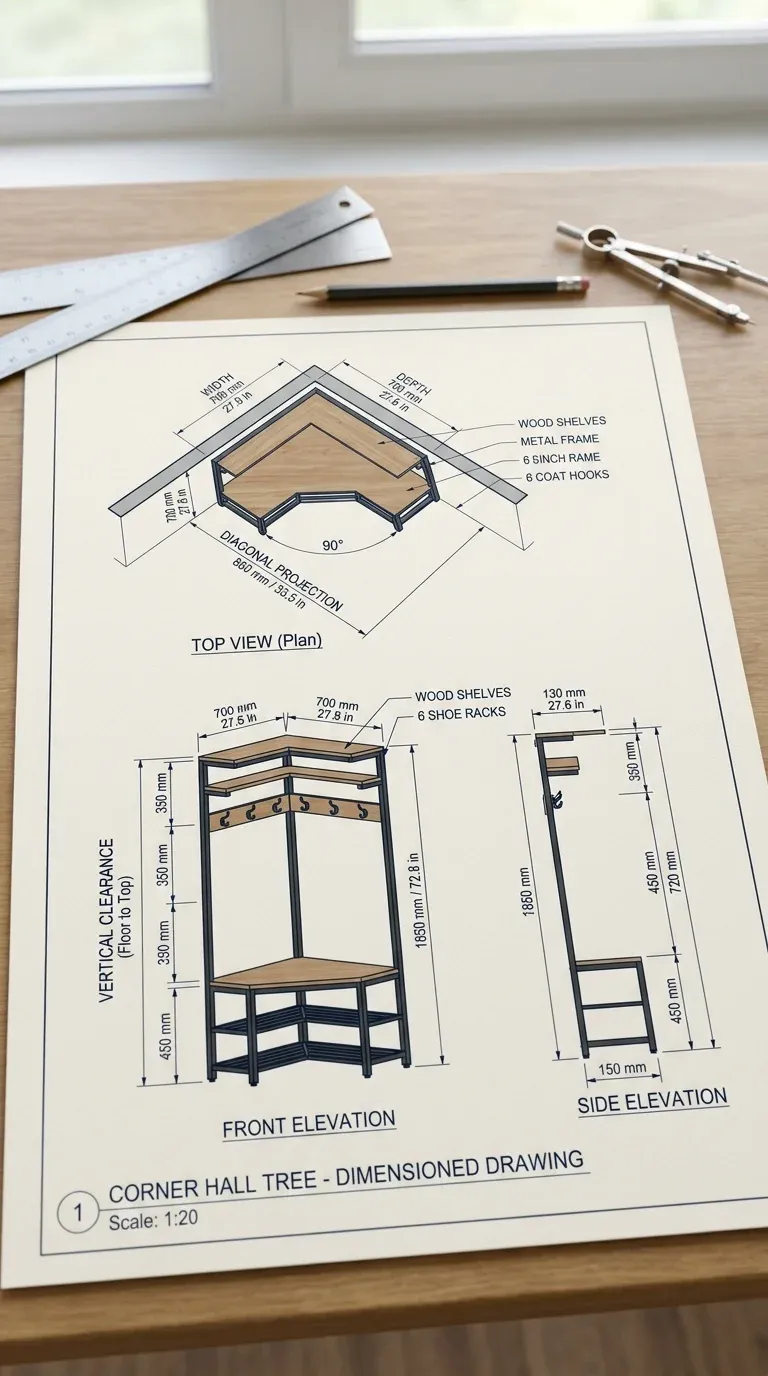
1. Spatial Clearance and Walkway Safety
Measure the “door swing radius” of your entry door. A corner hall tree must sit far enough back that the door can open to at least 90 degrees without striking the bench or hanging coats. Leave at least 30 inches of clear walkway space in front of the unit so people can move comfortably through the entryway.
2. Family Size vs. Hook Capacity
Single-prong hooks fill up quickly. For a household of three or more, look for a hall tree with at least six dual-prong hooks. If you have kids, choose a model with lower hooks so they can hang up their own bags and jackets.
3. Footwear Volume and Type
Consider your seasonal footwear needs. High-top boots require at least 10 inches of vertical clearance between shelves. If you have a large shoe collection, an open-slat shoe rack is ideal, as it allows you to easily stack and organize your shoes.
Maintenance, Longevity, and Structural Upgrades
A corner hall tree is a hardworking piece of furniture. Simple maintenance will keep it looking and performing its best for years to come.
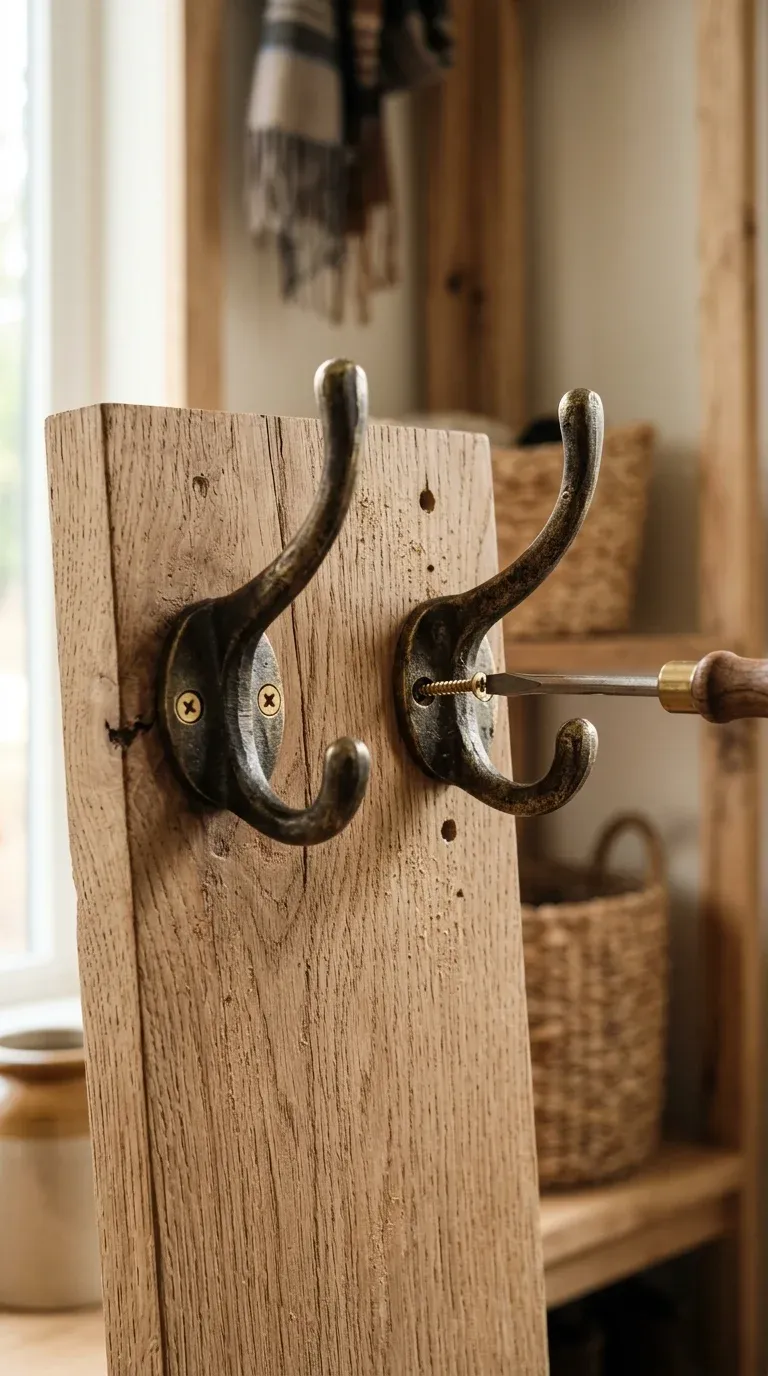
1. Tightening Hardware Over Time
Daily use creates micro-vibrations that can loosen hardware. Every six months, inspect the structural bolts, hook mounts, and wall anchors. Use a hand screwdriver or hex key to snug them up—avoid over-tightening with an impact driver, which can strip the wood or metal threads.
2. Moisture Protection
Damp coats and muddy boots introduce moisture to your hall tree.
- For Wooden Units: Apply a high-quality paste wax or polyurethane sealer to the bench seat once a year to protect the wood from water rings and stains.
- For Steel Units: Wipe down the metal frames with a damp microfiber cloth. If you notice any scratches in the paint, touch them up immediately with rust-inhibiting paint to prevent corrosion.
3. Upgrading Your Hardware
You can easily upgrade a budget-friendly hall tree by swapping out its stock hooks for premium hardware. Solid brass, oil-rubbed bronze, or hand-forged iron hooks instantly elevate the look of the piece while offering superior weight capacity.
Comprehensive FAQ
Can I use a corner hall tree if my entry walls are plaster and lath?
Yes, but you must take extra care when securing the wall anchors. Do not use standard plastic expansion anchors, as they will pull out of plaster. Instead, use heavy-duty toggle bolts, or mount a solid wood utility board across the studs first, and then secure your hall tree directly to that board.
How much weight can a corner hall tree bench actually hold?
Most high-quality steel-framed or solid wood corner benches support between 200 and 250 lbs of static weight. Engineered wood benches (MDF or particle board) typically top out around 150 to 175 lbs. Always check the manufacturer’s specifications before sitting down.
My entryway floor is uneven tile. Will a corner hall tree wobble?
Yes, unless it has adjustable leveling feet. If you have uneven tile, concrete, or wood floors, choose a steel-framed unit with threaded, adjustable leveling feet. If your favorite model has fixed wooden legs, you can use adhesive felt pads or plastic furniture shims to level it out.
Do corner hall trees work well on carpeted floors?
They do, but carpet adds stability challenges. When a hall tree sits on carpet and tack strips near a wall, it can tilt forward. To fix this, place a firm shim under the front legs to keep the unit level, and always secure it with wall anchors.
Can I build a custom DIY corner hall tree?
Absolutely. If you have basic woodworking tools, you can build a custom corner unit using 3/4-inch plywood. This allows you to cut custom baseboard reliefs and build the unit to the exact angles of your corner, ensuring a flawless, built-in look.
The Final Verdict
For a highly durable, low-maintenance, and ultra-stable entryway solution, the Vasagle Industrial Corner Hall Tree is tough to beat. Its steel frame and open-grid shoe shelves are built to handle daily use in busy households.
If you prefer a classic, built-in look with hidden storage, the Bush Furniture Salinas Corner Hall Tree is an exceptional choice. Its elegant beadboard backing and closed storage cabinet elevate the style of any foyer.
For those who value natural wood materials and multi-functional storage, the Linon Home Decor Corner Hall Tree offers a beautiful wood grain finish and a spacious flip-top storage bench that keeps seasonal gear neatly tucked away.
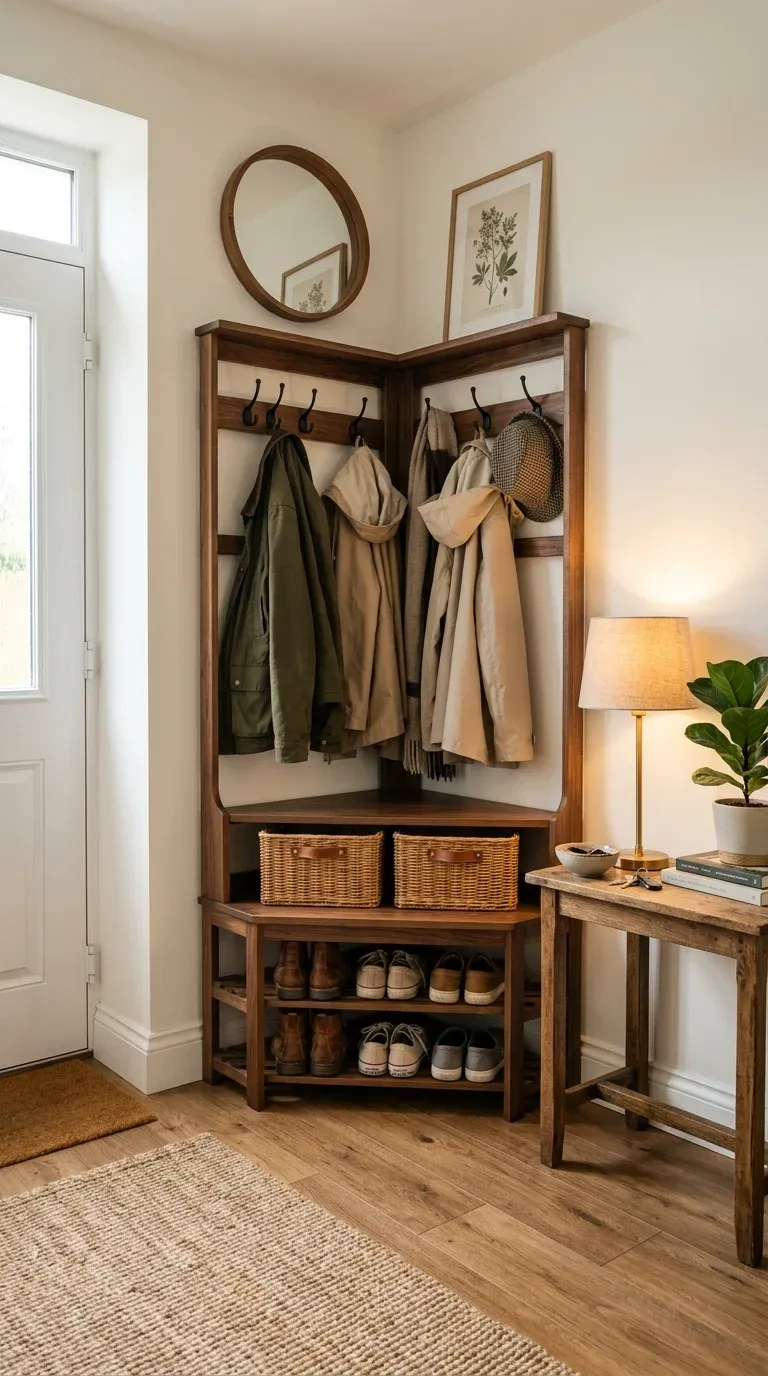
Whichever model you choose, take the time to measure your space, check your corner’s angles, and always install your anti-tip safety anchors. By turning an unused corner into a highly organized storage hub, you can make your small entryway feel larger, cleaner, and much more welcoming.
Top Picks: Best Entryway Essentials
Editor's shortlist with verified ratings. Prices and availability below — clicking an Amazon link earns us a small commission at no extra cost to you.
| # | Product | Rating | Reviews | Tag | Check Price |
|---|---|---|---|---|---|
| 1 | Vasagle Industrial Entryway Bench | 8,420 | Top Pick | View on Amazon | |
| 2 | Crosley Furniture Seaside Hall Tree | 5,410 | — | View on Amazon | |
| 3 | Seville Classics 12-Pair Shoe Rack | 6,420 | Best Storage | View on Amazon | |
| 4 | Franklin Brass Wall Hooks (5-Pack) | 9,820 | — | View on Amazon | |
| 5 | Simplihome Artisan Solid Wood Bench | 3,127 | Editor's Pick | View on Amazon |
Affiliate disclosure: As an Amazon Associate we earn from qualifying purchases.
Tag: entryway09-20 — change in src/data/topPicks.ts.