
The Best Pantry and Countertop Containers for Streamlined Kitchen Organization
The best pantry and countertop containers for a streamlined kitchen: airtight picks, stackable bins, glass vs plastic, and a measurement-first buying guide.
Published · Updated · Linda Wise
7 min readLast updated: November 6, 2026 | Reviewed by: Linda Wise, managing editor
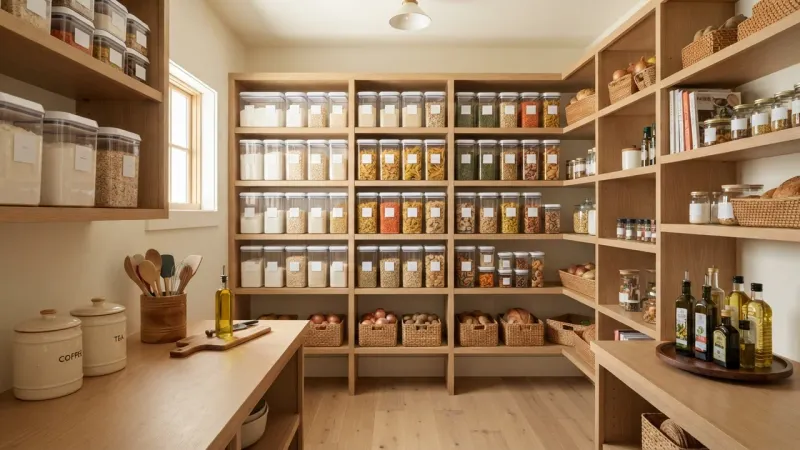
A matching pantry looks calm, but matching is not the goal. The goal is a system where you can see the flour, reach the cereal, and close the lid with one hand while holding a toddler or a phone.
That system starts with measurements, not containers. The best pantry container is the one that fits your shelf, seals properly, and uses the same lid as the container next to it.
The Short Answer
| Need | Best container type | Size | Why |
|---|---|---|---|
| Flour, sugar, rice | Square airtight canister | 3-6 qt | Uses shelf depth efficiently |
| Cereal, oats | Tall airtight cereal container | 2-4 qt | Fits a standard shelf height |
| Pasta, snacks | Medium stackable bin | 1-2 qt | Visible and easy to refill |
| Spices | Small square jar | 4-8 oz | Fits a drawer or rack |
| Coffee, tea | Countertop canister | 1-2 qt | Daily access, airtight |
| Produce | Ventilated basket or bin | Varies | Airflow reduces spoilage |
| Under-shelf | Hanging basket | Varies | Uses vertical air space |
Glass vs. Plastic vs. Stainless Steel
| Material | Pros | Cons | Best for |
|---|---|---|---|
| Glass | Non-porous, no staining, dishwasher-safe | Heavy, breakable, expensive | Oils, tomatoes, leftovers, long-term storage |
| Plastic (PP/Tritan) | Light, cheap, shatter-resistant | Can stain or absorb odors | Cereal, snacks, kids’ access |
| Stainless steel | Durable, opaque, no light exposure | Not microwave-safe, dents | Coffee, tea, oils |
| Silicone | Flexible, collapsible, lightweight | Can retain odors, less rigid | Travel, freezer, small spaces |
For most pantries, a mix of clear plastic and glass is the practical answer. Clear containers let you see what is running low; glass handles oily or staining foods better.
The Measurement Rules
1. Measure the shelf depth first
Most pantry shelves are 11-14 inches deep. A container that is 12 inches deep may fit, but the lid needs clearance. Leave at least 1 inch between the container and the shelf above, and 0.5 inch at the back.
2. Measure the shelf height
Cereal containers are tall. A standard cereal box is about 12 inches tall, so a container needs at least 12.5 inches of clearance. If your shelf is 12 inches, choose a shorter stackable bin and decant the cereal into it.
3. Measure the opening, not just the shelf
A container may fit on the shelf but not through the pantry door or around the corner. Measure the narrowest point of the entry.
4. Use the square-footprint rule
Square and rectangular containers waste less space than round ones. A 4-quart square canister can hold more than a 4-quart round canister in the same shelf footprint. Round containers are better for lazy Susans and deep corners.
5. Leave headspace
Leave 1-2 inches of empty space at the top. Food expands, and a container filled to the rim is hard to seal without spilling.
The 10 Best Container Types
1. OXO Good Grips POP Containers
Best overall airtight pantry system.
The POP line is popular for a reason: the push-button lid creates a seal, the square footprint stacks efficiently, and the containers come in sizes from small spice jars to 6-quart canisters. The lids are easy to operate with one hand.
Best for: flour, sugar, cereal, pasta, coffee, and baking supplies. Trade-off: the lids have multiple parts, so hand-wash and dry them thoroughly.
2. Rubbermaid Brilliance Containers
Best for visibility and stacking.
Brilliance containers are clear, lightweight, and designed with a tight-sealing lid. The square shapes stack neatly and the clear walls make inventory easy. They are also good for leftovers and meal prep.
Best for: pantry staples, snacks, and fridge organization. Trade-off: plastic can scratch over time; avoid abrasive cleaners.
3. Progressive ProKeeper+
Best for baking staples.
ProKeeper containers are designed for flour, sugar, brown sugar, and cereal. Some models include a leveler, a scoop, or a terra-cotta disc for brown sugar. The lids are sturdy and the square shape uses shelf space well.
Best for: bakers who want built-in tools. Trade-off: specialty shapes may not stack with other brands.
4. Anchor Hocking Glass Canisters
Best for glass storage on a budget.
Anchor Hocking glass canisters are affordable, sturdy, and non-porous. They are a good choice for oils, tomatoes, and strongly colored foods that can stain plastic. The glass is dishwasher-safe.
Best for: long-term pantry storage and visible shelves. Trade-off: heavy and breakable; not ideal for high shelves or homes with young children.
5. Felli Flip Tite Containers
Best for a strong seal at a low price.
Felli containers use a flip-lock lid with a silicone gasket. They are lightweight, stackable, and available in multiple sizes. The seal is easy to operate and holds up well with dry goods.
Best for: cereal, pasta, rice, and snacks. Trade-off: the plastic is lighter than premium brands; avoid dropping full containers.
6. Vtopmart Clear Pantry Bins
Best for budget-friendly organization.
Vtopmart bins are simple clear plastic containers with lids, often sold in sets. They are not the most airtight option, but they are affordable and good for categories that do not need a perfect seal, such as snack bars or packets.
Best for: snacks, packets, and kids’ pantry access. Trade-off: check the lid fit; inexpensive sets vary in quality.
7. Lazy Susan Turntable
Best for deep shelves and corners.
A turntable is not a container, but it is the best way to make deep pantry shelves usable. Choose one with a raised rim and a smooth-bearing base. Measure the shelf depth and subtract 2 inches for clearance.
Best for: oils, vinegars, spices, condiments, and supplements. Trade-off: round shape wastes corner space unless the shelf is deep.
8. Under-Shelf Hanging Basket
Best for using vertical air space.
An under-shelf basket hangs below a shelf and holds produce, bread, or snacks. It adds storage without taking shelf surface. Choose one with a sturdy hook and a flat base.
Best for: onions, potatoes, bread, and fruit. Trade-off: can block access to the shelf below if overloaded.
9. Countertop Coffee and Tea Canister
Best for daily countertop use.
A pair of airtight canisters keeps coffee and tea fresh and looks intentional. Choose opaque or dark glass for coffee to protect it from light, and a size that holds one bag or one week’s supply.
Best for: coffee, tea, and sugar. Trade-off: counter space is precious; measure the depth before buying.
10. Spice Jar Set with Labels
Best for drawer or rack organization.
A matching spice jar set with a funnel and labels turns a chaotic spice shelf into a usable system. Choose jars with airtight seals and a shaker insert if you use them at the stove.
Best for: spices, herbs, and seasoning blends. Trade-off: glass jars are breakable; keep them away from the edge.
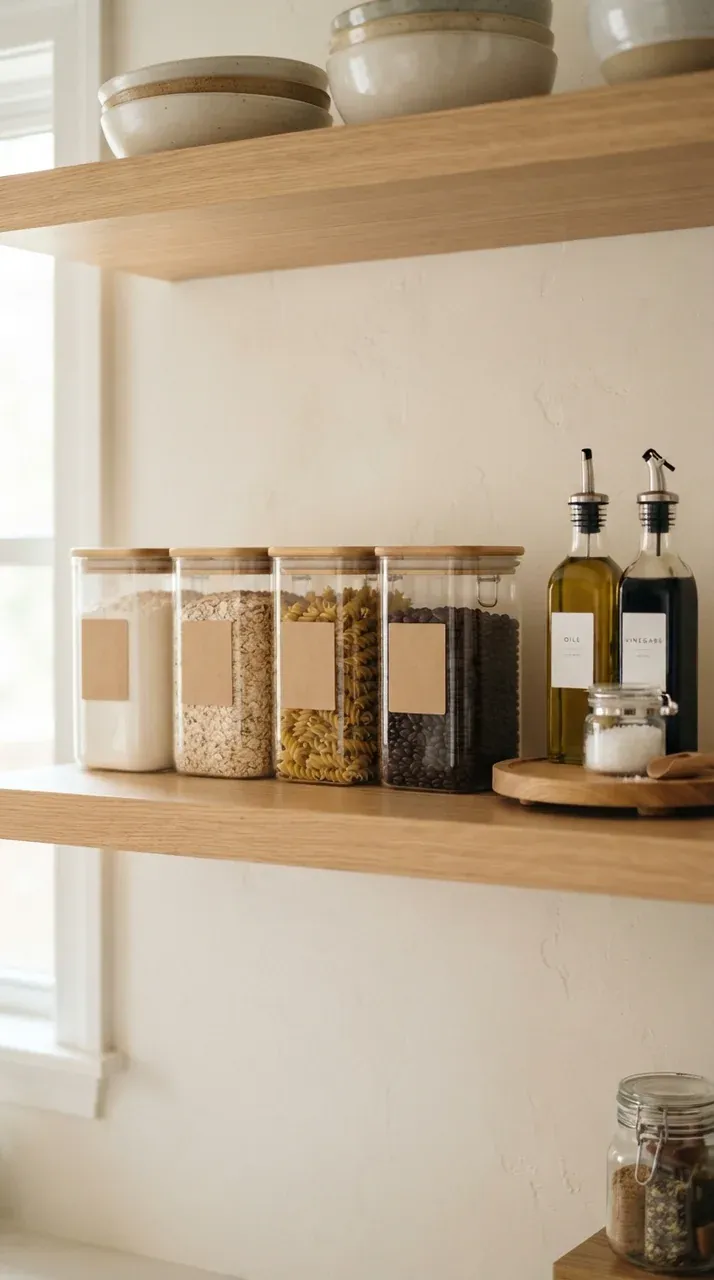
Image: clear square containers and a turntable make the back of a deep pantry reachable.
Countertop Containers: Less Is More
The countertop is not a pantry. It is a daily-use zone. Every container on the counter should earn its space by being used at least once a day.
The three-container rule
- Coffee or tea canister — one or two, depending on household size.
- Cooking utensil crock — one, near the stove.
- Everyday snack or fruit bowl — one, if your family actually eats from it.
Everything else belongs in a cabinet or pantry. Matching countertop canisters look beautiful in photos, but six of them usually mean six things you have to move to wipe the counter.
Countertop depth check
- Standard counter depth: 24 inches.
- Keep at least 18 inches of clear prep space.
- A canister should be no more than 6-8 inches in diameter.
- Keep containers away from the stove’s direct heat.
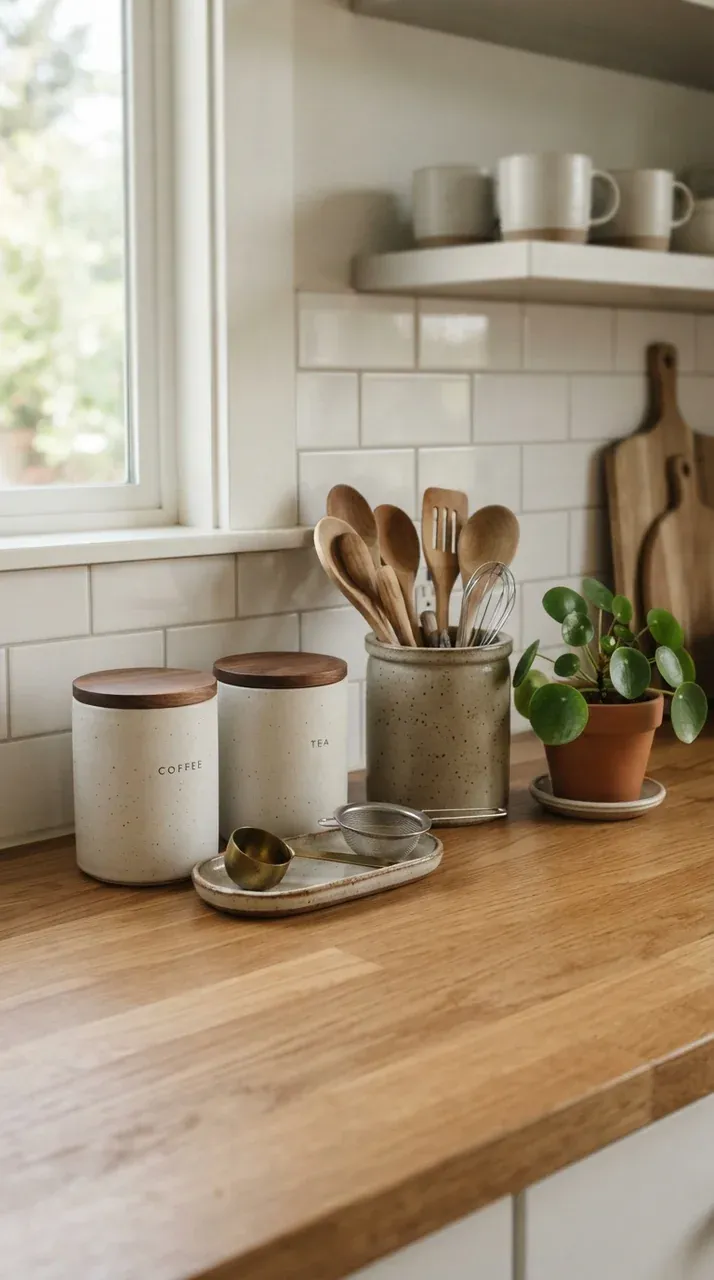
Image: keep only daily-use containers on the counter; everything else belongs in the pantry.
How to Organize the Pantry Around the Containers
Zone 1: Baking
Flour, sugar, brown sugar, baking powder, chocolate chips. Use large square canisters and a small bin for packets. Keep a scoop inside the flour container.
Zone 2: Breakfast
Cereal, oats, granola, coffee, tea. Use tall cereal containers and a small turntable for spreads.
Zone 3: Cooking
Pasta, rice, beans, canned goods, oils. Use medium stackable bins and a lazy Susan for oils and vinegars.
Zone 4: Snacks
Chips, crackers, granola bars, dried fruit. Use clear bins at kid height if possible. Decant crackers into airtight containers only if your family eats them quickly; otherwise the original bag is fine.
Zone 5: Overflow
Backstock, bulk packages, and seasonal items. Use opaque bins on the top shelf and label them clearly.
Maintenance That Keeps the System Working
- Wash new containers before filling. Dry thoroughly; moisture causes clumping.
- Check gaskets monthly. Remove, rinse, and dry the silicone ring.
- Replace stained or scratched plastic. Scratches harbor odors and bacteria.
- Label the lid or the front, not the bottom. You should be able to read it from the shelf.
- Use FIFO. Move older food to the front before adding a new bag.
- Don’t overfill. A container that is hard to close will be left open.
Where to Save and Where to Spend
Save on: snack bins, spice jars, and under-shelf baskets. These are easy to replace.
Spend on: flour, sugar, coffee, and cereal containers. These hold the most volume and need the best seals.
Costway’s kitchen and pantry organizers include stackable bins, clear containers, and countertop racks at factory-direct prices. Affiliate link: we may earn a commission at no extra cost to you. Measure your shelf height and depth before ordering; a container that does not fit is not a bargain.
For freezer storage, see our freezer organization guide. For a full kitchen reset, read the simple tidying buying guide.
Bottom Line
The best pantry containers are airtight, square, stackable, and measured to your shelf. Start with the staples you use every week—flour, sugar, cereal, pasta, coffee—and add specialty containers only when you have a specific problem to solve.
On the counter, keep it to three containers and protect your prep space. A calm kitchen is not the one with the most matching jars; it is the one where the lid closes and the flour is where you expect it.
For more small-space storage, see our small apartment storage solutions.
Shop Entryway Furniture & Storage Deals on Costway
Factory-direct pricing on entryway benches, shoe cabinets, hall trees, and organizers with fast, free US delivery.
* Affiliate disclosure: We may earn a commission if you shop through this link at no added cost to you.
Check Costway Entryway DealsFrequently Asked Questions
Are glass or plastic pantry containers better?
Glass is better for long-term food storage, stain resistance, and dishwasher cleaning. Plastic is lighter, cheaper, and safer around kids and pets. For everyday dry goods, either works if the seal is airtight and the container fits your shelf. Choose glass for oils, tomatoes, and strongly colored foods; plastic for cereals and snacks.
How do I know if a pantry container is truly airtight?
Look for a silicone gasket, a locking clamp or four-sided latch, and a lid that seats firmly without wobbling. Fill the container with water, seal it, and turn it upside down for 30 seconds. A few drops may escape; a steady leak means it is not airtight enough for flour or cereal.
What size containers should I buy for flour and sugar?
A 5-pound bag of flour is about 4 quarts by volume, and a 4-pound bag of sugar is about 2 quarts. Buy a 4-6 quart container for flour and a 2-3 quart container for sugar, leaving 1-2 inches of headspace. Measure the bag, not just the weight, because milling density varies.
How many pantry containers do I need?
Start with one container per open bag and one per category, not one per item. A typical pantry needs 8-12 containers: two large for flour and sugar, four medium for cereal, pasta, rice, and snacks, and four small for spices, nuts, and baking decorations. Add more only after you live with the setup.
Can I put pantry containers in the dishwasher?
Check the base and lid for a dishwasher-safe symbol. Many plastic bodies are top-rack safe but the lids and gaskets are not. Glass is usually dishwasher-safe, but sudden temperature changes can crack it. Hand-wash gaskets to extend their life.