
Best Shelving Solutions for a Small Home Office
Best shelving for a small home office: which shelf types fit shallow walls, how high to mount them, and how to build vertical storage that holds real weight.
Published · Linda Wise
7 min readLast updated: November 8, 2026 | Reviewed by: Linda Wise, managing editor
A small home office usually fails at the walls before it fails at the desk. The desk fits. The chair fits. Then the printer, the binders, the reference books, and the box of cables arrive, and suddenly the floor is gone.
The instinct is to buy a bookcase. That is usually the wrong move. A standard bookcase is 11 to 13 inches deep and 30 inches wide, and it consumes roughly 2.5 square feet of floor you cannot get back. In a room measuring 8 by 9 feet, that is a meaningful slice of the only space you have.
Vertical storage solves this because it uses the one dimension a small office has in surplus: height. This guide covers which shelf types actually work on a shallow wall, how high to mount them, and how to plan a run that holds real weight without pulling out of the drywall.
Measure the Wall Zone Before You Shop
Skip the product pages for twenty minutes and measure instead. Three numbers decide everything.
- Available wall width. Measure between obstructions, not between corners. A door swing, a radiator, or a light switch can cost you 12 inches.
- Clear depth from the wall. Sit in your chair and have someone measure from the wall to the back of your shoulders. That is your usable shelf depth before the shelf starts crowding you.
- Ceiling height minus 12 inches. This is your practical top limit. Anything above it needs a step stool, which means it stores archive material, not working material.
Write those three numbers down. Every shelf decision below refers back to them.
If your office is really a corner of a larger room, the same logic applies to the whole apartment. Our guide to storage solutions for small apartments covers the room-by-room version of this exercise.
The Five Shelf Types That Work on a Shallow Wall
Not every shelf system suits a small office. These five do, and each one fails in a predictable way that you can plan around.
1. Wall-mounted floating shelves
Best for: binders, books, small boxes, and a clean sightline.
A floating shelf hides its bracket inside the shelf body, so there is no visible hardware and no floor contact. Depth typically runs 8 to 12 inches. The catch is load: a concealed bracket concentrates force at two or three fixing points, so the published rating matters more than it does on a bracketed shelf.
Buy shelves with a steel internal frame rather than a hollow MDF box. Solid wood and steel-core shelves hold their shape; hollow shelves sag in the middle within a year under a full run of binders.
2. Bracketed wall shelves on a twin-slot standard
Best for: adjustable runs where the contents will change.
Twin-slot standards screw to the wall and accept brackets at one-inch increments. You can move a shelf in five minutes without patching holes. This is the most forgiving system for a home office because your storage needs will change: today it holds books, next year it holds a scanner and file boxes.
Use standards long enough to give yourself three or four height options, and place them at stud centers where possible.
3. A desk-hutch shelf unit
Best for: keeping the working surface clear without adding footprint.
A hutch sits on the desk or clamps to its rear edge and adds one or two shallow shelves directly above the work surface. It uses zero additional floor area. The limitation is height: most hutches top out around 30 inches above the desk, so they hold current projects, not archive.
4. Ladder and leaning shelves
Best for: rental walls you cannot drill, and rooms where you want visual lightness.
A ladder shelf leans against the wall and needs no fixings. It is also the least stable option for heavy loads and the least efficient, because the footprint grows as it leans. Use it for light items and keep it out of walkways.
5. A shallow bookcase, 11 inches or less
Best for: heavy reference material and anything you need at floor level.
If you must have a floor unit, choose a shallow one. Several manufacturers make bookcases in the 11-inch range that still hold standard binders. Anchor it to the wall regardless of height, and put the heaviest items on the bottom shelf.
Comparing the Options on the Numbers That Matter
| Shelf type | Typical depth | Floor space used | Load flexibility | Best for |
|---|---|---|---|---|
| Floating shelf | 8–12 in | None | Low, fixed rating | Clean look, light-to-medium loads |
| Twin-slot standard | 8–12 in | None | High, 1 in increments | Changing storage needs |
| Desk hutch | 8–10 in | None | Low | Active projects at desk height |
| Ladder shelf | 12–15 in | 1.5–2 sq ft | Low | Rentals, light decor loads |
| Shallow bookcase | 11–13 in | 2–2.5 sq ft | Medium | Heavy books, floor-level storage |

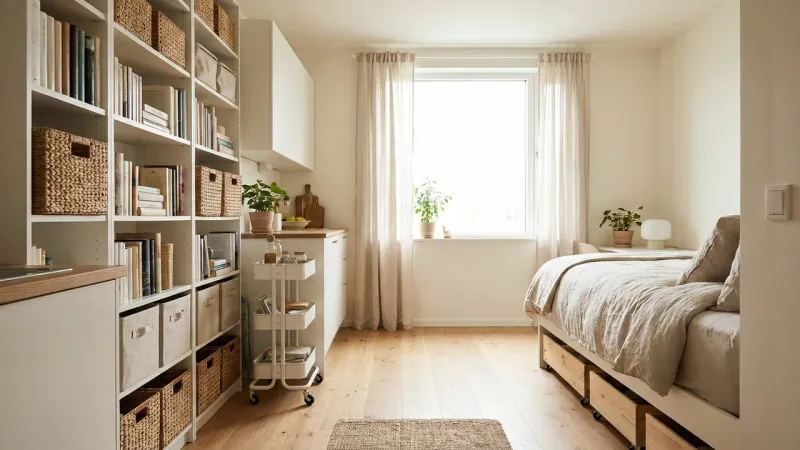
Image: a shallow wall run keeps the floor clear and puts the working material at eye level.
Set Heights That Match How You Actually Work
Height planning is where most home offices go wrong. People mount the first shelf at 12 inches above the desk because it looks balanced, then discover the monitor does not fit underneath.
Work from the desk up:
- Desktop to first shelf: 18 to 24 inches. This clears a monitor on a stand plus a lamp.
- Shelf spacing: 12 to 14 inches. That holds a standard binder (about 11 inches tall) with room to lift it out.
- Top shelf: no higher than 72 inches. Above that, you need a stool and you stop using the shelf.
- Keep 6 inches of clearance below the ceiling. It stops the run from looking like it is crushing the room.
For a seated reach zone, treat 24 to 60 inches above the floor as the band you use daily. Everything outside it is storage for things you touch monthly.
Anchor Properly or the Load Rating Means Nothing
A shelf rated for 50 pounds assumes it is screwed into wood studs. In drywall with toggle bolts, the real capacity is lower, and in old plaster it can be lower still.
- Find the studs first. A magnetic stud finder works on drywall screws; a deep-scan electronic finder handles plaster and lath.
- Use the fasteners the manufacturer specifies. Substituting a drywall plug for a structural screw voids the rating.
- Add a bracket rather than trusting one. On runs longer than 36 inches, a bracket every 16 inches is a safer pattern than the two-bracket minimum many shelves ship with.
- Keep heavy items low. A row of hardcover books at 70 inches is a lever arm pulling the top fixing out of the wall.
If your wall is masonry or you rent and cannot drill, a freestanding shallow unit anchored with an anti-tip strap is the honest answer. Our modular versus bespoke closet comparison walks through the same trade-off for built-in storage, and the logic transfers directly.
One more check before you drill: confirm what is inside the wall. A shelf run above a desk often lands where a cable, a coax drop, or a heating pipe runs vertically. A cheap stud finder with an electrical scan mode takes two minutes and prevents a repair that costs more than the shelving. If the wall is shared with a bathroom, assume there is plumbing in it and keep fixings shallow.
Add Closed Storage Without Losing the Open Look
Open shelves look tidy in photographs and dusty in real life. The compromise is to mix the two: open shelves for the things you want to see, closed boxes for the things you do not.
Match box depth to shelf depth. A 12-inch shelf with 11-inch boxes looks intentional; a 12-inch shelf with 9-inch boxes leaves a gap that reads as unfinished. Use one box style in one color across the whole run, and label the front edge rather than the lid so you can read it from standing height.
For material choices and how each bin type holds up over years of use, our storage bin buying guide covers the durability side in detail. If the office doubles as an entry point for the house, the wall-by-wall planning in our entryway storage layout guide is worth ten minutes before you commit to a shelf height.
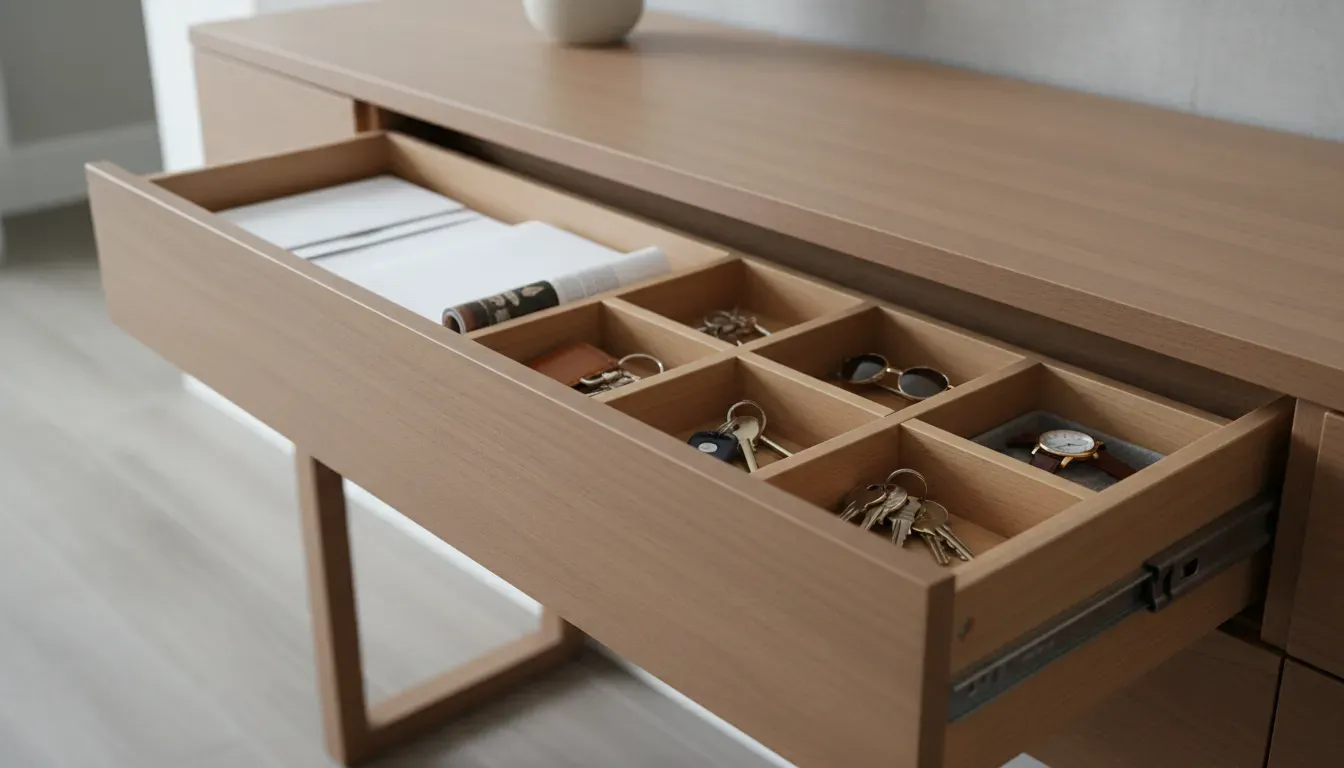
Image: consistent box depth and a single label position do more for the tidy look than the shelf itself.
A budget-friendly supplement
Costway’s storage and organization range includes stackable bins, foldable baskets, and closet organizers at factory-direct prices. Affiliate link: we may earn a commission at no extra cost to you. Measure first, and buy one sample before committing to a matching set.
Bottom Line
For most small home offices, the winning combination is a twin-slot standard run on the longest clear wall, set 18 to 24 inches above the desk and stopping at 72 inches, plus one shallow closed unit for heavy reference material. That gives you adjustable open storage where you need it and a floor footprint under 2.5 square feet.
Buy the bracket system before you buy the shelves. The brackets determine your load ceiling, your adjustability, and how much patching you will do when your needs change. Everything else is finish.
Shop Entryway Furniture & Storage Deals on Costway
Factory-direct pricing on entryway benches, shoe cabinets, hall trees, and organizers with fast, free US delivery.
* Affiliate disclosure: We may earn a commission if you shop through this link at no added cost to you.
Check Costway Entryway DealsFrequently Asked Questions
How deep should home office shelves be?
Eight to twelve inches covers binders, books, and most storage boxes. Go to 12 inches if you store printers, large reference books, or file boxes, and stay at 8 to 10 inches on a narrow wall where depth would crowd your chair.
How high should the first shelf be above a desk?
Leave 18 to 24 inches of clear space between the desktop and the underside of the lowest shelf. That clears a monitor and a task lamp while keeping the shelf reachable from a seated position.
Are floating shelves strong enough for books?
Only if the bracket is rated for the load and screwed into studs or proper anchors. A shelf rated for 30 pounds is fine for binders; a full run of hardcover reference books can exceed that, so check the published rating and spread weight across brackets.
Should I use a bookcase or wall shelves in a small office?
Wall shelves win on floor space and visual weight, because they leave the floor clear and stop at the height you choose. A bookcase makes sense when you need to store heavy items low, or when your walls are plaster or concrete and anchoring is difficult.
How much weight can a wall shelf hold?
It depends entirely on the bracket, the fasteners, and the wall. Manufacturer ratings usually assume stud mounting; drywall anchors cut that figure substantially. When in doubt, add a bracket and keep the heaviest items on the lowest shelf.